
Blog

Physics Fundamentals Blog

In-depth articles on physics fundamentals written by physicists and educators. Clear explanations, real-world examples, and the conceptual depth you won't find in a typical textbook.

Circular motion — ball on a string tracing a circle with centripetal force directed toward the centre
Classical Mechanics
Dr. Marcus Webb14 min read

Circular Motion and Centripetal Force: Complete Physics Guide

A ball whirled on a string, a car rounding a bend, the Moon orbiting Earth, an electron in a magnetic field — all are in circular motion. Despite moving at constant speed, every object in unifo...

Read article →
Ohm's law — circuit diagram showing voltage, current, and resistance relationship
Electromagnetism
Dr. Sarah Kim13 min read

Ohm's Law Explained: V = IR, Resistance and Examples

Every electronic device you use — from the phone in your pocket to the lamp on your desk — operates according to a single elegant relationship: Ohm's Law. This law states that the current flowi...

Read article →
Coulomb's law — two charged particles with attractive and repulsive force arrows
Electromagnetism
Dr. Sarah Kim14 min read

Electric Charge and Coulomb's Law Explained

Everything electrical — lightning, batteries, neural signals, transistors — begins with one fundamental property of matter: electric charge. The force between charges, described by Coulomb's La...

Read article →
Simple harmonic motion — pendulum tracing a sinusoidal oscillation pattern
Classical Mechanics
Dr. Marcus Webb15 min read

Simple Harmonic Motion: Definition, Formula, and Examples

Simple harmonic motion (SHM) is the most important type of oscillation in physics. A pendulum swinging, a mass bouncing on a spring, a vibrating guitar string, an alternating electric current —...

Read article →
Doppler effect — compressed wave fronts in front of a moving source and stretched wave fronts behind
Waves & Optics
Dr. Elena Vasquez13 min read

The Doppler Effect: Definition, Formula, and Real-World Examples

You have heard the Doppler effect thousands of times: the pitch of an ambulance siren rises as it approaches and drops as it recedes. A racing car's engine note plunges as it passes. The effect...

Read article →
Ideal gas law — piston compressing gas in a cylinder illustrating the relationship between pressure, volume, and temperature
Thermodynamics
Dr. Sarah Kim14 min read

Ideal Gas Law: PV = nRT Explained with Examples and Derivation

Every breath you take, every balloon you inflate, every weather system on Earth is governed by one elegant relationship: the ideal gas law. PV = nRT connects the pressure, volume, temperature,...

Read article →
Specific heat capacity — beakers being heated illustrating different energy requirements for different materials
Thermodynamics
Dr. Sarah Kim13 min read

Specific Heat Capacity: Formula Q = mcΔT Explained

Why does a sandy beach burn your feet while the adjacent sea stays cool, even after the same hours of sunlight? Why does water make the ideal coolant in car engines? Why does a large pot take s...

Read article →
The electromagnetic spectrum — from radio waves through visible light to gamma rays
Waves & Optics
Dr. Elena Vasquez16 min read

The Electromagnetic Spectrum: Wavelengths and Frequencies

Every time you use a mobile phone, get an X-ray, feel the warmth of sunlight, or see the colours of a rainbow, you are interacting with the electromagnetic spectrum. The electromagnetic spectru...

Read article →
Entropy — ink drop spreading in water illustrating the spontaneous increase in disorder and entropy
Thermodynamics
Dr. Sarah Kim14 min read

Entropy Explained: S = k_B ln W, Why It Increases, Examples

Drop a drop of ink into a glass of water. It spreads — slowly, irreversibly — until uniformly distributed. You will never see the ink spontaneously re-concentrate. Crack an egg: you cannot uncr...

Read article →
Acceleration in physics — rocket launching illustrating rapid change in velocity over time
Classical Mechanics
Dr. Marcus Webb12 min read

Acceleration: Definition, Formula a = Δv/Δt, and Examples

Acceleration is the rate at which velocity changes. Because velocity is a vector, any change in either the speed or the direction of motion constitutes acceleration. Every time you brake in a c...

Read article →
Special relativity — spaceship travelling near light speed illustrating time dilation and length contraction
Modern Physics
Dr. Marcus Webb18 min read

Special Relativity: Time Dilation, Length Contraction, E = mc²

In 1905, a 26-year-old patent clerk named Albert Einstein published four papers that transformed physics. One of them — "On the Electrodynamics of Moving Bodies" — introduced special relativity...

Read article →
Hooke's law — spring being stretched with proportional relationship between force and extension
Classical Mechanics
Dr. James Carter12 min read

Hooke's Law and Springs: F = kx Explained with Examples

Springs are among the most studied objects in physics — not because springs themselves are special, but because the spring restoring force is the simplest and most important type of restoring f...

Read article →
Work done in physics — person pushing a box illustrating force applied over displacement
Classical Mechanics
Dr. James Carter13 min read

Work Done in Physics: Formula W = Fd cosθ Explained

In everyday language, "work" means effort or activity. In physics it means something precise and often counterintuitive: work is done only when a force causes displacement in the direction of t...

Read article →
Magnetic field lines around a bar magnet with north and south poles labelled
Electromagnetism
Dr. Sarah Kim15 min read

Magnetic Fields and Forces: Formula F = qvB Explained

Magnetism and electricity appear to be separate phenomena — a bar magnet attracts iron, while a charged balloon attracts paper. But they are two aspects of a single fundamental force: electroma...

Read article →
Free fall and terminal velocity — skydiver falling with gravity and air resistance forces labelled
Classical Mechanics
Dr. Marcus Webb13 min read

Free Fall and Terminal Velocity: Physics Explained with Examples

Drop a feather and a hammer in air: the hammer wins easily. Drop them in a vacuum: they land simultaneously. This demonstration — performed on the Moon by Apollo 15 astronaut David Scott in 197...

Read article →
Velocity vs speed — runner on a track illustrating the vector nature of velocity versus the scalar nature of speed
Classical Mechanics
Dr. James Carter11 min read

Velocity vs Speed: Difference, Definition, and Examples

In everyday conversation, "speed" and "velocity" are interchangeable. In physics, they are fundamentally different quantities. Speed is a scalar — magnitude only. Velocity is a vector — magnitu...

Read article →
Second law of thermodynamics — heat engine diagram showing heat flow from hot to cold reservoir
Thermodynamics
Dr. Sarah Kim16 min read

Second Law of Thermodynamics: Entropy and Heat Engines

The second law of thermodynamics is arguably the most profound statement in all of science. It explains why time appears to have a direction (why we remember the past and not the future), why n...

Read article →
Friction force — block being pushed across a surface showing friction opposing motion
Classical Mechanics
Dr. James Carter14 min read

Friction Force Explained: Types, Formula, and Real-World Examples

Friction is the contact force that opposes relative motion between surfaces. It is why you can walk without slipping, why cars can brake, and why you need to keep pushing a box to keep it movin...

Read article →
Longitudinal waves — compression and rarefaction of a spring illustrating parallel wave oscillation
Waves & Optics
Dr. Elena Vasquez15 min read

Longitudinal Waves: Definition, Examples, and Diagrams

If you have ever heard a thunderclap, felt a bass beat through a wall, or watched a Slinky spring ripple back and forth, you have experienced longitudinal waves. Unlike transverse waves — where...

Read article →
Angular momentum — spinning ice skater pulling arms in to spin faster, illustrating conservation of angular momentum
Classical Mechanics
Dr. Marcus Webb14 min read

Angular Momentum: Definition, Formula L = Iω, and Conservation

A spinning ice skater pulls her arms inward — and immediately spins faster. A planet orbits faster when closer to the Sun. A gyroscope resists being tilted. A spinning top maintains its orienta...

Read article →
Electric field lines radiating from a positive charge and converging on a negative charge
Electromagnetism
Dr. Sarah Kim15 min read

Electric Field and Potential: E = F/q and V = kQ/r

An electric charge affects the space around it even before anything else is brought near. This influence on space is the electric field. Place a second charge in that field and it feels a force...

Read article →
Torque in physics — spanner turning a bolt illustrating rotational force and moment arm
Classical Mechanics
Dr. Marcus Webb13 min read

Torque in Physics: Formula τ = Fd and Examples

When you push a door open, you push near the edge — not near the hinge. Instinctively you know that the same force applied further from the pivot produces a greater turning effect. That turning...

Read article →
Kinetic energy — speeding car illustrating the relationship between mass, velocity, and energy of motion
Classical Mechanics
Dr. James Carter16 min read

Kinetic Energy: Definition, Formula KE = ½mv², Examples

Kinetic energy is one of the two fundamental forms of mechanical energy — the other being potential energy. Where potential energy is stored energy waiting to be released, kinetic energy is ene...

Read article →
Nuclear fission and fusion — uranium nucleus splitting and hydrogen nuclei combining with energy release arrows
Modern Physics
Dr. Marcus Webb16 min read

Nuclear Fission and Fusion: How Nuclear Energy Works

The Sun has been shining for 4.6 billion years and will continue for another 5 billion. The energy source is not chemical — no amount of burning hydrogen gas could sustain that output for geolo...

Read article →
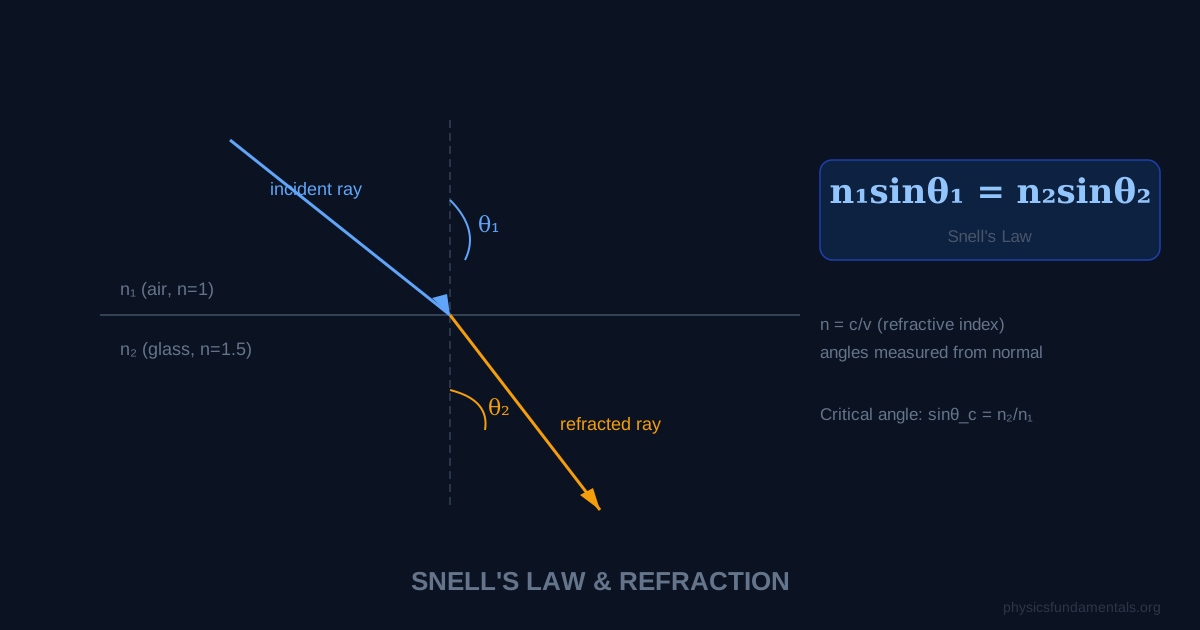
Reflection and refraction — light ray hitting a glass surface showing reflected and refracted beams with angles
Waves & Optics
Dr. Elena Vasquez15 min read

Reflection and Refraction of Light: Laws, Snell's Law, and Examples

Every time you look in a mirror, see a rainbow, or watch a straw appear bent in a glass of water, you are witnessing two of the most fundamental behaviours of light: reflection and refraction....

Read article →
Power in physics — electric motor and light bulb illustrating energy transfer rate in watts
Classical Mechanics
Dr. James Carter12 min read

Power in Physics: Formula P = W/t and Examples

Two cars can do identical work climbing a hill — but if one does it in half the time, it is twice as powerful. Power is not about how much work is done; it is about how quickly work is done. Po...

Read article →
Photoelectric effect — photons hitting a metal surface and ejecting electrons with kinetic energy
Modern Physics
Dr. Marcus Webb14 min read

The Photoelectric Effect: Einstein, Photons, and Quantum Physics

In 1905 — his miraculous year — Albert Einstein published a paper explaining the photoelectric effect using a radical idea: light comes in discrete energy packets. This insight connects to both...

Read article →
Momentum and impulse — collision between two balls showing momentum transfer
Classical Mechanics
Dr. James Carter14 min read

Momentum and Impulse: p = mv, J = FΔt, and Conservation

A cricket ball and a lorry travelling at the same speed are very different things to stop. The lorry is far harder to halt — not just because it is heavier, but because it has far more momentum...

Read article →
Speed of light — light beam crossing space with c = 3 × 10⁸ m/s label and Einstein equation E = mc²
Modern Physics
Dr. Marcus Webb15 min read

The Speed of Light: What Is c and Why Is It Constant?

The speed of light — c = 299,792,458 m/s exactly — is the most fundamental constant in physics. It is the speed at which all electromagnetic radiation travels through a vacuum. It is the speed...

Read article →
Wave-particle duality — electron double-slit experiment showing interference pattern alongside particle detections
Modern Physics
Dr. Marcus Webb16 min read

Wave-Particle Duality: What Is It and Why Does It Matter?

Light behaves as a wave: it diffracts through slits, interferes with itself, and has a measurable wavelength. Light also behaves as a particle: the photoelectric effect shows it comes in discre...

Read article →
Newton's law of universal gravitation — two masses attracting each other with gravitational force arrows
Classical Mechanics
Dr. Marcus Webb15 min read

Newton's Law of Universal Gravitation Explained

In 1687, Isaac Newton published his Principia Mathematica — arguably the most important scientific work ever written. Among its results was a single equation that unified the fall of an apple w...

Read article →
Young's double-slit experiment — two slits producing interference pattern of bright and dark fringes on a screen
Waves & Optics
Dr. Elena Vasquez14 min read

Young's Double-Slit Experiment Explained Explained

In 1801, Thomas Young performed one of the most elegant experiments in the history of physics. He shone light through two narrow slits onto a screen — and instead of two bright bands, he saw a...

Read article →
Heat transfer — three panels showing conduction through a rod, convection currents in a fluid, and radiation from a hot surface
Thermodynamics
Dr. Sarah Kim14 min read

Heat Transfer: Conduction, Convection, and Radiation Explained

Heat spontaneously flows from hot objects to cold ones — the direction dictated by the second law of thermodynamics and the concept of entropy. But how does it actually transfer? There are exac...

Read article →
Electromagnetic induction — bar magnet moving into a coil inducing current in a circuit
Electromagnetism
Dr. Sarah Kim15 min read

Electromagnetic Induction and Faraday's Law: How Generators Work

Every time you charge your phone, drive a car, or switch on a light, you are using a technology built on a discovery made in 1831 by Michael Faraday: electromagnetic induction. Faraday found th...

Read article →
Heisenberg uncertainty principle — electron probability cloud illustrating position-momentum uncertainty
Modern Physics
Dr. Marcus Webb14 min read

The Heisenberg Uncertainty Principle: What It Really Means

In 1927, Werner Heisenberg derived one of the most famous results in all of science: it is fundamentally impossible to simultaneously know the exact position and exact momentum of a quantum par...

Read article →
SUVAT equations — velocity-time graph showing uniform acceleration with area and gradient annotations
Kinematics
Dr. James Carter14 min read

SUVAT Equations: The Complete Kinematic Equations Guide

A car brakes from 30 m/s to rest in 50 m. How long does it take? A ball is thrown upward at 15 m/s — how high does it go? A stone is dropped from a cliff — how fast is it moving after 3 seconds...

Read article →
Centre of mass — irregular shaped object with centre of mass marked, and a dumbbell showing mass distribution
Classical Mechanics
Dr. Marcus Webb13 min read

Centre of Mass: Definition, Formula, and Applications

A hammer can be balanced on a fingertip — but only if you position your finger at exactly the right point. A high-jumper arches their back over the bar so that their centre of mass passes under...

Read article →
Radioactive decay — unstable nucleus emitting alpha, beta, and gamma radiation with half-life graph
Modern Physics
Dr. Marcus Webb16 min read

Radioactive Decay: Alpha, Beta, Gamma, and Half-Life

Every atom of carbon-14 in your body is slowly decaying. Every gram of uranium in Earth's crust is undergoing spontaneous nuclear transformation. Radioactive decay is the process by which an un...

Read article →
Tension force — block hanging from a rope showing tension force arrows acting along the rope
Classical Mechanics
Dr. James Carter12 min read

Tension Force: Definition, Formula, and Worked Examples

A climber hangs from a rope. A tow truck pulls a car. A pendulum bob swings on a string. In each case, a pulling force acts along the rope or string — the tension force. Tension is a pulling fo...

Read article →
Projectile motion parabola — water fountain arc showing the curved parabolic trajectory under gravity
Classical Mechanics
Dr. James Carter13 min read

Why Is Projectile Motion a Parabola? Physics Explained

Every object launched into the air — a basketball, a cannonball, a water droplet from a fountain — traces the same distinctive curved path under gravity alone. That curve is a parabola, one of...

Read article →
Normal force — block resting on a surface with weight and normal force arrows labelled
Classical Mechanics
Dr. James Carter12 min read

Normal Force Explained: Definition, Formula, and Examples

Every time you sit in a chair, stand on a floor, or press a book against a table, a force pushes back on you — perpendicular to the surface. This is the normal force. It is the contact force th...

Read article →
Kinetic theory of gases — molecules in motion representing gas pressure and temperature
Thermodynamics
Dr. Sarah Kim13 min read

Kinetic Theory of Gases: Pressure, Temperature, and Motion

What Is the Kinetic Theory of Gases? The kinetic theory of gases is a scientific model that explains the macroscopic properties of gases — pressure, temperature, and volume — in terms of...

Read article →
Wave speed frequency and wavelength — laboratory oscilloscope showing wave properties
Waves & Optics
Dr. Elena Vasquez14 min read

Wave Speed, Frequency, and Wavelength: v = fλ Explained

Every wave — whether a ripple on water, a sound in air, a transverse wave on a string, or a pulse of light crossing a vacuum — is governed by one fundamental relationship: v = fλ. This single e...

Read article →
Newton's law of universal gravitation — Earth from space showing gravitational attraction between masses
Classical Mechanics
Dr. Marcus Webb11 min read

Gravitational Force: Newton's Law of Gravitation

Every object in the universe with mass attracts every other object with mass. This isn't a metaphor — it's a precise, quantitative law. Newton's law of universal gravitation, published in 1687...

Read article →
First law of thermodynamics — fire illustrating heat as a form of energy transfer
Thermodynamics
Dr. Sarah Kim11 min read

The First Law of Thermodynamics: Energy, Heat, and Work Explained

Every engine ever built, every metabolic reaction in your body, every star burning in the sky — all operate under one inviolable constraint: the first law of thermodynamics. It is, at its core,...

Read article →
Conservation of momentum — Newton's cradle demonstrating elastic collision and momentum transfer
Classical Mechanics
Dr. James Carter16 min read

Conservation of Momentum: Formula, Collisions, and Examples

When two billiard balls collide, when a rocket expels exhaust, when a gun recoils after firing, when subatomic particles scatter in a collider — the same deep principle governs every one of the...

Read article →
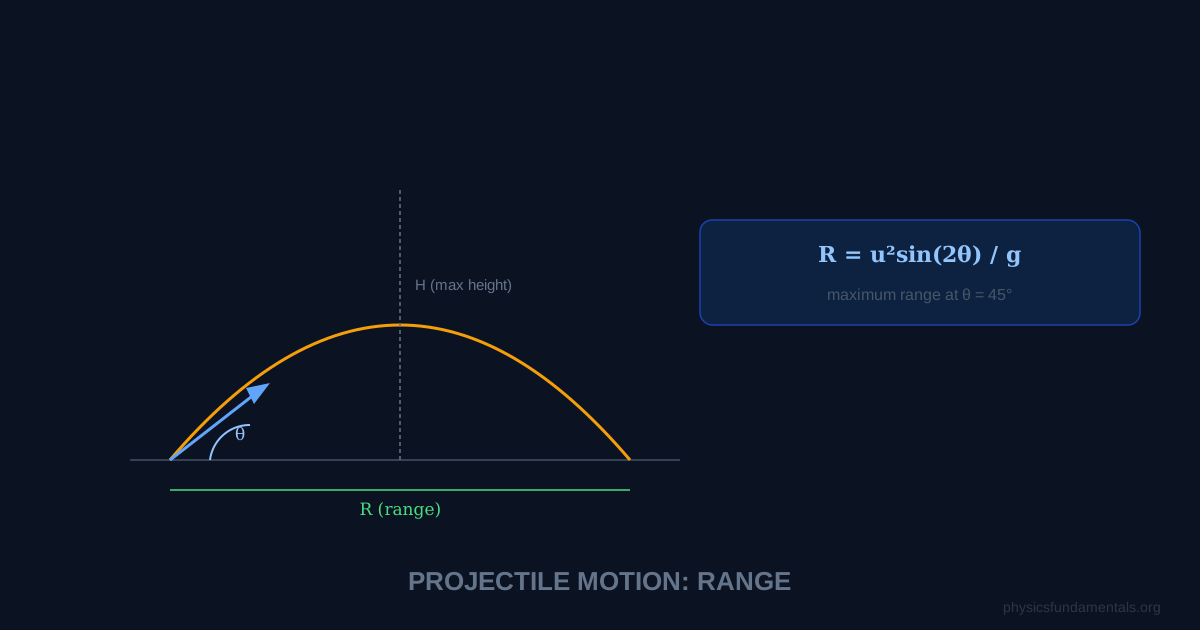
Projectile motion — basketball tracing a parabolic arc through the air
Classical Mechanics
Dr. James Carter15 min read

Projectile Motion: Equations, Angles, and Worked Examples

A basketball arcing toward the hoop, a cannonball launched from a fortress, a stream of water from a garden hose — all are examples of projectile motion. It's one of the first topics you encoun...

Read article →
What is energy — lightning bolt representing electrical energy and energy transformation
Thermodynamics
Dr. Sarah Kim12 min read

What Is Energy in Physics? Definition and Types Explained

What Is Energy? The Definition in Physics The definition of energy in physics: energy is a scalar quantity that measures the capacity of a system to do work or produce heat. It is not a...

Read article →
Force equals mass times acceleration — athlete demonstrating F=ma with explosive push
Classical Mechanics
Dr. James Carter14 min read

Newton's Second Law (F = ma): Why This Equation Runs the Universe

F = ma was discovered by Sir Isaac Newton and published in 1687 in Philosophiæ Naturalis Principia Mathematica. It is Newton's Second Law of Motion — the single most powerful and widely applied...

Read article →
Transverse waves — ripples spreading across water surface showing perpendicular wave oscillation
Waves & Optics
Dr. Elena Vasquez22 min read

Transverse Waves: Definition, Properties, and Examples

When you pluck a guitar string, watch ripples cross a pond, or see light travel 93 million miles from the Sun to your eyes, you're witnessing transverse waves in action. A transverse wave is on...

Read article →
Newton's laws of motion — billiard balls illustrating force, mass and acceleration
Classical Mechanics
Dr. James Carter16 min read

Newton's Laws of Motion: All Three Laws Explained

Every object you have ever seen — every car on the highway, every satellite in orbit, every atom vibrating in your coffee cup — follows the same three rules. These are Newton's laws of motion,...

Read article →

Never miss an article

Get new physics articles, study tips, and platform updates delivered to your inbox every Thursday.