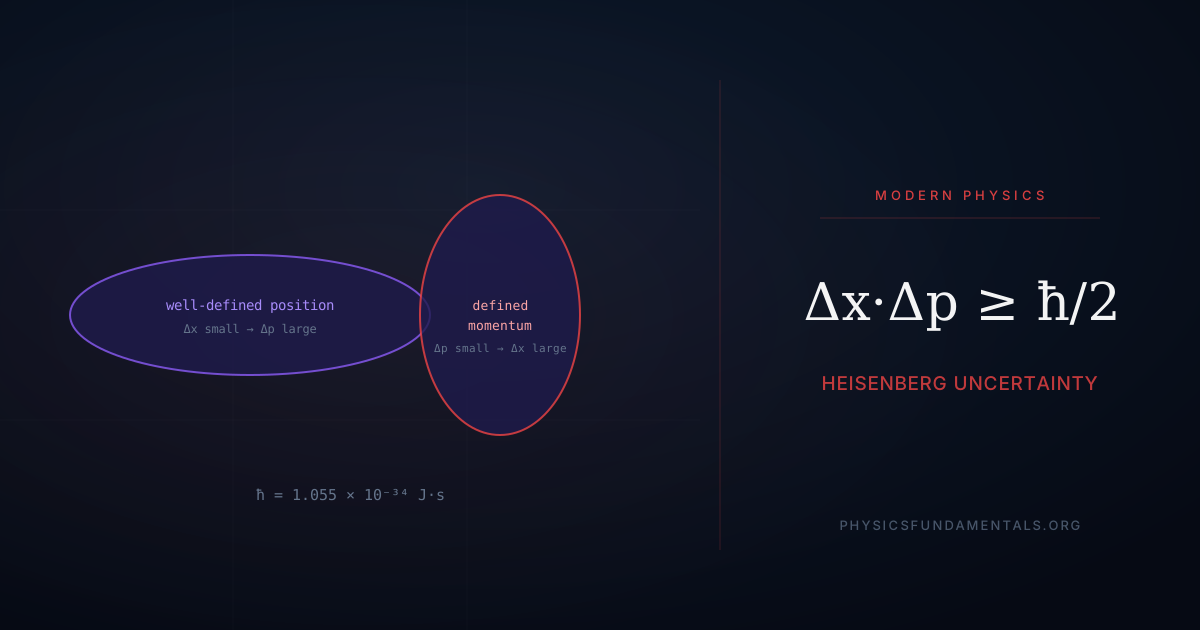
In 1927, Heisenberg proved something that sounds impossible: there is a fundamental limit to how precisely you can simultaneously know the position and momentum of a particle. Not a practical limit from imprecise instruments — a hard mathematical limit built into the structure of quantum mechanics. Measure position more precisely and momentum becomes less certain, automatically, as a consequence of what waves are. ΔxΔp ≥ ℏ/2 is not negotiable.
The common misconception is that the uncertainty principle is about disturbance — that measuring position disturbs momentum. That's not what it says. A particle in a state of well-defined position genuinely does not have a well-defined momentum, not even in principle. Both properties cannot simultaneously be sharp. This isn't a gap in our knowledge; it's a feature of reality that has been confirmed in experiment after experiment for nearly a century.
- The uncertainty principle ΔxΔp ≥ ℏ/2 — where it comes from mathematically
- Why it's about the nature of quantum states, not measurement disturbance
- The energy-time uncertainty relation ΔEΔt ≥ ℏ/2 and what it implies
- Real consequences: the ground state energy of hydrogen, nuclear tunnel effects, and virtual particles
What the Uncertainty Principle Actually Says
The inequality Δx · Δp ≥ ħ/2 means:
• If Δx is small (position is well-known), then Δp must be large (momentum is poorly known).
• If Δp is small (momentum is well-known), then Δx must be large (position is poorly known).
• You can make either Δx or Δp arbitrarily small — but only at the cost of making the other arbitrarily large.
• You can never make both simultaneously zero.
The minimum uncertainty product ħ/2 ≈ 5.27 × 10⁻³⁵ J·s is negligibly small for macroscopic objects. For a 1 kg ball with position known to 1 mm, the minimum momentum uncertainty is Δp ≥ ħ/(2Δx) = 5.27 × 10⁻³² kg·m/s — a velocity uncertainty of ~10⁻³² m/s, utterly undetectable. Quantum uncertainty is only significant at atomic scales.
Worked Example: Electron Confined to an Atom
An electron is confined to a region of size Δx = 0.1 nm, roughly the size of an atom. Find the minimum momentum uncertainty and the corresponding minimum kinetic energy.
Using this momentum uncertainty as an estimate of the electron's minimum kinetic energy (KE = p²/2m):
This is the same order of magnitude as real atomic binding energies (a few eV) — confirming that confining an electron to atomic dimensions forces it to have substantial kinetic energy purely from the uncertainty principle, independent of any orbital motion. This is the same reasoning, applied at the scale of the whole atom rather than the Bohr radius specifically, behind why atoms don't collapse (see below).
What the Uncertainty Principle Does NOT Say
The most common misconception: "the uncertainty principle is just about measurement disturbing the particle." This is the old "observer effect" interpretation — a photon used to measure an electron's position knocks it and changes its momentum. While measurement disturbance is real, it is not what the Heisenberg principle describes.
The uncertainty principle is deeper: even in principle, with perfect, non-disturbing measurements, a quantum particle cannot simultaneously have a definite position and definite momentum. This is because position eigenstates and momentum eigenstates are fundamentally incompatible — a particle with perfectly defined position is in a superposition of all momenta, and vice versa. The uncertainty is in the quantum state itself, not in our knowledge of it.
This was clarified by the EPR debate (Einstein, Podolsky, Rosen 1935) and ultimately by Bell's theorem (1964) and Aspect's experiments (1982), which showed that quantum mechanics is genuinely non-classical — not just incomplete knowledge of classical quantities.
Why the Uncertainty Principle Arises: Waves
The mathematical origin of the uncertainty principle lies in wave-particle duality. In quantum mechanics, a particle's state is described by a wave function ψ(x). The position probability distribution is |ψ(x)|². The momentum probability distribution is related to the Fourier transform of ψ(x).
A fundamental theorem of Fourier analysis (the bandwidth theorem) states that a well-localised function in one domain must be spread out in the conjugate domain. A wave packet localised in position space (small Δx) must be built from many Fourier components with a wide range of frequencies (large Δk, hence large Δp since p = ħk). This is the mathematical core of the uncertainty principle — it is a wave phenomenon, not a measurement effect.
The Energy-Time Uncertainty Relation
An energy state with a finite lifetime Δt has an inherent energy uncertainty ΔE ≥ ħ/(2Δt). This has real consequences:
Spectral line width: an excited atomic state that lives for time Δt emits a photon with frequency uncertainty Δf = ΔE/h ≥ 1/(4πΔt). This is the natural linewidth of atomic spectral lines — the Lorentzian shape seen in spectroscopy. Longer-lived states (small Δt means more certain frequency) produce sharper spectral lines.
Virtual particles: quantum field theory allows "virtual" particles to appear spontaneously from the vacuum, violating energy conservation by ΔE, as long as they disappear within time Δt = ħ/(2ΔE). These virtual particles mediate forces — photons mediate the electromagnetic force, W and Z bosons mediate the weak force. The Casimir effect (measurable attraction between uncharged metal plates in vacuum) arises from this zero-point energy of the quantum vacuum.
Consequences of the Uncertainty Principle
Atomic stability
Classically, an electron orbiting a proton radiates energy (accelerating charge → electromagnetic radiation) and spirals into the nucleus in ~10⁻¹¹ s. Atoms should collapse. They do not — why? The uncertainty principle. If the electron is confined to a region of size Δx ≈ Bohr radius (5.3 × 10⁻¹¹ m), it must have momentum uncertainty Δp ≥ ħ/(2Δx) ≈ 1.0 × 10⁻²⁴ kg·m/s, giving minimum kinetic energy ~10 eV. Compressing the electron further increases KE faster than it lowers potential energy — there is an equilibrium radius where total energy is minimised. The uncertainty principle literally prevents atomic collapse.
Zero-point energy
Even in the ground state (lowest energy), a quantum oscillator has non-zero kinetic energy due to the uncertainty principle. Zero position uncertainty would require infinite momentum uncertainty. The minimum energy of a quantum harmonic oscillator is ½ħω (zero-point energy) — measurable in the specific heat of solids at low temperature and in the Casimir effect.
Quantum tunnelling
Because a particle cannot have a definite position, its wave function extends into classically forbidden regions (potential energy barriers). There is a finite probability of finding it on the other side — quantum tunnelling. This powers nuclear fusion in stars (protons tunnel through the Coulomb barrier), alpha decay, and scanning tunnelling microscopes.
| Object | Size (Δx) | Min. Δp | Min. Δv |
|---|---|---|---|
| Baseball (0.145 kg) | 1 mm | 5.3 × 10⁻³² kg·m/s | ~4 × 10⁻³¹ m/s (undetectable) |
| Electron in atom | ~0.1 nm | ~5 × 10⁻²⁵ kg·m/s | ~5 × 10⁵ m/s (huge!) |
| Proton in nucleus | ~1 fm (10⁻¹⁵ m) | ~5 × 10⁻²⁰ kg·m/s | ~3 × 10⁷ m/s (~0.1c) |
Frequently Asked Questions
What is the Heisenberg Uncertainty Principle?
Why does the uncertainty principle exist?
Does the uncertainty principle apply to everyday objects?
What is zero-point energy?
What is the energy-time uncertainty principle?
Why don't electrons fall into the nucleus?
Share this article
Written by
Physics Fundamentals Editorial Team
Written and reviewed by our team of physics educators. Content is aligned with A-Level, GCSE, AP Physics, and undergraduate curricula.
About Physics Fundamentals →