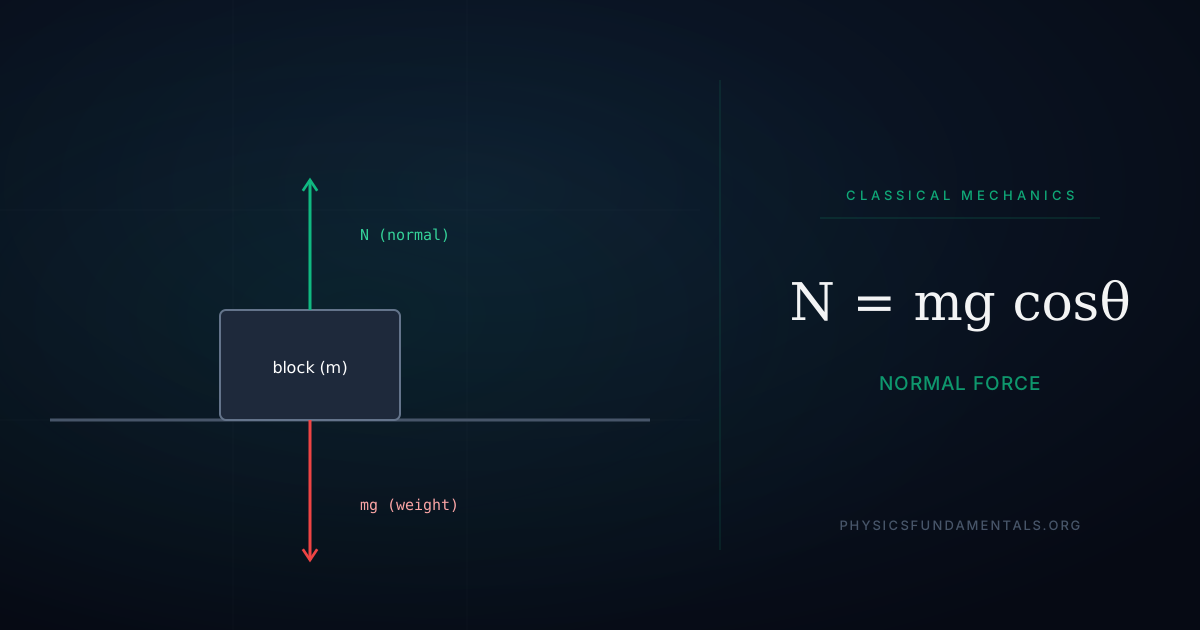
Sit in a chair and the chair pushes back. Stand on a floor and the floor pushes up. Press a book against a wall and the wall pushes outward. This perpendicular contact force — the normal force — is Newton's third law made visible. It's not a separate law of nature; it's the electromagnetic repulsion between electron clouds in adjacent materials, macroscopically expressed as a surface pushing back against whatever presses into it.
Normal force is simple on a flat horizontal surface: N = mg. It gets more interesting on inclined planes, in elevators, and when external forces act at angles — and in those cases, getting the normal force wrong means every subsequent calculation (friction, acceleration, tension) is also wrong. It's the foundation of most force problems.
- What the normal force actually is — and why it's always perpendicular to the surface
- How to calculate N on flat surfaces, inclined planes, and in accelerating systems
- Why normal force changes in an elevator — and what "apparent weight" means
- How normal force connects to friction: f = μN
The Normal Force on a Flat Horizontal Surface
For an object of mass m resting on a flat horizontal surface with no vertical acceleration, Newton's second law (vertical direction) gives:
The normal force equals the weight. This is the most familiar case — but it is a special result, not a universal rule. The normal force equals mg only when:
• The surface is horizontal
• There are no other vertical forces
• The object has no vertical acceleration
Change any of these conditions and N ≠ mg.
Normal Force on an Inclined Plane
On a slope at angle θ to the horizontal, the weight component perpendicular to the surface is mg cosθ:
As θ increases (steeper slope), N decreases. At θ = 90° (vertical wall), N = 0 — a vertical wall exerts no upward normal force on an object resting against it (only a horizontal one). This is why friction force f = μN also decreases on steeper slopes.
Worked example: Block on a slope
A 5 kg block sits on a 40° incline. Find the normal force.
Compare to weight on flat ground: mg = 49 N. The slope reduces the normal force by cos40° = 23.4%.
Normal Force in a Lift (Elevator)
In a lift accelerating upward at a (a > 0), Newton's second law vertically:
You feel heavier — the floor pushes harder on you. In a lift accelerating downward at a:
You feel lighter. In free fall (a = g downward): N = m(g − g) = 0 — apparent weightlessness. Astronauts in orbit are in continuous free fall around Earth — the normal force from their spacecraft floor is zero, giving the sensation of weightlessness despite gravity being nearly as strong as at Earth's surface.
| Situation | Normal force | Apparent weight |
|---|---|---|
| At rest / constant velocity | N = mg | Normal |
| Accelerating upward | N = m(g + a) | Heavier |
| Accelerating downward | N = m(g − a) | Lighter |
| Free fall (a = g down) | N = 0 | Weightless |
| On inclined plane (angle θ) | N = mg cosθ | Reduced |
Normal Force in Circular Motion
At the bottom of a valley or loop: the object follows a circular path — centripetal acceleration is upward. Newton's second law (upward positive):
N > mg — you feel pressed into the seat at the bottom of a roller coaster.
At the top of a convex hill or hump in the road: the road curves away beneath the car, so the centre of curvature is below the car and centripetal acceleration points downward. The road pushes up on the car (N upward), opposing gravity:
N < mg — you feel lighter cresting a hill. As speed increases, N decreases. If v² = gr, N = 0 — the car is momentarily weightless and about to leave the road. This is the maximum speed at which the car stays in contact with the road; go any faster and the car becomes briefly airborne, since N cannot go negative (the road can only push, not pull).
Top of a Vertical Loop
A roller coaster loop is a different geometry from a hill, even though both involve "the top of a curve" — and it's a common mistake to apply the hill formula to a loop. On a loop, the car travels on the inside of the circular track. At the top of the loop, the track is above the car, so it can only push the car downward (toward the centre) — the same direction as gravity:
Here N increases with speed — the opposite behaviour to the hill case. If v² = gr, N = 0, and below this speed N would need to be negative (impossible), meaning the car loses contact with the track before reaching the top and falls away from the loop rather than completing it. This is the minimum speed required to complete the loop — the opposite constraint to the hill's maximum safe speed. Roller coaster engineers size loops and entry speeds specifically to clear this minimum with a safety margin.
Worked Example: Roller Coaster Loop
A roller coaster loop has a radius of 10 m. Find (a) the minimum speed at the top needed to complete the loop, and (b) the normal force on a 70 kg rider at the bottom of the loop if the car is travelling at 15 m/s there.
At the bottom, the rider experiences a normal force 3.3 times their actual weight (70 × 9.8 = 686 N) — this is why riders feel pressed hard into their seats entering a loop, and why loop entry speeds are engineered well above the 9.9 m/s minimum needed just to survive the top.
Normal force equals weight (N = mg) only on a flat, horizontal surface with no vertical acceleration and no additional vertical forces. Add an angle, vertical acceleration, circular motion, or an applied force with a vertical component, and N ≠ mg. Always apply Newton's second law perpendicular to the surface to find the actual normal force in each situation.
Why Is It Called "Normal"?
In mathematics and physics, "normal" means perpendicular. The normal force acts perpendicular (normal) to the contact surface, not along it. The component of contact force along the surface is friction. Together, the normal force and friction are the two components of the total contact force between surfaces: one perpendicular (normal), one parallel (friction).
Normal Force in Engineering
Structural engineers calculate normal forces in columns, beams, and foundations constantly. A column supporting a floor load must provide a normal (compressive) force equal to the weight above. Reinforced concrete columns can support compressive normal forces of tens of megaNewtons. Bridges transfer loads through a network of normal and shear forces — the pylons of a cable-stayed bridge carry enormous compressive normal forces while the cables carry tensile forces. Understanding normal forces is fundamental to calculating whether a structure will collapse under its design loads plus safety factors.
Frequently Asked Questions
What is the normal force?
Is the normal force always equal to weight?
What is the relationship between normal force and friction?
Why do you feel heavier in an upward-accelerating lift?
What is the normal force at the top of a loop?
Can the normal force be zero or negative?
Share this article
Written by
Physics Fundamentals Editorial Team
Written and reviewed by our team of physics educators. Content is aligned with A-Level, GCSE, AP Physics, and undergraduate curricula.
About Physics Fundamentals →