A transverse wave is a wave where the medium oscillates perpendicular to the direction of travel. Shake a rope up and down: the wave moves horizontally, the rope moves vertically. That right-angle relationship defines every transverse wave — from light crossing the vacuum of space to a seismic S-wave rippling through rock.
Understanding what makes a wave transverse — not just memorising the definition — unlocks polarisation, electromagnetic theory, and a large chunk of wave physics. It's also one of the most frequently tested diagram topics in GCSE and A-Level exams.
- The precise definition of a transverse wave and how to identify one
- Key properties — amplitude, wavelength, frequency, period — and what each tells you
- How transverse waves differ from longitudinal waves, with real examples of each
- Why light is transverse but sound isn't, and why that matters for polarisation
What Is a Transverse Wave? (Definition)
The transverse wave definition: a transverse wave is a wave in which the displacement of the medium is perpendicular (at right angles) to the direction the wave travels. Imagine shaking one end of a rope up and down. The wave pulse moves horizontally along the rope, but each segment of the rope moves vertically — up and down, at right angles to the wave's propagation direction. That perpendicular relationship is what defines it as "transverse."
In other words: the oscillation direction ⊥ the propagation direction. This is the core of the transverse wave definition in physics, and it distinguishes transverse waves from every other wave type.
This is in direct contrast to longitudinal waves, where the displacement is parallel to the direction of propagation. Sound waves in air are longitudinal: air molecules compress and expand along the same axis the wave travels. In a transverse wave, nothing moves in the direction the wave is going — only energy does.
A transverse wave is a wave where the medium oscillates perpendicular to the direction of energy propagation. Light, guitar string vibrations, ripples on water, and seismic S-waves are all transverse waves.
Labeled Diagram of a Transverse Wave
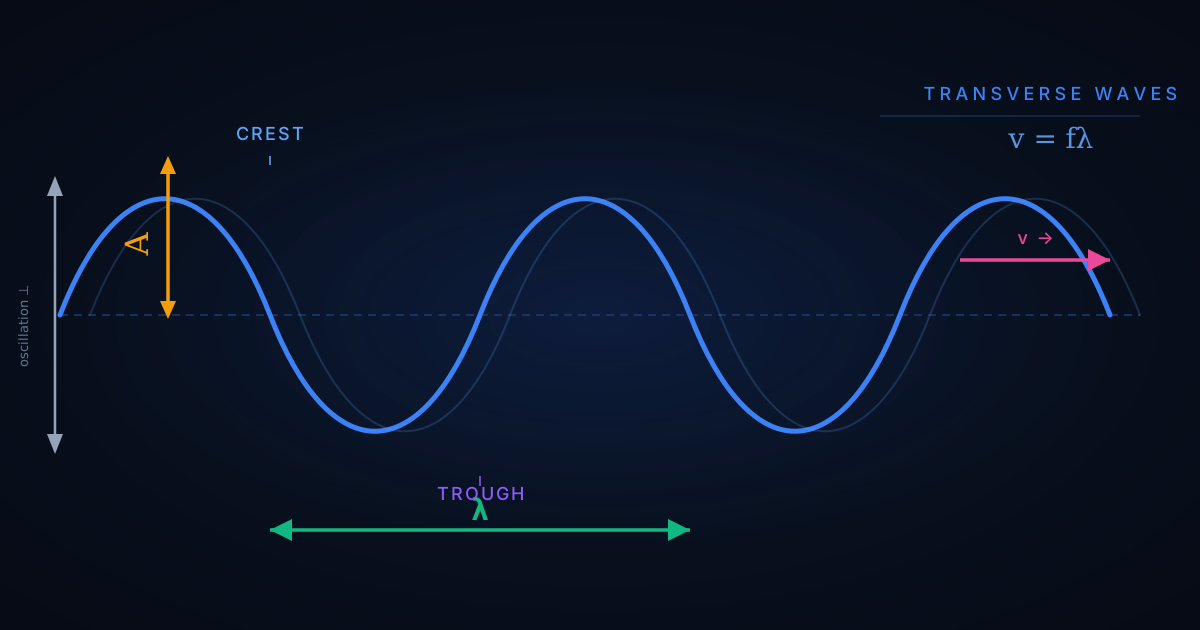
The diagram below shows the anatomy of a transverse wave with all parts labeled. Understanding this diagram is foundational — exam questions on "label a transverse wave diagram" are extremely common.
Diagram — Anatomy of a Transverse Wave (Labeled)
Key Properties of Transverse Waves
Every transverse wave is fully described by five measurable properties. Mastering these is the foundation for solving any wave problem.
Amplitude (A) — the maximum displacement of the medium from its equilibrium position, measured in metres. The amplitude determines the energy the wave carries: energy ∝ A². Double the amplitude and you quadruple the energy. This is why loud sounds (large amplitude) carry far more energy than whispers, and why high-amplitude ocean waves are so destructive.
Wavelength (λ) — the distance between two consecutive identical points on the wave: crest-to-crest, trough-to-trough, or any matching phase pair. Measured in metres. On the labeled transverse wave diagram above, λ is the horizontal distance between two crests.
Frequency (f) — the number of complete oscillation cycles that pass a given point per second. Measured in hertz (Hz), where 1 Hz = 1 cycle per second. Visible red light has a frequency around 4.3 × 10¹⁴ Hz. Middle C on a piano is 261.6 Hz.
Period (T) — the time for one complete cycle to pass a fixed point. Period and frequency are exact reciprocals:
Wave speed (v) — the speed at which the wave pattern propagates through the medium. Connected to wavelength and frequency by the universal wave equation:
This relationship is universal — it applies to all waves, transverse or longitudinal, mechanical or electromagnetic. If you know any two of these three quantities, you can always find the third. We cover this equation in complete depth in our guide to wave speed, frequency, and wavelength.
Transverse Wave Properties — Summary Table
| Property | Symbol | Unit | What it measures |
|---|---|---|---|
| Amplitude | A | metres (m) | Max displacement from equilibrium; determines energy |
| Wavelength | λ | metres (m) | Distance between two identical consecutive points |
| Frequency | f | hertz (Hz) | Cycles per second at a fixed point |
| Period | T | seconds (s) | Time for one complete cycle; T = 1/f |
| Wave speed | v | m/s | Speed of propagation; v = fλ |
Transverse Waves on a String
The simplest physical example of a transverse wave is a pulse on a stretched string or rope. When you flick one end of a rope sideways, the disturbance travels along the rope while each segment of the rope itself moves perpendicular to the rope's length. This is the clearest possible transverse wave example: the displacement is obviously at right angles to the direction of propagation.
The speed of the wave depends on two properties of the string: its tension (T) and its linear mass density (μ, mass per unit length):
Higher tension means a faster wave — which is why tightening a guitar string raises its pitch (higher frequency at fixed wavelength means higher wave speed, per v = λf). Greater mass density slows the wave down — which is why the thick bass strings on a guitar vibrate more slowly and produce lower tones than the thin treble strings. This is a beautiful example of how Newton's second law, applied to a continuous medium, gives rise to a wave equation.
Electromagnetic Waves: The Ultimate Transverse Wave Examples
Light, radio waves, X-rays, microwaves, UV radiation, infrared — the entire electromagnetic spectrum consists of transverse waves. These are the most important transverse wave examples in modern physics and everyday life. But unlike waves on a rope, electromagnetic waves don't need a medium. They are oscillations of electric and magnetic fields themselves, propagating through empty space at approximately 3 × 10⁸ m/s (the speed of light, denoted c).
In an electromagnetic wave, the electric field oscillates in one direction, the magnetic field oscillates at right angles to it, and the wave propagates in a direction perpendicular to both. This three-way perpendicular arrangement is a defining feature of electromagnetic radiation and is the basis for phenomena like polarization — a property that only transverse waves can exhibit.
Diagram — Electromagnetic Wave (Transverse: E-field ⊥ B-field ⊥ propagation)
Polarization: The Definitive Proof of Transverse Nature
Polarization is the restriction of a transverse wave's oscillation to a single plane. Unpolarized light vibrates in all directions perpendicular to its propagation. A polarizing filter passes only the component vibrating in one specific direction, reducing the intensity but creating polarized light.
This phenomenon is physically impossible for longitudinal waves — you can't restrict a back-and-forth motion to a "plane" when there's only one axis of motion to begin with. The existence of polarization is direct experimental proof that light is a transverse wave. Polarizing sunglasses exploit exactly this principle: they filter out horizontally polarized glare reflected from flat surfaces, dramatically improving visibility.
Sound is a longitudinal wave — molecules compress and expand along the direction of propagation. There is no perpendicular oscillation to polarize. This is why polarizing filters work on light but have no equivalent effect on sound. The transverse nature of light is not just a detail — it's central to how optics, photography, and telecommunications work.
How Does Energy Travel in a Transverse Wave?
This is one of the most important — and most commonly misunderstood — aspects of wave physics. The medium does not travel with the wave. Only energy does.
When you shake one end of a rope, each segment of rope moves up and down (perpendicular to the wave). No piece of rope travels from your hand to the far end. What travels is the disturbance — the pattern of displacement — and with it, the energy you put in. The same is true of water waves: individual water molecules move in small loops; they don't rush toward the shore. It's the wave pattern, and the energy it carries, that moves.
Diagram — Energy Travels Right, Medium Oscillates Up-Down
The energy in a transverse wave is shared between two forms — kinetic and potential — as each particle oscillates. At maximum displacement (crest or trough), the particle is momentarily still: all energy is potential. At the equilibrium position, the particle moves fastest: all energy is kinetic. This constant exchange is identical in form to a mass on a spring, and for the same reason — the restoring force in both cases follows Hooke's law. This deep connection to the broader concept of energy is what makes wave mechanics so elegant.
Wave Interference and Superposition
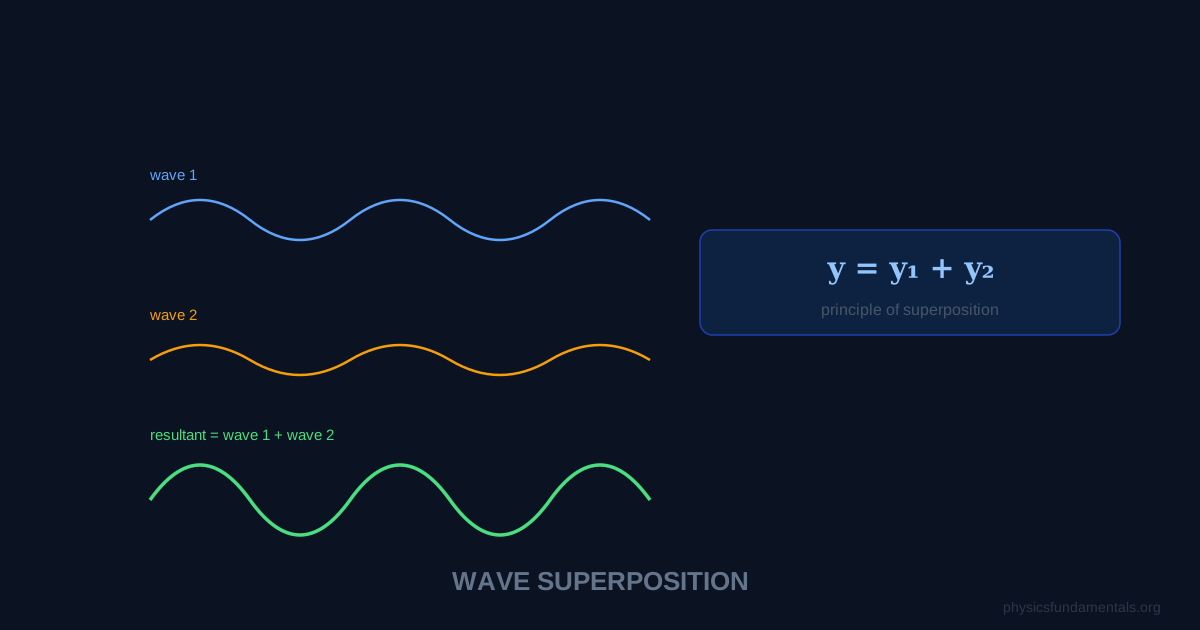
When two transverse waves meet in the same medium, they superpose — their displacements add algebraically at every point. If two wave crests align, the result is constructive interference: the amplitude doubles. If a crest meets a trough of equal magnitude, you get destructive interference: the waves cancel completely.
Diagram — Constructive vs. Destructive Interference
This superposition principle explains the bright and dark fringes in double-slit experiments, the patterns in soap bubbles, and the resonance of musical instruments. It also powers noise-cancelling headphones — which generate a wave that destructively interferes with ambient noise.
Transverse vs. Longitudinal Waves: Complete Comparison
Understanding the difference between transverse and longitudinal waves is a fundamental skill in wave physics. The diagram below shows both types side by side, followed by a full comparison table.
Diagram — Transverse Wave vs. Longitudinal Wave
| Property | Transverse Wave | Longitudinal Wave |
|---|---|---|
| Oscillation direction | Perpendicular (⊥) to propagation | Parallel (∥) to propagation |
| Can travel in vacuum? | Yes (electromagnetic waves) | No — needs a medium |
| Can be polarized? | Yes ✓ | No ✗ |
| Wave features | Crests and troughs | Compressions and rarefactions |
| Examples | Light, radio waves, guitar strings, seismic S-waves, water ripples | Sound, seismic P-waves, ultrasound |
| Travels through liquids? | Electromagnetic: yes. Mechanical: limited | Yes (sound travels through water) |
Transverse Wave Examples in Real Life
Transverse waves are everywhere once you know what to look for. Here are the most important real-world transverse wave examples, from everyday experience to cutting-edge science:
Guitar strings and stringed instruments — plucking a guitar string creates a transverse standing wave. The string's fundamental frequency (and all its harmonics — overtones at integer multiples of the fundamental) determine the pitch you hear. Tighter strings and shorter string lengths both increase frequency — that's exactly why tuning pegs and frets work. A guitar string vibrating at 440 Hz produces the note A₄.
Ripples on water — the surface ripples you see in a still pond after dropping a pebble are predominantly transverse. Each water molecule moves in a small ellipse perpendicular to the wave's travel direction, not in the direction of wave propagation. Deep-water ocean waves are technically more complex (orbital motion), but surface ripples are textbook transverse wave examples.
Seismic S-waves (Secondary waves) — during an earthquake, the Earth transmits both P-waves (longitudinal, faster, arrive first at seismographs) and S-waves (transverse, slower, arrive second — the "S" stands for secondary or shear). S-waves cannot travel through liquid. This single property — the absence of S-wave arrivals on the far side of the Earth — is how seismologists deduced that Earth's outer core is liquid iron. Transverse wave physics produced a major geological discovery.
All electromagnetic radiation — light, radio waves, X-rays, gamma rays, microwaves, UV, infrared — are all transverse waves of oscillating electric and magnetic fields. Radio waves have wavelengths from millimetres to kilometres. Visible light spans roughly 380–700 nanometres. X-rays are picometres long. All travel at the same speed in vacuum: c = 3 × 10⁸ m/s. The relationship between wave speed, frequency, and wavelength governs the entire electromagnetic spectrum.
Stadium wave (La Ola) — when fans in a stadium stand and sit in sequence around the stadium, the "wave" travels around the stadium while each individual fan only moves vertically. This is a perfect, macroscopic demonstration of the transverse wave concept: the medium (people) oscillates perpendicular to the direction the wave pattern travels.
Transverse waves in solids — unlike fluids, solid materials can support shear stresses, which means they can transmit transverse mechanical waves. This is why seismic S-waves travel through solid rock but not through liquid. Ultrasonic transverse waves are used in materials testing (non-destructive testing, or NDT) to detect cracks and voids inside solid structures.
Standing Waves: When Transverse Waves Reflect
When a transverse wave reflects off a fixed boundary and the returning wave overlaps the incident wave, a standing wave forms. Instead of traveling in one direction, the pattern appears to stand still — with fixed points called nodes (zero displacement) and antinodes (maximum displacement).
Diagram — Standing Wave: Nodes and Antinodes
Standing waves are the physical basis of how musical instruments produce pitched tones. A guitar string fixed at both ends can only vibrate at frequencies where an integer number of half-wavelengths fits exactly between the frets. These are the harmonics (or overtones), and their ratios determine the timbre — the characteristic "sound" — of each instrument. Understanding transverse waves is the gateway to the entire physics of musical acoustics.
The Science of Transverse Wave Definition in Physics
The formal transverse wave definition in physics encompasses both mechanical and electromagnetic contexts. For a mechanical transverse wave, the medium — whether a string, solid, or water surface — provides the restoring force that drives oscillation. Each particle returns to equilibrium after being displaced, and the wave pattern propagates as each particle's motion is communicated to its neighbours through the elastic properties of the medium.
For electromagnetic transverse waves, there is no medium. The oscillating electric field generates a changing magnetic field (by Faraday's law), and the changing magnetic field generates a changing electric field (by Ampère's law with Maxwell's correction). This mutual self-generation allows electromagnetic waves to propagate through empty space — at the speed of light — without any material medium at all. This was one of the most profound discoveries of 19th-century physics.
Worked Examples and Practice Problems
Example 1: Finding Wave Speed
A transverse wave on a string has a frequency of 200 Hz and a wavelength of 0.5 m. What is its wave speed?
Example 2: Finding Frequency from Period
A transverse wave has a period of 0.004 s. What is its frequency?
Example 3: String Wave Speed from Tension
A guitar string has a tension of 80 N and a linear mass density of 0.005 kg/m. What is the wave speed?
Example 4: Energy and Amplitude
If the amplitude of a transverse wave is doubled while frequency stays the same, by what factor does the wave's energy change?
Energy ∝ A². Doubling A gives A² × 4. The energy quadruples.
Frequently Asked Questions About Transverse Waves
What is a transverse wave?
What is a transverse wave example?
What is the transverse wave definition in science?
What are the parts of a transverse wave?
What is the difference between a transverse wave and a longitudinal wave?
Is sound a transverse wave?
Is light a transverse wave?
What is the frequency of a transverse wave?
Can transverse waves travel through a vacuum?
What is a transverse wave in science class (GCSE / A-level)?
Why Transverse Waves Matter in Modern Physics
Understanding transverse waves is the gateway to some of the deepest ideas in physics. Polarization of light is not just a curiosity — it's the working principle behind LCD screens, optical fibers, photography filters, quantum cryptography, and the entire field of fiber-optic telecommunications. Every time you use a smartphone, you're relying on polarized light traveling through glass fibers as transverse electromagnetic waves.
Seismic S-wave analysis — applying transverse wave physics to earthquake data — gave us the first reliable map of Earth's interior structure, revealing the liquid outer core and solid inner core that no drill has ever reached. Transverse wave physics gave us a geological map of Earth's interior from the surface.
At the quantum level, the transverse nature of the photon — the quantum of light — is directly related to the photon's spin (spin-1) and to the two possible polarization states that underlie quantum cryptography protocols like BB84. The "transverse" in transverse wave is not just classical mechanics — it runs all the way down to the quantum field theory description of photons.
Are Transverse Waves Perpendicular?
Yes — this is the defining property. In a transverse wave, the oscillation of the medium (or field) is perpendicular (at 90°) to the direction of wave propagation. "Perpendicular" and "transverse" mean the same thing in this context. If a wave travels horizontally to the right, the medium moves up and down (or in any direction in the plane perpendicular to travel). This perpendicular relationship is what makes transverse waves polarizable — a polarising filter can restrict the oscillation to a single perpendicular plane. Longitudinal waves oscillate parallel to propagation and cannot be polarised.
Do Transverse Waves Need a Medium?
Not always — and this is one of the most important distinctions in wave physics. Mechanical transverse waves (waves on strings, water surface waves, seismic S-waves) require a medium — they are oscillations of matter. Electromagnetic transverse waves (light, radio, X-rays, all of the electromagnetic spectrum) do not require a medium. They are oscillations of electric and magnetic fields and travel freely through a vacuum at c = 3 × 10⁸ m/s. This is why sunlight reaches Earth across 150 million km of empty space, and why radio signals travel to satellites. In contrast, sound (a longitudinal wave) cannot travel in a vacuum.
Examples of Transverse Waves
The most common examples of transverse waves are:
Electromagnetic waves: all light (visible, UV, infrared), radio waves, microwaves, X-rays, and gamma rays are transverse electromagnetic waves. They consist of oscillating electric and magnetic fields perpendicular to each other and to the direction of travel.
Waves on a string or rope: when you shake one end of a rope up and down, a transverse wave travels along it — the rope oscillates vertically while the wave travels horizontally.
Water surface waves: the surface of water moves approximately perpendicular to the direction of wave travel for small amplitude waves.
Seismic S-waves: secondary waves produced by earthquakes where rock shears perpendicular to the propagation direction. They cannot pass through liquids (which cannot support shear), which is how seismologists determined Earth's outer core is liquid.
Guitar and piano strings: vibrating strings oscillate transversely, producing standing wave patterns whose frequencies determine the musical pitch.
Understanding transverse waves fully is the gateway to standing waves, resonance, diffraction, the double-slit experiment, quantum mechanical wave-particle duality, and the physics of the entire electromagnetic spectrum. The concepts explored in this article run through all of modern physics — and they all begin with the perpendicular oscillation that defines a transverse wave.
Share this article
Written by
Physics Fundamentals Editorial Team
Written and reviewed by our team of physics educators. Content is aligned with A-Level, GCSE, AP Physics, and undergraduate curricula.
About Physics Fundamentals →