You already apply torque correctly before you know what it is. You push a door near the edge, not near the hinge. You use a long wrench, not a short one, when a bolt is stuck. You know intuitively that the turning effect of a force depends on both the force magnitude and where it's applied. Torque formalises that intuition: τ = rF sinθ, where r is the distance from the pivot and θ is the angle between the force and the lever arm.
Torque is to rotation what force is to linear motion — the cause of angular acceleration. Every gear system, every engine crankshaft, every balanced beam, every joint in the human body involves torque. It's also the quantity that determines whether a structure is in rotational equilibrium, which is the foundation of statics and structural engineering.
- The torque formula τ = rF sinθ — what each term means and how to apply it
- The conditions for rotational equilibrium (Στ = 0) and how to use them
- Torque and angular acceleration: τ = Iα and its analogy with F = ma
- Worked examples including levers, beams, and rotating systems
The Formula of Torque
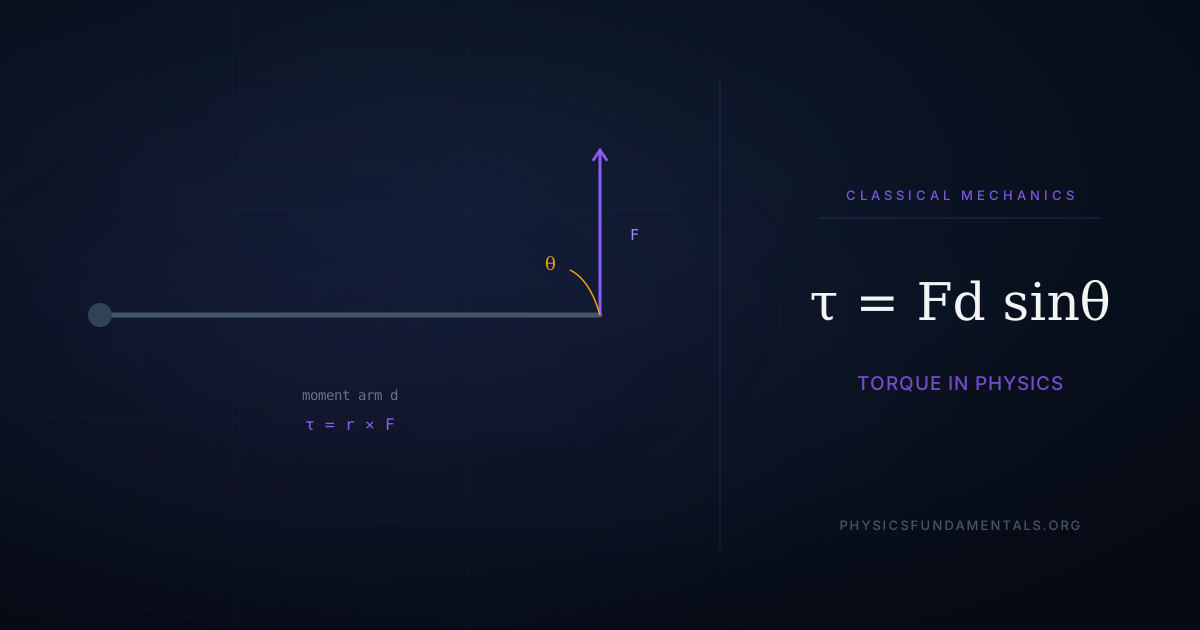
where τ (tau) is torque (N·m), F is force (N), d is the distance from the axis of rotation to the point where the force is applied (m), and θ is the angle between the force vector and the line from pivot to point of application.
When the force is perpendicular to the moment arm (θ = 90°, sinθ = 1), torque is maximised:
When the force is parallel to the moment arm (θ = 0° or 180°, sinθ = 0), torque is zero — a force directed straight toward or away from the pivot produces no rotation.
The Moment Arm
The moment arm (also called the lever arm) is the perpendicular distance from the axis of rotation to the line of action of the force. It is not necessarily the distance from pivot to point of application — it is the shortest (perpendicular) distance from the pivot to the extended line along which the force acts.
For a force perpendicular to the lever: moment arm = distance from pivot to point of application.
For a force at angle θ: moment arm = d sinθ, so τ = F × (d sinθ) = Fd sinθ.
Diagram — Torque: force, moment arm, and angle
Direction of Torque: Clockwise and Anticlockwise
Torque is a vector — it has both magnitude and direction. By convention:
• Anticlockwise (counterclockwise) torques are positive.
• Clockwise torques are negative.
The direction is determined by the right-hand rule: curl the fingers of the right hand from the moment arm toward the force direction; the thumb points in the direction of the torque vector (perpendicular to the plane of rotation).
Rotational Equilibrium: The Principle of Moments
An object is in rotational equilibrium when the net torque about any axis is zero:
This is the Principle of Moments: for equilibrium, the sum of clockwise torques about any pivot equals the sum of anticlockwise torques. This is the fundamental principle behind levers, see-saws, balance scales, and structural engineering.
Worked Example: See-saw
A 40 kg child sits 1.5 m from the centre of a see-saw. How far must a 60 kg adult sit on the other side for the see-saw to balance?
The adult must sit 1.0 m from the centre — lighter people sit further from the pivot to balance heavier people sitting closer.
Worked Example: Beam on Two Supports
A uniform beam of length 4 m and weight 200 N rests horizontally on two supports: one at end A, and one 1 m from the other end (3 m from A). Find the reaction force at each support.
The beam's weight acts at its centre of mass, 2 m from A. Taking moments about support A eliminates the unknown reaction at A from the equation, leaving only the reaction at the second support:
Then using ΣF = 0 (total upward force equals the beam's weight):
The support closer to the beam's centre of mass carries less of the load — this "choose the pivot at an unknown force" trick, used here to solve for R_B without ever needing R_A, is the standard technique for any beam problem with multiple unknown reactions.
More Worked Examples
Example 2: Tightening a bolt
A mechanic applies 80 N perpendicular to a 0.25 m spanner. What torque acts on the bolt?
Example 3: Force at an angle
A 100 N force acts at 35° to a 0.4 m moment arm.
Newton's Second Law for Rotation
Just as F = ma connects force and linear acceleration, the rotational equivalent connects torque and angular acceleration α:
where I is the moment of inertia (kg·m²) — the rotational analogue of mass — and α is angular acceleration (rad/s²). A larger moment of inertia means the same torque produces less angular acceleration. This is why it is harder to spin a long, heavy flywheel than a small, light disc — even if both have the same mass, the flywheel's mass is concentrated further from the axis, giving it a greater moment of inertia.
Common Moments of Inertia
Moment of inertia depends on both mass and how that mass is distributed relative to the axis of rotation:
| Shape (axis) | Formula |
|---|---|
| Point mass, distance r from axis | I = mr² |
| Rod, about the centre | I = (1/12)mL² |
| Rod, about one end | I = (1/3)mL² |
| Disc or cylinder, about centre | I = (1/2)mr² |
| Solid sphere, about centre | I = (2/5)mr² |
Notice that a rod rotated about its end has three times the moment of inertia of the same rod rotated about its centre (1/3 vs 1/12) — mass distributed further from the axis contributes disproportionately more, since the formula depends on the square of the distance.
Worked Example 4: Angular Acceleration from Torque
A flywheel is modelled as a solid disc of mass 5 kg and radius 1 m. A net torque of 15 N·m is applied. Find its angular acceleration.
The flywheel's angular velocity increases by 6 radians per second, every second, for as long as the 15 N·m torque is applied — directly analogous to a = F/m in linear motion.
Torque and Work in Rotation
Work done by a torque through angle θ (in radians):
Power delivered by a torque at angular velocity ω (rad/s):
This mirrors the linear relationships W = Fd and P = Fv exactly. For a car engine: engine torque × angular velocity = power output. High-revving engines (large ω) can produce high power at moderate torque; diesel engines produce high torque at low revs. Torque and power are related by P = τω — they are not independent quantities.
Real-World Applications of Torque
Door handles: positioned at the edge of the door (maximum moment arm) to minimise the force needed to open it. A handle near the hinge would require enormous force for the same torque.
Wheelie bars on dragsters: prevent the car from rotating (wheelie) by extending the effective wheelbase, increasing the anticlockwise torque of the rear downforce.
Torque wrenches: allow engineers to apply precisely specified torques to bolts, preventing both under-tightening (bolt works loose) and over-tightening (stripping threads or warping flanges).
Seesaws and levers: all governed by the principle of moments — the fundamental application of rotational equilibrium dating back to Archimedes, who reportedly said: "Give me a lever long enough and a fulcrum on which to place it, and I shall move the world."
Try it yourself: check your own numbers with the Torque Calculator, which shows the formula, the worked substitution and the answer step by step.
Frequently Asked Questions
What is the formula of torque?
What is torque in physics?
What is the difference between torque and force?
What is the unit of torque?
Why is torque maximum when the force is perpendicular to the moment arm?
What is the moment arm (lever arm)?
What are the conditions for rotational equilibrium?
How does torque relate to power in rotating machines?
Share this article
Written by
Physics Fundamentals Editorial Team
Written and reviewed by our team of physics educators. Content is aligned with A-Level, GCSE, AP Physics, and undergraduate curricula.
About Physics Fundamentals →