Heat flows from hot to cold. Never the other way, not spontaneously. You can't un-scramble an egg. A broken cup doesn't reassemble itself. These aren't engineering limitations — they're consequences of a fundamental law that gives time its direction. The second law of thermodynamics is the only law of physics that distinguishes the past from the future, and that makes it unlike any other equation in the subject.
The second law comes in several equivalent forms — Kelvin's, Clausius's, the entropy statement — and each illuminates a different aspect of the same truth: that nature has a preferred direction of change, always toward greater disorder. Understanding why, and being able to calculate how much disorder increases in a given process, is what this guide is about.
- The three statements of the second law and why they're all equivalent
- Entropy — what it actually measures and how to calculate ΔS = Q/T
- Why no heat engine can be 100% efficient — and the Carnot efficiency limit
- Why the second law gives time a direction when all other physics laws are time-reversible
What Is Entropy?
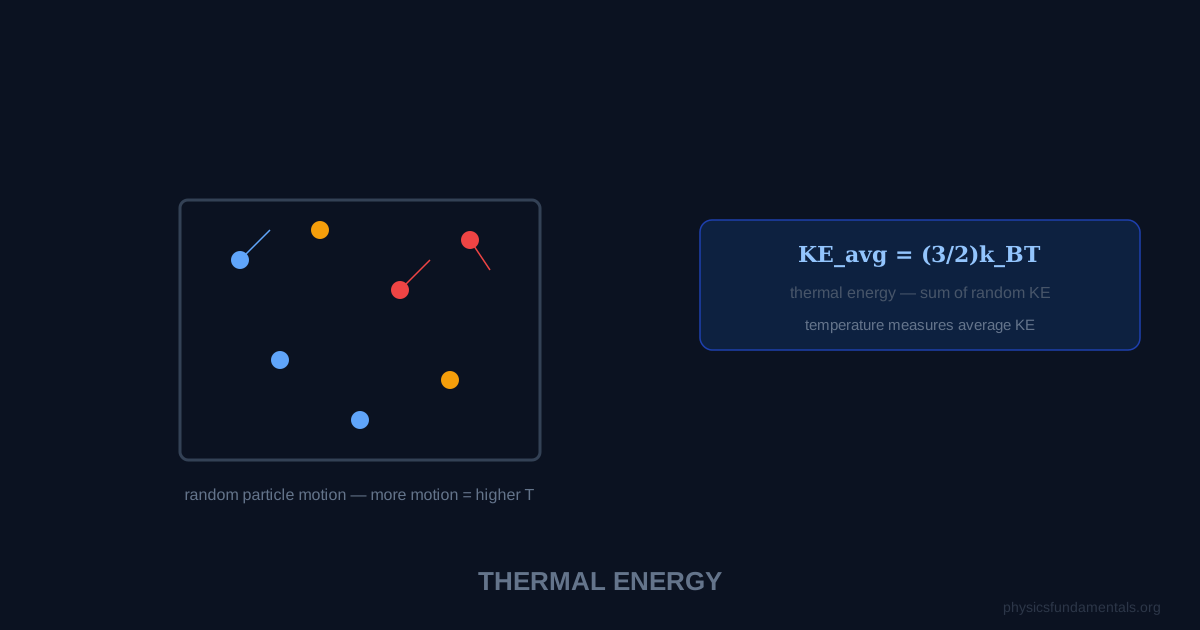
Entropy (symbol S, unit J/K) is a measure of the disorder or randomness of a system — more precisely, it measures the number of microscopic arrangements (microstates) that correspond to a given macroscopic state. The higher the entropy, the more ways the system can be arranged at the microscopic level.
A classic example: a gas confined to the left half of a box has low entropy (molecules are restricted to one region — few microstates). Open a partition and the gas expands to fill the whole box — vastly more microstates are available, so entropy is much higher. The gas never spontaneously returns to the left half because that would require moving from a high-entropy state (many microstates) to a low-entropy state (far fewer microstates) — overwhelmingly improbable.
The statistical definition of entropy, due to Ludwig Boltzmann, is:
where k_B = 1.38 × 10⁻²³ J/K is Boltzmann's constant and W is the number of microstates. This equation is so fundamental it is inscribed on Boltzmann's tombstone in Vienna.
The Entropy Change Formula
For a reversible heat transfer at constant temperature T:
where ΔS is the change in entropy (J/K), Q is the heat transferred (J), and T is the absolute temperature (K). Heat added to a system increases its entropy; heat removed decreases it. For irreversible processes, ΔS_universe > Q/T — the universe always gains more entropy than the minimum required.
Why Heat Flows From Hot to Cold
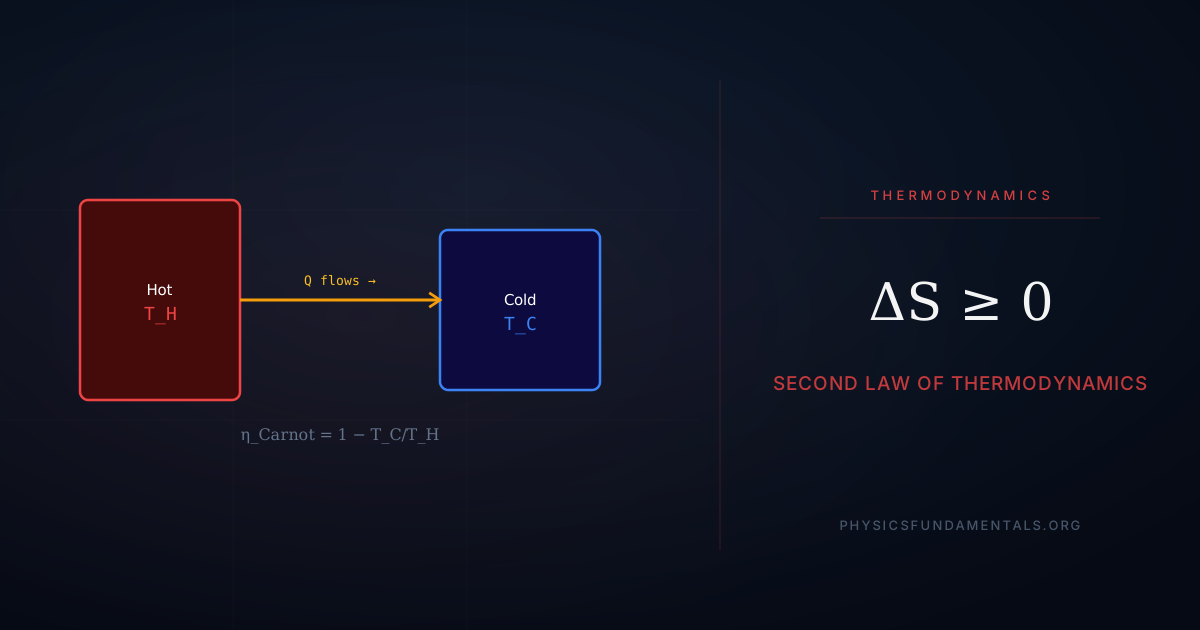
Consider a hot object (temperature T_H) in contact with a cold object (temperature T_C, where T_C < T_H). When heat Q flows from hot to cold:
Total entropy increases — consistent with the second law. If heat were to flow the other way (cold to hot), ΔS_total would be negative — entropy would decrease — violating the second law. This is why heat spontaneously flows only from hot to cold.
Heat Engines and the Carnot Limit
A heat engine is any device that converts thermal energy into work. It takes heat Q_H from a hot reservoir at temperature T_H, converts some to work W, and rejects the remainder Q_C to a cold reservoir at T_C:
The efficiency of any heat engine is:
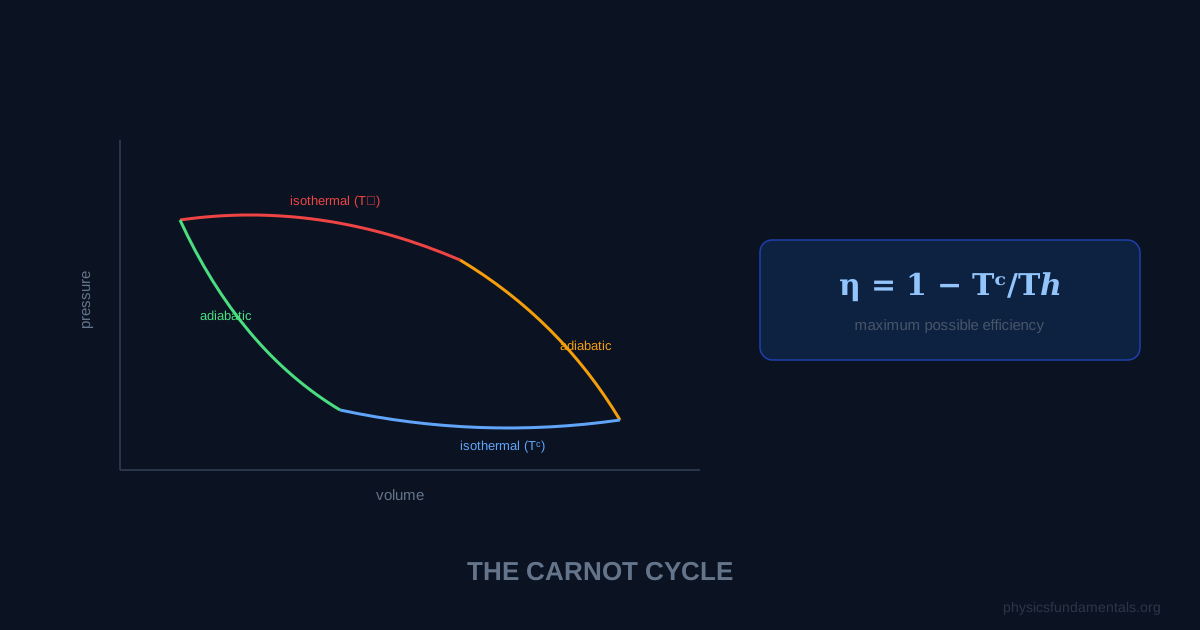
The second law (specifically, entropy cannot decrease) places a maximum on efficiency. The Carnot efficiency is the theoretical maximum for any engine operating between temperatures T_H and T_C:
where temperatures must be in kelvins (K). No real engine can exceed Carnot efficiency. A real engine always falls below it because real processes are irreversible (friction, heat leakage, turbulence) — generating entropy that reduces the work output.
| Engine | T_H (K) | T_C (K) | Carnot max | Actual |
|---|---|---|---|---|
| Petrol engine | ~800 K | ~350 K | 56% | 25–35% |
| Steam turbine | ~810 K | ~310 K | 62% | 40–45% |
| Human body | ~310 K | ~295 K | ~5% | ~25% (muscles) |
Why Perpetual Motion Machines Are Impossible
A perpetual motion machine of the first kind would create energy from nothing — violating the first law of thermodynamics (conservation of energy). It is impossible.
A perpetual motion machine of the second kind would convert heat entirely into work with 100% efficiency, with no heat rejected — violating the second law. A steam engine that took heat from the ocean and converted it all to work (with the ocean as the single reservoir) would seem plausible — there is plenty of thermal energy in the sea — but the second law forbids it. You need two reservoirs at different temperatures; work can only be extracted from the temperature difference, not from any single reservoir regardless of how much energy it contains.
Entropy and the Arrow of Time
The fundamental laws of mechanics (Newton's laws, quantum mechanics, electromagnetism) are all time-symmetric — they work equally well run forwards or backwards. Yet the macroscopic world clearly has a direction of time: eggs break but don't reassemble, heat flows from hot to cold, stars burn out but don't spontaneously ignite. The arrow of time emerges from the second law: entropy increases, so the future is the direction in which entropy is higher.
The ultimate reason entropy was low in the past — enabling the universe to evolve toward higher entropy — is that the universe began in an extremely low-entropy state at the Big Bang. This is one of the deepest unsolved questions in cosmology: why did the universe start so orderly?
Refrigerators and Heat Pumps: Running the Engine Backward
A refrigerator is a heat engine run in reverse: it uses work W to move heat Q_C from a cold reservoir (the fridge interior) to a hot reservoir (the kitchen). The coefficient of performance (COP) measures efficiency:
A heat pump moves heat from cold outdoor air to a warm building interior, also using work. The Carnot COP for a heat pump: COP_HP = T_H / (T_H − T_C). Heat pumps can deliver more heat than the electrical energy they consume — a 1 kW heat pump can deliver 3–4 kW of heating by moving heat from cold air — which is why they are far more efficient than electric resistance heaters.
The Second Law Stated Three Ways
Clausius statement: heat cannot spontaneously flow from a cold object to a hot object. Refrigerators require work input — without it, heat won't move from cold to hot on its own.
Kelvin-Planck statement: no heat engine can convert all absorbed heat entirely into work. Some heat must always be rejected to a cold reservoir.
Entropy statement: the total entropy of an isolated system never decreases: ΔS_universe ≥ 0 for any process. For reversible processes: ΔS = 0. For irreversible: ΔS > 0.
All three statements are equivalent — each implies the other two.
Frequently Asked Questions
What is the second law of thermodynamics?
What is entropy?
What is Carnot efficiency?
Why can't a heat engine be 100% efficient?
Does entropy always increase?
What is the difference between the first and second laws of thermodynamics?
What is a heat pump and how efficient can it be?
What does irreversible mean in thermodynamics?
Share this article
Written by
Physics Fundamentals Editorial Team
Written and reviewed by our team of physics educators. Content is aligned with A-Level, GCSE, AP Physics, and undergraduate curricula.
About Physics Fundamentals →