

A straw in a glass of water looks bent. A diamond ring sparkles more than a glass one. A mirage shimmers on a hot road. Rainbows arc across the sky after rain. Every one of these is caused by light changing direction — either bouncing off a surface, or bending as it crosses from one medium into another. Reflection and refraction are not separate phenomena with separate explanations: both arise from the same underlying fact that light travels at different speeds in different materials.
The mathematics is clean. The law of reflection (angle in = angle out) needs one line. Snell's law (n₁sinθ₁ = n₂sinθ₂) needs two. But the applications branch out into fibre optic cables, camera lenses, glasses prescriptions, and the total internal reflection that makes diamonds brilliant. Getting the physics right opens all of those.
- The law of reflection — and why the normal matters more than the surface itself
- Snell's law — derived from Fermat's principle, then applied to real problems
- Total internal reflection: the critical angle formula and why fibre optics depend on it
- Refractive index — what it means physically and values for common materials
The Law of Reflection
The angle of incidence (θ_i) equals the angle of reflection (θ_r). Both angles are measured from the normal — the line perpendicular to the surface at the point of incidence. The incident ray, reflected ray, and normal all lie in the same plane.
This law holds for all types of reflection — flat (plane) mirrors, curved mirrors, and even rough surfaces (where the normal varies across the surface, causing diffuse reflection rather than specular reflection).
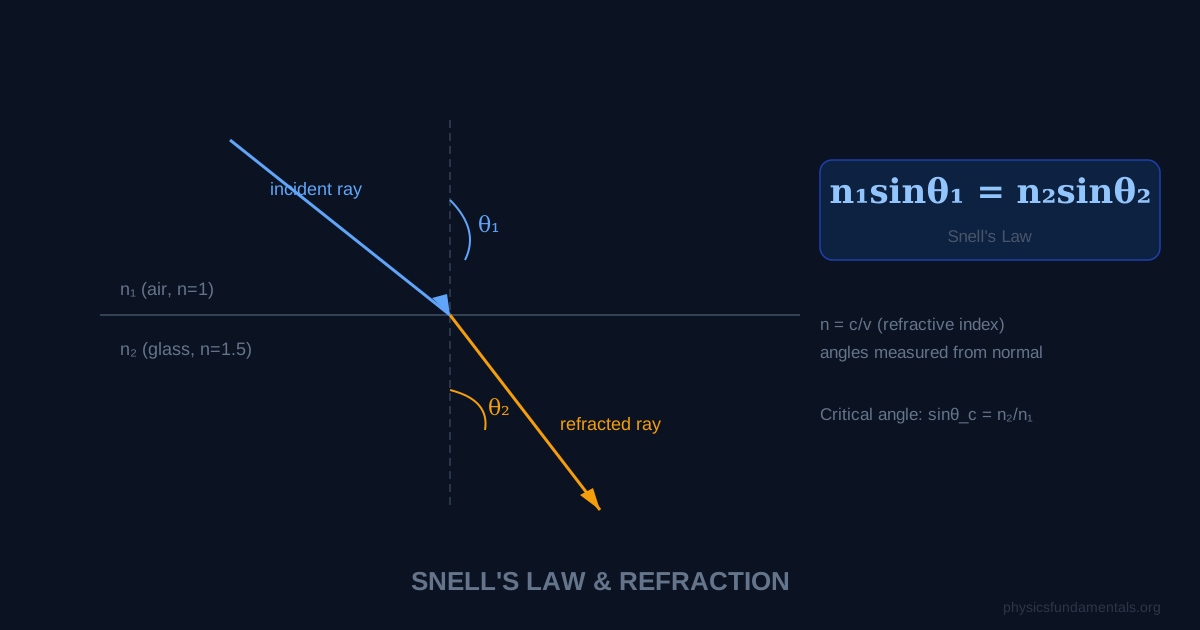
Diagram — Reflection and refraction at a glass surface
Refraction and the Refractive Index
When light passes from one medium to another, its speed changes. The refractive index n of a medium is defined as the ratio of the speed of light in a vacuum (c) to the speed of light in that medium (v):
Since light always travels slower in matter than in vacuum, n ≥ 1 for all real materials. Air: n ≈ 1.0003 (effectively 1.0). Water: n = 1.33. Glass: n ≈ 1.5. Diamond: n = 2.42.
| Medium | Refractive index n | Speed of light (m/s) |
|---|---|---|
| Vacuum | 1.000 | 3.00 × 10⁸ |
| Air | 1.0003 | ≈ 3.00 × 10⁸ |
| Water | 1.33 | 2.26 × 10⁸ |
| Crown glass | 1.52 | 1.97 × 10⁸ |
| Diamond | 2.42 | 1.24 × 10⁸ |
Snell's Law
Snell's Law (also called the law of refraction) gives the angle of refraction when light crosses a boundary:
where n₁ is the refractive index of the first medium, θ₁ is the angle of incidence, n₂ is the refractive index of the second medium, and θ₂ is the angle of refraction. Both angles are measured from the normal.
Key consequences:
• Light entering a denser medium (n₂ > n₁) bends toward the normal (θ₂ < θ₁).
• Light entering a less dense medium (n₂ < n₁) bends away from the normal (θ₂ > θ₁).
• Light at normal incidence (θ₁ = 0°) does not bend — it passes straight through.
Worked Example: Snell's Law
Light in air (n = 1.0) hits a glass surface (n = 1.5) at 40° to the normal. Find the refraction angle.
Light bends toward the normal (25.4° < 40°) on entering the denser glass. ✓
Total Internal Reflection
When light travels from a denser medium to a less dense medium (n₁ > n₂), the refracted angle θ₂ > θ₁. As θ₁ increases, at some point θ₂ reaches 90° — the refracted ray travels along the surface. This angle is the critical angle θ_c:
For glass (n = 1.5) to air (n = 1.0): sinθ_c = 1/1.5 = 0.667 → θ_c = 41.8°.
For angles greater than θ_c, total internal reflection occurs — all light is reflected back into the denser medium. No refraction takes place. This is the principle behind:
Optical fibres: light enters a glass fibre and is totally internally reflected along its entire length with almost no loss, enabling high-bandwidth telecommunications. The fibre core has higher n than the surrounding cladding, ensuring TIR at all incidence angles above the critical angle.
Diamond brilliance: diamond's very high n (2.42) gives a critical angle of only 24.4° — much smaller than glass. Most light entering a diamond exceeds the critical angle and undergoes TIR many times before exiting, producing the characteristic sparkle (fire and brilliance) that makes cut diamonds so visually striking.
Prisms in binoculars: use TIR to reflect light and fold the optical path without the energy loss of metallic mirrors.
Why Does Refraction Cause a Straw to Look Bent?
When you look at a straw in a glass of water, the part below the water surface appears displaced from the part above. Your eye traces the light rays reaching it backward in a straight line — but the rays have been bent at the water-air interface. The brain, assuming straight-line travel, places the underwater straw tip at the wrong apparent position. This is why objects seen through water appear shallower than they are: apparent depth = real depth / n.
Try it yourself: check your own numbers with the Refractive Index & Critical Angle Calculator, which shows the formula, the worked substitution and the answer step by step.
Frequently Asked Questions
What is the law of reflection?
What is Snell's Law?
What is the refractive index?
What is total internal reflection?
What is the critical angle and how is it calculated?
Why does a straw look bent in water?
Why does light bend when it enters water?
Share this article
Written by
Physics Fundamentals Editorial Team
Written and reviewed by our team of physics educators. Content is aligned with A-Level, GCSE, AP Physics, and undergraduate curricula.
About Physics Fundamentals →
Discussion
Comments
Leave a comment
Have a question about this article? Spot a mistake? Or just want to share your thoughts? We'd love to hear from you.
Keep learning physics fundamentals
Get new articles and platform updates delivered to your inbox.
Physics Fundamentals
👋 Get concise physics updates — new articles, calculators, and tools. Your number stays private. No spam. No group chats. Just worthy content.