Energy is one of those words everyone uses and almost nobody can define precisely. Ask someone what energy is and you'll hear "the ability to do work" — which is circular, because work is defined in terms of energy. The honest answer is that energy is a conserved quantity: whatever form it takes, however it moves between objects, the total never changes. That conservation law is what makes energy useful.
Physics has a long list of energy types — kinetic, potential, thermal, chemical, nuclear, electromagnetic — but they're all the same thing in different forms. Every conversion between them follows the same accounting rule: nothing created, nothing destroyed, everything transferred.
- What energy actually is in physics — and why the textbook definition is incomplete
- The main forms of energy and how they convert between each other
- The law of conservation of energy and how to apply it to solve problems
- Units, worked examples, and the connection between energy and work
What Is Energy? The Definition in Physics
The definition of energy in physics: energy is a scalar quantity that measures the capacity of a system to do work or produce heat. It is not a substance, a force, or a thing you can hold — it is a property of physical systems, measured in joules (J), that has one extraordinary characteristic: it is always conserved.
Energy is the capacity to do work. It exists in many forms — kinetic, potential, thermal, chemical, electrical, nuclear — but the total amount in any isolated system never changes. This is the law of conservation of energy.
Is Energy a Fundamental Concept in Physics?
Yes — energy is arguably the most fundamental concept in all of physics. Here's why:
It connects every branch of physics. Kinetic energy links mechanics to thermodynamics. Electromagnetic energy links optics to electricity. Chemical energy links physics to chemistry. No other single concept appears in every branch of physics with equal importance.
It is always conserved. The law of conservation of energy has no known exceptions anywhere in the universe — in quantum mechanics, relativity, thermodynamics, and classical mechanics alike. When energy appears to be lost, it has simply converted to another form (usually thermal) that is harder to detect.
It defines what is physically possible. Any process that would violate conservation of energy is physically impossible. This makes energy the most powerful constraint on physical processes — more fundamental than any specific force law.
Ask a physicist "what is energy?" and you'll often get a pause. Not because the question is trivial — quite the opposite. Energy is arguably the single most important concept in all of physics, yet it resists a simple one-line definition. It's not a substance you can hold. It's not a force. It's a quantity — a number you can calculate for any physical system — that has one remarkable property: it never changes.
That property is the law of conservation of energy: the total energy of an isolated system remains constant over time. Energy can change form — kinetic to potential, chemical to thermal, electrical to mechanical — but the total amount never increases or decreases. It is, as far as we know, an exact law of nature with no known exceptions. Every conservation law we've found in physics turns out to be connected to a deep symmetry in the laws of nature — and energy conservation is connected to the symmetry of time itself.
Kinetic Energy: The Energy of Motion
Any object that moves has kinetic energy. If you've studied Newton's laws, you've already encountered the ingredients: mass and velocity. The kinetic energy of an object with mass m moving at speed v is:
Two things jump out. First, kinetic energy depends on the square of velocity. A car going 60 mph has four times the kinetic energy of the same car going 30 mph — not twice. This is why highway accidents are far more destructive than low-speed collisions: doubling your speed quadruples the energy your body must absorb in a crash. Seat belts and crumple zones work by extending the time over which that energy is dissipated — reducing peak force, per Newton's second law.
Second, kinetic energy is always positive. You can't have negative kinetic energy because mass and velocity-squared are both always positive. An object at rest has zero kinetic energy. An object in motion always has positive kinetic energy, regardless of which direction it moves.
Potential Energy: Stored Energy of Position
Potential energy is energy stored in a system due to the arrangement of its parts. Gravitational potential energy, the most common type in introductory physics, depends on an object's height above some reference point:
Here, m is mass, g is gravitational acceleration (~9.8 m/s² on Earth), and h is height. Lift a book one meter off the ground and you've given it roughly 10 joules of gravitational potential energy (for a 1 kg book). That energy doesn't disappear when you let go — it converts to kinetic energy as the book falls. This conversion is direct: at the moment of impact, every joule of potential energy has become kinetic energy. The total never changed.
Other forms of potential energy include elastic potential energy (stored in a compressed spring: PE = ½kx²), electric potential energy (stored in the arrangement of electric charges), and chemical potential energy (stored in molecular bonds — this is what food and fuel contain). Each is simply a different way of storing energy in a configuration that can later be released.
Conservation of Energy: The Master Principle
The conservation of energy is not just another rule in physics. It is the rule — the single most powerful constraint on what physical processes can and cannot happen. It connects mechanics, thermodynamics, electromagnetism, chemistry, and even nuclear physics under one unifying principle.
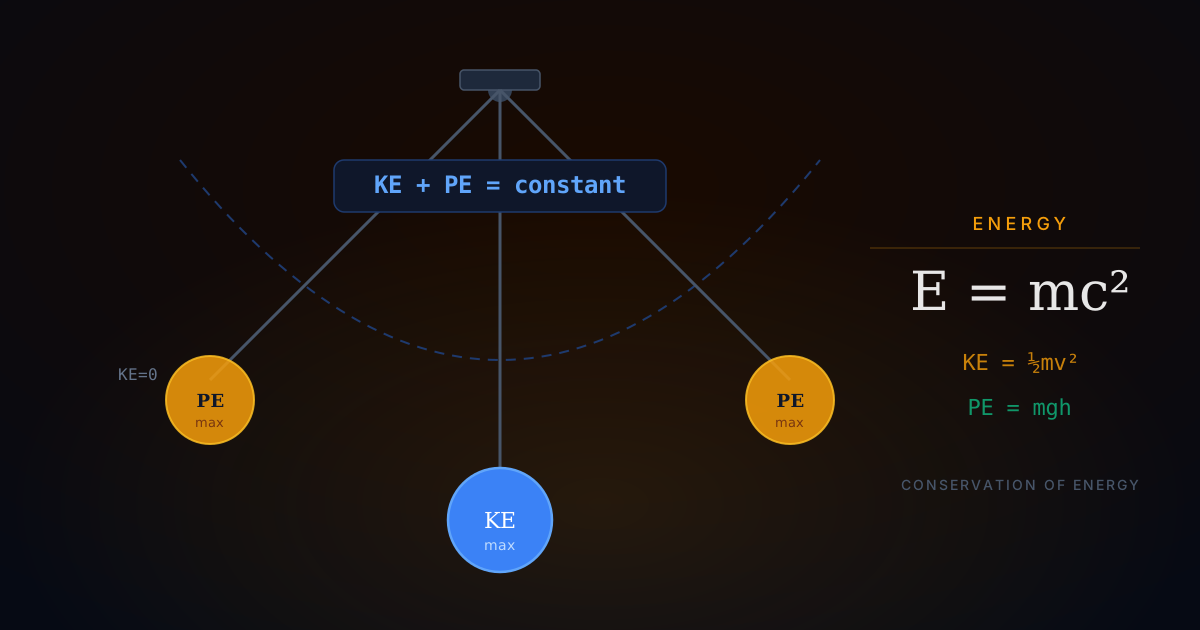
Consider a simple pendulum. At the top of its swing, it has maximum gravitational potential energy and zero kinetic energy (it's momentarily at rest). At the bottom, all that potential energy has converted to kinetic energy — the pendulum moves fastest at its lowest point. At every intermediate position, the total mechanical energy (KE + PE) remains constant:
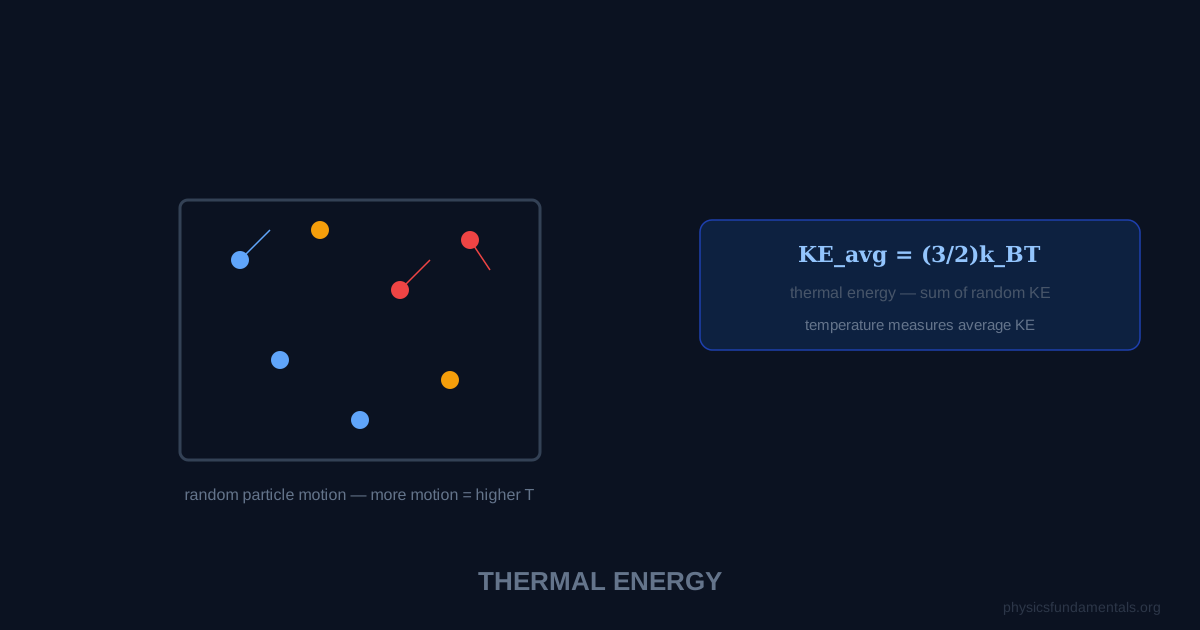
When friction is present, mechanical energy appears to decrease — the pendulum gradually slows. But the energy hasn't vanished. It has been converted to thermal energy through friction. If you could precisely measure the warming of the pivot and the surrounding air, you'd find the total energy — mechanical plus thermal — is still exactly conserved. This is why energy is such a powerful tool: it's always conserved, even when the forms change.
Energy Methods vs. Force Methods
Conservation of energy lets you solve problems that would be tortuous with force methods alone. To find the speed of a roller coaster at the bottom of a 30-meter hill using F = ma, you'd need to solve a differential equation along a curved path. Using energy conservation, it's a two-line calculation:
The mass cancels entirely — every roller coaster car, regardless of mass, reaches the same speed at the bottom of the same hill (if friction is negligible). This is the same insight Galileo discovered for falling objects: the rate of fall is independent of mass. Energy methods reveal why.
For projectile motion, energy conservation gives you the launch and landing speeds immediately, without tracking the full trajectory. You can then use kinematic equations only for the directional information you need. The two approaches — forces and energy — are complementary tools, each revealing different aspects of the same physical reality.
Forms of Energy and Transformations
Energy comes in many forms: kinetic, gravitational potential, elastic potential, thermal, chemical, electrical, nuclear, and electromagnetic (including light and other electromagnetic waves). Every physical process is a transformation from one form to another. A car engine converts chemical energy (fuel) to kinetic energy and thermal energy. A solar panel converts electromagnetic energy (sunlight) to electrical energy. A nuclear reactor converts nuclear binding energy to thermal energy to electrical energy.
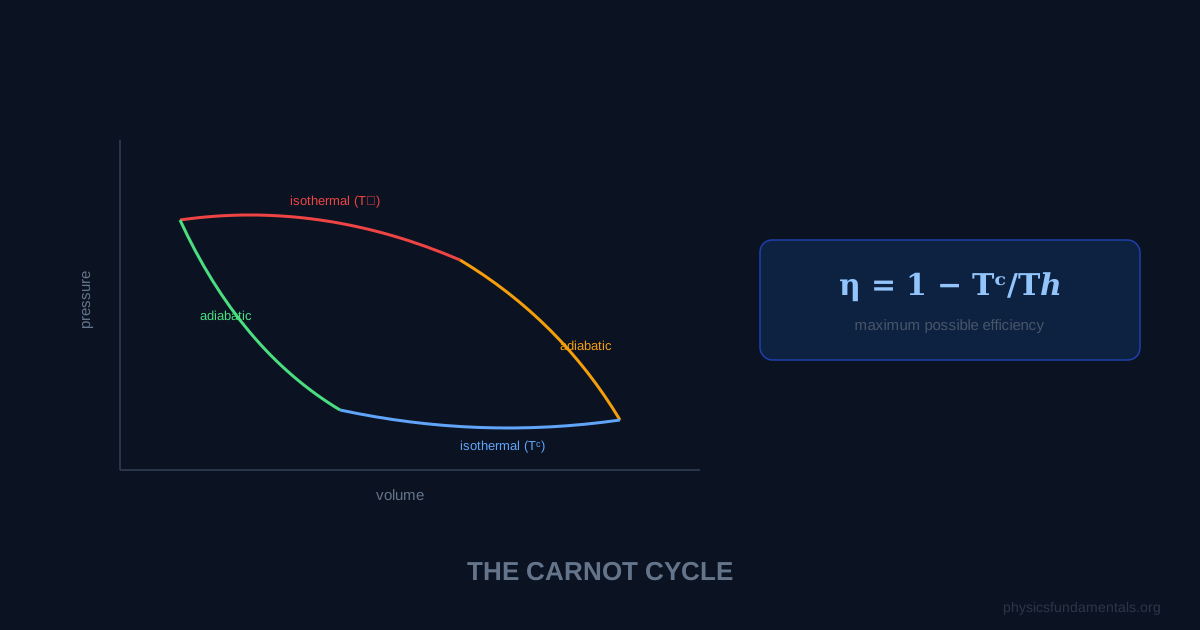
The efficiency of these transformations is a central concern of thermodynamics — and the reason we can never build a perfect engine. But the total amount of energy before and after every transformation is always exactly the same. That's the conservation of energy, and it is one of the most profound discoveries in the history of science.
Forms of Energy — Quick Reference
| Form | Formula | Example |
|---|---|---|
| Kinetic | ½mv² | Moving car, flowing water |
| Gravitational PE | mgh | Water behind a dam |
| Elastic PE | ½kx² | Compressed spring, drawn bow |
| Thermal | mc ΔT | Hot water, warm air |
| Chemical | — | Fuel, food, batteries |
| Nuclear | E = mc² | Fission, fusion, radioactive decay |
| Electromagnetic | E = hf | Light, X-rays, radio waves |
Work-Energy Theorem
Work done on an object equals the change in its kinetic energy: W = ΔKE = ½mv² − ½mu². This follows from F = ma combined with SUVAT. When multiple forms of energy are involved, the general statement is: work done by non-conservative forces = change in mechanical energy (ΔKE + ΔPE).
Energy Units and Scale
1 joule = 1 N·m. Other units: 1 calorie = 4.184 J; 1 kWh = 3.6 × 10⁶ J; 1 eV = 1.6 × 10⁻¹⁹ J; 1 tonne of TNT = 4.184 × 10⁹ J. Energy scales: a matchstick contains ~1 kJ; a smartphone battery ~40 kJ; a litre of petrol ~34 MJ; a Hiroshima bomb ~6 × 10¹³ J; the Sun's annual output ~1.2 × 10³⁴ J.
Frequently Asked Questions
What is energy in physics?
What is the difference between energy and power?
What is the definition of energy in physics?
Is energy conserved in all processes?
What is potential energy?
What is the work-energy theorem?
Share this article
Written by
Physics Fundamentals Editorial Team
Written and reviewed by our team of physics educators. Content is aligned with A-Level, GCSE, AP Physics, and undergraduate curricula.
About Physics Fundamentals →