Before two billiard balls collide, you can calculate exactly how they'll move afterward — without knowing anything about the forces involved during the impact, or how long the collision lasts, or what's happening inside. That's the power of momentum conservation: it holds regardless of the internal details.
Conservation of momentum isn't a separate law you have to memorise alongside Newton's laws. It's a mathematical consequence of Newton's third law. Once you see the derivation, you'll understand why it works and when it applies — which is more useful than treating it as a rule to plug numbers into.
- Why momentum is conserved — derived from Newton's third law, not just stated
- The difference between elastic and inelastic collisions, and what's conserved in each
- How to solve collision and explosion problems step by step
- Real-world applications from rocket propulsion to particle physics
What Is Momentum?
Linear momentum (p) is defined as the product of an object's mass and its velocity:
Momentum is a vector quantity — it has both magnitude and direction. A 2 kg object moving at 5 m/s east has a momentum of 10 kg·m/s east. An identical object moving west has a momentum of −10 kg·m/s (taking east as positive). This sign is critical: when calculating total momentum of a system, you must account for directions, not just magnitudes. The SI unit of momentum is kg·m/s, which is equivalent to N·s (newton-seconds).
The unit equivalence reveals momentum's deep connection to Newton's second law. In its most general form, Newton's second law states that the net force on an object equals the rate of change of its momentum: Fnet = Δp/Δt. The familiar F = ma is just the special case where mass is constant. When mass changes (as in a rocket expelling exhaust), the full momentum form is required.
Conservation of Momentum: The Law
The law of conservation of momentum states: the total linear momentum of an isolated system remains constant over time.
An "isolated system" is one where the net external force is zero. In practice, this means we consider only the forces between objects within the system (internal forces) and treat any external forces as negligible or balanced. This is an excellent approximation for collisions, where the collision forces are enormous compared to gravity or friction during the brief collision interval.
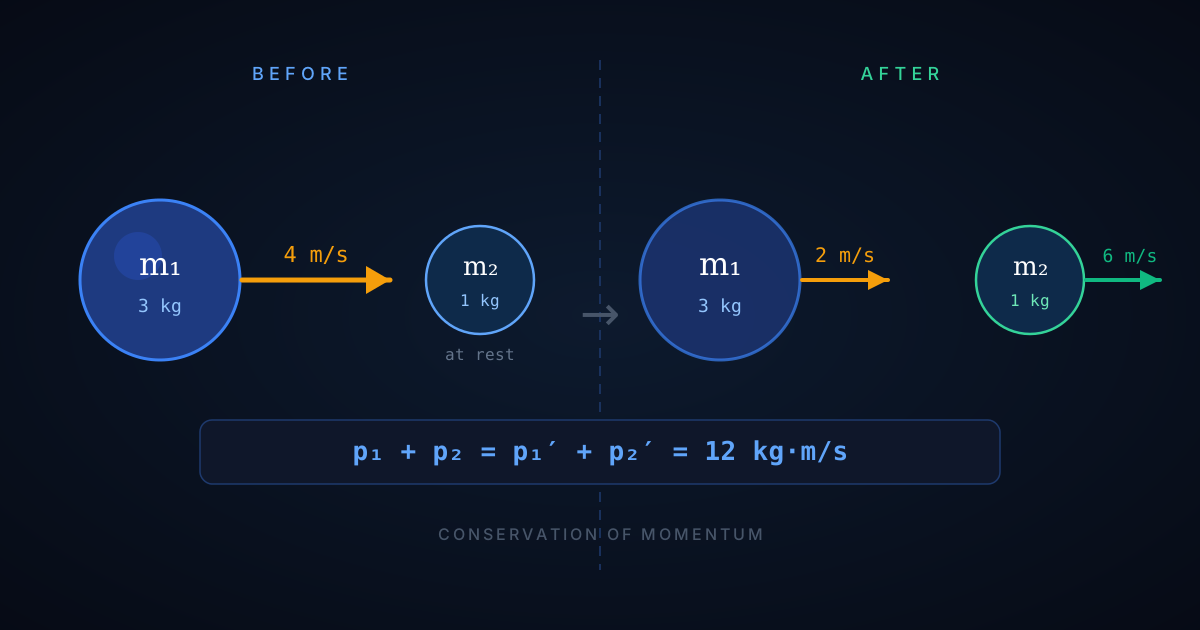
Diagram — Conservation of Momentum: Before and After Collision
Why Is Momentum Conserved? The Deep Reason
Consider two objects that interact — say, two billiard balls colliding. By Newton's third law, the force ball A exerts on ball B is equal and opposite to the force ball B exerts on ball A. These forces act for the same duration (the collision time). Therefore, the impulse (force × time) delivered to A is equal and opposite to the impulse delivered to B. Since impulse equals change in momentum, the increase in momentum of one ball exactly equals the decrease in momentum of the other. The total momentum of the system doesn't change.
This reasoning applies to any isolated system. There's an even deeper reason, discovered by mathematician Emmy Noether in 1915: conservation of momentum is a direct consequence of the translational symmetry of space. Because the laws of physics are the same everywhere in space (the outcome of an experiment doesn't depend on where you perform it), momentum must be conserved. This is one of the most profound results in all of mathematical physics.
Types of Collisions
Diagram — Elastic vs Inelastic vs Perfectly Inelastic Collision
Elastic collisions conserve both momentum and kinetic energy. At the atomic scale, collisions between gas molecules are approximately elastic. At everyday scales, perfectly elastic collisions are an idealization — some kinetic energy is always lost to sound, heat, and deformation. Newton's cradle approximates elastic collisions between steel balls.
Inelastic collisions conserve momentum but not kinetic energy. Some kinetic energy converts to other forms — sound, heat, deformation. Most real-world collisions are inelastic.
Perfectly inelastic collisions are the extreme case: the objects stick together after colliding, moving as one unit. The kinetic energy lost is maximum in this case, though momentum is still conserved.
Worked Examples
Example 1: Elastic Collision
A 3 kg ball moving at 4 m/s collides elastically with a stationary 1 kg ball. Find both final velocities.
Using momentum conservation and kinetic energy conservation simultaneously:
Both balls move right. The heavy ball slows from 4 to 2 m/s; the light ball shoots off at 6 m/s.
Example 2: Perfectly Inelastic Collision
A 1500 kg car at 20 m/s east collides with a 1000 kg car at rest. They stick together. Final velocity?
pinitial = 1500 × 20 = 30,000 kg·m/s
v′ = 30,000 / 2500 = 12 m/s east
KE before: ½(1500)(400) = 300,000 J. KE after: ½(2500)(144) = 180,000 J. The missing 120,000 J deformed metal, produced sound, and generated heat.
Example 3: Recoil
A 5 kg rifle fires a 0.01 kg bullet at 800 m/s. What is the recoil speed of the rifle?
Initial total momentum = 0 (both at rest).
The rifle recoils at 1.6 m/s opposite to the bullet. The negative sign confirms opposite direction. This is Newton's third law and momentum conservation in perfect agreement.
Impulse: The Bridge Between Force and Momentum
Impulse (J) is the product of a force and the time it acts:
Diagram — Impulse-Momentum Theorem: Same Δp, Different F×t Combinations
This is why airbags save lives. In a collision, the change in momentum (stopping the passenger) is fixed by the initial speed. An airbag extends the stopping time from ~1 ms (bare dashboard) to ~30 ms — reducing the average force by a factor of 30. Per F = ma, reducing force directly reduces acceleration and damage. The same principle governs crumple zones, helmets, padding, and every other crash protection system in existence.
Rocket Propulsion: Momentum Conservation Without Ground Contact
A rocket in deep space has no surface to push against. Yet it accelerates. How? By ejecting mass (exhaust gases) at high velocity in one direction. The momentum of the ejected gas is exactly balanced by the momentum gained by the rocket — total system momentum is conserved. This is Newton's third law and momentum conservation working in tandem.
The rocket equation (Tsiolkovsky equation) formalises this:
Where v_e is exhaust velocity, m₀ is initial mass, and m_f is final mass after burning fuel. The logarithm means that doubling Δv requires squaring the mass ratio — which is why rockets consist mostly of propellant. A mission with Δv of 9 km/s (roughly low Earth orbit) needs a mass ratio of about 10:1. Momentum conservation dictates every aspect of space mission planning.
Momentum in Two Dimensions
Momentum conservation applies independently in every direction. For a 2D collision, you apply the conservation law separately in x and y:
This is crucial for analysing oblique collisions (where objects don't hit head-on), billiard shot planning, particle physics detector analysis, and accident reconstruction. In 2D, the vector nature of momentum is essential — you cannot simply add magnitudes.
Momentum vs. Energy: The Key Distinction
Students often confuse momentum and kinetic energy. They are related but distinct:
| Property | Momentum (p = mv) | Kinetic Energy (KE = ½mv²) |
|---|---|---|
| Vector or scalar? | Vector (has direction) | Scalar (magnitude only) |
| Speed dependence | Linear (∝ v) | Quadratic (∝ v²) |
| Conserved in all collisions? | Always ✓ | Only elastic ✗/✓ |
| Can be zero for moving system? | Yes (equal+opposite momenta) | No (always positive) |
A key insight: two equal-mass objects moving at the same speed in opposite directions have zero total momentum but positive total kinetic energy. Momentum cancels because it's a vector; kinetic energy does not cancel because it's a scalar. This distinction becomes critical when analysing explosions (a stationary bomb has zero momentum but enormous internal energy) and particle physics (particle-antiparticle pairs can be created from pure energy with zero net momentum).
Real-World Applications of Momentum Conservation
Automotive safety engineering — every crash test uses impulse-momentum analysis to design crumple zones, airbags, and seatbelt pre-tensioners that extend collision time and reduce peak force.
Space mission design — every orbital manoeuvre, thruster burn, and gravity assist is calculated using momentum conservation. The Voyager probes used gravity assists (momentum exchange with Jupiter and Saturn) to reach speeds no rocket alone could provide.
Forensic accident reconstruction — police investigators use skid marks, deformation patterns, and momentum conservation to determine pre-collision speeds from post-collision evidence, even without witnesses or cameras.
Particle physics — at the Large Hadron Collider, detectors measure the momenta of all particles produced in a collision. Conservation of momentum allows physicists to infer the existence of undetected particles (like neutrinos) from missing momentum in the detector record. The Higgs boson was discovered this way.
Sports science — the "follow-through" in golf, cricket, and tennis extends the contact time between club/bat/racket and ball, increasing impulse and therefore the momentum (and speed) imparted to the ball.
The Conservation of Momentum Formula
The law of conservation of momentum states that the total momentum of a closed system remains constant when no external forces act. For a collision or explosion between objects 1 and 2:
where u₁, u₂ are velocities before and v₁, v₂ are velocities after. This applies to both elastic collisions (kinetic energy conserved) and inelastic collisions (kinetic energy not conserved, but momentum always is).
For a perfectly inelastic collision (objects stick together):
For an explosion (initially at rest, so total momentum = 0):
The two fragments fly apart with equal and opposite momenta, so the total is still zero.
Worked Example: Perfectly Inelastic Collision
A 2.0 kg trolley moving at 6.0 m/s collides with and sticks to a stationary 3.0 kg trolley. Find the combined velocity after collision.
Check kinetic energy: before = ½ × 2.0 × 6.0² = 36 J; after = ½ × 5.0 × 2.4² = 14.4 J. 21.6 J was lost to deformation and heat — this is an inelastic collision.
Elastic vs Inelastic Collisions
| Type | Momentum conserved? | KE conserved? | Example |
|---|---|---|---|
| Elastic | ✅ Yes | ✅ Yes | Ideal gas molecules, billiard balls (approx) |
| Inelastic | ✅ Yes | ❌ No (some lost to heat/deformation) | Car crash, clay balls |
| Perfectly inelastic | ✅ Yes | ❌ No (maximum KE lost) | Objects that stick together |
Momentum is always conserved in any collision. Kinetic energy is only conserved in elastic collisions. This is why "conservation of momentum" is the fundamental law — it doesn't depend on the type of interaction, only on the absence of external forces.
Impulse and the Change in Momentum
Momentum changes when a net force acts for a time interval. The impulse-momentum theorem:
Impulse J (N·s) equals the change in momentum. A large force for a short time (punch) or a small force for a long time (gentle push over many seconds) can produce the same impulse. This is why car airbags work: they extend the collision time, reducing the peak force for the same impulse (same change in momentum).
Try it yourself: check your own numbers with the Momentum Calculator, which shows the formula, the worked substitution and the answer step by step.
Frequently Asked Questions
What is the law of conservation of momentum?
Is momentum always conserved?
What is the difference between elastic and inelastic collisions?
What is the impulse-momentum theorem?
Share this article
Written by
Physics Fundamentals Editorial Team
Written and reviewed by our team of physics educators. Content is aligned with A-Level, GCSE, AP Physics, and undergraduate curricula.
About Physics Fundamentals →