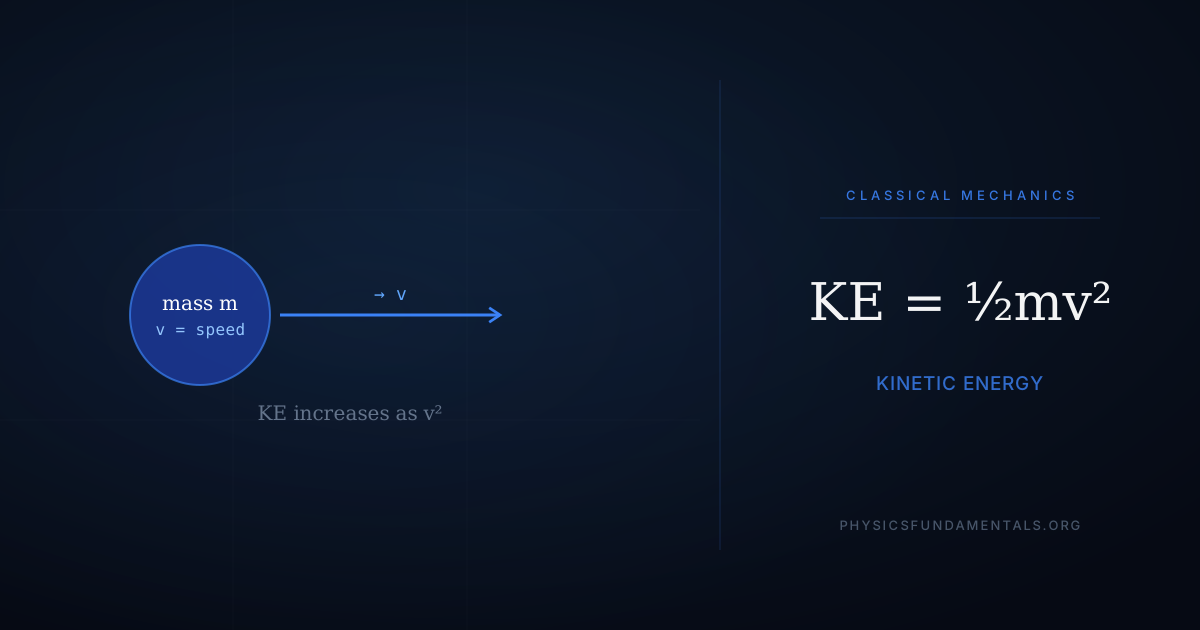
Kinetic energy is the energy something has because it's moving. That sounds obvious — but the formula that quantifies it, KE = ½mv², contains a surprise that catches most students off guard: velocity is squared. Double an object's speed and its kinetic energy quadruples. That's why a car at 60 mph needs four times the stopping distance of the same car at 30 mph, not twice. The squared term has serious real-world consequences.
Kinetic energy is also the key that unlocks the work-energy theorem — one of the most useful tools in mechanics. Rather than tracking forces moment by moment, you can often jump straight from initial to final state using energy, which is frequently faster and simpler.
- Where the ½mv² formula comes from — derived, not just given
- Why velocity is squared and what that means for stopping distances and collisions
- How to apply the work-energy theorem to problems involving forces and motion
- Worked examples including moving vehicles, falling objects, and rotating systems
What Is Kinetic Energy? — Definition
Kinetic energy is the energy possessed by an object due to its motion. It is a scalar quantity (no direction) equal to half the product of the object's mass and the square of its speed: KE = ½mv². The SI unit is the joule (J). Any object with mass that is moving has kinetic energy; an object at rest has zero kinetic energy.
The word "kinetic" comes from the Greek kinētikos, meaning "of motion." The concept was developed through the work of Gottfried Leibniz and later formalised by the physicist Gaspard-Gustave de Coriolis in 1829, who introduced the ½ factor and the term force vive (living force). Today the term "kinetic energy" and the formula KE = ½mv² are universally standard.
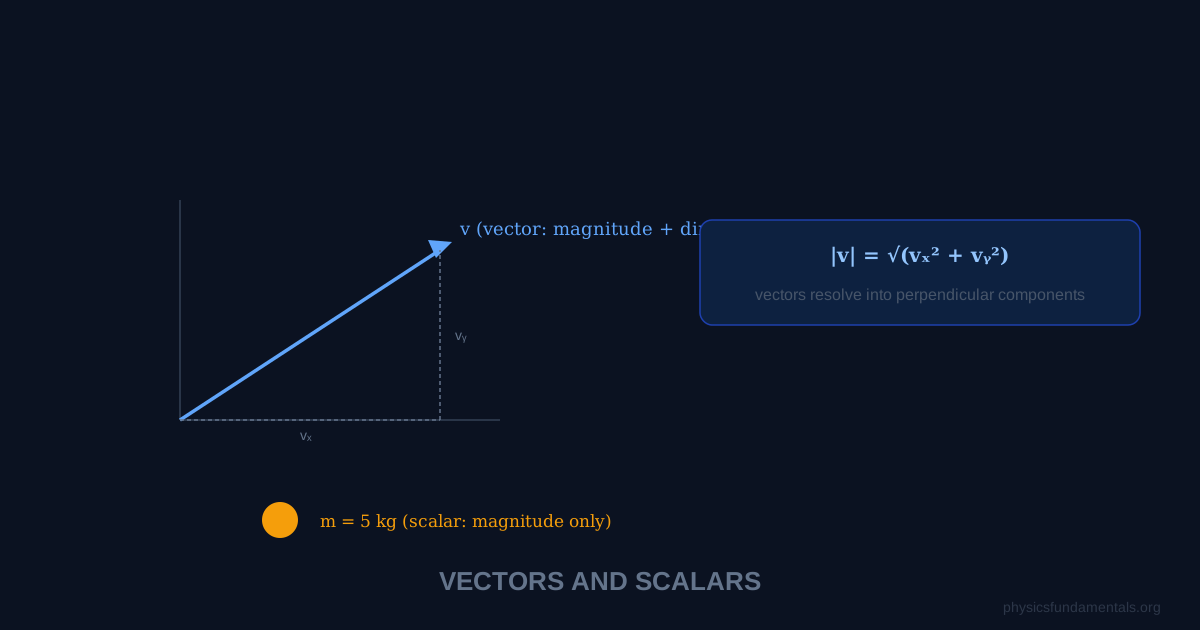
Kinetic energy is a scalar — it has magnitude but no direction. Two identical objects moving in opposite directions have the same kinetic energy. This contrasts with momentum (p = mv), which is a vector and does depend on direction. When objects collide and come to rest, their combined momentum is zero but their kinetic energy was non-zero before the collision — the distinction between these two quantities is one of the deepest conceptual points in mechanics.
The KE = ½mv² Formula Explained
Where:
- KE = kinetic energy, measured in joules (J)
- m = mass of the object, measured in kilograms (kg)
- v = speed of the object, measured in metres per second (m/s)
The formula can be rearranged to solve for mass or velocity:
Use our Kinetic Energy Calculator to solve for any variable instantly with multiple unit systems.
Why ½? The Origin of the Factor
The factor of ½ is not arbitrary — it emerges directly from the mathematics of Newton's Second Law and kinematics. Consider an object of mass m starting from rest (u = 0) and accelerating uniformly to speed v over distance s under constant force F.
From kinematics: v² = u² + 2as = 2as, so s = v²/(2a). The work done by the force is W = Fs = ma × v²/(2a) = ½mv². Since work equals energy transferred, the kinetic energy gained is exactly ½mv². The factor of ½ is a direct consequence of the kinematics of uniformly accelerated motion — it has no arbitrary origin.
Derivation from the Work-Energy Theorem
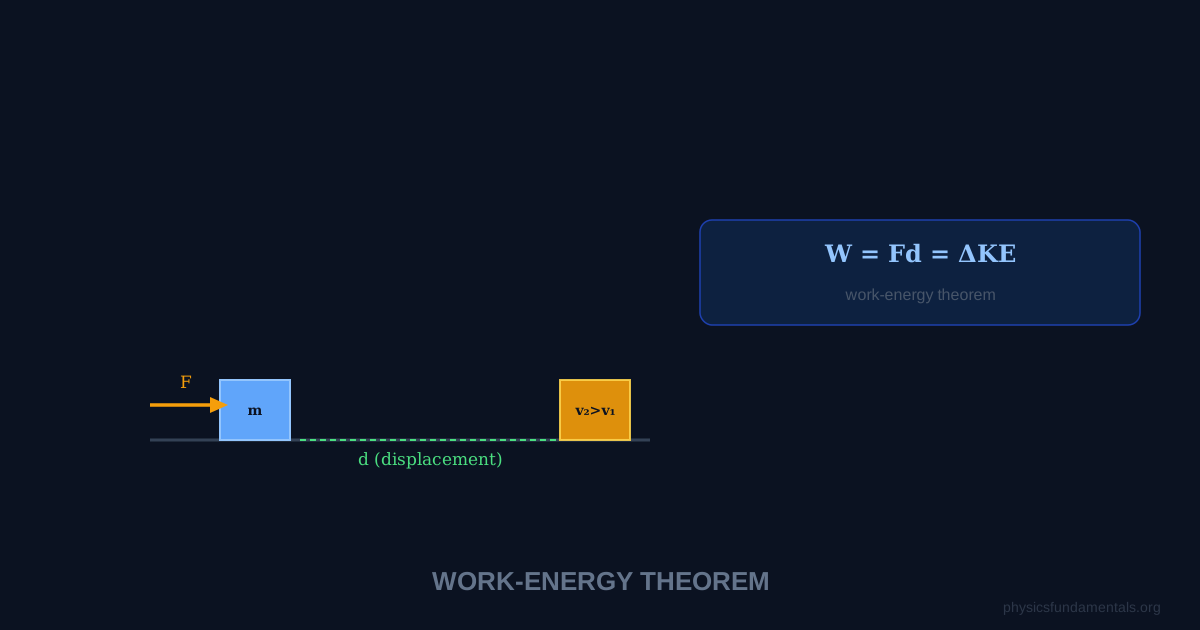
The most rigorous derivation of KE = ½mv² comes through the work-energy theorem, which states that the net work done on an object equals its change in kinetic energy:
To derive this, start with Newton's second law: F = ma. Work is defined as force times displacement in the direction of force: W = ∫F·ds. Substituting F = ma and using the chain rule (a = v·dv/ds):
This is the work-energy theorem in its full form. For an object starting from rest (u = 0), it reduces to W = ½mv² — the kinetic energy gained equals the work done on the object. This derivation shows that KE = ½mv² is not a separate postulate of physics. It follows necessarily from Newton's Second Law and the definition of work.
The net work done on an object equals its change in kinetic energy: Wnet = ΔKE. This is one of the most powerful results in all of classical mechanics — it connects forces, displacements, and speeds in a single elegant relationship, bypassing the need to track time.
Kinetic Energy Units and Orders of Magnitude
The SI unit of kinetic energy is the joule (J), where 1 J = 1 kg·m²/s². Named after James Prescott Joule, one joule is the kinetic energy of a 2 kg mass moving at 1 m/s. For large amounts of energy, kilojoules (kJ), megajoules (MJ) and even gigajoules (GJ) are used.
| Object | Mass | Speed | Kinetic Energy |
|---|---|---|---|
| Walking person | 70 kg | 1.4 m/s (5 km/h) | 68.6 J |
| Tennis ball (serve) | 57 g | 63 m/s (227 km/h) | 113 J |
| Car at 30 mph | 1,500 kg | 13.4 m/s | 134 kJ |
| Car at 60 mph | 1,500 kg | 26.8 m/s | 538 kJ (4× the 30 mph figure) |
| Rifle bullet | 4 g | 900 m/s | 1,620 J |
| Boeing 747 cruising | 300,000 kg | 250 m/s | 9.4 GJ |
| Asteroid (1 km diameter) | ~10¹² kg | 20 km/s | ~200 EJ (extinction-level) |
The car example in the table is worth pausing on. Doubling speed from 30 to 60 mph quadruples kinetic energy from 134 kJ to 538 kJ. This is why stopping distances at 60 mph are not twice those at 30 mph — they are four times as long (in the ideal frictionless case). The Highway Code's figures reflect this exactly.
Kinetic Energy and Momentum: Two Different Measures of Motion
Kinetic energy and momentum both describe aspects of a moving object's "quantity of motion," but they are fundamentally different quantities and should never be confused.
| Property | Kinetic Energy | Momentum |
|---|---|---|
| Formula | KE = ½mv² | p = mv |
| Type | Scalar (no direction) | Vector (has direction) |
| Depends on speed as | v² (quadratic) | v (linear) |
| Units | Joules (J = kg·m²/s²) | kg·m/s (= N·s) |
| Conserved in all collisions? | No — only in elastic collisions | Yes — always conserved |
| Relationship | KE = p²/(2m) · p = √(2m·KE) | |
The relationship KE = p²/(2m) is particularly useful. It means that for a given momentum, a more massive object has less kinetic energy. A heavy lorry and a motorbike with the same momentum: the motorbike has more kinetic energy because its smaller mass means higher speed, and KE scales with v².
Kinetic Energy in Collisions
Collisions are classified by what happens to kinetic energy during the impact. This is one of the most testable topics at A-level and university, and understanding it requires keeping kinetic energy and momentum clearly separate.
Elastic Collisions
In a perfectly elastic collision, both momentum and kinetic energy are conserved. The objects bounce off each other with no energy loss. Real-world examples include billiard balls (approximately elastic), gas molecule collisions at the atomic level (essentially perfectly elastic), and Newton's cradle. The equations for elastic collision outcomes are:
For equal masses (m₁ = m₂), these simplify beautifully: the objects exchange velocities. This is exactly what Newton's cradle demonstrates — the incoming ball stops dead and the outgoing ball takes its velocity.
Inelastic Collisions
In a perfectly inelastic collision, the objects stick together and move as one. Momentum is still conserved, but kinetic energy is not — some is converted to heat, sound, and deformation. This is what happens in car crashes, and it is why crumple zones exist: they convert kinetic energy into deformation work over a longer time and distance, reducing the peak force on occupants.
Many students think "conserved" means "unchanged in amount." Kinetic energy is not conserved in most real collisions — it converts to other forms. What is always conserved is total energy (including thermal energy, sound, deformation energy) and momentum. Never confuse conservation of momentum with conservation of kinetic energy.
Kinetic Energy and Conservation of Energy
In a frictionless mechanical system, kinetic energy and potential energy are continuously interconverted while their sum remains constant:
Drop a ball from height h: it starts with PE = mgh and KE = 0. As it falls, PE decreases and KE increases. At the instant of impact: KE = mgh and PE = 0. The impact speed follows directly: ½mv² = mgh → v = √(2gh). This result is independent of mass — another manifestation of the same principle that makes free fall acceleration mass-independent.
This principle powers roller coasters (one big drop provides all the energy for every subsequent hill and loop), hydroelectric dams (gravitational PE of water converts to KE of turbines then to electrical energy), and pendulum clocks (continuous KE ↔ PE conversion at constant total energy).
Kinetic Energy with Friction
When friction is present, the total mechanical energy is not conserved — friction converts kinetic energy irreversibly to thermal energy (heat). The work done against friction is:
where μ is the coefficient of kinetic friction, m is mass, g is gravitational acceleration, and d is the distance slid. This is the energy lost as heat. The work-energy theorem still holds: the net work (including friction's negative work) equals the change in KE.
Rotational Kinetic Energy
The KE = ½mv² formula applies to translational (linear) motion. For rotating objects, there is an analogous form:
where I is the moment of inertia (the rotational equivalent of mass) and ω is the angular velocity in radians per second. For an object that both translates and rotates (a rolling ball, a spinning top moving across a table), the total kinetic energy is the sum:
This is why a solid ball rolls faster than a hollow ball of the same mass down an incline: the solid ball has a smaller moment of inertia, so less of the available energy goes into rotation and more into translation.
Relativistic Kinetic Energy
At speeds approaching the speed of light, KE = ½mv² breaks down. Einstein's special relativity gives the correct formula:
where γ = 1/√(1 − v²/c²) is the Lorentz factor and c is the speed of light. At low speeds, this reduces exactly to ½mv² (a Taylor expansion gives γ ≈ 1 + v²/(2c²), so KE ≈ ½mv²). The correction matters only when v exceeds roughly 10% of c. For all everyday physics — even supersonic aircraft and orbital spacecraft — the Newtonian formula is accurate to better than 0.001%.
Worked Examples
Example 1: Car crash energy
A 1,400 kg car travels at 20 m/s (72 km/h). Calculate its kinetic energy and the braking force needed to stop it in 40 m.
KE = ½mv² = 0.5 × 1,400 × 20² = 0.5 × 1,400 × 400 = 280,000 J = 280 kJ
Work done by brakes = F × d → 280,000 = F × 40 → F = 7,000 N
Example 2: Bullet penetration
A 5 g bullet travels at 800 m/s. What is its kinetic energy?
KE = ½mv² = 0.5 × 0.005 × 800² = 0.5 × 0.005 × 640,000 = 1,600 J
Compare to a 70 kg person walking at 1.5 m/s: KE = 0.5 × 70 × 1.5² = 78.75 J. The tiny bullet at high speed carries 20 times more kinetic energy than a walking person.
Example 3: Speed from kinetic energy
A cyclist and bicycle have total mass 80 kg and kinetic energy 3,200 J. What is the speed?
v = √(2·KE/m) = √(2 × 3,200 / 80) = √80 ≈ 8.94 m/s ≈ 32 km/h
Kinetic Energy in Engineering and Technology
Kinetic energy management is central to transport engineering. Regenerative braking in electric vehicles captures kinetic energy during deceleration and converts it back to electrical energy stored in the battery — recovering energy that would otherwise be wasted as heat in conventional brakes. Modern electric vehicles recover 60–70% of braking energy this way.
Flywheel energy storage systems store kinetic energy in a spinning rotor (KE = ½Iω²) and release it on demand. They are used in Formula 1 KERS systems, UPS power conditioning, and grid-scale energy storage. The advantage is extremely high power density — a flywheel can release energy very rapidly.
In structural engineering, understanding the kinetic energy of impacts — falling objects, vehicle crashes, seismic energy — determines the design of safety barriers, crash boxes, and blast-resistant structures. The goal is always to absorb kinetic energy over as large a distance as possible, minimising peak force (F = W/d — same energy absorbed over longer distance = less force).
Frequently Asked Questions About Kinetic Energy
What is kinetic energy?
What is the formula for kinetic energy?
Why does kinetic energy depend on v² and not v?
What are the units of kinetic energy?
Can kinetic energy be negative?
What is the difference between kinetic energy and potential energy?
Is kinetic energy conserved in a collision?
What is the relationship between kinetic energy and momentum?
Summary: Key Points About Kinetic Energy
Kinetic energy is the energy of motion, given by KE = ½mv². It scales quadratically with speed — the single most important fact to remember — which means small increases in speed cause large increases in kinetic energy. It is a scalar derived from Newton's Second Law through the work-energy theorem. It is always positive or zero. It converts freely with potential energy in conservative systems and converts irreversibly to heat in the presence of friction. In collisions, it is conserved only if the collision is perfectly elastic; in all other cases momentum is conserved but kinetic energy is not.
Mastering kinetic energy is the gateway to understanding conservation of energy, momentum and impulse, and the dynamics of everything from particle physics to the engineering of safe vehicles. The formula KE = ½mv² is four characters long and among the most consequential equations in science.
Share this article
Written by
Physics Fundamentals Editorial Team
Written and reviewed by our team of physics educators. Content is aligned with A-Level, GCSE, AP Physics, and undergraduate curricula.
About Physics Fundamentals →