
A cricket ball and a lorry travelling at the same speed are very different things to stop. The lorry requires far more force, or far more time, or both. That difficulty is what momentum quantifies — and the connection between force, time, and momentum change is what impulse captures. Together they give you a way to analyse collisions and impacts without needing to know the exact forces involved at every instant.
Impulse is especially powerful in real-world problems where the force varies with time — a bat striking a ball, an airbag deploying, a rocket firing. Instead of integrating a complicated force-time curve, you only need the area under it: the total impulse. That equals the change in momentum, full stop.
- Momentum p = mv — a vector quantity, with direction mattering as much as magnitude
- The impulse-momentum theorem: FΔt = Δp — and what it means physically
- How airbags, crumple zones, and sports equipment use impulse to reduce peak force
- Three worked examples covering collisions, explosions, and variable forces
Momentum: p = mv
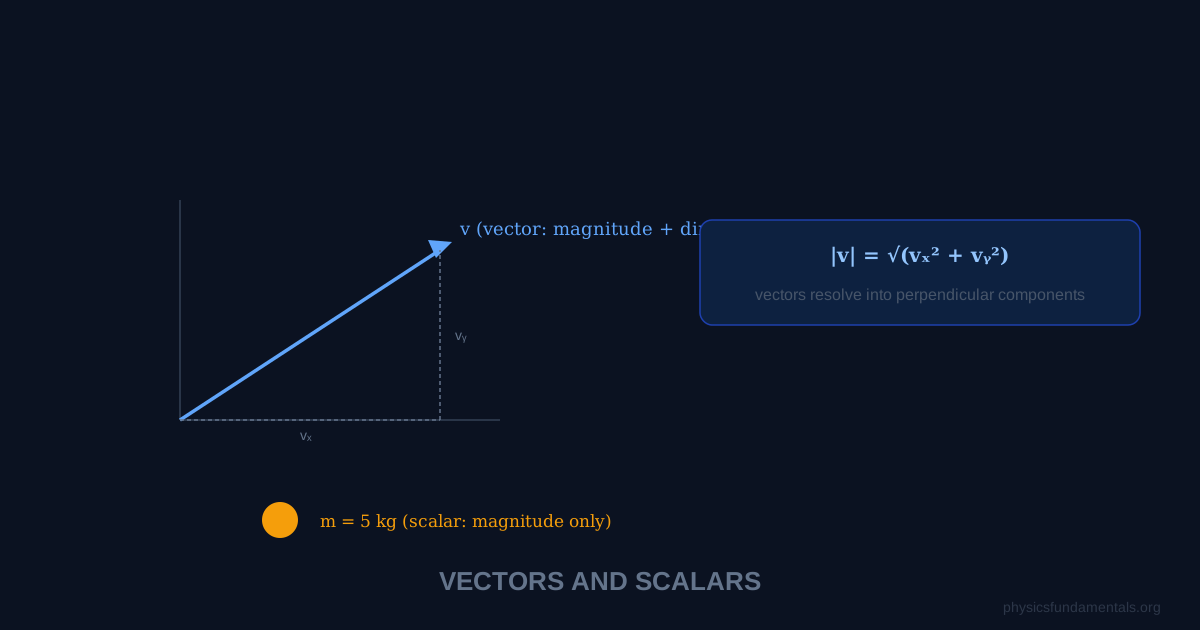
Momentum is a vector — it has the same direction as velocity. A 1,500 kg car at 20 m/s north has momentum 30,000 kg·m/s north. The same car at 20 m/s south has momentum 30,000 kg·m/s south — same magnitude, opposite direction.
Newton's second law is more fundamentally stated in terms of momentum:
The net force equals the rate of change of momentum. The familiar F = ma is a special case when mass is constant: F = m(Δv/Δt) = ma. For variable-mass systems (like a rocket burning fuel), the more general form is required.
Impulse: J = FΔt = Δp
Impulse is the change in momentum produced by a force over a time interval:
The impulse-momentum theorem connects force, time, and momentum change. It reveals a crucial design principle: the same change in momentum can be produced by a large force for a short time, or a small force for a long time.
This is why:
• Car airbags inflate in milliseconds, extending the collision time — the same momentum change (to zero) over a longer time means less average force on the occupant.
• Gymnasts and martial artists bend their knees on landing — extending impact time, reducing peak force.
• Cricket batsmen "give" with the ball on catching — extending contact time, reducing the force on their hands.
• Crash barriers and crumple zones in cars are deliberately deformable — maximising collision time to minimise deceleration force.
The Law of Conservation of Momentum
In an isolated system (no external net force), total momentum is conserved:
where primed quantities are post-collision velocities. This follows directly from Newton's third law: during any collision, the force on object 1 from object 2 is equal and opposite to the force on object 2 from object 1. Their impulses are equal and opposite, so momentum is transferred between them — but the total is unchanged.
Conservation of momentum applies in all directions independently. In 2D collisions, both x and y components are separately conserved.
Types of Collisions
| Type | Momentum conserved? | KE conserved? | Example |
|---|---|---|---|
| Elastic | Yes | Yes | Ideal billiard balls, atomic collisions |
| Inelastic | Yes | No (some lost to heat/sound) | Most real collisions, bouncing ball |
| Perfectly inelastic | Yes | Maximum KE lost | Objects stick together: clay, car crash |
Momentum is always conserved in collisions (no external force). Kinetic energy is only conserved in perfectly elastic collisions. In any real collision, some kinetic energy is converted to heat, sound, and deformation. However, since KE = p²/(2m), knowing post-collision momenta allows you to calculate how much KE was lost — useful in crash analysis and forensics.
Worked Examples
Example 1: Head-on elastic collision
Ball A (2 kg) moving at 6 m/s hits stationary ball B (2 kg). Equal masses in elastic collision: A stops, B moves at 6 m/s.
Example 2: Perfectly inelastic collision
A 1,200 kg car at 15 m/s east collides with a stationary 2,000 kg lorry and they stick together.
Example 3: Rocket propulsion (explosion)
A 500 kg rocket at rest fires exhaust gases: 50 kg of gas ejected at 400 m/s backward. Find the rocket's velocity.
Rocket Propulsion: Momentum Without Anything to Push Against
Rockets work by expelling mass at high velocity backward — by conservation of momentum, the rocket accelerates forward. No air or ground is needed to "push against." This is why rockets work in the vacuum of space. The Tsiolkovsky rocket equation gives the velocity change for a rocket burning fuel:
where v_e is exhaust velocity and m_i/m_f is the initial-to-final mass ratio (the fuel fraction). Reaching orbit requires Δv ≈ 9.4 km/s — which is why most of a rocket's launch mass is fuel.
Worked Example 1: Finding Momentum
A 0.15 kg cricket ball is bowled at 36 m/s. Find its momentum.
A 2,000 kg car at 1 m/s has p = 2,000 kg·m/s — nearly 400 times more momentum despite the vast difference in speed. Mass dominates momentum at low speeds.
Worked Example 2: Impulse and Force
A tennis ball (m = 0.058 kg) travelling at 30 m/s is hit back at 40 m/s. The ball is in contact with the racket for 4.0 ms. Find the impulse and average force.
Taking the direction of the return shot as positive:
Over 1 kN of average force from a 58 gram ball — because the contact time is only 4 milliseconds. Professional tennis serves involve peak forces exceeding 4,000 N.
Worked Example 3: 2D Collision
A 3.0 kg ball moving at 4.0 m/s east collides with a stationary 2.0 kg ball. After the collision, the 3.0 kg ball moves at 2.0 m/s at 30° north of east. Find the velocity of the 2.0 kg ball.
x-direction (east positive):
Before: p_x = 3.0 × 4.0 = 12 kg·m/s
After (3 kg): 3.0 × 2.0 × cos30° = 5.196 kg·m/s
So 2 kg ball: p_x = 12 − 5.196 = 6.804 kg·m/s → v_x = 3.40 m/s east
y-direction (north positive):
Before: p_y = 0
After (3 kg): 3.0 × 2.0 × sin30° = 3.0 kg·m/s north
So 2 kg ball: p_y = −3.0 kg·m/s → v_y = 1.50 m/s south
Momentum in Rocket Propulsion
Rockets work entirely by conservation of momentum — no air is needed to push against. The rocket expels propellant backward; by conservation of momentum, the rocket accelerates forward. The Tsiolkovsky rocket equation gives the final velocity:
where v_e is the exhaust speed, m_0 is initial mass (rocket + fuel), m_f is final mass (rocket empty). The logarithm means you need exponentially more fuel for each additional increment of Δv. To escape Earth's gravity (Δv ≈ 9.4 km/s for low Earth orbit), a rocket with v_e = 4.4 km/s (liquid hydrogen/oxygen) needs a mass ratio m_0/m_f = e^(9.4/4.4) ≈ e^2.14 ≈ 8.5 — meaning 87% of the launch mass is propellant. This is why rockets are mostly fuel.
Angular Momentum
Linear momentum (p = mv) has a rotational analogue: angular momentum L = Iω, where I is moment of inertia and ω is angular velocity. Like linear momentum, angular momentum is conserved in the absence of external torques.
This explains why a spinning skater speeds up when they pull their arms in — arms in reduces I, and since L = Iω is conserved, ω must increase. The same principle explains why planets move fastest when closest to the Sun (Kepler's second law — equal areas in equal times — is a direct consequence of angular momentum conservation).
See the angular momentum article for a full treatment, and use the momentum calculator to solve p = mv and impulse problems instantly.
Momentum in Relativistic Physics
At speeds approaching the speed of light, classical momentum p = mv fails. Special relativity replaces it with relativistic momentum:
At low speeds (v ≪ c), γ ≈ 1 and we recover p = mv. At v = 0.87c, γ = 2 and momentum is double the classical value. At v → c, γ → ∞ — which is another way of seeing that infinite energy is needed to reach c.
Relativistic momentum is still conserved in isolated systems — conservation of momentum is one of the few laws that survives unchanged into special relativity. The 4-momentum (energy + momentum combined) is the true conserved relativistic quantity, relating to the famous E² = (pc)² + (mc²)² — from which E = pc for massless photons and E = mc² at rest.
Common Mistakes
Forgetting momentum is a vector. When two objects move in opposite directions before a collision, their momenta have opposite signs. p_total = m₁v₁ + m₂v₂ — always assign a positive direction and include signs. A head-on collision between equal masses at equal speeds gives p_total = 0, so after the collision they must together have zero total momentum.
Assuming kinetic energy is conserved. Only elastic collisions conserve KE. In any real collision, some KE is lost to heat, sound, and deformation. Momentum is always conserved (no external forces); kinetic energy usually isn't.
Applying conservation of momentum to systems with external forces. A sliding block slowing due to friction has an external force (friction from the floor) acting on it. Momentum is NOT conserved for that block alone. Conservation only applies when the net external force on the entire system is zero — or for the very brief duration of a collision where external impulses are negligible.
Frequently Asked Questions
What is momentum in physics?
What is impulse?
What is conservation of momentum?
What is the difference between elastic and inelastic collisions?
Is momentum a vector or scalar?
How are momentum and kinetic energy related?
Share this article
Written by
Physics Fundamentals Editorial Team
Written and reviewed by our team of physics educators. Content is aligned with A-Level, GCSE, AP Physics, and undergraduate curricula.
About Physics Fundamentals →