Throw a ball at any angle and it follows a parabola. Always. Every time. That's not a coincidence — it's what happens when one direction has constant velocity and the perpendicular direction has constant acceleration. The shape is mathematically inevitable.
Projectile motion is the first topic in physics where you have to handle two directions simultaneously. That's what trips most students up — not the maths, but the habit of treating the horizontal and vertical as one problem instead of two independent ones running in parallel.
- Why horizontal and vertical motion are independent — and how to use that to your advantage
- How to derive the range, maximum height, and time of flight formulas from first principles
- Four fully worked examples covering different launch conditions
- The most common mistakes in projectile problems and how to avoid them
The Two-Component Approach
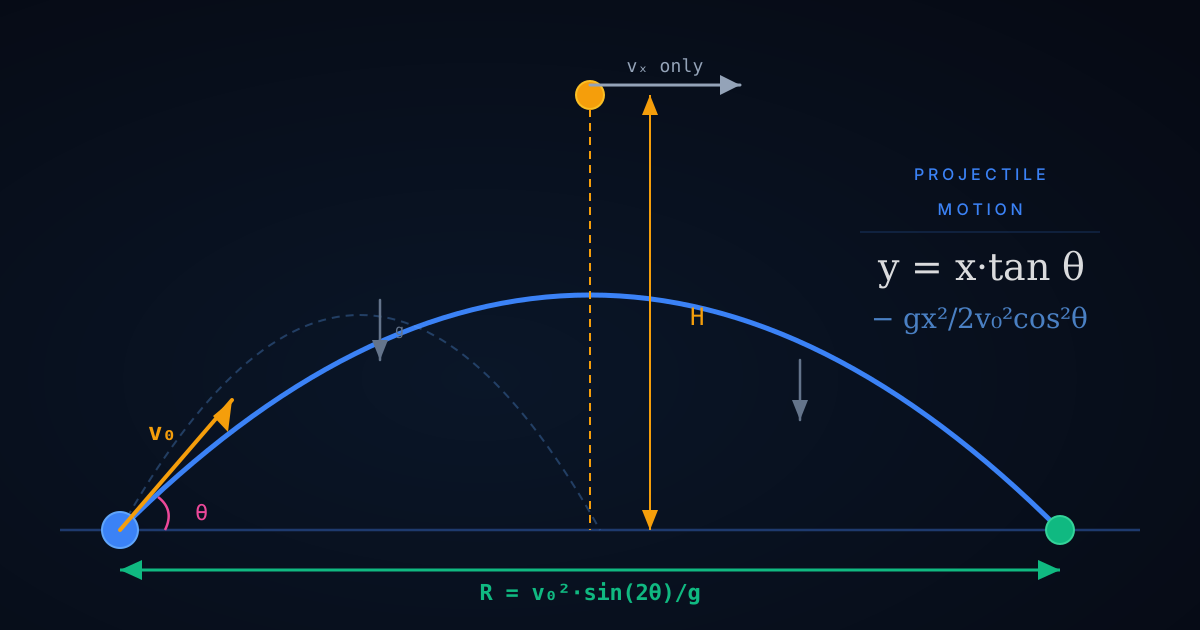
Resolve the initial velocity u at angle θ into components:
Horizontal motion (no air resistance → no horizontal force → no horizontal acceleration):
Vertical motion (gravity acts downward; taking upward as positive, a = −g):
The link between components is time t — horizontal and vertical motion share the same time variable. This is the coupling that makes projectile problems solvable: find t from the vertical equations, then use it in the horizontal equation to find range.
Projectile Motion Equations — Quick Reference
| Quantity | Equation |
|---|---|
| Horizontal position | x = u cos θ × t |
| Vertical velocity | v_y = u sin θ − gt |
| Vertical position | y = u sin θ × t − ½gt² |
| Vertical velocity² (no t) | v_y² = (u sin θ)² − 2gy |
| Time of flight (level ground) | T = 2u sin θ / g |
| Range (level ground) | R = u² sin 2θ / g |
| Maximum height | H = (u sin θ)² / (2g) |
Every equation below is derived from first principles in the sections that follow — this table is a reference to return to once you understand where each formula comes from.
Deriving the Range Formula
For a projectile launched from and landing at the same height (y = 0 on return):
Substitute into x = u cos θ × T:
Maximum range occurs at θ = 45°, where sin 2θ = sin 90° = 1 gives R_max = u²/g.
Deriving Maximum Height
At maximum height, vertical velocity = 0:
Time to reach max height = T/2 = u sin θ / g (by symmetry — same time up as down).
Worked Example 1: Classic Range Problem
A ball is kicked at 20 m/s at 30° above horizontal. Find: (a) time of flight; (b) maximum height; (c) horizontal range.
Components: u_x = 20 cos 30° = 17.32 m/s; u_y = 20 sin 30° = 10.0 m/s
(a) Time of flight:
(b) Maximum height:
(c) Range:
Or using the formula: R = u² sin 2θ / g = 400 × sin 60° / 9.8 = 400 × 0.866 / 9.8 = 35.3 m ✓
Worked Example 2: Projectile Launched from a Height
A ball is thrown horizontally at 15 m/s from a cliff 45 m high. Find: (a) time to hit the ground; (b) horizontal distance from base of cliff; (c) speed at impact.
Horizontal: u_x = 15 m/s, u_y = 0 (thrown horizontally)
(a) Vertical: y = ½gt² → 45 = ½ × 9.8 × t² → t² = 9.18 → t = 3.03 s
(b) x = u_x × t = 15 × 3.03 = 45.5 m
(c) v_x = 15 m/s (unchanged); v_y = gt = 9.8 × 3.03 = 29.7 m/s
Worked Example 3: Finding Launch Angle for a Target
A ball must travel 80 m horizontally and land at the same height, launched at 30 m/s. Find the launch angle(s).
Two angles work: a low, fast trajectory (30.3°) and a high, slow one (59.7°). Both give the same range because sin 2(30.3°) = sin 2(59.7°) — complementary angles give equal ranges.
Worked Example 4: Projectile with Non-Zero Landing Height
A ball is launched at 25 m/s at 40° above horizontal from ground level. A wall 20 m away is 5 m high. Does the ball clear the wall?
Time to reach x = 20 m: t = x/u_x = 20/(25 cos 40°) = 20/19.15 = 1.045 s
Height at that time: y = u_y × t − ½gt² = 25 sin 40° × 1.045 − ½ × 9.8 × 1.045²
The ball is 11.44 m high at the wall — it clears the 5 m wall with 6.44 m to spare.
Why Projectile Motion is a Parabola
The trajectory y(x) is a parabola. From x = u_x t → t = x/u_x. Substituting into y = u_y t − ½gt²:
This is y = ax − bx² — the standard form of a parabola. The coefficient of x gives the initial slope (tan θ); the coefficient of x² gives the curvature (determined by g and horizontal speed). This is explored further in the why is projectile motion a parabola article.
Effect of Launch Angle on Range and Height
| Angle θ | sin 2θ | Range (u=20 m/s) | Max height (u=20 m/s) |
|---|---|---|---|
| 15° | 0.500 | 20.4 m | 1.35 m |
| 30° | 0.866 | 35.3 m | 5.10 m |
| 45° | 1.000 | 40.8 m (MAX) | 10.2 m |
| 60° | 0.866 | 35.3 m | 15.3 m |
| 75° | 0.500 | 20.4 m | 19.1 m |
Complementary angles (30° and 60°, 15° and 75°) give equal ranges but different heights and flight times. The 45° launch maximises range; steeper angles maximise height at the cost of range.
Real-World Complications
Air resistance: Real projectiles experience drag proportional to v² (at high speeds). This shortens range, reduces max height, and breaks the symmetry of the trajectory — the descending path is steeper than the ascending path. The optimal angle for maximum range with air resistance is less than 45° (typically 30–40° for a sports ball). Long-range artillery accounts for drag, wind, Earth's rotation (Coriolis effect), and even the curvature of the Earth.
Spin: A spinning ball experiences the Magnus effect — a force perpendicular to both the spin axis and velocity. This is why a spinning football curves mid-flight (a "banana" free kick), why a topspin tennis shot dips faster, and why a backspin golf shot stays in the air longer.
Sports applications: The ideal basketball free throw (distance ~4.57 m, basket height 3.05 m, release height ~2.13 m) requires a minimum launch speed when thrown at about 51° and benefits from backspin which increases the effective target size. Olympic shot put records require careful optimisation of launch angle (~42°) accounting for the non-zero release height (~2.1 m above ground).
Using the Projectile Motion Calculator
The projectile motion calculator solves all these equations instantly — enter launch speed and angle, get range, max height, time of flight, and the full trajectory plotted automatically. It also works for any planet's gravity, so you can compare a football kick on Earth versus the Moon.
Common Mistakes
Using the full launch speed instead of components. The horizontal and vertical equations each need their respective components (u cos θ and u sin θ), not the total speed u. Plugging u directly into vertical equations is the most common projectile error.
Forgetting to take upward as positive consistently. If upward is positive, g = −9.8 m/s² in all vertical equations. If downward is positive, g = +9.8 m/s² and initial upward velocities become negative. Pick one and stick to it for the entire problem.
Assuming 45° always gives maximum range. This is only true when launching and landing at the same height. When launched from above (e.g. off a cliff), the optimal angle is less than 45°. When the target is higher than the launch point, the optimal angle is greater than 45°.
Frequently Asked Questions
What is projectile motion?
What is the formula for the range of a projectile?
Why does a projectile launched at 45° have maximum range?
Are horizontal and vertical motion truly independent in a projectile?
How do you solve a projectile motion problem step by step?
What is the velocity of a projectile at maximum height?
Share this article
Written by
Physics Fundamentals Editorial Team
Written and reviewed by our team of physics educators. Content is aligned with A-Level, GCSE, AP Physics, and undergraduate curricula.
About Physics Fundamentals →