
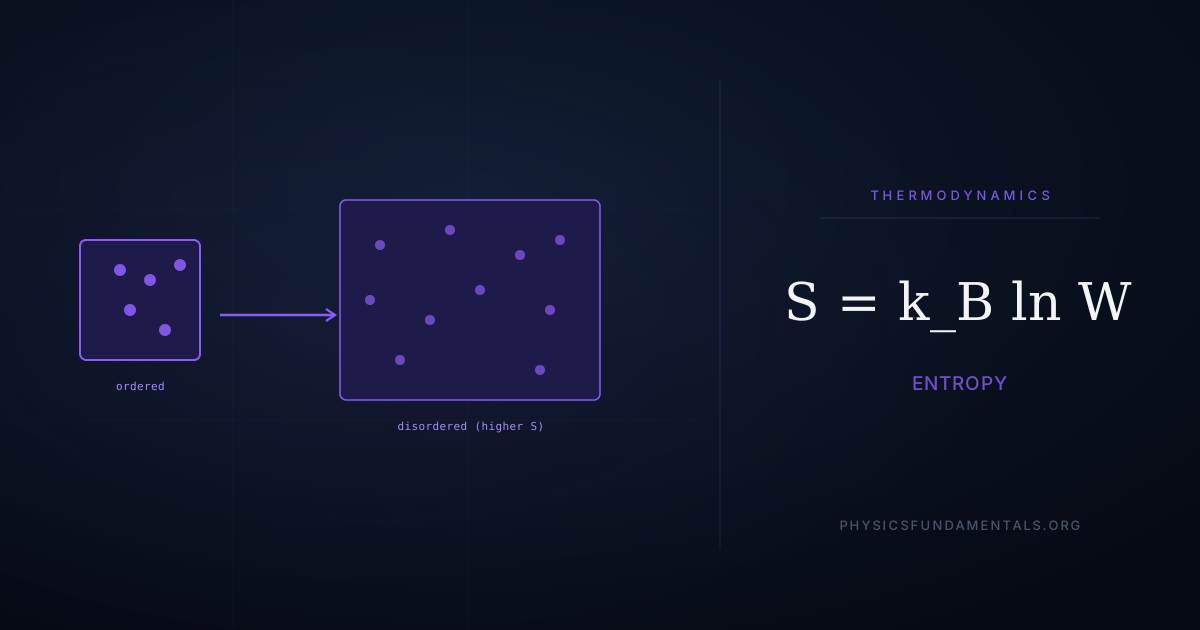
Drop ink into water. It spreads — slowly, irreversibly — until uniformly distributed. You will never see it spontaneously re-concentrate. Crack an egg: you cannot uncrack it. A hot coffee cools to room temperature; a cold one never spontaneously heats up. These aren't engineering limitations or practical difficulties. They're consequences of a single law, expressed through a single quantity: entropy.
Entropy is the most misunderstood concept in physics. It is not "disorder" in any vague sense — it has a precise statistical definition: the number of microscopic arrangements that produce the same macroscopic state. The reason entropy increases is that there are overwhelmingly more ways to be spread out than concentrated. The second law isn't a moral principle about the universe preferring chaos. It's a counting argument.
- What entropy actually measures — statistically and thermodynamically
- The formula ΔS = Q/T — when to use it and what the sign tells you
- Why entropy always increases in an isolated system — the counting argument
- How entropy connects to the arrow of time, heat engines, and the heat death of the universe
Entropy as Disorder: Macrostates and Microstates
A macrostate is what we can observe: temperature, pressure, volume, colour. A microstate is the exact position and momentum of every single molecule. Many different microstates can correspond to the same macrostate.
Consider 4 gas molecules in a box with two equal halves. How many ways can they be arranged?
| Macrostate | Number of microstates W | Probability |
|---|---|---|
| All 4 in left half | 1 | 1/16 = 6.25% |
| 3 left, 1 right | 4 | 4/16 = 25% |
| 2 left, 2 right | 6 | 6/16 = 37.5% (most likely) |
| 1 left, 3 right | 4 | 4/16 = 25% |
| All 4 in right half | 1 | 1/16 = 6.25% |
The most disordered macrostate (equal distribution) has the most microstates and is the most probable. The perfectly ordered macrostate (all molecules in one half) has only 1 microstate out of 16 — improbable with 4 molecules. With 10²³ molecules (a realistic gas), the ratio of microstates between ordered and disordered states is so astronomically large that spontaneous ordering is effectively impossible. This is why entropy increases: it is overwhelmingly probable.
Boltzmann's Entropy Formula
where k_B = 1.38 × 10⁻²³ J/K is Boltzmann's constant and W is the number of microstates available to the system. This equation — so fundamental it is inscribed on Boltzmann's tombstone — unifies thermodynamic entropy with statistical mechanics. It shows that entropy measures the multiplicity of a system: high W (many microstates) = high entropy = high disorder.
For two systems in contact, the total number of microstates is the product W_total = W₁ × W₂. But entropy is additive: S_total = S₁ + S₂ = k_B ln W₁ + k_B ln W₂ = k_B ln(W₁W₂). The logarithm converts the multiplicative property of probabilities to the additive property we expect of extensive thermodynamic quantities.
The Thermodynamic Definition
For a reversible heat transfer at temperature T:
Entropy increases (ΔS > 0) when heat is added at temperature T. Entropy decreases when heat is removed. For irreversible processes, the actual entropy change of the universe is always greater than Q/T — extra entropy is generated by irreversibilities (friction, mixing, unrestrained expansion).
Example: Melting ice
Melting 1 kg of ice at 0°C (273 K) requires L = 334,000 J. Entropy change:
The entropy of the water is 1,223 J/K greater than the entropy of the ice — water has more microstates available than ice because its molecules can move freely rather than being locked in a crystal lattice.
Entropy and Information
In 1948, Claude Shannon developed information theory and defined a quantity he called information entropy — mathematically identical in form to Boltzmann's entropy. Shannon entropy measures the amount of information (or uncertainty) in a message. High entropy = highly random, unpredictable = maximum information content. Low entropy = highly ordered, predictable = minimum information.
This mathematical identity is not a coincidence. Erasing one bit of information in a computer requires a minimum of k_B T ln 2 of energy to be dissipated as heat — Landauer's principle — directly connecting information processing to thermodynamic entropy. Maxwell's demon thought experiment (a demon controlling a partition between two gases) seems to allow entropy to decrease — but the demon must store and erase information, generating entropy that more than compensates.
Entropy and the Arrow of Time
The fundamental laws of physics — Newton's laws, Maxwell's equations, quantum mechanics — are all time-symmetric: they work equally well forward and backward. Yet macroscopic processes have a clear direction. The arrow of time is the direction of increasing entropy.
A film of a glass shattering looks wrong in reverse because the reverse process would involve entropy spontaneously decreasing — overwhelmingly improbable but not impossible in principle. A film of two molecules colliding looks identical forward and backward — microscopic processes are reversible.
The ultimate reason time appears to flow in one direction is that the universe started in an extraordinarily low-entropy state — the Big Bang. The universe has been evolving toward higher entropy ever since. Stars, planets, life, and complexity are all temporary low-entropy structures that form when large entropy increases are available elsewhere (the Sun radiates low-entropy photons and receives high-entropy waste heat).
The Second Law and Entropy
The second law of thermodynamics: the total entropy of an isolated system never decreases. ΔS_universe ≥ 0. For reversible processes: ΔS_universe = 0. For irreversible processes: ΔS_universe > 0. This means the universe tends toward higher entropy — greater disorder — over time. Heat flows from hot to cold (not the reverse) because this increases entropy. Ice melts at room temperature. Gases expand to fill containers. These are all entropy increases.
What is the relationship between entropy and disorder?
What is entropy in everyday life?
Is entropy the same as energy?
Frequently Asked Questions
What is entropy in physics?
Why does entropy always increase?
Can entropy decrease?
What is the relationship between entropy and the arrow of time?
What is thermodynamic entropy vs information entropy?
Share this article
Written by
Physics Fundamentals Editorial Team
Written and reviewed by our team of physics educators. Content is aligned with A-Level, GCSE, AP Physics, and undergraduate curricula.
About Physics Fundamentals →
Discussion
Comments
Leave a comment
Have a question about this article? Spot a mistake? Or just want to share your thoughts? We'd love to hear from you.
Keep learning physics fundamentals
Get new articles and platform updates delivered to your inbox.
Physics Fundamentals
👋 Get concise physics updates — new articles, calculators, and tools. Your number stays private. No spam. No group chats. Just worthy content.