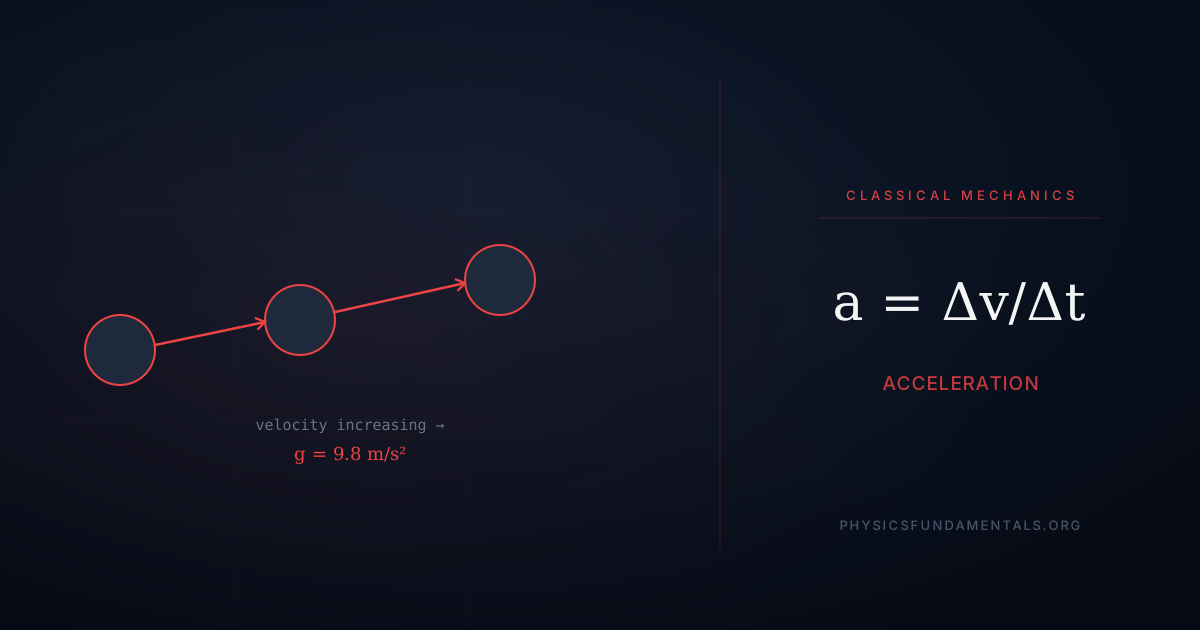
Acceleration doesn't just mean speeding up. A car braking hard is accelerating. A ball moving at constant speed around a circular track is accelerating. Even an object sitting stationary in a gravitational field is — in the language of general relativity — accelerating. The common thread is this: acceleration is any change in velocity, and velocity includes direction, not just magnitude.
That vector nature of acceleration is what makes it so central to mechanics. Force causes acceleration (F = ma), and acceleration changes velocity, and velocity determines position. The entire story of how things move flows from that chain. Get comfortable with acceleration — including negative acceleration, radial acceleration, and acceleration due to gravity — and Newtonian mechanics becomes a much more unified picture.
- The precise definition of acceleration as a vector quantity — and why direction matters
- How to calculate average and instantaneous acceleration from velocity data
- The four types of acceleration: linear, deceleration, centripetal, and gravitational
- Worked examples using a = Δv/Δt and the SUVAT equations
The Acceleration Formula
The unit m/s² is intuitive: acceleration of 1 m/s² means velocity changes by 1 m/s every second. A car accelerating from rest at 3 m/s² will reach 3 m/s after 1 s, 6 m/s after 2 s, 9 m/s after 3 s, and so on.
Types of Acceleration
Uniform (constant) acceleration
Velocity changes by the same amount every second. Free fall near Earth's surface is the canonical example: in the absence of air resistance, every object falls with constant acceleration g = 9.8 m/s² downward. The SUVAT equations describe all constant-acceleration motion.
Non-uniform acceleration
Most real-world cases involve varying acceleration — a car in traffic, a rocket burning fuel (mass decreasing so acceleration increases for the same thrust). For non-uniform acceleration, instantaneous acceleration is:
Centripetal acceleration
For an object in circular motion with radius r at speed v:
This changes the direction of velocity without changing its magnitude. It keeps planets in orbit, cars on curved roads, and electrons in cyclotrons. By Newton's second law, centripetal force = mv²/r, directed toward centre.
Acceleration and Newton's Second Law
Acceleration is directly proportional to net force and inversely proportional to mass. Double the force → double the acceleration. Double the mass → halve the acceleration. A lorry accelerates more slowly than a car under the same engine force because it has greater mass.
| Scenario | Net Force | Acceleration |
|---|---|---|
| Free fall (no air resistance) | mg downward | 9.8 m/s² downward |
| Constant velocity | 0 N | 0 m/s² |
| Braking car | Friction backward | Negative (deceleration) |
| Circular orbit | Gravity toward centre | v²/r toward centre |
Acceleration Due to Gravity: g = 9.8 m/s²
Any object in free fall — regardless of mass — accelerates at g = 9.8 m/s². A feather and a hammer fall identically in vacuum, as Apollo 15 astronaut David Scott famously demonstrated on the Moon in 1971. This mass-independence was Galileo's great discovery and the seed of Einstein's general relativity.
g varies slightly: 9.832 m/s² at the poles, 9.780 m/s² at the equator, ~9.77 m/s² atop Everest. For most problems, g = 9.8 m/s² or g = 10 m/s² (approximate) is used.
Worked Examples
Example 1: Car acceleration
0 to 30 m/s in 10 seconds: a = (30 − 0) / 10 = 3 m/s²
Example 2: Braking (negative acceleration)
25 m/s to 0 in 5 seconds: a = (0 − 25) / 5 = −5 m/s²
Example 3: Newton's second law
1,200 kg car, 3,600 N net force: a = 3600 / 1200 = 3 m/s²
Example 4: Centripetal acceleration
Roundabout of radius 40 m at 15 m/s: a_c = 15² / 40 = 5.625 m/s² toward centre
SUVAT Equations for Constant Acceleration
Four equations link the five kinematic variables s (displacement), u (initial velocity), v (final velocity), a (acceleration), t (time):
Know any three variables → find the other two. These equations underpin all of projectile motion analysis and are among the most-used equations in introductory physics.
Worked Example 1: Finding Acceleration
A car accelerates from 10 m/s to 30 m/s in 5.0 s. Find acceleration.
Worked Example 2: Deceleration
A train slows from 50 m/s to 20 m/s in 30 s. Find acceleration.
The negative sign confirms deceleration (opposing the direction of motion). The magnitude is 1.0 m/s².
Worked Example 3: Using Acceleration to Find Velocity
A ball rolls from rest and accelerates at 3.0 m/s² for 4.0 s. Find final velocity and distance covered.
Worked Example 4: g-Force
A fighter pilot pulls 6g in a tight turn. Find the acceleration and the apparent weight of a 80 kg pilot.
At 6g, blood pools in the lower body and the pilot may lose consciousness (G-LOC) without an anti-g suit.
Acceleration on Velocity-Time Graphs
On a v-t graph, acceleration = gradient of the line. Steeper gradient = larger acceleration. Horizontal line = zero acceleration (constant velocity). Negative gradient = deceleration. The area under the v-t graph = displacement (not distance, unless the object never reverses direction). For non-uniform acceleration, the instantaneous acceleration is the gradient of the tangent to the v-t curve at that moment.
Measuring Acceleration Experimentally
Acceleration can be measured with: Light gates: two light beams a known distance apart; a card of known length breaks each beam; timing gives velocities at each gate; Δv/Δt gives acceleration. Video analysis: record motion at known frame rate; measure position each frame; displacement differences give velocity; velocity differences give acceleration. Accelerometer: a small proof mass attached to springs; acceleration displaces the mass, which is measured electrically. Modern smartphones contain MEMS accelerometers accurate to ~0.01 m/s². Ticker tape: a tape pulled through a timer at 50 Hz (50 dots per second); spacing between dots gives velocity; changing spacing reveals acceleration.
Acceleration in Special Relativity
Classical mechanics defines a = F/m with no upper limit on acceleration or final speed. Special relativity changes this: as v → c, the effective inertia increases without limit. A constant force produces decreasing acceleration as speed increases. The relativistic version: a = F/(γ³m) for acceleration parallel to velocity, where γ = 1/√(1−v²/c²). Even a constant force applied for infinite time never reaches c — the relativistic mass keeps increasing. This is why particle accelerators require enormous energies to push particles from 0.99c to 0.999c, even though the absolute speed gain is small.
Frequently Asked Questions
What is acceleration in physics?
What is the formula for acceleration?
What is the difference between acceleration and deceleration?
What is the acceleration due to gravity?
Can an object have zero velocity but non-zero acceleration?
What is centripetal acceleration?
Is acceleration a vector or scalar?
How is acceleration shown on a velocity-time graph?
Share this article
Written by
Physics Fundamentals Editorial Team
Written and reviewed by our team of physics educators. Content is aligned with A-Level, GCSE, AP Physics, and undergraduate curricula.
About Physics Fundamentals →