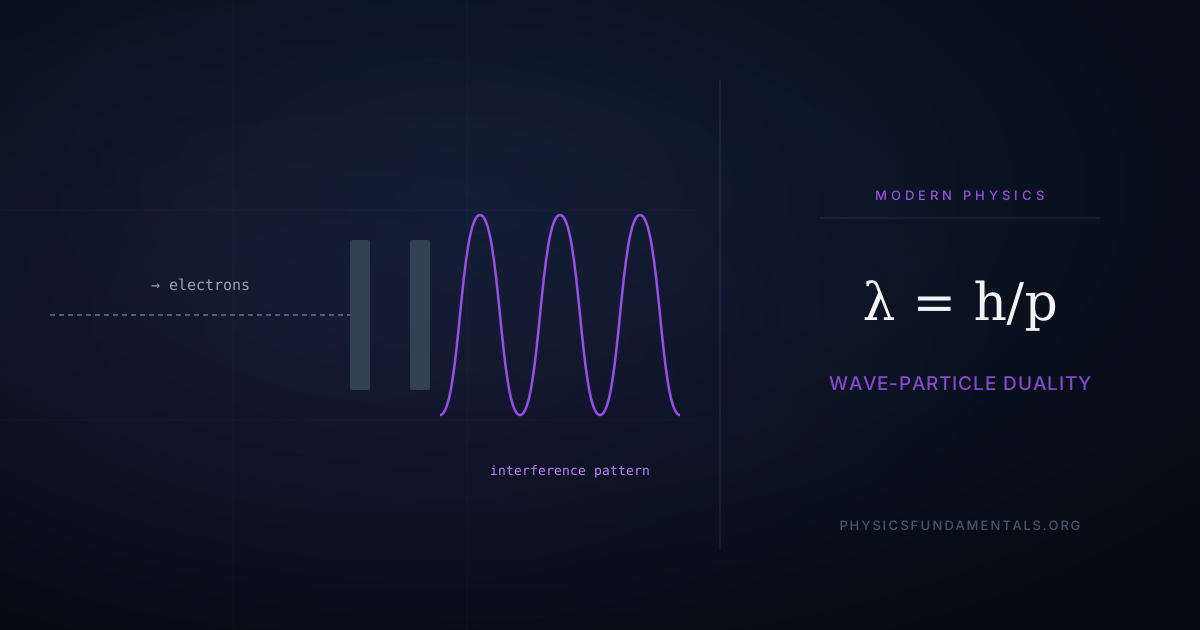
In 1927, physicists sent electrons through two slits and watched them build up an interference pattern on a detector — one electron at a time. Each electron arrived as a single particle, hitting one spot. But the spots accumulated into a wave pattern. The electron went through both slits. Or through one, but as a wave. Or in some way that ordinary language simply doesn't have words for, because nothing in human experience behaves this way.
Wave-particle duality isn't a mystery that physics hasn't solved yet. It's the answer. Quantum objects are neither waves nor particles in the classical sense — they're something else, described by a wavefunction whose square gives the probability of finding the particle at any location. The wave interference is real. The particle detection is real. They're both aspects of the same quantum object.
- The double-slit experiment — what it shows and why it's so difficult to interpret
- de Broglie's hypothesis: λ = h/p — matter has a wavelength, and here's how to calculate it
- The photoelectric effect as evidence for the particle nature of light
- What wave-particle duality actually means — and what it doesn't mean
What Is Wave-Particle Duality?
Wave-particle duality is the property of quantum objects that causes them to exhibit wave-like behaviour (interference, diffraction) or particle-like behaviour (discrete detection events, definite positions) depending on what experiment is performed. No single classical concept — wave or particle — describes a quantum object completely. Instead, quantum mechanics uses a mathematical object called a wavefunction, which encodes the probabilities of different measurement outcomes.
The duality is not a failure of our understanding — it is a fundamental feature of nature. Asking whether an electron is "really" a wave or "really" a particle is the wrong question. It is something new, described by quantum mechanics, that has wave-like and particle-like aspects in different experimental contexts.
Historical Development
Newton vs Huygens (17th century): Newton argued light consists of particles (corpuscles), which explained reflection and refraction. Huygens argued light is a wave. For over a century, Newton's authority kept the particle model dominant.
Young's double-slit experiment (1801): Thomas Young passed light through two narrow slits and observed an interference pattern of alternating bright and dark bands on a screen. Only waves interfere — particles would produce two bright strips, not a spread pattern. Young's experiment settled the debate in favour of waves for over a century.
Maxwell's electromagnetic theory (1865): light is an electromagnetic wave, with frequency and wavelength. The wave model seemed complete.
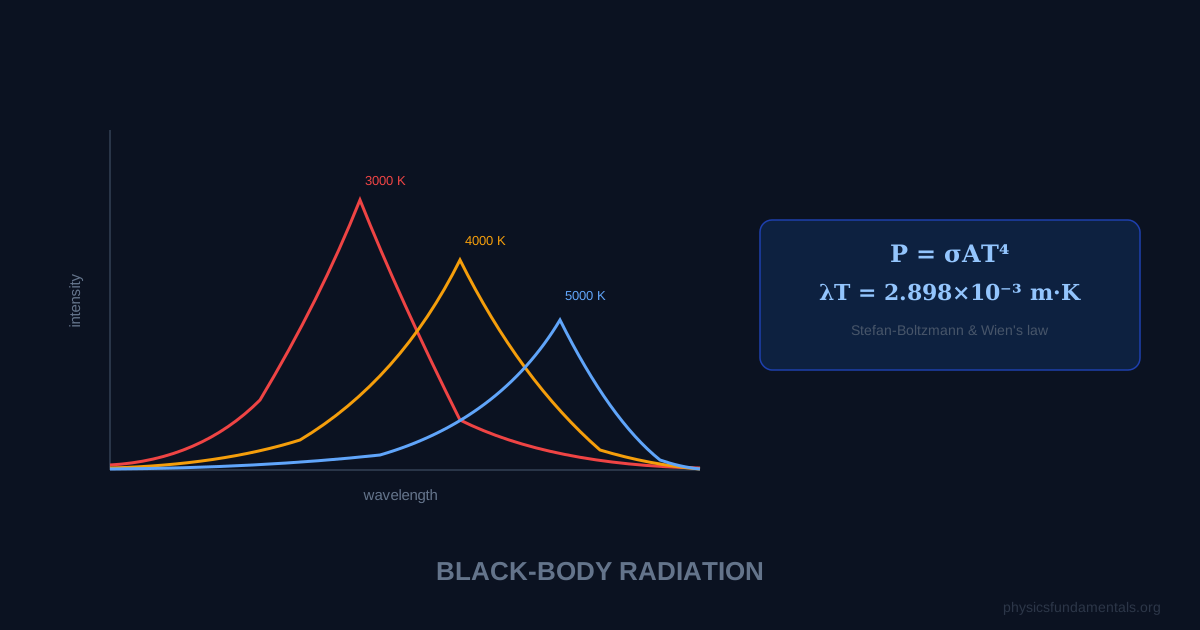
Planck's quantum hypothesis (1900): Max Planck solved the ultraviolet catastrophe (the failure of classical physics to predict blackbody radiation) by proposing that energy is exchanged in discrete packets — quanta — of size E = hf, where h = 6.626 × 10⁻³⁴ J·s. This was not a claim about particles; Planck considered it a mathematical trick. But it planted the seed.
Einstein's photoelectric effect (1905): Einstein explained the photoelectric effect by proposing that light consists of discrete packets — photons — each carrying energy E = hf. This won him the 1921 Nobel Prize and re-established the particle picture for light. But Young's interference experiment hadn't gone away. Light was simultaneously behaving as a wave AND as a particle depending on the experiment.
de Broglie's hypothesis (1924): Louis de Broglie proposed that matter — electrons, atoms, everything — also has a wave nature. The wavelength of a particle with momentum p is λ = h/p. He won the Nobel Prize in 1929 after this was confirmed by experiment.
Davisson-Germer experiment (1927): Electrons scattered off a nickel crystal produced a diffraction pattern — the definitive proof that electrons behave as waves. The wavelength measured matched de Broglie's formula exactly.
The de Broglie Wavelength: λ = h/p
Every object with momentum p has an associated de Broglie wavelength:
For a particle with mass m and velocity v, p = mv (non-relativistic). The wavelength decreases as momentum increases — faster or heavier objects have shorter wavelengths.
Example: electron at 10⁶ m/s
This is comparable to atomic spacings in crystals (0.1–0.5 nm), which is why electron diffraction off crystal lattices works — the wavelength matches the grating spacing.
Example: cricket ball (0.16 kg, 40 m/s)
This is 10¹⁹ times smaller than a proton. The wave nature of a cricket ball is completely undetectable — which is why classical physics works perfectly for everyday objects. Wave-particle duality only becomes significant when the de Broglie wavelength is comparable to the physical scale of the problem.
What Happens When a Photon Hits a Metal Surface?
When a photon strikes a metal surface, three things can happen depending on the photon's energy:
1. If the photon energy E = hf is less than the work function φ of the metal: The photon is absorbed but no electron is ejected. The energy goes into heating the metal. No matter how many such photons arrive, no electrons are emitted — this is the key observation that classical wave physics could not explain.
2. If E = hf ≥ φ (the work function): The photon is absorbed by an electron in the metal, which gains enough energy to escape the surface. The maximum kinetic energy of the emitted electron is:
This is Einstein's photoelectric equation. The work function φ is the minimum energy needed to remove an electron from the metal surface (typically 2–6 eV depending on the metal). For example, sodium has φ = 2.36 eV — ultraviolet light is needed to release photoelectrons from sodium.
3. High-energy photons (X-rays, gamma rays) hitting metal: The photon can scatter off an electron with a measurable change in wavelength — Compton scattering. The scattered photon has lower energy (longer wavelength), and the electron recoils. This demonstrates photon momentum p = h/λ directly.
The photoelectric effect is covered in full detail in the photoelectric effect article.
The Double-Slit Experiment — Wave Behaviour with Single Particles
The most striking demonstration of wave-particle duality is the double-slit experiment with single particles. Fire electrons (or photons) one at a time through two slits. Each electron arrives at the detector as a single point — particle behaviour. But after thousands of electrons, the pattern of dots builds up into an interference pattern — wave behaviour.
Each electron interferes with itself, going through both slits simultaneously as a wave, then collapsing to a single point when detected. If you add a detector at the slits to find out which slit each electron went through, the interference pattern disappears — you get two strips instead. The act of measurement destroys the wave behaviour.
This is not a trick of statistics or apparatus sensitivity. It has been performed with electrons, photons, neutrons, atoms, and even molecules as large as C₆₀ (buckminsterfullerene, 60 carbon atoms). The interference pattern always appears when no which-path information is available.
Photon Energy and Momentum
Photons are the particle-like quanta of light. Although massless, they carry both energy and momentum:
A visible light photon (λ = 500 nm = 5 × 10⁻⁷ m):
Photon momentum is tiny by everyday standards, but it's measurable. Solar radiation pressure on Earth is about 4.5 × 10⁻⁶ Pa — weak, but sufficient to propose solar sails for spacecraft propulsion over long timescales.
Heisenberg Uncertainty Principle
Wave-particle duality has a mathematical consequence: the Heisenberg uncertainty principle. A wave spread over space has a well-defined wavelength (hence momentum) but no definite position. A localised particle has a well-defined position but requires a superposition of many wavelengths (hence uncertain momentum):
where ℏ = h/(2π) = 1.055 × 10⁻³⁴ J·s. This is not a statement about measurement precision — it reflects the physical reality that position and momentum cannot both be precisely defined simultaneously for a quantum object. The uncertainty is intrinsic, not a limitation of instruments.
Wave-Particle Duality in Modern Technology
Electron microscopes: electrons at 100–300 kV have de Broglie wavelengths of ~4–2 pm (much smaller than visible light wavelengths of 400–700 nm). This allows imaging of individual atoms — impossible with light microscopes limited by diffraction to features no smaller than ~λ/2 ≈ 200 nm. Modern transmission electron microscopes (TEM) resolve features below 0.1 nm.
Electron diffraction in materials science: sending electrons through a crystalline material produces a diffraction pattern (wave behaviour) that reveals the crystal structure. The technique (used in X-ray crystallography too) was how DNA's double helix structure was solved in 1953.
Quantum tunnelling: a particle's wave nature means it has a non-zero probability of being found on the far side of an energy barrier it classically couldn't cross. This tunnelling drives nuclear fusion in the Sun (protons tunnel through the Coulomb barrier), flash memory in computers (electrons tunnel through insulating oxide layers), and scanning tunnelling microscopy.
Lasers: work by stimulated emission — a photon triggering an excited atom to emit an identical photon. The coherence (all photons in phase) is a wave phenomenon; the discrete energy levels are a particle/quantum phenomenon. Lasers are fundamentally wave-particle dual devices.
The "Severed Photon" and Wave-Particle Duality
One notable modern quantum optics concept involves "which-path" experiments where photon paths are intercepted or monitored mid-flight. When a photon's path information becomes available — even in principle, even if no one looks at the data — the interference pattern disappears. This is called quantum erasure when the path information is later erased: the interference pattern returns.
These delayed-choice and quantum-eraser experiments demonstrate that wave-particle duality is not about physical disturbance of the photon during measurement. It is about whether path information exists anywhere in the universe. The photon's wavefunction collapses based on what information is (or isn't) in principle available — a deeply non-classical result that has no intuitive explanation in everyday terms.
Frequently Asked Questions
What is wave-particle duality?
What happens when a photon hits a metal surface?
What is the de Broglie wavelength?
How does the double-slit experiment demonstrate wave-particle duality?
What is the energy of a photon?
Does wave-particle duality apply to large objects?
Share this article
Written by
Physics Fundamentals Editorial Team
Written and reviewed by our team of physics educators. Content is aligned with A-Level, GCSE, AP Physics, and undergraduate curricula.
About Physics Fundamentals →