
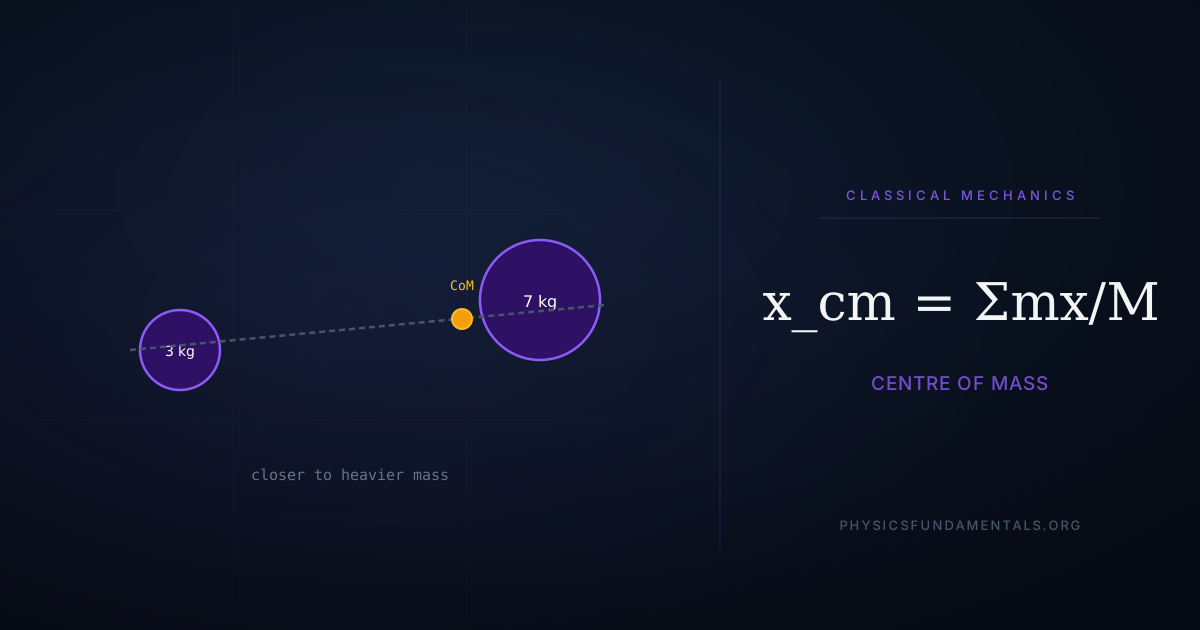
A hammer thrown through the air tumbles end over end — but one point traces a perfect parabola throughout the motion. That point is the centre of mass (also written "center of mass" in American usage), and it moves exactly as if all the hammer's mass were concentrated there and all external forces acted there. This is not an approximation. It's a theorem that follows directly from Newton's second law applied to a system of particles, and it's the reason we can treat extended objects as point masses in so many problems.
The high-jumper who arches over the bar while their centre of mass passes beneath it isn't cheating physics — they're exploiting it. Understanding where the centre of mass sits, and how it moves, is the key to analysing everything from gymnastics to rocket trajectories to the stability of ships.
- The centre of mass formula for discrete and continuous mass distributions
- Why the centre of mass moves as if all external forces act on it — the theorem and its proof
- How to locate the centre of mass of irregular objects experimentally
- Applications: stability, projectile motion, and the high-jump technique
The Centre of Mass Formula
For a system of discrete masses m₁, m₂, ... at positions x₁, x₂, ... along a line:
where M = Σmᵢ is the total mass. In two dimensions, the x and y coordinates of the centre of mass are found independently:
For continuous objects with non-uniform density, the sums become integrals — but for uniform objects, the centre of mass is simply the geometric centre (centroid).
Centre of Mass of Simple Systems
Worked Example 1: Two masses on a rod
A 3 kg mass is at x = 0 and a 7 kg mass is at x = 1.0 m. Find the centre of mass.
The centre of mass is 70 cm from the lighter mass — closer to the heavier one. It always lies between the objects, nearer to the more massive one.
Worked Example 2: Three masses in 2D
Mass 1: 2 kg at (0, 0). Mass 2: 3 kg at (4, 0). Mass 3: 5 kg at (2, 3). All positions in metres.
Centre of Mass vs Centre of Gravity
The centre of gravity is the point where the total gravitational torque acts — where you could support the object and it would balance. In a uniform gravitational field (which holds to excellent approximation for objects much smaller than Earth), centre of gravity = centre of mass. For very large objects (a mountain, a planet) in a non-uniform gravitational field, the two points differ slightly — but for all practical physics problems, they are identical.
Newton's Second Law for Systems
The most powerful result of the centre of mass concept: the net external force on a system equals the total mass times the acceleration of the centre of mass:
Internal forces (between parts of the system) cancel in Newton's third law pairs — they cannot accelerate the centre of mass. Only external forces matter. This means:
• An exploding firework's centre of mass follows a simple parabolic projectile trajectory — regardless of the complex internal fragments.
• A diver somersaulting through the air has a centre of mass that traces a perfect parabola — even as body parts move in complex ways.
• A binary star system's centre of mass moves in a straight line at constant velocity (if isolated) even as each star orbits the other.
Stability and the Centre of Mass
An object is in stable equilibrium when its centre of mass is directly above its base of support, and when tilting would raise the centre of mass (requiring energy input). Key principles:
Low centre of mass → more stable: racing cars have very low profiles; cargo ships carry heavy ballast at the bottom; the Leaning Tower of Pisa hasn't fallen because its centre of mass is still above its base.
Wide base → more stable: the wider the base, the greater the angle of tilt before the centre of mass moves outside it. Sumo wrestlers spread their legs wide; tripods are more stable than bipods.
Toppling condition: an object topples when its centre of mass moves outside the base of support. A double-decker bus is tested by tilting it to see if the centre of mass reaches the tipping point before it rolls onto its side.
The Fosbury Flop and the High-Jump
One of the most elegant demonstrations of centre of mass in athletics: in the Fosbury Flop (the modern high-jump technique), the athlete arches backwards over the bar. As each body part rises above and then drops below the bar level, the entire body forms an arch — and remarkably, the athlete's centre of mass may pass below the bar while the body clears it. The athlete is essentially jumping their centre of mass just high enough to clear the bar, while the arch of their body means each part goes higher than the centre of mass. This is not a trick — it is a direct application of the definition of centre of mass, and it allows athletes to clear bars that would be impossible with an upright jump.
Centre of Mass in Rocket Design
A rocket remains stable in flight when its centre of pressure (where aerodynamic forces act) is behind its centre of mass (where thrust and gravity act). This ensures that any aerodynamic perturbation creates a restoring torque — the rocket is self-righting. If the centre of mass is behind the centre of pressure, the rocket is unstable — a small perturbation grows. Model rocket designers carefully add nose weight or move fins to ensure stable flight.
More Worked Examples
Example 1: Two masses. Mass m₁ = 3 kg at x = 0, m₂ = 1 kg at x = 4 m. x_cm = (3×0 + 1×4)/(3+1) = 4/4 = 1.0 m from m₁. (CoM is closer to the heavier mass.)
Example 2: Three masses. 2 kg at (0,0), 3 kg at (4,0), 1 kg at (2,3).
x_cm = (2×0 + 3×4 + 1×2)/(2+3+1) = 14/6 = 2.33 m. y_cm = (2×0 + 3×0 + 1×3)/6 = 3/6 = 0.50 m. CoM is at (2.33, 0.50) m.
What is the difference between centre of mass and centre of gravity?
Frequently Asked Questions
What is the centre of mass?
Why does the centre of mass follow a parabolic path when an object is thrown?
How is the centre of mass related to stability?
Can the centre of mass be outside the object?
How does centre of mass differ from centroid?
Share this article
Written by
Physics Fundamentals Editorial Team
Written and reviewed by our team of physics educators. Content is aligned with A-Level, GCSE, AP Physics, and undergraduate curricula.
About Physics Fundamentals →
Discussion
Comments
Leave a comment
Have a question about this article? Spot a mistake? Or just want to share your thoughts? We'd love to hear from you.
Keep learning physics fundamentals
Get new articles and platform updates delivered to your inbox.
Physics Fundamentals
👋 Get concise physics updates — new articles, calculators, and tools. Your number stays private. No spam. No group chats. Just worthy content.