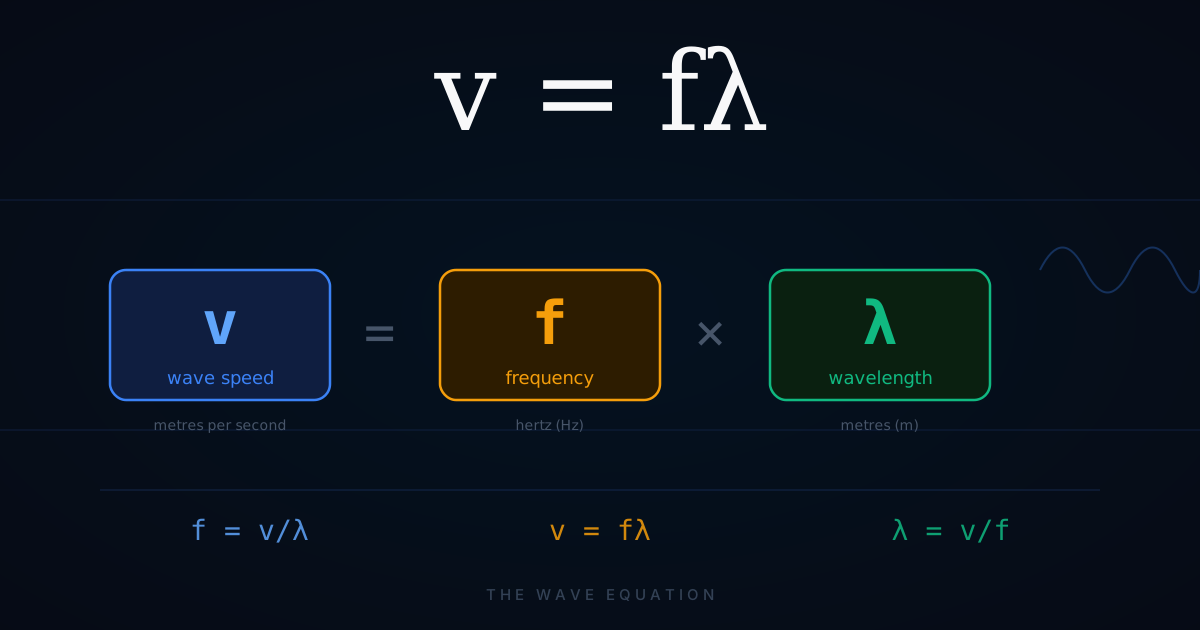
The wave speed formula is v = fλ — wave speed equals frequency multiplied by wavelength. It applies to every wave that exists: sound, light, water ripples, seismic waves, radio signals. If you know any two of the three quantities, you can find the third.
The equation looks simple, but it hides something important: in a given medium, wave speed is fixed by the medium itself. Change the frequency of a wave and its wavelength adjusts automatically to compensate — speed doesn't change. That single insight resolves most confusion students have about wave calculations.
- What wave speed, frequency, and wavelength each mean physically — not just mathematically
- Why v = fλ follows directly from the definition of a wave
- How to use the equation to solve problems involving sound, light, and other waves
- What determines wave speed in different media, and what doesn't
Why v = fλ Is True — The Logic Behind the Equation
This equation isn't an arbitrary formula to memorise — it follows directly from what frequency and wavelength mean.
Frequency f is the number of complete wave cycles that pass a fixed point per second. If f = 5 Hz, then 5 complete wavelengths pass your observation point every second.
Wavelength λ is the length of one complete cycle — the distance from one crest to the next (or trough to trough, or any corresponding points on adjacent cycles).
In one second, f waves pass a point, each λ metres long. The total distance the wave front moves in one second is f × λ — and distance per second is speed. So v = fλ is a geometric identity: it's true by definition of what frequency and wavelength mean, for any wave.
Period and Its Relationship to Frequency
The period T is the time for one complete wave cycle — the reciprocal of frequency:
A 440 Hz sound wave has T = 1/440 = 0.00227 s per cycle (2.27 ms). A 0.1 Hz ocean swell has T = 10 s per wave. Using T, the wave equation becomes v = λ/T — wave speed equals one wavelength per period, which is even more geometrically obvious: the wave travels one wavelength in the time it takes one cycle to complete.
What Determines Wave Speed?
The wave speed v is set by the medium, not by frequency or wavelength. For a given medium and wave type, v is fixed — and frequency and wavelength must adjust to satisfy v = fλ. This is one of the most important principles in wave physics:
- Change the frequency of a wave in a fixed medium → wavelength changes proportionally (λ = v/f), speed stays the same.
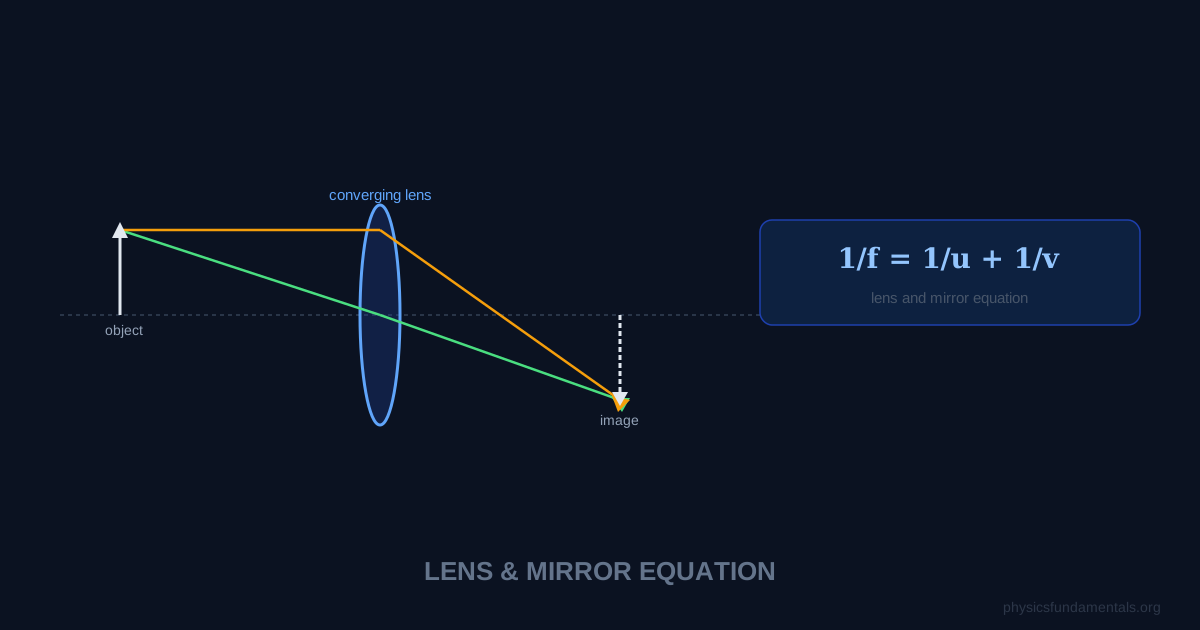
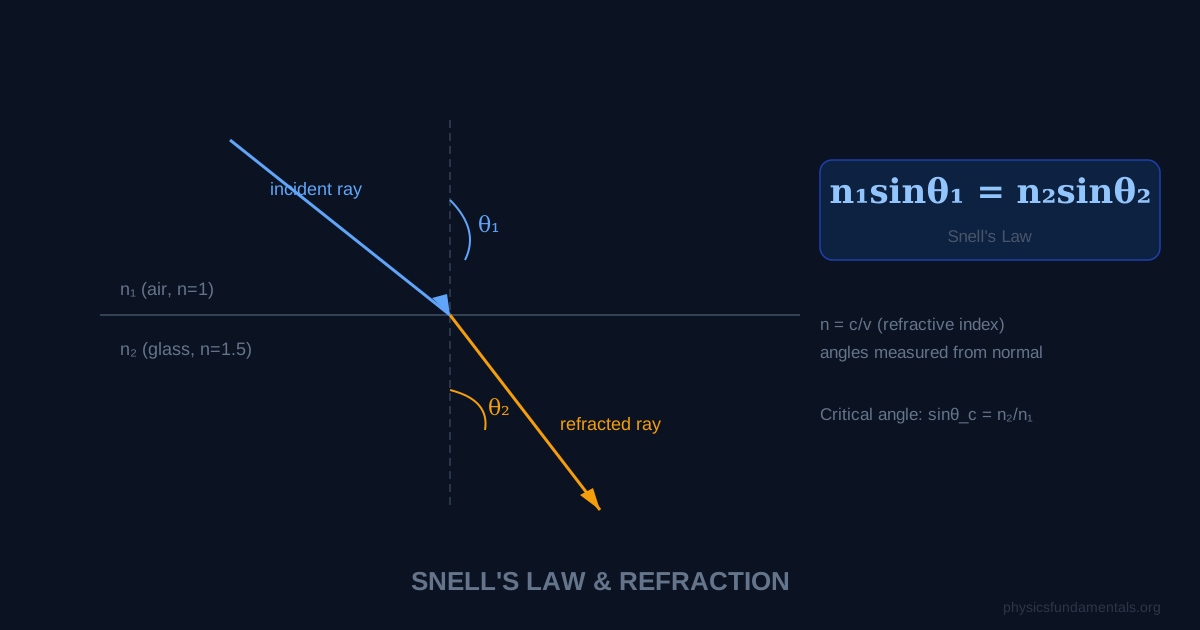
- Change the medium → speed changes, and if frequency is fixed (as it is when a wave passes from one medium to another), wavelength changes too. This is why light bends at a glass surface: it slows down, its frequency stays fixed (set by the source), so its wavelength shortens — and the changed wavelength means a changed direction.
| Wave type | Medium | Speed |
|---|---|---|
| Sound | Air (20°C) | 343 m/s |
| Sound | Water (25°C) | 1,480 m/s |
| Sound | Steel | 5,100 m/s |
| Light | Glass (crown) | ~1.97 × 10⁸ m/s |
| Light | Vacuum | c = 2.998 × 10⁸ m/s |
Worked Example 1: Finding Wavelength of Sound
A sound wave at concert A (f = 440 Hz) travels through air at 343 m/s. Find its wavelength.
The wavelength of concert A is about 78 cm — roughly arm's length. Longer wavelengths (bass notes) can bend around obstacles more easily than short ones, which is why you hear the bass from a neighbour's music through walls but not the treble.
Worked Example 2: Finding Frequency of Light
Green light has a wavelength of 550 nm = 5.50 × 10⁻⁷ m in vacuum. Find its frequency.
545 trillion cycles per second. That's the oscillation rate of green light's electric and magnetic fields — far too fast to detect directly, which is why we use wavelength (measurable by diffraction) to characterise light rather than frequency.
Worked Example 3: Wave Speed from Frequency and Wavelength
A water wave has frequency 0.5 Hz and wavelength 3.0 m. Find its speed.
Ocean swell can travel thousands of kilometres at speeds of 10–20 m/s. Tsunami waves in open ocean (where water depth is ~4,000 m) travel at v = √(gh) ≈ √(9.8 × 4000) ≈ 198 m/s — around 700 km/h — with wavelengths of hundreds of kilometres and periods of 10–60 minutes.
Worked Example 4: Wavelength Change When Light Enters Glass
Yellow light (f = 5.09 × 10¹⁴ Hz) travels in air (v ≈ c = 3.0 × 10⁸ m/s) and enters crown glass (refractive index n = 1.52, so v_glass = c/n = 1.97 × 10⁸ m/s). Find the wavelength in air and in glass.
In air: λ_air = v/f = (3.0 × 10⁸) / (5.09 × 10¹⁴) = 5.89 × 10⁻⁷ m = 589 nm (sodium yellow)
In glass: λ_glass = v_glass/f = (1.97 × 10⁸) / (5.09 × 10¹⁴) = 3.87 × 10⁻⁷ m = 387 nm
The frequency (5.09 × 10¹⁴ Hz) is unchanged — it's set by the source. The speed drops (from c to c/n), so the wavelength shortens proportionally. The shorter wavelength in the glass is what causes bending at the air-glass interface (refraction).
The v = fλ Equation for Electromagnetic Waves
All electromagnetic radiation obeys v = fλ with v = c = 2.998 × 10⁸ m/s in vacuum. The entire electromagnetic spectrum is just different frequencies (and therefore wavelengths) of the same phenomenon:
| EM wave type | Typical frequency | Typical wavelength | Application |
|---|---|---|---|
| Radio waves | kHz – GHz | km – cm | Broadcasting, MRI |
| Microwaves | GHz | cm – mm | Wi-Fi, radar, cooking |
| Infrared | THz | μm | Thermal imaging, remote controls |
| Visible light | 430 – 750 THz | 700 – 400 nm | Human vision |
| Ultraviolet | PHz | nm | Sterilisation, sunburn |
| X-rays | EHz | pm | Medical imaging, crystallography |
| Gamma rays | >EHz | <pm | Cancer treatment, nuclear physics |
All travel at c = 3 × 10⁸ m/s in vacuum. Only the frequency (and therefore wavelength) differs. Higher frequency means shorter wavelength, more energy per photon (E = hf), and greater penetrating power — which is why X-rays pass through flesh but not bone, and gamma rays penetrate almost everything.
v = fλ and the Doppler Effect
The Doppler effect is the apparent change in frequency (and wavelength) when a wave source or observer is moving. When an ambulance approaches, the siren sounds higher-pitched — waves are compressed ahead of the moving source, so wavelength decreases and frequency increases (v = fλ, with v fixed and λ decreasing → f increases). As it passes, wavelength stretches behind the source — frequency drops.
The observed frequency when source moves toward observer at speed v_s:
The Doppler effect applies to light too. Distant galaxies show redshift — their light is shifted to longer wavelengths (lower frequency) because the galaxies are receding. The extent of redshift reveals recession speed. Edwin Hubble's 1929 discovery that redshift scales with distance was the first direct evidence for an expanding universe.
Standing Waves and Resonance
When waves reflect in a confined space — a guitar string fixed at both ends, air in a flute, electrons in a quantum well — v = fλ determines which frequencies produce standing waves. For a string of length L fixed at both ends, standing waves form when L = nλ/2 (n = 1, 2, 3...). The fundamental frequency (n=1) has λ = 2L, so:
Higher harmonics: f_n = nv/(2L) = n × f₁. A guitar string of length 0.65 m with wave speed 400 m/s: f₁ = 400/(2 × 0.65) = 308 Hz. The string also resonates at 616 Hz, 924 Hz, and so on — these overtones give the guitar its characteristic timbre.
Young's Double-Slit and Wavelength Measurement
The wavelength of light can be measured using Young's double-slit experiment. Two slits separated by distance d create an interference pattern on a screen at distance D. The fringe spacing y is:
For d = 0.5 mm = 5 × 10⁻⁴ m, D = 2.0 m, y = 2.2 mm = 2.2 × 10⁻³ m:
This was how Thomas Young first measured the wavelength of visible light in 1801 — a remarkably accurate result achieved with nothing more sophisticated than a candle, a card with slits, and careful measurement.
Common Mistakes with v = fλ
Assuming faster frequency means faster wave. Frequency does not affect wave speed in a given medium. A 1,000 Hz sound and a 100 Hz sound both travel at 343 m/s in air. Their wavelengths differ (0.343 m vs 3.43 m), not their speeds.
Mixing up wavelength and amplitude. Wavelength (λ) is the spatial length of one cycle — a horizontal distance. Amplitude is the maximum displacement from equilibrium — a vertical distance. They're completely independent: a wave can have a large wavelength and tiny amplitude, or small wavelength and large amplitude.
Using the wrong wave speed. Light's speed in a medium is c/n, not c. For problems involving refraction or optical fibres, always use the speed in the relevant medium. Sound speed also changes significantly with temperature: v_sound ≈ 331 + 0.6T m/s, where T is temperature in °C. At 0°C: 331 m/s. At 20°C: 343 m/s. At 100°C: 391 m/s.
Forgetting units. If frequency is in Hz (s⁻¹) and wavelength is in nm, v comes out in nm/s — not m/s. Always convert wavelength to metres before using v = fλ with frequency in Hz.
Try it yourself: check your own numbers with the Wave Speed Calculator, which shows the formula, the worked substitution and the answer step by step.
Frequently Asked Questions
What is the wave equation v = fλ?
What is v = fλ used for?
Does frequency change when a wave moves from one medium to another?
What is the speed of sound in air?
What is wavelength and how is it measured?
Why does v = fλ work for all types of waves?
Share this article
Written by
Physics Fundamentals Editorial Team
Written and reviewed by our team of physics educators. Content is aligned with A-Level, GCSE, AP Physics, and undergraduate curricula.
About Physics Fundamentals →