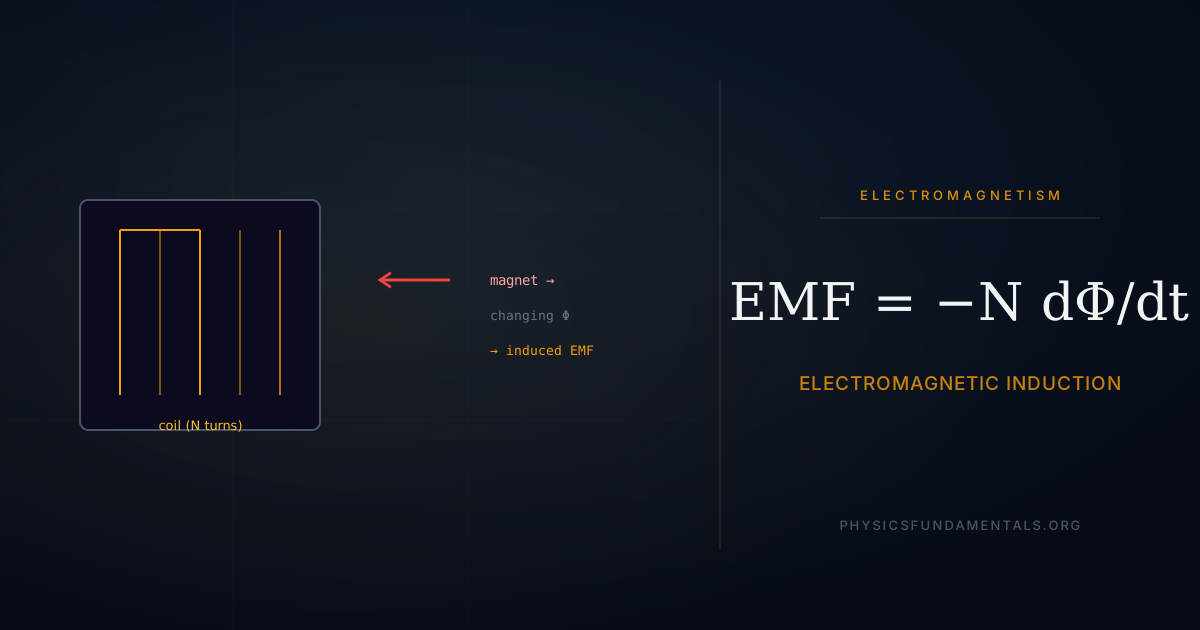
In 1831, Michael Faraday did something remarkable: he showed that magnetism could create electricity, not just deflect it. Move a magnet through a coil of wire and a current flows — with no battery, no chemical reaction, no direct contact. That discovery is the operating principle behind every generator, every transformer, and every wireless charger in use today. It is, in a very real sense, the discovery that electrified the world.
Faraday's law — that the induced EMF equals the rate of change of magnetic flux — is one of Maxwell's four equations, and the connection runs deep: changing magnetic fields create electric fields. Combined with the reverse (changing electric fields create magnetic fields), you get electromagnetic waves, and from there the entire theory of light. Induction is where electricity and magnetism stop being separate subjects.
- Magnetic flux Φ = BA cosθ — what it measures and how it changes
- Faraday's law: EMF = −ΔΦ/Δt — derived and applied to coils, generators, and transformers
- Lenz's law: why the induced current always opposes the change that caused it
- How transformers work — and why the mains voltage in your wall is AC, not DC
Magnetic Flux and Why Change Matters
Magnetic flux Φ = BA cosθ measures how much magnetic field passes through a loop. A static flux — no matter how large — induces no EMF. Only a changing flux induces an EMF. The flux can change because:
• B changes in magnitude (e.g. a magnet moving toward a coil)
• The area A changes (e.g. a coil being stretched)
• The angle θ changes (e.g. a coil rotating in a fixed field — the basis of generators)
Lenz's Law: The Direction of Induced Current
The negative sign in Faraday's law encodes Lenz's Law: the induced current flows in a direction such that its magnetic effect opposes the change in flux that caused it.
Practical rule: push a north pole into a coil → the induced current creates a north pole facing the approaching magnet (opposing the increase in flux). Pull the magnet away → the induced current creates a south pole, trying to maintain the flux as it decreases.
Lenz's Law is conservation of energy in action. If the induced current aided the flux change rather than opposing it, you could get a self-amplifying current from nothing — violating the first law of thermodynamics. The opposing force Lenz's Law creates is why generators require mechanical work to rotate against the magnetic braking effect.
EMF = N dΦ/dt — more turns N does increase EMF for the same rate of flux change. But the flux change matters as much as N. A coil rotating slowly in a strong field may induce less EMF than a coil rotating fast in a weaker field. Both N and dΦ/dt determine the output.
Worked Examples
Example 1: Flux change through a coil
A 200-turn coil of area 0.05 m² is in a uniform magnetic field. B increases from 0.2 T to 0.8 T in 0.4 s. Find the induced EMF.
Example 2: Rotating coil (generator)
A 100-turn coil of area 0.02 m² rotates at 50 Hz in a 0.3 T field. Find the peak EMF.
The instantaneous EMF varies sinusoidally: EMF(t) = 188.5 sin(2π × 50 × t) — this is how AC generators produce sinusoidal alternating current.
Generators: Mechanical Energy → Electrical Energy
An AC generator (alternator) converts mechanical rotation to electrical energy using electromagnetic induction. A coil rotates in a magnetic field — the angle θ between the coil normal and B changes continuously, so flux Φ = BA cosθ changes continuously, inducing a sinusoidal EMF.
In a power station, the mechanical rotation is provided by steam turbines (coal, gas, nuclear) or water turbines (hydroelectric) or wind (wind turbines). The rotating coil is the rotor; the stationary magnets or field coils form the stator. Slip rings (not a commutator) maintain continuous contact, allowing AC output.
In the UK, generators produce 50 Hz AC at ~25,000 V, which is stepped up to 275,000–400,000 V by transformers for transmission, then stepped back down for domestic use at 230 V.
Transformers: Changing Voltage Using Induction
A transformer uses mutual induction to change AC voltage. An alternating current in the primary coil (N_p turns) creates a changing magnetic flux in a soft iron core. This changing flux passes through the secondary coil (N_s turns), inducing an EMF in it.
For an ideal transformer, power is conserved: V_p I_p = V_s I_s. So:
A step-up transformer (N_s > N_p) increases voltage and decreases current. A step-down transformer (N_s < N_p) decreases voltage and increases current. National grids use step-up transformers to reduce transmission current — since power losses in cables are P_loss = I²R, reducing current dramatically reduces waste heat.
| Device | Principle | Energy conversion |
|---|---|---|
| Generator / alternator | Rotating coil in B field | Mechanical → electrical |
| Transformer | Mutual induction via iron core | AC voltage change (same frequency) |
| Electric motor | Force on current in B field | Electrical → mechanical |
| Induction charging | Mutual induction (no contact) | AC electrical → AC electrical (wireless) |
Self-Inductance and Inductors
When the current in a coil changes, the changing magnetic flux the coil itself creates induces an EMF in the same coil — opposing the change in current. This is self-inductance:
where L is the inductance (henries, H). An inductor opposes changes in current — it resists sudden increases or decreases, smoothing current flow. Inductors are used in power supplies to filter ripple, in tuned LC circuits (radios, TVs) to select frequencies, and in transformers.
Beyond generators and transformers, electromagnetic induction also powers induction hobs (high-frequency alternating current creates rapidly changing flux in a metal pan, inducing eddy currents that resistively heat the pan directly, with no flame or hot element) and wireless phone charging (an alternating flux from the charging pad induces an EMF in the phone's receiver coil, transferring power with no physical contact).
Frequently Asked Questions
What is electromagnetic induction?
What is Faraday's law?
What is Lenz's Law?
What is magnetic flux?
How does a generator work?
How does a transformer work?
Why do transformers only work with AC?
What are eddy currents?
Share this article
Written by
Physics Fundamentals Editorial Team
Written and reviewed by our team of physics educators. Content is aligned with A-Level, GCSE, AP Physics, and undergraduate curricula.
About Physics Fundamentals →