A gas exerts pressure on the walls of its container because billions of molecules are constantly bouncing off them. Temperature is a measure of how fast those molecules are moving on average. These are not just convenient analogies — they are precise, quantitative statements that predict the behaviour of real gases with remarkable accuracy.
The kinetic theory of gases is the bridge between the microscopic world of atoms and molecules and the macroscopic quantities we can actually measure — pressure, volume, temperature. It's also one of the clearest examples in physics of how a simple model with a few assumptions can produce deep, testable predictions.
- The assumptions of the kinetic theory and why they're reasonable
- How molecular motion gives rise to pressure and temperature
- The root mean square speed of gas molecules and how to calculate it
- How kinetic theory connects to the ideal gas law PV = nRT
What Is the Kinetic Theory of Gases?
The kinetic theory of gases is a scientific model that explains the macroscopic properties of gases — pressure, temperature, and volume — in terms of the microscopic motion of individual molecules. It is the bridge between Newtonian mechanics at the molecular level and the thermodynamic laws we observe at the human scale.
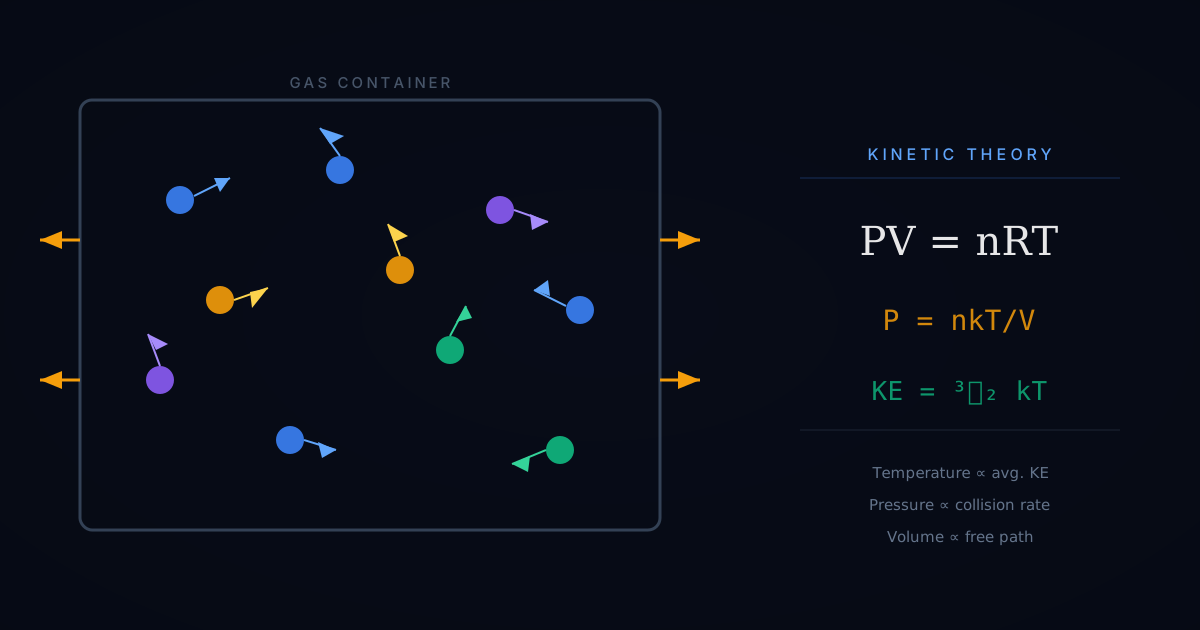
The kinetic theory of gases states that a gas consists of a large number of small particles (molecules or atoms) in constant, random motion. The pressure a gas exerts is caused by molecules colliding with container walls, and the temperature of a gas is a direct measure of the average kinetic energy of its molecules.
The word "kinetic" comes from the Greek kinētikos, meaning "of motion." The theory is called kinetic theory because it attributes all observable gas behaviour to the motion of molecules — their speeds, collisions, and the forces they exert on their surroundings.
The kinetic theory of gases was developed primarily in the 19th century by James Clerk Maxwell, Ludwig Boltzmann, and Rudolf Clausius. It unified two previously separate sciences — mechanics and thermodynamics — into a single framework, and provided the first microscopic explanation for the ideal gas law (PV = nRT).
What is temperature, really? What causes the pressure a gas exerts on the walls of its container? For centuries these seemed like distinct, perhaps unanswerable questions. The kinetic theory of gases provided the answer by connecting the macroscopic, observable properties of gases — pressure, temperature, volume — to the microscopic motion of individual molecules. It is one of the great triumphs of classical physics: a direct bridge between Newton's mechanics and the large-scale behavior of matter.
The Model: What We Assume
The kinetic theory builds on an idealized model called the ideal gas. The key assumptions are:
1. A gas consists of a huge number of tiny molecules in constant, random motion.
2. The molecules are point-like — their volume is negligible compared to the container.
3. Collisions between molecules and with container walls are perfectly elastic — kinetic energy is conserved. (This directly applies conservation of momentum at the microscopic level.)
4. Molecules exert no forces on each other except during collisions.
5. The average kinetic energy of the molecules is proportional to the absolute temperature.
These assumptions simplify reality, but the resulting model describes real gases extraordinarily well at moderate temperatures and pressures, and reveals the deep physical meaning of temperature itself.
Pressure: Molecules Hitting Walls
Pressure in a gas arises from the collective bombardment of container walls by trillions of molecules per second. Each molecule that bounces off a wall transfers momentum to it — a microscopic impulse. The macroscopic pressure is the average force per unit area from these continuous impacts.
Applying Newton's second law to a single molecule bouncing elastically between two walls, then summing over all N molecules in a container of volume V, gives:
where m is the molecular mass and ⟨v²⟩ is the mean squared speed. This is the central result of kinetic theory — a derivation of the pressure of a gas from purely mechanical principles.
Temperature: A Measure of Molecular Kinetic Energy
Comparing the kinetic theory result to the ideal gas law (PV = nRT, where n is moles, R is the gas constant, T is absolute temperature), we find:
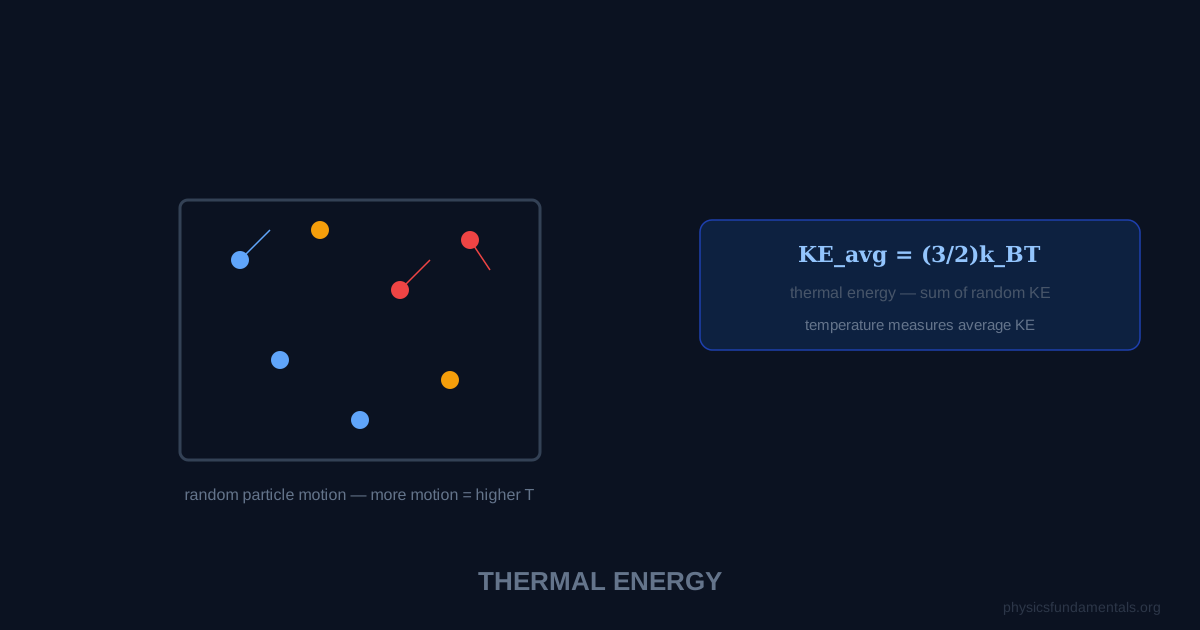
where kB = 1.38 × 10⁻²³ J/K is Boltzmann's constant. This equation is profound: temperature is a direct measure of the average translational kinetic energy of the molecules. Higher temperature doesn't mean "more heat" stored in an object — it means the molecules are moving faster on average. Absolute zero (0 K = −273.15°C) corresponds to zero molecular kinetic energy — the molecules stop translating entirely (quantum mechanically, they still have zero-point energy, but classically this is the lower limit).
This connects directly to the concept of internal energy: the internal energy U of an ideal monatomic gas is simply the total kinetic energy of all its molecules:
RMS Speed: How Fast Are the Molecules?
From ½m⟨v²⟩ = (3/2)kBT, we can solve for the root mean square speed — the square root of the mean squared speed:
where M is the molar mass (kg/mol). For nitrogen (N₂, M = 0.028 kg/mol) at room temperature (T = 293 K):
The nitrogen molecules in the air around you are moving at roughly 511 m/s — faster than a bullet. They don't travel far before colliding with another molecule (the mean free path at atmospheric pressure is only about 70 nm), which is why the smell of perfume diffuses slowly across a room despite each molecule moving at supersonic speed.
The Maxwell-Boltzmann Distribution
Not all molecules in a gas move at the same speed. They follow a statistical distribution — the Maxwell-Boltzmann distribution — which gives the fraction of molecules with speeds in any given range. The distribution has a characteristic shape: it peaks at a "most probable speed" slightly below vrms, has a long tail extending to very high speeds, and shifts to higher speeds as temperature increases.
This distribution has profound consequences. Chemical reactions require molecules to collide with sufficient energy to overcome activation barriers. Even at modest temperatures, the high-speed tail of the Maxwell-Boltzmann distribution means that some fraction of molecules always have enough energy to react — and this fraction grows dramatically with temperature. This is why reaction rates increase so strongly with temperature.
The Ideal Gas Law from First Principles
The ideal gas law (PV = nRT) was discovered empirically long before its molecular basis was understood. Kinetic theory provides the microscopic derivation: starting only from Newton's laws of motion, the assumption of elastic collisions, and the identification of temperature with molecular kinetic energy, you can derive PV = nRT from scratch. This derivation is one of the most satisfying in all of physics — a macroscopic law emerging from microscopic first principles, confirming that thermodynamics and classical mechanics are not separate sciences but two views of the same underlying reality.
The Key Results of Kinetic Theory
Starting from Newton's laws applied to gas molecules bouncing off container walls, kinetic theory derives:
where N is number of molecules, m is mass per molecule, ⟨v²⟩ is mean square speed, k_B = 1.381 × 10⁻²³ J/K is Boltzmann's constant, and T is absolute temperature. Combining: PV = Nk_BT = nRT — the ideal gas law emerges from first principles.
The Assumptions
Kinetic theory applies to an ideal gas with these assumptions: molecules are point masses (negligible volume); no intermolecular forces except during elastic collisions; molecular speeds are random, following the Maxwell-Boltzmann distribution; number of molecules is very large (statistical behaviour); collisions with walls are elastic.
Root Mean Square Speed
The RMS speed is the square root of the mean square speed:
where M is molar mass (kg/mol). For nitrogen (M = 0.028 kg/mol) at 300 K:
Nitrogen molecules move at ~517 m/s on average at room temperature — faster than a bullet. Hydrogen (M = 0.002 kg/mol) at 300 K: v_rms = √(3 × 8.314 × 300/0.002) = 1,934 m/s. Lighter molecules move faster at the same temperature.
Maxwell-Boltzmann Distribution
Not all molecules move at v_rms — there is a distribution of speeds. The Maxwell-Boltzmann distribution gives the fraction of molecules at each speed. Three characteristic speeds: most probable speed v_p = √(2k_BT/m); mean speed ⟨v⟩ = √(8k_BT/πm); RMS speed v_rms = √(3k_BT/m). Their ratio: v_p : ⟨v⟩ : v_rms = 1 : 1.128 : 1.225. At higher temperatures, the entire distribution shifts to higher speeds and broadens. This explains why some molecules in planetary atmospheres always exceed escape velocity, causing slow atmospheric loss over geological time.
Pressure from Molecular Collisions
Consider N molecules in a box of side L. A molecule with x-component of velocity v_x bouncing off a wall transfers momentum 2mv_x per collision. The average force from all molecules on the wall, summed over all velocity components, gives P = Nm⟨v²⟩/(3V). For an ideal gas with ⟨v²⟩ ∝ T, this directly gives PV ∝ T — Boyle's and Charles's laws simultaneously.
Internal Energy of an Ideal Gas
For an ideal monatomic gas (He, Ne, Ar), each molecule has three translational degrees of freedom. The equipartition theorem assigns ½k_BT of energy to each degree of freedom, giving total internal energy per molecule = (3/2)k_BT, and for n moles: U = (3/2)nRT. For diatomic gases (N₂, O₂) at room temperature, two additional rotational degrees of freedom contribute: U = (5/2)nRT (giving C_V = (5/2)R = 20.8 J mol⁻¹ K⁻¹). At very high temperatures, vibrational modes activate further, increasing U. This molecular structure is why monatomic noble gases have lower specific heat capacities than diatomic gases like air.
Diffusion and Mean Free Path
Gas molecules don't travel far before colliding — the mean free path λ is the average distance between collisions. For an ideal gas: λ = 1/(√2 × n × π × d²), where n is number density (N/V) and d is molecular diameter. For nitrogen at atmospheric pressure (n ≈ 2.7 × 10²⁵ m⁻³, d ≈ 3.7 × 10⁻¹⁰ m): λ ≈ 65 nm. At this scale, a nitrogen molecule collides ~10⁹ times per second. Reducing pressure (lower n) increases λ — in space (n ≈ 1 molecule/cm³), the mean free path is vast. Diffusion is the net movement of molecules from high to low concentration driven by random molecular motion, governed by Fick's law: J = −D(dc/dx).
Frequently Asked Questions
What is the kinetic theory of gases?
What is the RMS speed of gas molecules?
What is the relationship between temperature and kinetic energy in kinetic theory?
Why does pressure increase with temperature at constant volume?
What are the assumptions of the ideal gas model?
Share this article
Written by
Physics Fundamentals Editorial Team
Written and reviewed by our team of physics educators. Content is aligned with A-Level, GCSE, AP Physics, and undergraduate curricula.
About Physics Fundamentals →