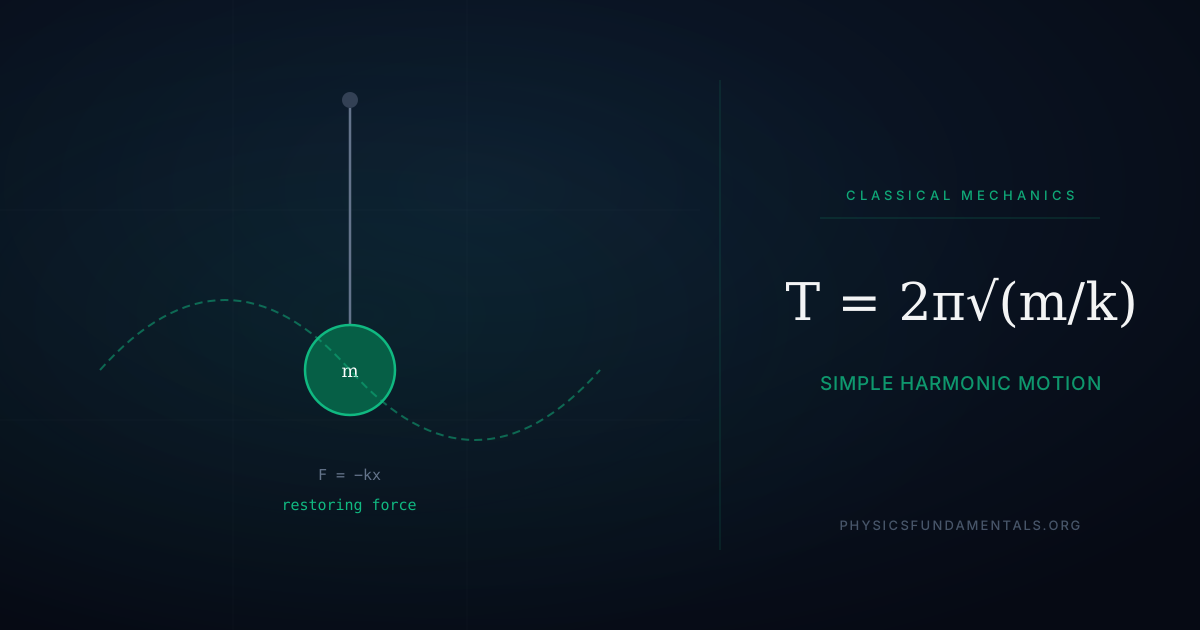
Simple harmonic motion (SHM) is oscillation in which the restoring force is proportional to the displacement from equilibrium and directed towards it (F = −kx). The acceleration is then a = −ω²x, and the motion is sinusoidal with period T = 2π/ω.
Pull a pendulum to one side and release it. Stretch a spring and let go. Disturb almost any stable system slightly and it will oscillate — and if that oscillation is simple harmonic motion, you can describe the entire future behaviour of the system with a single equation. That's not an oversimplification; for pendulums, springs, LC circuits, and sound waves, SHM is the exact description.
SHM turns up everywhere in physics because the mathematics of restoring forces that are proportional to displacement is extremely common. Once you understand SHM properly, you have the foundation for acoustics, optics, quantum mechanics, and electrical circuits — they all use the same underlying mathematical structure.
- The defining condition for SHM: acceleration proportional and opposite to displacement
- Pendulums and springs, including the physical (compound) pendulum T = 2π√(I/(mgd))
- The equations for displacement, velocity, and acceleration as functions of time
- Period, frequency, and amplitude — what affects them and what doesn't
- Energy in SHM: how kinetic and potential energy trade off through each cycle
What Makes Motion "Simple Harmonic"?
SHM has a precise definition: the restoring force must be proportional to displacement and opposite in direction. In equation form:
The negative sign is critical — it means the force always pushes or pulls the object back toward equilibrium (x = 0), not away from it. The greater the displacement, the stronger the restoring force. This produces the characteristic sinusoidal oscillation: the object overshoots equilibrium, the force reverses direction, it's pulled back, overshoots in the other direction, and the cycle repeats indefinitely (in the absence of damping).
Applying Newton's second law, F = ma = m(d²x/dt²), gives the equation of motion:
where ω = √(k/m) is the angular frequency (rad/s). The solution to this differential equation is:
where A is the amplitude (maximum displacement in metres), ω is angular frequency (rad/s), t is time (s), and φ is the initial phase (rad, determined by initial conditions).
Key SHM Quantities
| Quantity | Symbol | Formula | Unit |
|---|---|---|---|
| Amplitude | A | Maximum displacement from equilibrium | m |
| Period | T | T = 2π/ω = 1/f | s |
| Frequency | f | f = 1/T = ω/(2π) | Hz |
| Angular frequency | ω | ω = 2πf = √(k/m) | rad/s |
| Maximum velocity | v_max | v_max = Aω (at equilibrium) | m/s |
The Simple Pendulum
A simple pendulum — a mass m on a string of length L, swinging through small angles — is the classic SHM example. For small angles (θ < ~15°), the restoring force along the arc is approximately F = −mg sinθ ≈ −mgθ, which is proportional to displacement. This gives SHM with period:
where L is string length (m) and g = 9.8 m/s² is gravitational acceleration. Note what does not appear: mass. The period of a pendulum is independent of the mass of the bob. A 1 kg bob and a 10 kg bob on the same length string swing with identical periods. This was one of Galileo's great discoveries, made (allegedly) by watching a chandelier swing in Pisa Cathedral.
The period does depend on g — a pendulum beats slightly faster at the poles (where g is larger) than at the equator. This effect is significant enough to require correction in precision pendulum clocks used in different latitudes.
Worked example: pendulum period
A pendulum has length L = 1.00 m. Find its period on Earth (g = 9.8 m/s²).
A 1-metre pendulum has a period of almost exactly 2 seconds. This is why "seconds pendulums" — used in grandfather clocks — have lengths of about 1 metre.
For the full derivation, the small-angle approximation and more worked examples, see the simple pendulum article, or check a result with the Pendulum Period Calculator.
Real pendulums: the physical pendulum
Most real pendulums are extended bodies rather than a point mass on a string. For a rigid body pivoted about a horizontal axis, the small-swing period is T = 2π√(I/(mgd)), where I is the moment of inertia about the pivot and d is the distance from the pivot to the centre of mass. A uniform 1.00 m rod pivoted at one end, for example, has T = 2π√(2L/(3g)) = 2π√(2 × 1.00/(3 × 9.8)) = 1.64 s. The simple pendulum article derives the formula and works through rod, disc and rolling-disc examples.
Mass-Spring System
A mass m attached to a spring of spring constant k (where Hooke's law F = −kx applies) undergoes SHM with period:
Here, mass does matter: a heavier mass oscillates more slowly (larger T); a stiffer spring (larger k) oscillates faster (smaller T). A 0.5 kg mass on a spring with k = 200 N/m:
For more on spring constants and the force law behind this result, read Hooke's law and springs, or try the Hooke's Law Calculator.
Energy in SHM
Energy continuously exchanges between kinetic and potential forms throughout SHM — a perfect illustration of conservation of energy.
At maximum displacement (amplitude A): velocity = 0 → KE = 0; PE = maximum = ½kA²
At equilibrium (x = 0): velocity = maximum (v_max = Aω) → KE = maximum = ½mω²A²; PE = 0
Total mechanical energy at any point:
This energy is independent of time — it depends only on amplitude A and spring constant k. Doubling the amplitude quadruples the energy (E ∝ A²).
Worked Example: Energy in SHM
A 0.5 kg mass oscillates on a spring (k = 200 N/m) with amplitude 0.05 m. Find the total energy, and the kinetic and potential energy when the displacement is 0.03 m.
At every point in the cycle, KE + PE always sums to the same 0.25 J — energy shifts between the two forms but the total never changes.
A larger amplitude means the object travels further in each cycle — but it also moves faster (because it starts from a higher PE, converting more to KE). These two effects exactly cancel: larger distance but proportionally higher speed gives the same period. This amplitude-independence is a defining property of SHM and does not hold for large-angle pendulums or nonlinear oscillators.
Velocity and Acceleration in SHM
Velocity and acceleration as functions of time in SHM:
Velocity is 90° out of phase with displacement (maximum velocity when displacement is zero). Acceleration is 180° out of phase with displacement (maximum acceleration when displacement is maximum, directed oppositely). Acceleration is always proportional to displacement and directed toward equilibrium — the defining property of SHM.
Real-World Examples of SHM
Musical strings: A guitar string vibrates in SHM (approximately). The restoring force is the string tension. The frequency determines the pitch; the amplitude determines the loudness.
Quartz watches: A quartz crystal oscillates at 32,768 Hz under an applied voltage (piezoelectric effect). The circuit counts oscillations to keep time. The stability of the SHM frequency makes quartz clocks far more accurate than pendulum clocks.
LC circuits: An inductor (L) and capacitor (C) in a circuit exchange energy between magnetic field (inductor) and electric field (capacitor) in an exactly analogous way to a mass-spring system. The "natural frequency" is f = 1/(2π√LC) — the direct analogue of the spring formula. For example, a circuit with L = 10 mH and C = 100 nF: f = 1/(2π√(0.01 × 100×10⁻⁹)) ≈ 5,033 Hz — this is the same mathematical structure that tunes radio receivers to a specific station frequency.
Molecular vibrations: Atoms in molecules oscillate about their equilibrium bond lengths. For small displacements, the restoring force is approximately harmonic (F ≈ −kx), so molecular vibrations are approximately SHM. The frequencies, typically in the infrared range, are the basis of infrared spectroscopy.
Damped and Forced Oscillations
Real oscillators lose energy to friction and air resistance — they are damped. In underdamped systems, amplitude decreases exponentially with time while the frequency remains approximately the same. In overdamped systems, the object returns slowly to equilibrium without oscillating. In critically damped systems (the engineering ideal for shock absorbers), the object returns to equilibrium as quickly as possible without oscillating.
Resonance occurs when an oscillator is driven at its natural frequency. The amplitude grows — potentially to destructive levels. The Tacoma Narrows Bridge collapsed in 1940 partly due to wind-induced resonance. Microwave ovens exploit resonance: the 2.45 GHz microwaves are close to the natural rotational frequency of water molecules.
Worked Examples
Example 1: Spring. 0.5 kg mass on spring (k = 200 N/m). T = 2π√(0.5/200) = 2π × 0.0500 = 0.314 s. f = 1/0.314 = 3.18 Hz.
Example 2: Pendulum. Find length for T = 2.0 s. T = 2π√(L/g) → L = g(T/2π)² = 9.8 × (2/2π)² = 9.8 × 0.1013 = 0.993 m ≈ 1.0 m. (Grandfather clocks have ~1 m pendulums that tick once per second.)
Example 3: Velocity and position. A = 0.10 m, ω = 5 rad/s. Maximum speed = Aω = 0.10 × 5 = 0.50 m/s (at x = 0). Speed at x = 0.08 m: v = ω√(A² − x²) = 5√(0.01 − 0.0064) = 5 × 0.060 = 0.30 m/s.
Frequently Asked Questions
What is simple harmonic motion?
What is the period of a simple pendulum?
What is the period of a mass-spring system?
What is the velocity in SHM?
Why is SHM amplitude-independent?
What is the difference between frequency and period in SHM?
What is resonance in SHM?
What is damped oscillation?
Share this article
Written by
Physics Fundamentals Editorial Team
Written and reviewed by our team of physics educators. Content is aligned with A-Level, GCSE, AP Physics, and undergraduate curricula.
About Physics Fundamentals →