
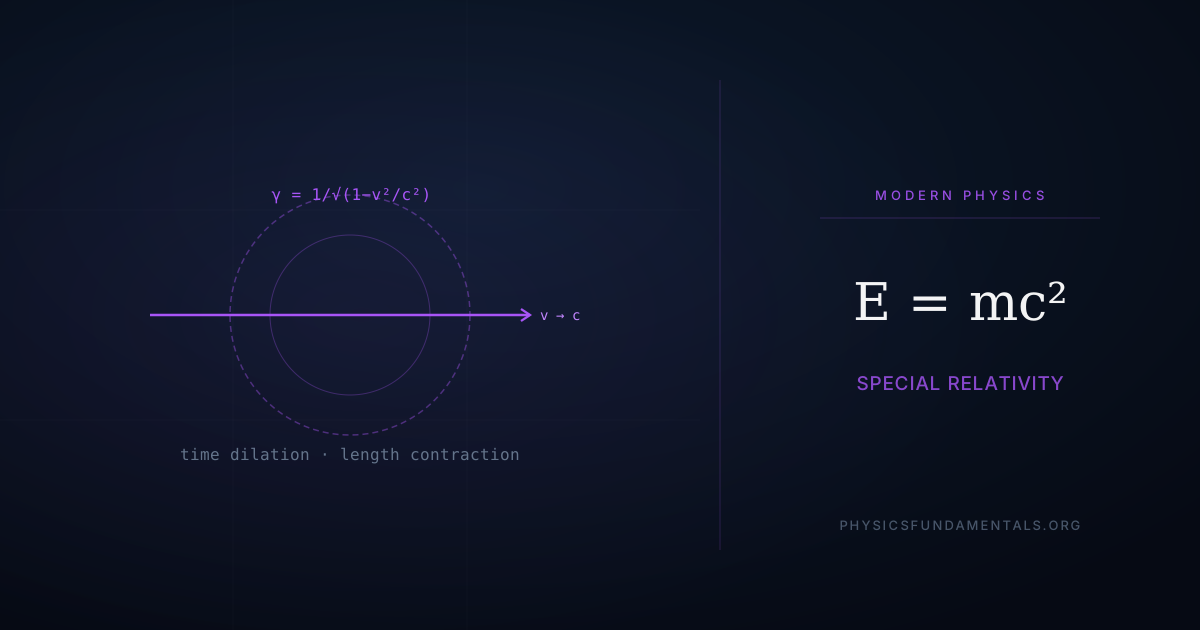
In 1905, Einstein was 26, working in a patent office, and had no academic position. He submitted four papers that year. One of them dismantled 200 years of assumptions about space and time. The central claim was startling: the speed of light is the same for all observers, regardless of how fast they're moving. From that single postulate, consequences follow that still feel wrong even after you've understood the maths — time running slower for moving clocks, moving objects shrinking in the direction of travel, mass and energy being the same thing.
Special relativity isn't just a correction for extreme speeds. Its effects are measured daily in GPS satellites, particle accelerators, and cosmic ray detectors. If you've ever used Google Maps, special relativity has already affected your life — the GPS system would accumulate errors of kilometres per day without relativistic corrections.
- Einstein's two postulates and why they force us to abandon absolute time
- Time dilation and length contraction — derived from first principles, not just stated
- The Lorentz factor γ and how to calculate relativistic effects at different speeds
- E = mc² — what it actually means and where it comes from
The Speed of Light: c = 3 × 10⁸ m/s
The second postulate is deeply counterintuitive. In everyday experience, speeds add: a ball thrown at 20 m/s from a car moving at 30 m/s has speed 50 m/s relative to the road. But light from a torch on a moving train travels at exactly c relative to the road — not c + train speed. This was confirmed by the Michelson-Morley experiment (1887), which found no variation in the speed of light regardless of Earth's direction of motion around the Sun.
Everything else in special relativity follows mathematically from accepting both postulates simultaneously.
The Lorentz Factor γ
The central quantity of special relativity is the Lorentz factor γ (gamma):
where v is the relative speed between frames. At low speeds (v ≪ c), γ ≈ 1 and relativistic effects are negligible. As v → c, γ → ∞. At v = 0.9c, γ ≈ 2.29. At v = 0.99c, γ ≈ 7.09. At v = 0.999c, γ ≈ 22.4.
| Speed v | v/c | Lorentz factor γ |
|---|---|---|
| Jet aircraft | ~10⁻⁶ | ≈ 1.0000000000005 |
| 0.5c | 0.5 | 1.155 |
| 0.9c | 0.9 | 2.294 |
| 0.99c | 0.99 | 7.089 |
| 0.9999c | 0.9999 | 70.7 |
Time Dilation: Moving Clocks Run Slow
A clock moving at speed v relative to an observer runs slower than a stationary clock by the Lorentz factor:
where Δt₀ is the proper time — the time measured by the moving clock (in its own rest frame) — and Δt is the time measured by the stationary observer. Since γ ≥ 1, Δt ≥ Δt₀: the observer sees the moving clock as running slow.
This is not a mechanical effect on the clock's gears — it is a property of time itself. All processes (mechanical, biological, chemical, nuclear) run slow in a moving frame.
Experimental confirmation: Muons from cosmic rays
Muons are unstable particles created in the upper atmosphere (about 15 km up) when cosmic rays hit air molecules. Their half-life is ~2.2 μs. At nearly c, they travel ~660 m in one half-life — so classically, almost none should reach sea level. Yet detectors at sea level measure muons in large numbers. Why? Time dilation: at v ≈ 0.998c (γ ≈ 15.8), their half-life in our frame is 15.8 × 2.2 μs ≈ 34.8 μs — long enough to travel the full 15 km. Time dilation is not a thought experiment. It is measured every day.
Length Contraction: Moving Objects Are Shorter
An object moving at speed v along its length appears contracted in the direction of motion:
where L₀ is the proper length (the length in the object's rest frame) and L is the length measured by the observer. The factor γ ≥ 1 means L ≤ L₀ — the object appears shorter. This contraction is only in the direction of motion; perpendicular dimensions are unaffected.
From the muon's own reference frame: it does not experience a longer half-life — it measures its proper time of ~2.2 μs. Instead, the distance it must travel appears contracted: 15 km / 15.8 ≈ 0.95 km. The contracted distance is covered comfortably within its half-life. Both observers (ground and muon) agree on the physical outcome (muon reaches the ground), though they use different explanations.
Relativistic Addition of Velocities
If a rocket moves at speed u relative to the ground, and fires a laser (at speed c) forward, the laser's speed relative to the ground is:
At low speeds this reduces to simple addition: u + v. For the laser: v_total = (u + c) / (1 + uc/c²) = (u + c)/(1 + u/c) = c. The speed of light remains c regardless of the rocket's speed. No matter how velocities are combined, the result can never exceed c.
Mass-Energy Equivalence: E = mc²
Perhaps the most famous equation in science follows directly from special relativity:
where E is the total energy (J), m is mass (kg), and c = 3 × 10⁸ m/s. This tells us that mass is a form of energy — they are different aspects of the same thing. The energy equivalent of even a tiny mass is enormous: 1 gram of matter contains E = 10⁻³ × (3 × 10⁸)² = 9 × 10¹³ J — equivalent to about 21 kilotons of TNT, roughly the yield of the atomic bomb dropped on Nagasaki.
The full relativistic energy-momentum relation is:
where p is relativistic momentum. For a stationary object (p = 0): E = mc² (rest energy). For a massless photon (m = 0): E = pc. For a moving massive object: total energy E = γmc², kinetic energy KE = (γ − 1)mc².
Why Nothing Can Travel at the Speed of Light
As an object with mass accelerates toward c, its relativistic energy E = γmc² increases. As v → c, γ → ∞, so the energy required → ∞. Reaching c would require infinite energy — impossible. The speed of light is an absolute speed limit for objects with mass. Massless particles (photons, gravitons) travel exactly at c. No massive particle can reach c; no particle of any kind can exceed c.
Real-World Applications of Special Relativity
The implications of special relativity extend into quantum mechanics — particularly in wave-particle duality and the photoelectric effect. GPS satellites: GPS clocks run fast due to gravitational time dilation (general relativity) and slow due to velocity-based time dilation (special relativity). The net effect without correction would cause GPS to accumulate ~10 km of positional error per day. GPS systems correct for both relativistic effects continuously.
Particle accelerators: The LHC accelerates protons to 0.9999999896c. At this speed, γ ≈ 7,460 — the protons are 7,460 times more massive (relativistic mass) than at rest, and their lifetime is 7,460 times longer. Relativistic mechanics is essential for designing all accelerator systems.
Nuclear energy: In nuclear fission and fusion, a small amount of mass is converted to energy via E = mc². In nuclear fission, uranium-235 loses about 0.1% of its mass per reaction — corresponding to ~200 MeV of energy per fission event. This mass defect, summed over 10²³ nuclei, powers nuclear reactors and bombs.
The Twin Paradox
Twin A stays on Earth; twin B travels to a star 10 light-years away at 0.9c and returns. Time dilation predicts B ages less than A. But from B's perspective, isn't A the one moving? Who actually ages less?
B ages less — this is unambiguous. The paradox resolves because the situation is not symmetric: B must decelerate, turn around, and re-accelerate — transitions between inertial frames that A does not experience. During the turnaround, simultaneity shifts dramatically in B's frame, effectively "jumping" A's clock forward. Both observers agree: when reunited, B is younger. For a 10 light-year journey at 0.9c (γ = 2.294), A ages ~22.2 years; B ages ~9.7 years — 12.5 years younger.
The Two Postulates
Einstein's special relativity (1905) rests on two postulates: (1) The laws of physics are identical in all inertial (non-accelerating) reference frames. (2) The speed of light c is the same for all inertial observers, regardless of the motion of the source or observer. These two simple statements, taken seriously, lead to time dilation, length contraction, relativity of simultaneity, and E = mc².
Frequently Asked Questions
What is special relativity?
What is time dilation?
What is length contraction?
What does E = mc² mean?
What is the Lorentz factor γ?
Why can't anything travel faster than light?
What is the difference between special and general relativity?
Share this article
Written by
Physics Fundamentals Editorial Team
Written and reviewed by our team of physics educators. Content is aligned with A-Level, GCSE, AP Physics, and undergraduate curricula.
About Physics Fundamentals →
Discussion
Comments
Leave a comment
Have a question about this article? Spot a mistake? Or just want to share your thoughts? We'd love to hear from you.
Keep learning physics fundamentals
Get new articles and platform updates delivered to your inbox.
Physics Fundamentals
👋 Get concise physics updates — new articles, calculators, and tools. Your number stays private. No spam. No group chats. Just worthy content.