Rub a balloon on your hair and it sticks to the wall. A lightning bolt crosses kilometres of air in microseconds. A nerve impulse travels along a neuron by moving charged ions. All of these — from the trivial to the spectacular — are consequences of a single property of matter: electric charge. And the force between charges follows a law so structurally similar to Newton's law of gravitation that the parallel is impossible to ignore.
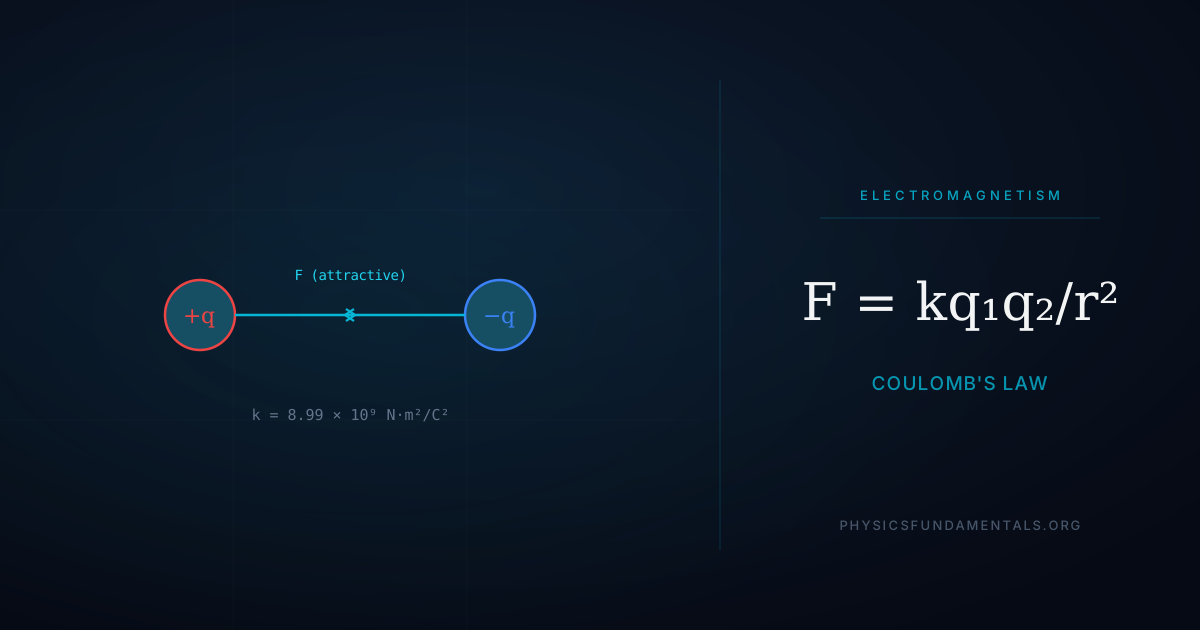
Coulomb's Law — F = kq₁q₂/r² — has the same inverse-square distance dependence as gravity, but with two crucial differences: it can be repulsive as well as attractive, and it is roughly 10³⁶ times stronger. That enormous strength is why electric forces dominate chemistry, biology, and materials science, even though gravity dominates cosmology.
- What electric charge is — the two types, quantisation, and conservation
- Coulomb's Law: the formula, what each term means, and how to apply it
- Why Coulomb's Law and Newton's gravity have the same mathematical form
- How to handle multiple charges using superposition
Electric Charge: The Basics
Atoms are neutral: equal protons (+e each) and electrons (−e each). Objects become charged by transferring electrons: gain electrons → negative; lose electrons → positive. Protons are fixed in nuclei; electrons are transferable.
Conservation of charge: charge is never created or destroyed, only transferred. When a rubber balloon is rubbed on wool, the balloon gains electrons (becomes negative) while the wool loses them (becomes equally positive). Total charge: unchanged.
Coulomb's Law
where k = 8.99 × 10⁹ N·m²/C² (Coulomb's constant), q₁ and q₂ are charges (C), and r is separation (m). The force is repulsive for like charges, attractive for unlike charges, acts along the line connecting the charges, and is equal and opposite on each charge (Newton's third law).
Coulomb's Law vs Gravity
| Property | Coulomb's Law | Gravity |
|---|---|---|
| Formula | F = kq₁q₂/r² | F = Gm₁m₂/r² |
| Distance law | 1/r² (inverse square) | 1/r² (inverse square) |
| Repulsion possible? | Yes (like charges) | No — always attractive |
| Relative strength | ~10³⁶ × stronger | Weakest fundamental force |
The electrostatic force between two protons is ~10³⁶ times stronger than their gravitational attraction. Gravity dominates at cosmic scales only because large masses accumulate and gravity is always attractive, while positive and negative charges tend to cancel in bulk matter.
Worked Examples
Example 1: Force between two charges
+3 μC and −2 μC separated by 0.10 m:
Example 2: Comparing electric and gravitational forces
Two protons (charge +e = 1.6 × 10⁻¹⁹ C, mass m_p = 1.67 × 10⁻²⁷ kg) separated by 10⁻¹⁰ m:
Ratio: F_e / F_g ≈ 1.24 × 10³⁶ — the electric force is 10³⁶ times stronger.
Conductors and Insulators
Conductors (metals, graphite): free electrons move easily. Charge distributes to the outer surface in electrostatic equilibrium. No net electric field inside a conductor at equilibrium — free charges rearrange until internal fields cancel. This is the principle behind Faraday cages: a conducting enclosure shields its interior from external electric fields.
Insulators (rubber, plastic, glass): electrons are tightly bound — charge stays where placed. Static electricity effects work because insulators retain charge without it spreading. Semiconductors (silicon) are intermediate — their conductivity can be controlled by doping or electric fields, the basis of all modern electronics.
The electric field E at a point is the force per unit positive test charge: E = F/q (N/C or V/m). For a point charge Q: E = kQ/r² directed radially outward (for +Q). The field concept is essential — it describes how charge influences the surrounding space. Force on any charge q in field E: F = qE.
Real-World Applications
Laser printers: electrostatic attraction transfers charged toner particles to paper in patterns corresponding to the printed image.
Electrostatic precipitators: charge particles in industrial exhaust; collect them on oppositely charged plates. Used in power stations to remove particulates before emission.
Lightning: charge separation in thunderclouds builds enormous potential differences. When the electric field exceeds ~3 × 10⁶ V/m (breakdown strength of air), plasma forms and charge discharges rapidly — a lightning bolt.
Van de Graaff generators: accumulate static charge on a conducting sphere for demonstrations and particle acceleration (Tandem generators reach millions of volts).
Worked Example: Distance for a Given Force
Two protons experience a repulsive force of 1.0 × 10⁻⁸ N. Find the separation. (q_proton = 1.6 × 10⁻¹⁹ C)
About 0.15 nm — roughly an atomic radius.
Charging Methods
Friction: rubbing a glass rod with silk transfers electrons, leaving the rod positively charged. Conduction: touching a charged object transfers charge. Induction: bringing a charged object near a neutral conductor redistributes charge without contact — the near side is attracted to the external charge, the far side is repelled. This is how lightning rods work: the charged cloud induces opposite charge on the rod tip, lowering the potential difference that drives a strike.
Electric Field from Coulomb's Law
The electric field E at a point is the force per unit positive charge: E = F/q = kQ/r². Coulomb's law gives the force on a test charge q₀ placed at distance r from charge Q: F = kQq₀/r², so E = kQ/r². Field lines point away from positive charges and toward negative ones. Superposition: the total field from multiple charges is the vector sum of each individual field. This is how molecular modelling and protein folding calculations work — summing Coulomb interactions between every pair of charged atoms.
Screening and the Dielectric Constant
In a material (not vacuum), Coulomb's law becomes F = kq₁q₂/(εr r²), where ε_r is the relative permittivity (dielectric constant). Water has ε_r ≈ 80 — the Coulomb force between charges in water is 80 times weaker than in vacuum. This is why ionic compounds dissolve in water: the electrostatic attraction holding the lattice together is drastically weakened by water's dielectric screening. For DNA in cell nuclei, the high dielectric constant of water allows charged phosphate groups to coexist without repelling each other violently.
The Superposition Principle
When multiple charges are present, the force on any one charge is the vector sum of the individual forces from each other charge — the charges don't interfere with each other's fields, each exerts its Coulomb force independently: F_total = F₁₂ + F₁₃ + F₁₄ + ... Each force is calculated separately using Coulomb's law, then added as vectors, accounting for direction. For three equal charges Q = +2 μC at the vertices of an equilateral triangle with side 0.3 m, symmetry means the two forces on any one charge from the other two have equal magnitude (F = kQ²/r² = 0.399 N each) and combine to a net force of 2 × 0.399 × cos30° = 0.691 N directed away from the midpoint of the opposite side.
Millikan's Oil Drop Experiment
Coulomb's law underlies one of the most important experiments in physics — Millikan's 1909 measurement of the electron charge. Tiny oil droplets carrying charge were held stationary in an electric field. At equilibrium, the upward electric force balanced gravity: qE = mg → q = mg/E. By measuring the terminal velocity (which gives the droplet radius and hence mass), and knowing the electric field, Millikan could calculate q for each droplet. He found that charge always came in integer multiples of a fundamental unit e = 1.592 × 10⁻¹⁹ C (close to the modern value 1.602 × 10⁻¹⁹ C) — the first direct evidence for the quantisation of electric charge.
Shielding and Faraday Cages
A conducting shell completely shields its interior from external electric fields. Any external charge rearranges on the outer surface of the conductor, and the resulting charge distribution cancels the external field inside. This is a Faraday cage — used to protect sensitive electronic equipment from electromagnetic interference, and why you are safe inside a car struck by lightning (the charge distributes over the car's conducting body, leaving the interior field-free). The principle is an exact consequence of Gauss's law (a more powerful generalisation of Coulomb's law) — the net field inside a closed conductor due to all external charges is exactly zero.
Charge Distribution and the Shell Theorem
Coulomb's law applies to point charges. For a uniformly charged sphere, the shell theorem (which also applies to electrostatics via Gauss's law, just as it does for gravitation) shows that outside the sphere, it behaves exactly as if all charge were concentrated at the centre; inside a uniformly charged spherical shell, the field is zero. This is why the Earth, planets, and atomic nuclei can be treated as point charges in many calculations — their spherical charge distribution means the external field is indistinguishable from a point charge at the centre.
Applications of Coulomb's Law
Atomic structure: Coulomb attraction between the positive nucleus and negative electrons holds atoms together. The hydrogen ground state has r = a₀ = 5.29 × 10⁻¹¹ m (Bohr radius); the Coulomb force there is F = ke²/a₀² = 8.2 × 10⁻⁸ N — enormous at the atomic scale. Chemical bonding: ionic bonds (NaCl) are electrostatic attraction between opposite ions. Covalent bonds involve shared electrons attracted to both nuclei. Van der Waals forces are temporary dipole-induced dipole Coulomb interactions. Electrostatic precipitators: industrial air cleaners that charge dust particles and attract them to oppositely charged plates, removing >99% of particulate pollutants from power station flue gases.
Exam Approach for Coulomb's Law Problems
Always: (1) identify all charges and their positions; (2) calculate the magnitude of each force using F = kQ₁Q₂/r²; (3) determine the direction of each force from the signs of the charges (like = repel, opposite = attract); (4) add all forces as vectors using components. For three or more charges, draw a diagram first, label each force with its direction, and use the component method. Symmetry arguments can save enormous calculation effort — if two equal charges are symmetrically placed relative to a third, their force components along the axis of symmetry add while perpendicular components cancel. One check that trips students up: verify that an equilibrium position makes physical sense against the geometry of attractive vs repulsive forces before trusting the algebra.
Try it yourself: check your own numbers with the Coulomb's Law Calculator, which shows the formula, the worked substitution and the answer step by step.
Frequently Asked Questions
What is Coulomb's Law?
What is the unit of electric charge?
Why is the electric force so much stronger than gravity?
How does Coulomb's Law differ from Newton's Law of Gravitation?
Is charge conserved?
What is the elementary charge?
What is the difference between a conductor and an insulator?
Share this article
Written by
Physics Fundamentals Editorial Team
Written and reviewed by our team of physics educators. Content is aligned with A-Level, GCSE, AP Physics, and undergraduate curricula.
About Physics Fundamentals →