The same force that makes an apple fall from a tree keeps the Moon in orbit. Newton realised this in the 1660s — that the Moon is essentially falling toward Earth continuously, but moving fast enough sideways that it keeps missing. That insight unified terrestrial and celestial mechanics for the first time in history.
Gravitational force is the attractive force that every object with mass exerts on every other object with mass. It is one of the four fundamental forces of nature, it always pulls objects together (never pushes them apart), and its strength depends on how much mass each object has and how far apart they are.
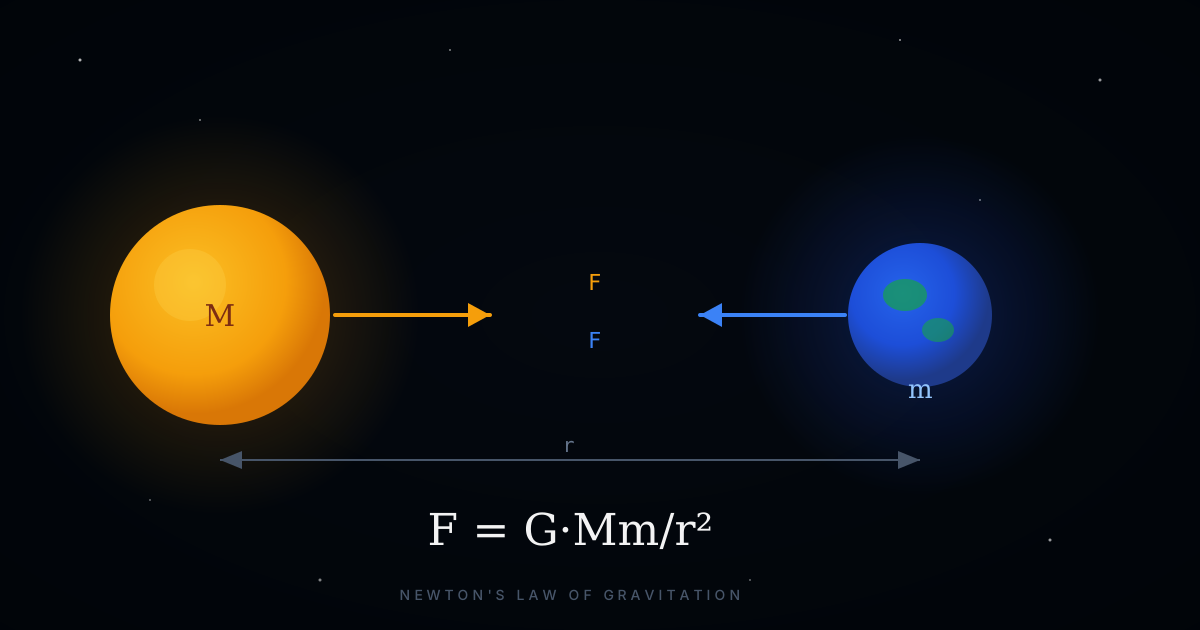
Newton's law of gravitation gives you a precise equation for the attractive force between any two masses. It's an inverse-square law, which means doubling the distance between objects reduces the force by a factor of four. This single relationship explains the orbits of planets, the trajectories of spacecraft, and the structure of galaxies.
- The formula F = Gm₁m₂/r² — what each term means and how to use it
- Why gravity is an inverse-square law and what that implies for orbits
- How to calculate gravitational field strength on different planets
- The connection between Newton's gravity and Kepler's laws of planetary motion
Newton's Law of Universal Gravitation
The gravitational force between two objects with masses m₁ and m₂ separated by distance r is:
Here, G is the universal gravitational constant: G ≈ 6.674 × 10⁻¹¹ N·m²/kg². Several things jump out immediately from this equation.
First, the force is always attractive — there is no gravitational repulsion. Unlike electric forces, which can push or pull depending on charge signs, gravity only pulls.
Second, the force follows an inverse-square law: doubling the distance between two objects reduces the gravitational force to one quarter. Triple the distance and the force drops to one ninth. This rapid falloff with distance means that while gravity is theoretically infinite in range, it becomes negligible at large distances. The Sun's gravity, though 27 times stronger at its surface than Earth's, decreases enough over 150 million km that Earth orbits at a manageable speed rather than spiraling inward.
Third, the force scales with the product of both masses. Earth pulls on you with the same force you pull on Earth — Newton's third law applied to gravity. But because Earth's mass is ~10²⁴ times yours, Earth's resulting acceleration (a = F/m) is utterly negligible while yours is 9.8 m/s².
Weight vs. Mass: The Critical Distinction
Mass is a fundamental property of an object — a measure of its inertia and the quantity of matter it contains. It is the same everywhere in the universe. Weight is the gravitational force exerted on an object by a nearby massive body (usually a planet). Weight depends on both the object's mass and the local gravitational field strength:
On Earth's surface, g ≈ 9.8 m/s². On the Moon, g ≈ 1.6 m/s². An astronaut with mass 80 kg weighs 784 N on Earth and only 128 N on the Moon — but their mass is 80 kg in both places. This distinction matters enormously in physics: when you apply Newton's second law (F = ma), the m is always mass, not weight.
Why Do All Objects Fall at the Same Rate?
Galileo famously demonstrated (or at least argued convincingly) that objects of different masses fall at the same rate, dropping the famous cannonball-and-musket-ball thought experiment. Newton's law explains why.
The gravitational force on an object is proportional to its mass (F = mg). The acceleration produced by that force is also inversely proportional to mass (a = F/m). The mass cancels exactly: a = mg/m = g. Every object, regardless of mass, accelerates at the same rate under gravity — 9.8 m/s² downward near Earth's surface. A bowling ball and a feather would hit the ground simultaneously in a vacuum — as demonstrated famously on the Moon by Apollo 15 astronaut David Scott in 1971. This is exactly the same independence of mass that appears in projectile motion.
Orbital Mechanics: Gravity as a Centripetal Force
An orbit is what happens when an object falls toward a planet but moves sideways fast enough that the planet's surface curves away beneath it at the same rate it falls. The gravitational force provides the centripetal force required for circular orbital motion:
This tells you the orbital speed needed for a circular orbit at radius r. At Earth's surface (ignoring atmosphere), this works out to about 7.9 km/s — roughly 28,000 km/h. The International Space Station orbits at about 400 km altitude and 7.66 km/s. GPS satellites orbit much higher at ~20,200 km and move more slowly at ~3.9 km/s. In every case, the energy analysis shows a beautiful balance: kinetic energy and gravitational potential energy sum to a constant total — the orbit is a perpetual energy exchange.
From Newton to Einstein
Newton's law of gravitation is extraordinarily accurate for everyday scales and speeds. It predicts planetary orbits, tidal forces, and satellite trajectories with exceptional precision. It breaks down only in extreme conditions: near very massive, compact objects (neutron stars, black holes) or at very high speeds. In those regimes, Einstein's general relativity — which describes gravity not as a force but as the curvature of spacetime — takes over. But for everything from a falling apple to a spacecraft trajectory, Newton's law is the tool of choice, and understanding it deeply is foundational to the physics fundamentals every student needs.
What Is Gravitational Force?
Gravitational force is the attractive force that acts between any two objects that have mass. It pulls them toward each other — the Earth pulls you down, you pull the Earth up (by an imperceptibly small amount), and the Sun pulls every planet in the solar system inward. Every object with mass exerts a gravitational pull on every other object with mass, across any distance, with no exceptions.
Three things make gravitational force unusual compared to other fundamental forces. First, it is always attractive — unlike electric force, which can repel as well as attract, gravity only ever pulls. Second, it is universal — it acts between all masses everywhere in the universe, not just between certain types of particles. Third, it is by far the weakest of the four fundamental forces, roughly 10³⁶ times weaker than electromagnetism — yet it dominates at cosmic scales because it has infinite range and acts on all matter without exception.
In everyday experience, you feel gravitational force as weight — the pull of Earth's gravity on your body. On the scale of solar systems and galaxies, it is the force that governs every orbit, every trajectory, and the large-scale structure of the universe.
Worked Example 1: Gravitational Force Between Earth and Moon
m_Earth = 5.97 × 10²⁴ kg, m_Moon = 7.34 × 10²² kg, r = 3.84 × 10⁸ m.
This enormous force keeps the Moon in orbit, producing a centripetal acceleration of 2.73 × 10⁻³ m/s² — about 1/3600 of g at Earth's surface.
Worked Example 2: Surface Gravity
Derive g at Earth's surface from Newton's Law. m_Earth = 5.97 × 10²⁴ kg, R_Earth = 6.371 × 10⁶ m.
The slight difference from 9.8 m/s² reflects Earth's non-uniform density and rotation.
Gravitational Field Strength
Gravitational field strength g at distance r from mass M is:
This is the acceleration due to gravity at that point. At Earth's surface: 9.8 m/s². At 400 km altitude (ISS): g = GM/(R+h)² = 9.8 × (6371/(6771))² = 9.8 × 0.886 = 8.68 m/s². The ISS is still under ~89% of surface gravity — astronauts feel weightless because they are in free fall, not because gravity is absent.
Orbital Mechanics from F = Gm₁m₂/r²
For a circular orbit, gravitational force provides centripetal force:
Orbital speed decreases with distance — further orbits are slower. For Earth: a 400 km orbit requires v = √(GM/(R+h)) = 7.67 km/s. A geostationary orbit (35,786 km altitude) requires only 3.07 km/s. Kepler's Third Law follows: T² ∝ r³.
Tidal Forces and the Roche Limit
Gravity doesn't just attract — it creates differential forces across extended objects. The Moon's gravity is stronger on the near side of Earth than the far side (because of the inverse-square law). This differential — the tidal force — stretches Earth into a slightly prolate shape and is responsible for ocean tides. The tidal acceleration across an object of diameter d at distance r from mass M is approximately: a_tidal ≈ 2GMd/r³. The Roche limit is the minimum distance at which a self-gravitating body (held together by its own gravity) can survive in the tidal field of a larger body. Saturn's rings exist within Saturn's Roche limit — any moon there would be shredded by tidal forces.
Escape Velocity from F = Gm₁m₂/r²
The minimum speed to escape a planet's gravity well (ignoring atmosphere) follows from energy conservation. At the surface, the object has kinetic energy KE = ½mv² and gravitational PE = −GMm/R. At infinity, both are zero. Setting total energy = 0:
For Earth: v_esc = √(2 × 6.674 × 10⁻¹¹ × 5.97 × 10²⁴ / 6.371 × 10⁶) = 11,185 m/s ≈ 11.2 km/s. For the Moon (weaker gravity, smaller mass): 2.38 km/s. For the Sun: 617.5 km/s. Black holes have escape velocity > c — which is why nothing, not even light, can escape from within the event horizon. Use the escape velocity calculator to compute this for any body.
Black Holes: When Escape Velocity Exceeds c
If a mass M is compressed into a sufficiently small radius r_s (the Schwarzschild radius), the escape velocity reaches c — the speed of light. Nothing, not even light, can escape. This is a black hole:
For the Sun (M = 2 × 10³⁰ kg): r_s ≈ 3 km. The Sun would need to be compressed from its actual radius of 696,000 km into a sphere 3 km across to form a black hole. Earth's Schwarzschild radius is about 9 mm. Newton's formula gives the right Schwarzschild radius through a fortunate coincidence — the full calculation requires general relativity — but it illustrates how Newton's law of gravitation naturally leads to the concept of objects from which light cannot escape.
Kepler's Laws from Newton's Gravitation
All three of Kepler's laws follow from F = Gm₁m₂/r². First law (elliptical orbits): circular orbits are a special case; the general solution to the two-body gravitational problem is a conic section (ellipse, parabola, or hyperbola). Second law (equal areas in equal times): conservation of angular momentum (since gravity is a central force with no torque). Third law (T² ∝ r³): for circular orbits, setting GMm/r² = mv²/r and T = 2πr/v gives T² = 4π²r³/(GM) → T² ∝ r³.
Common Mistakes with Gravitational Force Problems
Using diameter instead of radius. r in F = Gm₁m₂/r² is the centre-to-centre distance — for objects near Earth's surface, this is Earth's radius (~6,371 km), not diameter. Using diameter gives a force four times too small.
Confusing G and g. G = 6.674 × 10⁻¹¹ N·m²·kg⁻² is the universal gravitational constant (appears in F = Gm₁m₂/r²). g = 9.8 m/s² is the local acceleration due to gravity at Earth's surface (derived from G via g = GM/R²). G is universal; g is local and varies with location.
Forgetting the inverse-square relationship. Double the distance and the gravitational force drops to ¼, not ½. This is easy to miss in calculations — always square the distance ratio when comparing forces at different distances.
Frequently Asked Questions
What is Newton's Law of Universal Gravitation?
What is the gravitational constant G?
How is g related to G?
Why is gravity an inverse-square law?
How does Newton's gravity differ from Einstein's general relativity?
Share this article
Written by
Physics Fundamentals Editorial Team
Written and reviewed by our team of physics educators. Content is aligned with A-Level, GCSE, AP Physics, and undergraduate curricula.
About Physics Fundamentals →