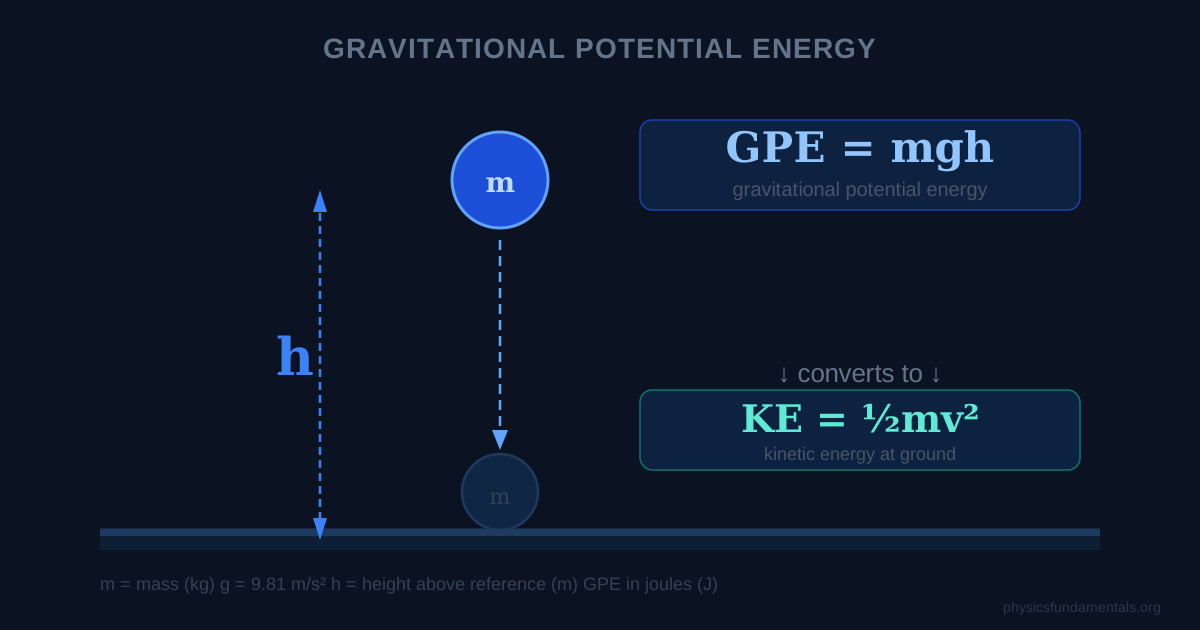
Gravitational potential energy (GPE) is the energy stored in an object due to its position in a gravitational field. The formula is GPE = mgh, where m is mass in kilograms, g is gravitational field strength (9.81 m/s² on Earth's surface), and h is height above a reference point in metres. Lift a 2 kg book 1.5 m off a desk and it gains 2 × 9.81 × 1.5 = 29.4 J of gravitational potential energy.
GPE matters because it converts directly into kinetic energy when objects fall. That energy exchange — potential to kinetic and back — is one of the most powerful tools in mechanics, letting you solve problems about falling objects, pendulums, roller coasters, and projectiles without tracking forces at every instant.
- The GPE = mgh formula — what each variable means and its SI unit
- Where the formula comes from — derived from work done against gravity
- How GPE converts to kinetic energy, with the combined energy equation
- 4 worked examples covering falling objects, pendulums, and inclined planes
- The more precise formula for large heights: GPE = −GMm/r
What Is Gravitational Potential Energy? — Definition
Gravitational potential energy is the energy an object possesses due to its position in a gravitational field. It is a form of stored energy that can be converted into kinetic energy. Near Earth's surface: GPE = mgh. The SI unit is the joule (J). GPE is always measured relative to a chosen reference level — it's the change in GPE that matters in calculations, not the absolute value.
The key word is "potential" — this energy is stored, not active. A boulder perched at the top of a cliff has enormous gravitational potential energy. The moment it falls, that stored energy converts to kinetic energy. At the bottom of the cliff (if we set that as our reference height), the GPE is zero and all the original energy is kinetic — assuming no air resistance.
GPE is a scalar quantity: it has magnitude but no direction. It's also a state function — it depends only on the current position of the object, not on the path taken to get there. Whether you lift a box straight up or carry it up a winding staircase to the same height, the gain in GPE is identical.
The GPE = mgh Formula Explained
Where:
- GPE = gravitational potential energy, measured in joules (J)
- m = mass of the object, measured in kilograms (kg)
- g = gravitational field strength, measured in N/kg or m/s² (9.81 m/s² on Earth's surface; 1.62 m/s² on the Moon; 3.72 m/s² on Mars)
- h = height above the chosen reference level, measured in metres (m)
Rearranging for each variable:
Use our Gravitational Potential Energy Calculator to solve for GPE, mass, or height with any unit system.
Why h is measured from a reference level, not the ground
The formula only gives a meaningful answer when h is measured from a consistently defined reference point. In most school problems, the reference level is the ground, the floor, or the lowest point of motion — wherever is most convenient. The choice doesn't affect the physics because only changes in GPE matter:
Set the ground as your reference (h = 0) for falling objects. Set the lowest point of a pendulum's swing as your reference for oscillation problems. The numbers will be different, but the change in GPE — and therefore the kinetic energy gained — will be the same.
Derivation of GPE = mgh
The formula isn't handed down from authority — it's derived directly from the definition of work. Work is the energy transferred when a force acts over a displacement. To lift an object of mass m through a height h at constant velocity (so no kinetic energy change), you must apply an upward force equal to the object's weight:
The work done by this force over height h is:
Since no kinetic energy changes (constant velocity), all the work done goes into stored potential energy. Therefore:
This derivation assumes g is constant — valid near Earth's surface where h is small compared to Earth's radius (6,371 km). For large heights, g decreases with distance and a more precise formula is needed (see below).
GPE and Kinetic Energy — The Energy Exchange
The most powerful application of GPE is its conversion to kinetic energy. In the absence of friction and air resistance, total mechanical energy is conserved:
At the top of a fall (height h, speed v₀ = 0) and at the bottom (height 0, speed v):
The mass cancels — the speed at the bottom of a fall is independent of mass. A feather and a bowling ball dropped from the same height in a vacuum reach the ground at the same speed. This is one of Galileo's great discoveries, confirmed by the conservation of energy.
4 Worked Examples
Example 1 — GPE of a book on a shelf
Problem: A 0.8 kg textbook sits on a shelf 1.2 m above the floor. Calculate its gravitational potential energy relative to the floor. (g = 9.81 m/s²)
Solution:
GPE = mgh
GPE = 0.8 × 9.81 × 1.2
GPE = 9.42 J
If the book falls, this 9.42 J converts entirely to kinetic energy just before it hits the floor (ignoring air resistance).
Example 2 — Speed of a falling object
Problem: A 3 kg rock falls from a cliff 45 m high. What is its speed just before hitting the ground? (g = 9.81 m/s²)
Solution:
Using conservation of energy: mgh = ½mv²
The mass cancels: gh = ½v²
v² = 2gh = 2 × 9.81 × 45 = 882.9
v = √882.9 = 29.7 m/s
Note: the mass of the rock is irrelevant. Any object falling 45 m reaches 29.7 m/s.
Example 3 — Pendulum at maximum height
Problem: A pendulum bob of mass 0.5 kg swings from rest at a point 0.3 m above its lowest position. What is its speed at the lowest point?
Solution:
At highest point: KE = 0, GPE = mgh = 0.5 × 9.81 × 0.3 = 1.47 J
At lowest point: GPE = 0, KE = ½mv²
Conservation of energy: ½mv² = 1.47
v² = 2 × 1.47 / 0.5 = 5.886
v = √5.886 = 2.43 m/s
Example 4 — Object on an inclined plane
Problem: A 5 kg trolley rolls down a frictionless ramp inclined at 30° to the horizontal. The ramp is 6 m long. Find the speed of the trolley at the bottom.
Solution:
Vertical height: h = 6 × sin(30°) = 6 × 0.5 = 3 m
GPE lost = mgh = 5 × 9.81 × 3 = 147.15 J
This equals KE gained: ½mv² = 147.15
v² = 2 × 147.15 / 5 = 58.86
v = √58.86 = 7.67 m/s
The angle only matters for finding the vertical height — everything else follows from the energy equation.
GPE on Other Planets
The formula GPE = mgh works on any planet — you just substitute the appropriate value of g:
- Earth: g = 9.81 m/s²
- Moon: g = 1.62 m/s² (about 1/6 of Earth's)
- Mars: g = 3.72 m/s²
- Jupiter: g = 24.8 m/s²
An astronaut who can jump 0.5 m high on Earth can jump about 3 m high on the Moon — same initial kinetic energy from leg muscles, but GPE = mgh means a much smaller g gives much more height per joule.
The Precise Formula: GPE = −GMm/r
The mgh formula assumes g is constant, which holds near Earth's surface. For large heights — satellites, rockets, anything where the distance from Earth's centre changes significantly — you need the full formula from Newton's law of gravitation:
Where:
- G = universal gravitational constant = 6.674 × 10⁻¹¹ N·m²/kg²
- M = mass of the planet or large body (kg)
- m = mass of the object (kg)
- r = distance from the centre of the planet to the object (m)
The negative sign is important: GPE is defined as zero at infinite distance (r → ∞) and becomes increasingly negative as the object gets closer to the planet. This is a convention, not an error — it ensures that bound systems (where the object doesn't escape) have negative total energy.
The mgh formula is recovered as an approximation: near Earth's surface, r ≈ R (Earth's radius), and the change in GPE for a small height h is:
Common Mistakes with GPE
Mistake 1 — Forgetting the reference level. GPE is meaningless without a reference. If a problem says "the object has GPE of 500 J", it must specify "above the floor" or "above the ground" or some reference. Always state or identify your reference level before calculating.
Mistake 2 — Using height instead of vertical height. On inclined planes, h is the vertical height gained, not the distance along the slope. Use h = L·sin(θ) where L is the slope length and θ is the angle to the horizontal.
Mistake 3 — Including mass in the energy conservation equation when it cancels. When GPE = KE (both sides have m), divide through immediately. Don't carry m through the calculation unnecessarily — it cancels and the speed at the bottom is independent of mass.
Mistake 4 — Using g = 10 m/s² without checking. Some exam boards permit g = 10 m/s² for quick estimates; others require 9.81. Check your specification. Using 10 introduces a 2% error.
Real-World Applications of GPE
Hydroelectric power stations store energy by pumping water uphill into a reservoir (increasing GPE) and release it by letting water fall through turbines (converting GPE to kinetic energy to electrical energy). Pumped-storage hydro is currently the world's largest form of grid-scale energy storage.
Roller coasters are almost entirely designed around GPE and KE exchange. The first hill is the tallest — it stores maximum GPE which powers every subsequent drop, loop, and turn. Friction losses mean later hills must be progressively shorter.
Wrecking balls are lifted (gaining GPE) and then swung or dropped (converting to kinetic energy) to demolish structures. The height of the lift directly determines the impact energy.
Ski jumping athletes maximise their GPE at the top of the ramp and convert it to kinetic energy during the descent, then to projectile motion off the jump. The physics of projectile motion takes over once they leave the ramp.
Gravitational Slingshot — Using GPE in Practice
The gravity assist manoeuvre exploits gravitational potential energy to accelerate spacecraft without burning fuel. As a spacecraft approaches a planet, it falls into the planet's gravitational potential well and gains kinetic energy. As it recedes on the far side, it climbs out of the well and loses kinetic energy. In the planet's reference frame, speed in equals speed out (elastic encounter). But in the Sun's reference frame, the spacecraft arrives moving in the same direction as the planet and leaves moving faster — the planet's orbital velocity has been partially transferred to the spacecraft. The net effect: the spacecraft gains heliocentric speed by borrowing from the planet's enormous orbital kinetic energy (the planet slows imperceptibly). Voyager 2 used Jupiter, Saturn, Uranus, and Neptune slingshots to reach 15.4 km/s heliocentric speed — twice what chemical rockets alone could have achieved.
Gravitational PE and Tidal Heating
When a moon's orbit is not perfectly circular, its distance from the parent planet varies. Its gravitational PE therefore oscillates — and so does the tidal deformation of the moon. This oscillating deformation converts orbital energy (GPE + KE) to heat through internal friction. Jupiter's moon Io experiences this so severely — four Jupiter-mass moons perturb its orbit into an ellipse — that it is the most volcanically active body in the solar system. Its surface temperature rises and falls, and sulphur volcanoes continuously resurface it. The power dissipated in Io (~10¹⁴ W) comes entirely from the conversion of gravitational potential energy via tidal friction.
Worked Example 5 — Energy to raise a satellite to GEO
Problem: Find the minimum energy needed to move a 1000 kg satellite from a 400 km low-Earth orbit to geostationary orbit at 42,200 km above Earth's centre. (R_E = 6.37 × 10⁶ m, M_E = 5.97 × 10²⁴ kg, G = 6.674 × 10⁻¹¹)
Solution:
r₁ = 6.37 × 10⁶ + 400,000 = 6.77 × 10⁶ m
r₂ = 42.2 × 10⁶ m
Total orbital energy: E = −GMm/(2r)
E₁ = −6.674 × 10⁻¹¹ × 5.97 × 10²⁴ × 1000/(2 × 6.77 × 10⁶) = −2.944 × 10¹⁰ J
E₂ = −6.674 × 10⁻¹¹ × 5.97 × 10²⁴ × 1000/(2 × 42.2 × 10⁶) = −4.726 × 10⁹ J
ΔE = E₂ − E₁ = −4.726 × 10⁹ − (−2.944 × 10¹⁰) = 2.47 × 10¹⁰ J ≈ 24.7 GJ
This energy is provided by two rocket burns (Hohmann transfer) — the actual propellant mass required depends on the engine's specific impulse.
Frequently Asked Questions
What is the formula for gravitational potential energy?
What is gravitational potential energy in simple terms?
What are the units of gravitational potential energy?
Does gravitational potential energy depend on mass?
What is the difference between gravitational potential energy and gravitational potential?
Can gravitational potential energy be negative?
Share this article
Written by
Physics Fundamentals Editorial Team
Written and reviewed by our team of physics educators. Content is aligned with A-Level, GCSE, AP Physics, and undergraduate curricula.
About Physics Fundamentals →