Sit on a train moving at 100 km/h and drop a ball straight down: to you, it falls straight down, exactly as SUVAT predicts. To someone standing on the platform watching the train go by, that same ball traces a curved path, moving forward at 100 km/h while it falls. Neither observer is wrong — velocity is never an absolute quantity, only a quantity measured relative to something. Relative velocity is the tool that lets you move cleanly between different observers' points of view, and it turns out to be exactly the same vector addition and subtraction you already use for forces and displacements, just applied to velocity instead.
- The relative velocity formula in one dimension, and how to handle sign conventions correctly
- Relative velocity in two dimensions as full vector subtraction
- The classic river-crossing problem, solved two different ways
- 4 fully worked examples, from closing speeds between cars to a boat crossing a current
- Why relative velocities simply add at everyday speeds, and what changes close to the speed of light
The Relative Velocity Formula
The velocity of object A relative to object B is the vector difference between their velocities, both measured in the same reference frame:
This says exactly what it looks like it says: to find how fast A appears to move from B's point of view, subtract B's velocity from A's. If both velocities are measured relative to the ground, the result is A's velocity relative to B — which is the same as saying "how fast would B see A moving, if B could ignore its own motion and treat itself as stationary." This single formula covers every relative velocity problem, from cars on a motorway to spacecraft rendezvous.
Relative Velocity in One Dimension
Along a single line, relative velocity reduces to simple addition or subtraction, provided you're careful and consistent with sign convention (pick a positive direction and stick to it for the whole problem). Two objects moving toward each other have velocities of opposite sign, so their relative velocity — the closing speed — is the sum of their individual speeds. Two objects moving the same way have velocities of the same sign, so their relative velocity is the difference of their speeds. This single rule, correctly signed, handles every 1D relative motion scenario: overtaking, closing speeds, and objects moving apart.
Worked Example 1: Two Cars Approaching Each Other
Car A travels east at 25 m/s. Car B travels west at 20 m/s. Find the velocity of A relative to B.
Taking east as positive: v_A = +25 m/s, v_B = −20 m/s.
The cars close the distance between them at 45 m/s (162 km/h) — the sum of their individual speeds, because they're moving toward each other. This is exactly why closing speeds in head-on scenarios (and head-on collision severity) are so much higher than either vehicle's individual speed, which is the physical reason head-on collisions are disproportionately dangerous compared to same-direction ones at similar individual speeds.
Worked Example 2: Overtaking on a Motorway
Car C travels at 30 m/s. Car D travels in the same direction at 22 m/s. Find the velocity of C relative to D.
Taking the direction of travel as positive: v_C = +30 m/s, v_D = +22 m/s.
From D's point of view, C is only approaching at 8 m/s — far gentler than the 45 m/s closing speed in the head-on example, even though both cars here are moving faster individually. This is the everyday experience of overtaking: it feels gradual because the relative velocity involved is only the difference in speeds, not the sum.
Relative Velocity in Two Dimensions
In two dimensions, the same formula v_AB = v_A − v_B applies, but now as full vector subtraction: resolve each velocity into components, subtract component by component, then recombine into a magnitude and direction if needed. This is exactly the same vector arithmetic used for resolving forces, so if you're comfortable with 2D force problems, 2D relative velocity uses identical technique — the only difference is that you're subtracting velocity vectors instead of adding force vectors.
Worked Example 3: A Boat Crossing a River
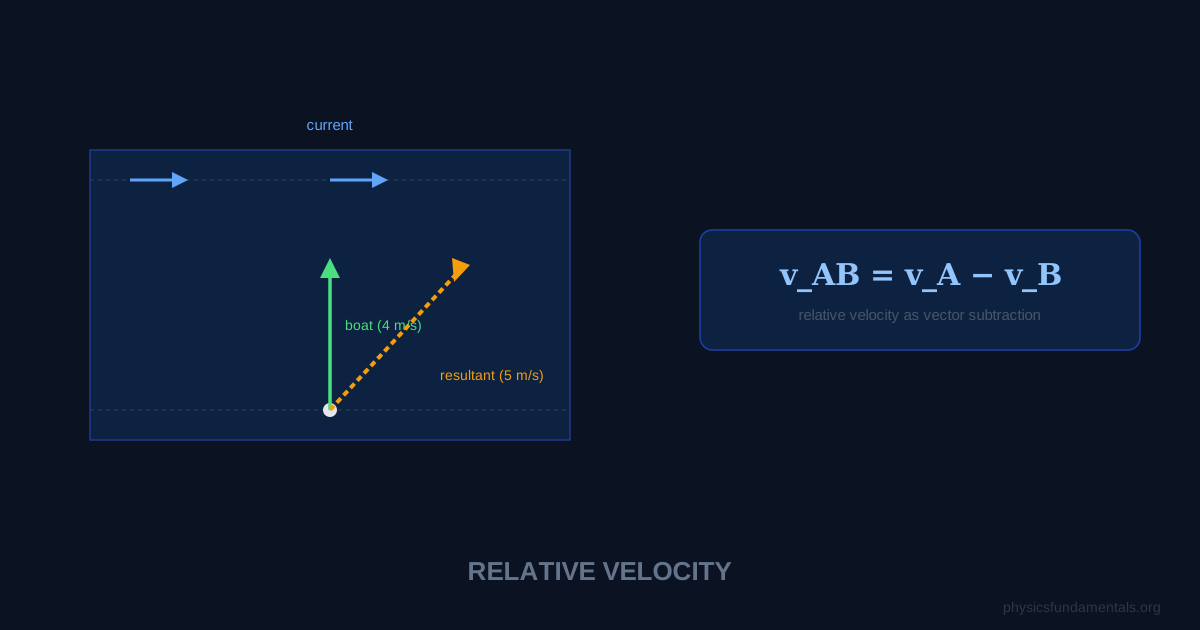
A boat can travel at 4 m/s relative to the water. It's aimed straight across a river 200 m wide, flowing at 3 m/s. Find the time to cross, the downstream drift, and the boat's resultant speed relative to the riverbank.
The boat's velocity relative to the ground is its velocity relative to the water plus the water's velocity relative to the ground (v_boat,ground = v_boat,water + v_water,ground) — the crossing speed (4 m/s) and the downstream drift speed (3 m/s) are perpendicular components that don't interact:
The boat takes 50 seconds to cross, lands 150 m downstream of directly opposite its starting point, and moves at a resultant 5 m/s relative to the bank — the hypotenuse of the 3-4-5 triangle formed by the crossing velocity and the current, tracing a straight diagonal path as seen from the shore even though the boat's bow points straight across the whole time.
Worked Example 4: Compensating for the Current
The same river (current 3 m/s, width 200 m), but now the boat has a faster engine, capable of 5 m/s relative to the water, and the pilot wants to land directly opposite the starting point — straight across, no drift. Find the angle to steer and the time taken.
To cancel the current exactly, the boat's upstream velocity component must equal the current's speed: v_boat sinθ = v_current, where θ is measured from the straight-across direction, angled upstream.
Steering 36.9° upstream exactly cancels the drift, but notice the crossing time is still 50 seconds — identical to the uncompensated case in Worked Example 3, even though the boat is faster and travelling a longer diagonal path through the water. The extra speed goes entirely into fighting the current, not into crossing faster; only the component of velocity perpendicular to the bank actually gets the boat across.
Relative Velocity in Projectile and Circular Motion
The same vector-subtraction approach applies wherever two objects move independently and you need one object's motion as seen from the other. A ball thrown from a moving vehicle has a velocity relative to the ground equal to its velocity relative to the vehicle plus the vehicle's velocity — exactly the boat-and-current addition, just relabelled, and the reason a ball tossed straight up inside a moving car lands back in the thrower's hand rather than flying toward the rear window: relative to the car, its horizontal velocity is genuinely zero throughout the flight, even though relative to the ground it's moving forward at the car's speed the entire time, tracing the same parabolic path any projectile follows. Two objects in circular motion — planets, satellites, or objects on a spinning platform — have a relative velocity that changes continuously in direction even when each object's individual speed is constant, since v_AB = v_A − v_B must be recomputed at every instant as each velocity vector's direction rotates.
Common Mistakes
Forgetting sign convention in 1D problems. Always define a positive direction explicitly before starting, and keep every velocity's sign consistent with it — most 1D relative velocity errors come from silently flipping a sign partway through. Adding speeds instead of subtracting velocity vectors. v_AB = v_A − v_B is a vector subtraction, not a magnitude subtraction — in 2D, you cannot just subtract the speeds and ignore direction; you must resolve into components first. Confusing "velocity relative to water" with "velocity relative to ground" in river-crossing problems. The boat's engine sets its velocity relative to the water, not the ground — the ground-frame velocity only appears after adding the current's velocity, which is precisely the step that introduces drift.
Reference Frames and Why This All Works
Relative velocity works this cleanly because, at everyday (non-relativistic) speeds, velocities measured in different reference frames simply add and subtract as ordinary vectors — a principle called Galilean relativity. If you walk forward at 1 m/s inside a train moving at 30 m/s, your velocity relative to the ground is simply 31 m/s: straightforward vector addition, no complications. This isn't a coincidence or an approximation that happens to work for small numbers — it follows directly from treating time as absolute (the same for every observer), which is an excellent approximation at everyday speeds and the assumption every SUVAT and Newtonian mechanics problem implicitly relies on.
Where Simple Addition Breaks Down
Galilean velocity addition is only an approximation, and it fails as speeds approach the speed of light. Special relativity replaces simple addition with v_total = (u + v)/(1 + uv/c²), which guarantees that no combination of velocities can ever exceed c, no matter how the speeds are combined — a laser fired forward from a spaceship travelling at 0.9c still measures at exactly c to an outside observer, not 1.9c. At everyday speeds, the uv/c² correction term is so vanishingly small that Galilean addition and the full relativistic formula are indistinguishable to any measurement precision that matters — which is exactly why ordinary relative velocity problems never need to worry about relativity at all, and why the simple v_AB = v_A − v_B formula remains the correct tool for every car, boat, and aircraft problem you'll ever meet outside a particle accelerator.
Real-World Applications
Air traffic control and navigation: pilots must account for wind velocity (analogous to river current) to determine the heading needed to reach a destination along a straight ground track, using exactly the compensating-angle method from Worked Example 4. Radar and collision avoidance: a ship's radar measures other vessels' velocities relative to itself, and closing speed calculations (as in Worked Example 1) determine how much time is available to react. Orbital rendezvous: spacecraft docking requires matching relative velocity to zero — two spacecraft can be moving at many kilometres per second relative to Earth, but docking only requires their relative velocity to each other to approach zero.
Try it yourself: check your own numbers with the Relative Velocity Calculator, which shows the formula, the worked substitution and the answer step by step.
Frequently Asked Questions
What is relative velocity?
What is the formula for relative velocity?
How do you solve a river-crossing (boat and current) problem?
Why is the closing speed between two approaching cars the sum of their speeds?
Do velocities always simply add together?
What is the difference between velocity relative to water and velocity relative to ground?
Why does compensating for a current not make the crossing faster?
Share this article
Written by
Physics Fundamentals Editorial Team
Written and reviewed by our team of physics educators. Content is aligned with A-Level, GCSE, AP Physics, and undergraduate curricula.
About Physics Fundamentals →