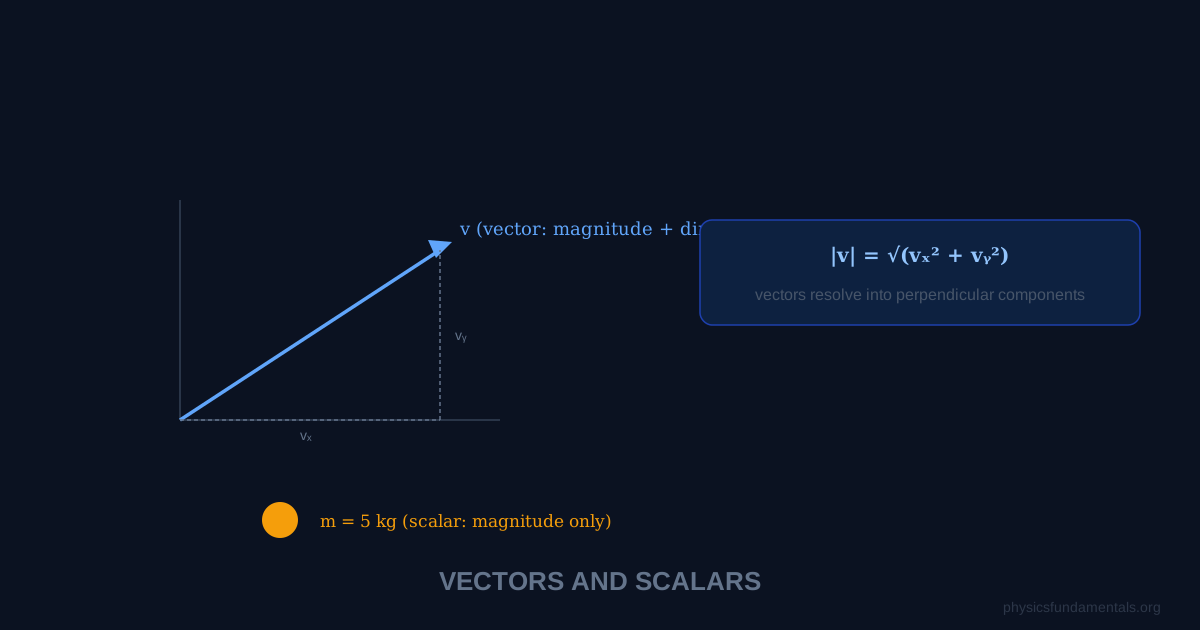
A vector is a quantity that has both magnitude and direction; a scalar has magnitude only. Velocity (50 m/s north) is a vector; speed (50 m/s) is a scalar. Force, displacement, acceleration, and momentum are all vectors. Mass, temperature, energy, and time are scalars. The distinction matters enormously — two 10 N forces can produce a net force of anywhere from 0 to 20 N depending on their directions, which is impossible with scalars.
Every equation in mechanics involves this distinction implicitly. Newton's second law F = ma is a vector equation on both sides. The work done by a force is a scalar formed by combining two vectors. Getting comfortable with vector arithmetic — resolving, adding, finding resultants — is the foundation that makes the rest of mechanics work.
- Vectors vs scalars — the defining distinction with a full table of examples
- Resolving a vector into perpendicular components using trigonometry
- Adding vectors by the component method — the most reliable approach
- Finding resultant magnitude and direction from components
- 4 worked examples including force resolution, resultants, and relative velocity
Vectors vs Scalars — The Definitive List
Scalar: described completely by a magnitude (a number and unit). Adding scalars uses ordinary arithmetic.
Vector: described by a magnitude AND a direction. Adding vectors requires accounting for direction — two equal and opposite vectors sum to zero.
| Vectors | Scalars |
|---|---|
| Displacement (m, with direction) | Distance (m) |
| Velocity (m/s, with direction) | Speed (m/s) |
| Force (N, with direction) | Mass (kg) |
| Acceleration (m/s²) | Temperature (K or °C) |
| Momentum (kg·m/s) | Kinetic energy (J) |
| Electric field (N/C) | Electric potential (V) |
| Gravitational field (N/kg) | Gravitational potential (J/kg) |
| Magnetic field (T) | Power (W) |
Vector Notation
Vectors are written in bold (F, v, a) or with an arrow overhead (F⃗). Their magnitude is written in italics (F, v, a) or with vertical bars (|F|). In component form using unit vectors î, ĵ, k̂ along the x, y, z axes: F = Fₓî + Fᵧĵ + Fzk̂.
A negative sign in front of a vector doesn't mean the magnitude is negative — it means the direction is reversed. If F = 10 N east, then −F = 10 N west. The magnitude |F| = 10 N in both cases.
Resolving a Vector into Components
Any vector can be split into two perpendicular components — almost always horizontal and vertical. For a vector of magnitude A at angle θ above the horizontal:
And to reverse the process — finding magnitude and direction from components:
The angle is measured from the positive x-axis (horizontal) anticlockwise. Be careful with the quadrant — arctan alone doesn't tell you which quadrant the vector is in. Always sketch a diagram and check the signs of Aₓ and Aᵧ to confirm the direction.
Adding Vectors — The Component Method
The most reliable method for adding any number of vectors:
- Resolve each vector into horizontal (x) and vertical (y) components.
- Sum all x-components: Rₓ = A₁ₓ + A₂ₓ + A₃ₓ + ...
- Sum all y-components: Rᵧ = A₁ᵧ + A₂ᵧ + A₃ᵧ + ...
- Find the resultant magnitude: R = √(Rₓ² + Rᵧ²)
- Find the direction: θ = arctan(Rᵧ / Rₓ) — check quadrant.
An alternative — the tip-to-tail (triangle) method — draws vectors head to tail and the resultant goes from the first tail to the last head. Useful for quick diagrams but less precise than the component method for calculation.
4 Worked Examples
Example 1 — Resolving a single force
Problem: A force of 60 N acts at 40° above the horizontal. Find its horizontal and vertical components.
Solution:
Fₓ = 60 cos40° = 60 × 0.766 = 45.96 N (horizontal)
Fᵧ = 60 sin40° = 60 × 0.643 = 38.57 N (vertical)
Check: √(45.96² + 38.57²) = √(2112 + 1488) = √3600 = 60 N ✓
Example 2 — Resultant of two perpendicular forces
Problem: Two forces act on an object: F₁ = 30 N due east, F₂ = 40 N due north. Find the resultant force.
Solution:
Rₓ = 30 + 0 = 30 N
Rᵧ = 0 + 40 = 40 N
|R| = √(30² + 40²) = √(900 + 1600) = √2500 = 50 N
θ = arctan(40/30) = arctan(1.333) = 53.1° north of east
Example 3 — Three forces at angles
Problem: Three forces act on a point: 10 N at 0°, 8 N at 90°, 6 N at 180°. Find the resultant.
Solution:
Rₓ = 10cos0° + 8cos90° + 6cos180° = 10 + 0 − 6 = 4 N
Rᵧ = 10sin0° + 8sin90° + 6sin180° = 0 + 8 + 0 = 8 N
|R| = √(4² + 8²) = √(16 + 64) = √80 = 8.94 N
θ = arctan(8/4) = arctan(2) = 63.4° above horizontal
Example 4 — Relative velocity
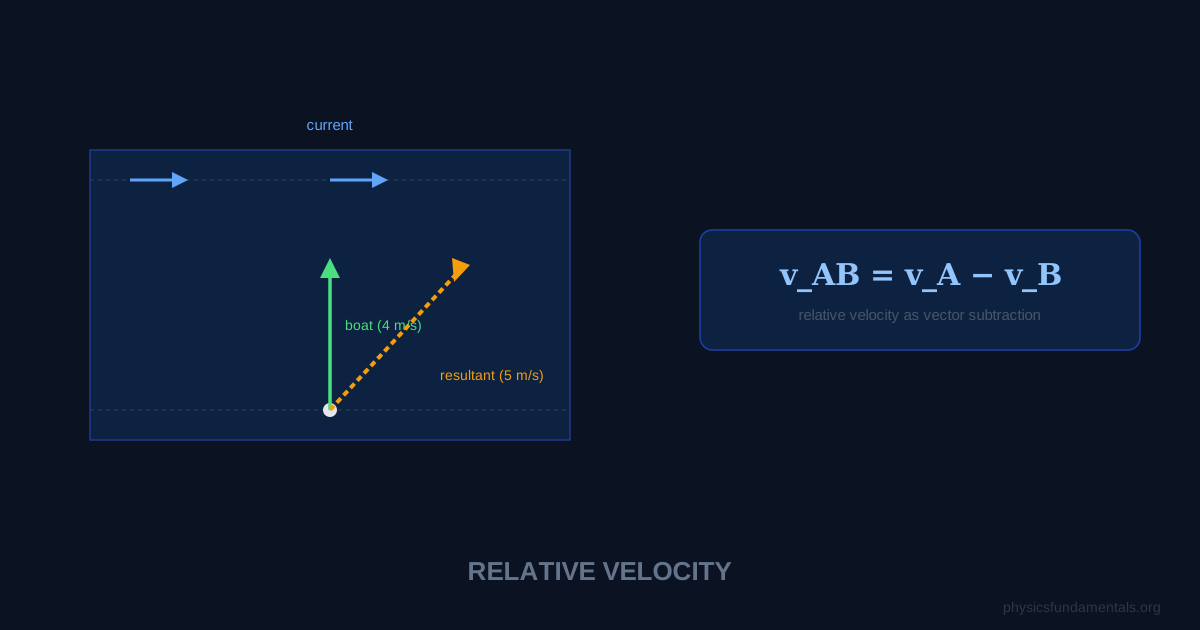
Problem: A river flows at 3 m/s due east. A swimmer can swim at 4 m/s relative to the water and aims due north. Find the swimmer's velocity relative to the ground (magnitude and direction).
Solution:
The swimmer's velocity relative to ground is the vector sum of their swimming velocity (4 m/s north) and the river velocity (3 m/s east).
Rₓ = 3 m/s, Rᵧ = 4 m/s
|v_ground| = √(3² + 4²) = √25 = 5 m/s
θ = arctan(3/4) = arctan(0.75) = 36.9° east of north
The swimmer moves at 5 m/s but is carried downstream — they travel northeast rather than straight north.
Unit Vectors
Unit vectors î, ĵ, k̂ each have magnitude 1 in the x, y, z directions respectively. Any vector can be expressed in component form: A = Aₓî + Aᵧĵ. For example, a velocity of 5 m/s east and 3 m/s north is written v = 5î + 3ĵ m/s.
This notation becomes essential for 3D problems and is the standard in university-level physics. For A-Level, you mostly work in 2D with horizontal and vertical components, but the component method is identical.
Common Mistakes
Mistake 1 — Using sin and cos on the wrong component. cos gives the adjacent side (the component along the direction of the angle's reference axis), sin gives the opposite. If θ is measured from horizontal, horizontal component = A cosθ, vertical = A sinθ. If θ is measured from vertical, it's reversed.
Mistake 2 — Ignoring direction when subtracting vectors. A − B = A + (−B). Reverse B's direction, then add. This trips students up in momentum calculations and relative velocity.
Mistake 3 — Treating kinetic energy as a vector. Energy, speed, mass, distance — these are all scalars. Kinetic energy has no direction, even though it comes from a vector (velocity) squared. KE = ½mv² is a scalar because v² = v·v (dot product) which produces a scalar.
3D Vector Components and Unit Vectors
In three dimensions, any vector A is written in component form using unit vectors î, ĵ, k̂ along the x, y, z axes:
The magnitude: |A⃗| = √(Aₓ² + Aᵧ² + Aᵤ²). Direction is specified by direction cosines: cosα = Aₓ/|A|, cosβ = Aᵧ/|A|, cosγ = Aᵤ/|A| (angles with x, y, z axes respectively). A unit vector in the direction of A: â = A/|A| = (Aₓî + Aᵧĵ + Aᵤk̂)/|A|.
The dot product (scalar product): A⃗ · B⃗ = AₓBₓ + AᵧBᵧ + AᵤBᵤ = |A||B|cosθ. This equals the work done by force A⃗ along displacement B⃗ (W = F⃗·d⃗ = Fdcosθ — hence the name "scalar product"; the result is a scalar).
The cross product (vector product): A⃗ × B⃗ has magnitude |A||B|sinθ (area of the parallelogram formed by A and B) and direction perpendicular to both A and B (right-hand rule). Used for torque τ = r × F and magnetic force F = qv × B.
Worked Example 5 — 3D velocity and displacement
Problem: An aircraft has velocity v⃗ = 200î + 50ĵ − 10k̂ m/s (î = east, ĵ = north, k̂ = up). Find: (a) the speed, (b) the angle of descent.
Solution:
(a) Speed = |v⃗| = √(200² + 50² + (−10)²) = √(40000 + 2500 + 100) = √42600 = 206.4 m/s
(b) Vertical component: −10 m/s (descending). Horizontal speed: √(200² + 50²) = √42500 = 206.2 m/s
Angle below horizontal: arctan(10/206.2) = arctan(0.0485) = 2.78° below horizontal — a gentle descent.
Resultant Forces — Polygon Method
For three or more forces, the resultant is found by the component method (most reliable) or the tip-to-tail polygon method (graphical). For the polygon method: draw all forces tip to tail in any order — the resultant goes from the tail of the first to the tip of the last. For equilibrium, the polygon closes (the resultant is zero — the last tip meets the first tail).
Three forces in equilibrium: if three forces are in equilibrium, they form a closed triangle when placed tip to tail (Lami's theorem: each force / sin(angle opposite to it) = constant). This is the graphical equivalent of the three component equations ΣFₓ = 0, ΣFᵧ = 0.
Vectors in Electromagnetism
Electric and magnetic fields are vectors — which is why their effects depend on direction. The force on a charge q moving with velocity v⃗ in fields E⃗ and B⃗:
The v⃗ × B⃗ cross product is zero when v and B are parallel (the force vanishes — a charged particle moving along a magnetic field experiences no magnetic force) and maximum when they are perpendicular (the particle curves). This is why charged particles spiral along magnetic field lines — the component of velocity along B is unaffected, while the perpendicular component undergoes uniform circular motion.
Common Errors in Vector Problems
Error 1 — Adding magnitudes instead of vectors. Two 10 N forces don't give 20 N unless they're in the same direction. The resultant could be anywhere from 0 N (opposite) to 20 N (same direction). Always use the component method or Pythagoras for right-angle cases.
Error 2 — Wrong angle for components. The component along a direction uses cosine of the angle between the vector and that direction. If the angle is measured from the wrong reference, sin and cos are swapped. Always draw a diagram and identify the angle carefully before applying trigonometry.
Error 3 — Treating vector equations as scalar equations. F = ma is a vector equation — F, a are vectors, m is scalar. In a 2D problem with forces in multiple directions, this gives two equations (x and y components), not one. Solving only one component equation and missing the other is the most common error in two-dimensional dynamics problems.
Applications in Navigation and Engineering
Aircraft navigation: an aircraft aiming for a destination must account for wind. Desired track vector + wind velocity vector = air speed vector (what the plane actually points at). Pilots calculate the required heading angle to account for crosswind — the classic "cross-wind" vector addition problem. Flying from London to Edinburgh with a 30 m/s crosswind from the west at 200 m/s airspeed requires pointing the nose into the wind by arctan(30/200) ≈ 8.5° west of north to track north.
Structural analysis: forces in roof trusses are vectors. Each joint is in equilibrium (ΣF = 0 in both x and y), giving two equations per joint. For a truss with n joints and 2n unknown member forces plus reaction forces, the 2n equilibrium equations determine all unknowns — if the truss is statically determinate. Statically indeterminate structures have more unknowns than equations and require additional compatibility conditions (relating to elastic deformation) to solve.
Vectors are the mathematical language of physics. Every fundamental law — Newton's second law (F = ma), Maxwell's equations, Schrödinger's equation in 3D, Einstein's field equations — is expressed in terms of vectors or their higher-dimensional generalisations (tensors). The reason is physical: the universe is three-dimensional and most physical quantities have a direction. The distinction between scalars (temperature, mass, energy) and vectors (force, velocity, field strength) is not merely a classification exercise — it determines what mathematical operations are valid and how quantities combine. A thorough understanding of vector addition, components, and direction is the essential mathematical prerequisite for all of physics beyond the most elementary level.
Exam technique for vector problems: always begin by drawing a clear vector diagram with all arrows correctly labelled — direction and magnitude. Choose a coordinate system aligned with the problem (often horizontal and vertical, but for inclined planes, along and perpendicular to the slope). Resolve every vector into its chosen components — use sinθ and cosθ carefully, identifying which angle applies to which component. Sum components in each direction. Then find magnitude and direction from the summed components. Never skip the diagram: it catches sign errors before they propagate. In problems where equilibrium is required (ΣF = 0), the vector diagram must form a closed shape — a useful check that no force has been omitted.
The Pythagorean theorem and basic trigonometry underpin all 2D vector operations — it is genuinely worth ensuring these are fluent before tackling vector problems under exam conditions. The key triangle: a right-angled triangle with hypotenuse = vector magnitude, opposite = perpendicular component (use sinθ), adjacent = parallel component (use cosθ). Every resolved force, velocity component, or field component reduces to this triangle. The confusion between which component uses sin and which uses cos is almost always resolved by a clear diagram: label the angle, label which side is opposite and adjacent, apply SOHCAHTOA. The component method for vector addition — resolve, sum components, reconstruct resultant — is then mechanical and reliable.
Try it yourself: check your own numbers with the 2D Vector Addition & Resolution Calculator, which shows the formula, the worked substitution and the answer step by step.
Frequently Asked Questions
What is the difference between a vector and a scalar?
Is energy a vector or a scalar?
How do you add two vectors?
Can a vector have a negative magnitude?
Why does direction matter for forces but not for energy?
Share this article
Written by
Physics Fundamentals Editorial Team
Written and reviewed by our team of physics educators. Content is aligned with A-Level, GCSE, AP Physics, and undergraduate curricula.
About Physics Fundamentals →