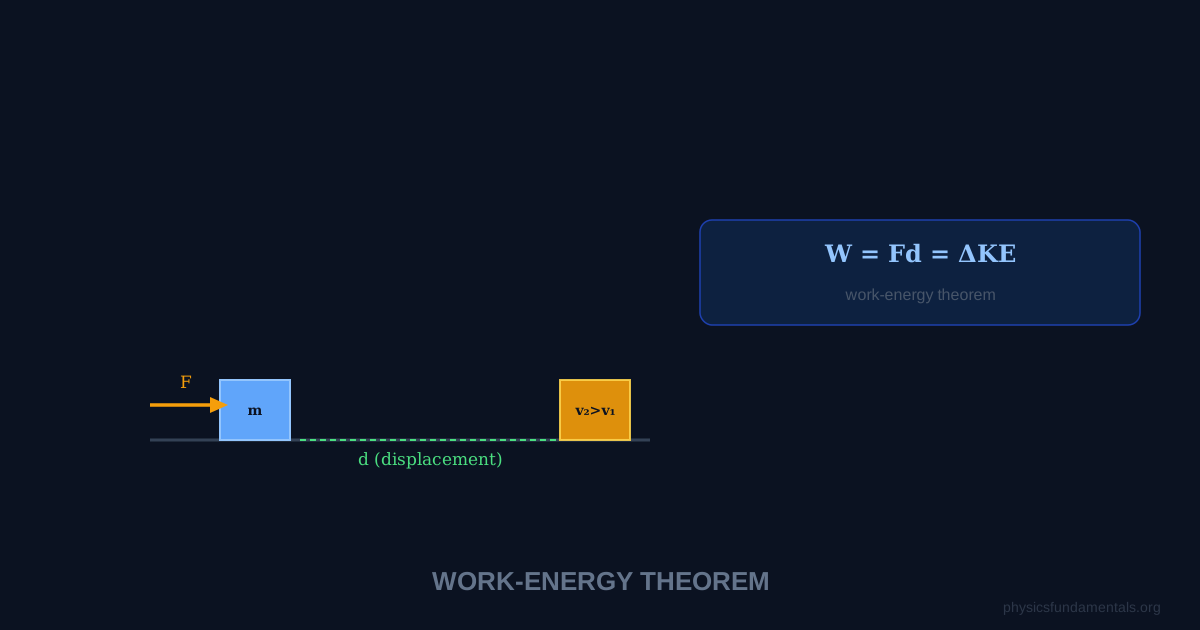
The work-energy theorem states that the net work done on an object equals its change in kinetic energy: W_net = ΔKE = ½mv² − ½mu². Every joule of net work done on an object appears as kinetic energy; every joule of kinetic energy removed by work (friction, braking, air resistance) slows the object down. This single relationship connects force, motion, and energy in a way that often makes problems far easier to solve than tracking forces at every instant.
The theorem is derived directly from Newton's second law — it's not an independent principle, but a consequence of F = ma applied over a displacement. Its power comes from what it ignores: you don't need to know how long the process took, or how the force varied along the path, as long as you know the total work done.
- The work-energy theorem: W_net = ΔKE — stated and derived from F = ma
- How to calculate net work when multiple forces act
- 4 worked examples: accelerating car, braking distance, friction on a slope
- The relationship between the work-energy theorem and conservation of energy
- When to use energy methods vs force methods
The Work-Energy Theorem — Statement
The net work done on an object equals its change in kinetic energy.
Where:
- W_net = total work done by all forces acting on the object (J)
- ΔKE = change in kinetic energy (J)
- m = mass of the object (kg)
- v = final speed (m/s)
- u = initial speed (m/s)
The sign matters: positive W_net means the object speeds up; negative W_net means it slows down. If the net work is zero, kinetic energy — and therefore speed — is unchanged.
Derivation from Newton's Second Law
Start with Newton's second law for a constant net force F acting on mass m over displacement s:
From kinematics: v² = u² + 2as, so as = (v² − u²)/2. The net work done:
This derivation works for variable forces too — using calculus (W = ∫F·ds) the result is identical. The work-energy theorem holds for any force, constant or not, as long as W_net is the total work done by the net force.
Net Work — Accounting for All Forces
The theorem uses net work — the sum of work done by every force. Forces perpendicular to motion do zero work. Forces opposing motion do negative work:
- Driving force (engine): positive work (force in direction of motion)
- Friction, air resistance: negative work (force opposes motion)
- Normal force, centripetal force: zero work (perpendicular to motion)
- Gravity: positive when falling (force in direction of motion), negative when rising
4 Worked Examples
Example 1 — Accelerating car
Problem: A 1200 kg car accelerates from rest to 20 m/s. What net work was done on it?
Solution:
W_net = ½mv² − ½mu²
W_net = ½ × 1200 × 20² − 0
W_net = ½ × 1200 × 400 = 240,000 J = 240 kJ
Example 2 — Braking distance
Problem: A 1000 kg car travelling at 30 m/s brakes to a stop. The braking force is 9000 N. Find the stopping distance.
Solution:
W_net = ΔKE
−F × s = 0 − ½mu² (negative work because force opposes motion)
−9000 × s = −½ × 1000 × 30²
9000s = 450,000
s = 50 m
Example 3 — Object on a slope with friction
Problem: A 5 kg box slides 4 m down a 30° frictionless ramp. Find its speed at the bottom.
Solution:
Height fallen: h = 4 × sin30° = 2 m
Work by gravity: W = mgh = 5 × 9.81 × 2 = 98.1 J
No friction, so W_net = 98.1 J
W_net = ½mv² − 0
v² = 2 × W_net / m = 2 × 98.1 / 5 = 39.24
v = 6.26 m/s
Example 4 — Applied force with friction
Problem: A 10 kg crate is pushed 6 m along a floor by a 50 N horizontal force. Friction is 20 N. Find the final speed if the crate starts from rest.
Solution:
W_push = 50 × 6 = 300 J
W_friction = −20 × 6 = −120 J
W_net = 300 − 120 = 180 J
½mv² = 180 → v² = 360/10 = 36
v = 6 m/s
Work-Energy Theorem vs Conservation of Energy
The work-energy theorem and conservation of energy are closely related but distinct:
- Work-energy theorem: W_net = ΔKE. Applies even when energy is dissipated (friction, air resistance). It accounts for all work, including work done against non-conservative forces.
- Conservation of energy: KE + PE = constant. Only applies in the absence of non-conservative forces (friction, drag). When friction acts, conservation of mechanical energy doesn't hold — but the work-energy theorem still does.
When friction acts on a sliding object: W_friction = −f × s. The work-energy theorem gives: W_net = W_applied + W_friction = ΔKE. Energy is conserved overall (friction converts KE to heat), but mechanical energy is not.
When to Use Energy Methods
The work-energy theorem is particularly powerful when:
- You want to relate speed at two points without caring about intermediate forces
- Forces vary along the path (springs, gravity on a curve) — W = ∫F·ds handles this cleanly
- You know the work done by friction and want to find speed — avoiding the need to track acceleration
- Multiple forces act simultaneously — sum the work of each, then apply ΔKE
Deriving the Work-Energy Theorem from Newton's Laws
Start with Newton's second law: F = ma. Multiply both sides by displacement ds along the direction of motion and integrate:
The left side is the work done by the net force (W_net = ∫F ds). The right side is the change in kinetic energy (ΔKE). Therefore:
This derivation is valid for any force (constant or variable) and any path (straight or curved), as long as we use the component of force along the direction of motion ds. The work-energy theorem is not an independent law — it is a mathematical consequence of Newton's second law, derived rigorously.
Work Done by Multiple Forces
When several forces act: W_net = W₁ + W₂ + W₃ + ... = ΔKE. Each force contributes work W = Fd cosθ independently. Forces perpendicular to motion do zero work (cosθ = 0 for θ = 90°). This is why:
- Normal force does no work (always perpendicular to motion for a surface)
- Tension in a string (for circular motion) does no work (perpendicular to velocity)
- Magnetic force does no work on a charged particle (F = qv × B is always perpendicular to v)
- Gravity does work equal to −ΔGPe (or +mgh when falling height h)
- Friction always does negative work (opposes motion, so F and d are anti-parallel → cosθ = −1 → W = −fd)
Worked Example 5 — Car braking distance
Problem: A 1400 kg car travelling at 30 m/s brakes to rest. The braking force is 8,400 N. (a) Find the braking distance using the work-energy theorem. (b) If the speed had been 40 m/s, find the braking distance. (c) What does this tell us about speed and stopping distances?
Solution:
(a) W_friction = ΔKE: −8400 × d = 0 − ½ × 1400 × 30² = −630,000 J
d = 630,000/8400 = 75 m
(b) d = ½ × 1400 × 40²/8400 = 1,120,000/8400 = 133.3 m
(c) Speed increases from 30 to 40 m/s (ratio 4/3); stopping distance increases from 75 to 133 m (ratio 133/75 = 1.78 ≈ (4/3)²). Stopping distance ∝ v² — doubling speed quadruples stopping distance. This is why speed limits in urban areas are so important for pedestrian safety: a car at 40 mph (17.9 m/s) needs 4× the braking distance of a car at 20 mph (8.9 m/s).
Power and the Work-Energy Theorem
Power is the rate of doing work: P = dW/dt = F × v (force times velocity). At constant velocity (zero acceleration, zero net force), the applied force equals friction: P_engine = F_friction × v. At constant velocity, all engine power goes to overcoming resistance — none goes to increasing KE. During acceleration, engine power both increases KE (useful) and overcomes friction (wasted).
Worked example: A car engine (60 kW) accelerates a 1200 kg car from 0 to 27 m/s (0 to 97 km/h). Minimum time (assuming all power goes to KE with zero friction): ΔKE = ½ × 1200 × 27² = 437,400 J. Time = ΔKE/P = 437,400/60,000 = 7.29 s. Real cars take longer because friction also removes energy, so the engine must supply ΔKE + friction work.
Elastic and Inelastic Collisions Revisited via Work-Energy
The work-energy theorem clarifies what "perfectly elastic" means at a deeper level. In an elastic collision between a moving mass m₁ and a stationary mass m₂:
- Contact forces between the objects are conservative (spring-like) — they store energy as elastic PE during compression and fully return it as KE during expansion.
- No permanent deformation → no work done against internal friction → no energy converted to heat.
- Total work done by contact forces = 0 → ΔKE_total = 0 → KE is conserved.
In an inelastic collision, the contact forces do net negative work (internal friction converts KE to heat): W_internal < 0 → ΔKE_total < 0 → final KE < initial KE. The work done against internal friction equals the KE lost: |W_internal| = ½m₁u₁² − ½m₁v₁² − ½m₂v₂². The work-energy theorem makes precise what "kinetic energy loss" means mechanistically.
Variable Forces and Work Calculations
When force varies with position, work is calculated as the integral: W = ∫F(x) dx = area under the F-x graph. Common examples:
- Spring (F = kx): W = ½kx² (triangular area under F-x graph) — elastic PE stored.
- Gravity near Earth's surface (F = mg, constant): W = mgh (rectangular area) — gravitational PE change.
- Gravity at large distances (F = GMm/r²): W = GMm(1/r₁ − 1/r₂) — from integrating 1/r².
- Gas at constant pressure (F = PA, constant): W = PΔV — work done by/against pressure.
The F-x graph area technique is particularly useful when the force-displacement relationship is known experimentally (from a graph) but doesn't follow a simple algebraic form — the area under the curve gives work done, which via the work-energy theorem gives the final speed.
Exam Summary for the Work-Energy Theorem
Work done = force × displacement × cosθ = F d cosθ (J). Net work done = ΔKE = ½mv² − ½mu². Work done against friction is always negative — it reduces KE. Normal force, tension in circular motion, and magnetic force do zero work (perpendicular to motion). For variable forces: W = area under F-x graph. Power = work/time = force × velocity (P = Fv). The key advantage of the work-energy theorem over force analysis: it connects initial and final velocities directly without tracking intermediate motion — essential for variable forces, curved paths, and complex multi-force situations.
The Deeper Significance: Energy as a Bookkeeping Tool
The work-energy theorem is powerful because energy is a scalar — it has no direction, adds algebraically, and is conserved. Force analysis requires tracking directions at every instant; energy analysis just requires accounting at the initial and final states. This is why energy methods are preferred whenever they apply. In complex systems (multi-body problems, flexible structures, thermodynamic systems), direct force analysis becomes intractable while energy accounting remains straightforward — which is why Lagrangian mechanics (based entirely on kinetic and potential energy, not forces) is the preferred formulation for advanced classical mechanics and quantum field theory. The work-energy theorem is the first glimpse of this deeper framework: that energy, not force, is the more fundamental concept in physics.
The connection to power and efficiency is also central to engineering. The work-energy theorem applied to electrical systems: power input = rate of KE increase + power dissipated as heat (P_in = dKE/dt + P_friction). For an electric motor driving a load: efficiency = mechanical power output/electrical power input = (F_load × v)/(VI). The work-energy theorem makes these efficiencies calculable and comparable across different energy conversion technologies — from electric motors (~90% efficient) to jet engines (~35%) to human muscles (~25%).
The work-energy theorem W_net = ΔKE is one of the most versatile equations in mechanics. Apply it when: you need to find a velocity after a known force acts over a known distance; you need to find the force required to produce a given velocity change over a given distance; you need to find the stopping distance for a known braking force and initial speed. The key steps: identify all forces, calculate work done by each (F × d × cosθ), sum for W_net, set equal to ΔKE, and solve. For problems involving gravity alone (no friction): W_net = mgh → ΔKE = mgh → this is just conservation of mechanical energy. The work-energy theorem includes friction explicitly (negative work), making it the more general tool that subsumes energy conservation as a special case.
The work-energy theorem reveals why friction is so different from conservative forces. Friction always opposes motion, so the work done by friction is always negative — it removes KE from the system, converting it to heat. Unlike gravity or springs (which can give energy back), friction never returns the energy it takes. This is the thermodynamic arrow of time at the macroscopic level: a ball sliding to rest due to friction never spontaneously reacquires its lost KE from the warm ground — the process is irreversible. The work-energy theorem quantifies exactly how much KE is lost (|W_friction| = f × d) and where it goes (thermal energy in the surfaces). Understanding this dissipation is the foundation of thermodynamics: the second law states that this irreversible energy conversion from organised (kinetic) to disordered (thermal) form always increases the total entropy of the universe.
Frequently Asked Questions
What is the work-energy theorem?
What is the difference between work done and net work?
Can the work-energy theorem be negative?
Does the work-energy theorem apply when friction is present?
How does the work-energy theorem relate to power?
Share this article
Written by
Physics Fundamentals Editorial Team
Written and reviewed by our team of physics educators. Content is aligned with A-Level, GCSE, AP Physics, and undergraduate curricula.
About Physics Fundamentals →