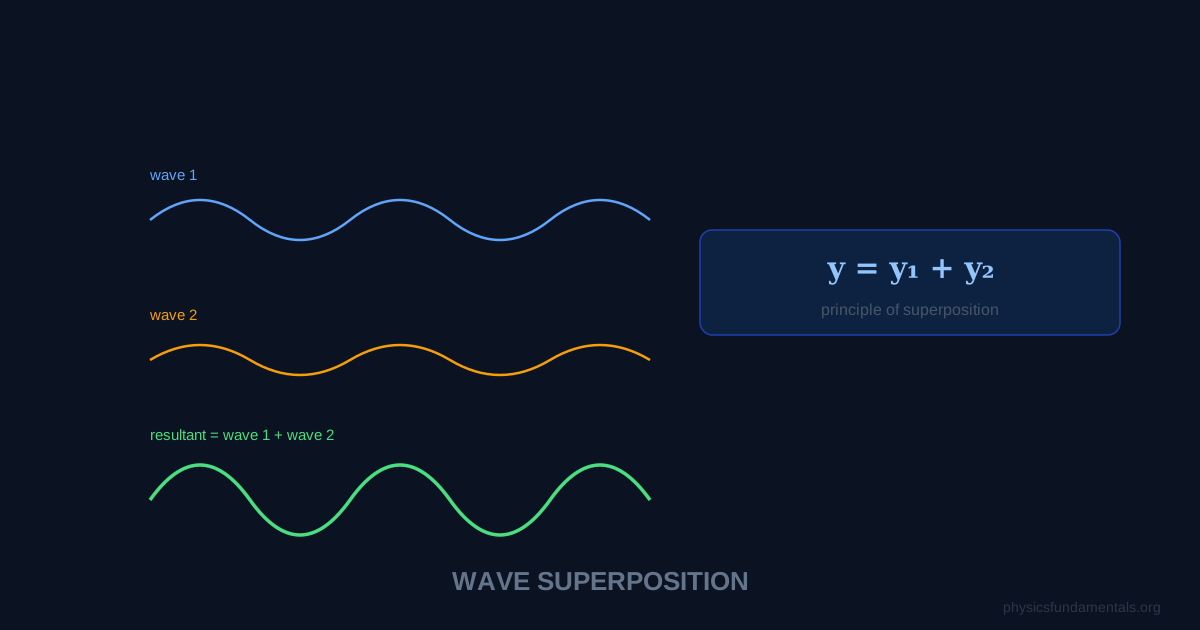
The principle of superposition states that when two or more waves overlap, the resultant displacement at any point is the algebraic sum of the individual displacements at that point. If two waves of the same amplitude are perfectly in phase (phase difference = 0), they produce a wave of double the amplitude — constructive interference. If they are exactly out of phase (phase difference = π radians = 180°), they cancel completely — destructive interference. Most real situations fall somewhere in between, producing partial interference.
Superposition is one of the most consequential principles in physics. It gives rise to interference patterns, standing waves, diffraction, and beats. It also underlies quantum mechanics — quantum states superpose just as classical waves do, producing phenomena like electron diffraction and the double-slit experiment with single particles.
- The superposition principle — algebraic addition of displacements
- In-phase waves: constructive interference, amplitude doubles
- Anti-phase waves: destructive interference, amplitude zeros
- Phase difference and path difference — the relationship
- Beats — superposition of two slightly different frequencies
- 4 worked examples with displacement calculations
The Superposition Principle
When two or more waves meet at a point, the resultant displacement equals the vector sum of all individual displacements at that point and time. After the waves pass through each other, each continues unchanged.
Mathematically, if wave 1 has displacement y₁ and wave 2 has displacement y₂ at the same point and time:
This is a vector sum — displacements in the same direction add, displacements in opposite directions subtract. The principle applies equally to transverse waves (displacement perpendicular to travel) and longitudinal waves (displacement along the direction of travel).
Phase Difference and Its Effects
Two waves of the same frequency and amplitude with phase difference φ produce a resultant with amplitude:
Key cases:
- φ = 0 (in phase): A_result = 2A cos(0) = 2A — constructive interference, maximum amplitude
- φ = π (anti-phase, 180°): A_result = 2A cos(π/2) = 0 — destructive interference, complete cancellation
- φ = π/2 (90°): A_result = 2A cos(π/4) = A√2 ≈ 1.41A — partial interference
- φ = 2π (360°, one full cycle): Same as φ = 0 — back to constructive
Path Difference and Phase Difference
When two waves travel different distances to a point, the path difference Δx creates a phase difference:
Constructive interference (φ = 0, 2π, 4π, ...): path difference = nλ (n = 0, 1, 2...)
Destructive interference (φ = π, 3π, 5π, ...): path difference = (n + ½)λ
Standing Waves — Superposition in Action
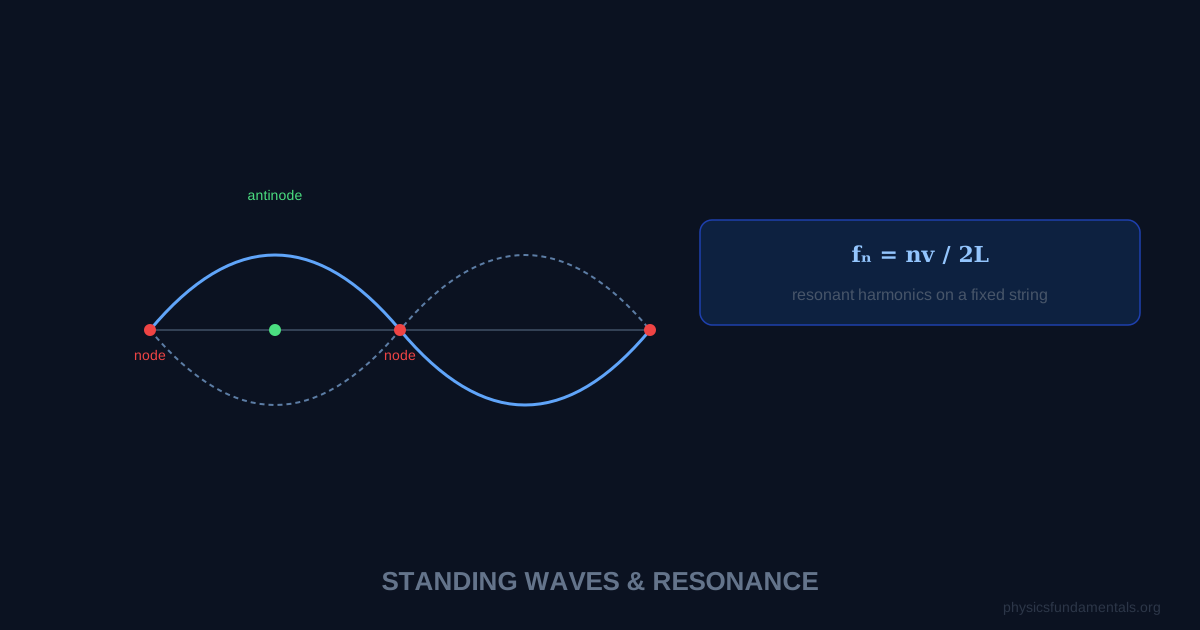
A standing wave is the superposition of two identical waves travelling in opposite directions. Adding y₁ = A sin(kx − ωt) and y₂ = A sin(kx + ωt):
The sin(kx) factor creates the spatial pattern — fixed nodes (kx = nπ → sin(kx) = 0) and antinodes (kx = (n+½)π → |sin(kx)| = 1). The cos(ωt) factor shows the entire pattern oscillates in time. This is a standing wave: energy doesn't propagate, it oscillates in place. See our full article on standing waves and resonance.
Beats — Two Slightly Different Frequencies
When two waves of slightly different frequencies f₁ and f₂ superpose, they periodically come in and out of phase, producing a regular amplitude variation — beats:
The beat frequency is the rate at which the sound's amplitude goes from loud to quiet and back. A violinist tuning to a reference pitch hears beats slow down and disappear as the strings come into tune — the ultimate zero-beat condition means the frequencies are identical.
Mathematically: adding y₁ = A sin(2πf₁t) and y₂ = A sin(2πf₂t), using sum-to-product:
The sin term oscillates at the average frequency (f₁+f₂)/2; the cos term modulates the amplitude at (f₁−f₂)/2, giving a beat frequency of |f₁−f₂|.
4 Worked Examples
Example 1 — Adding two in-phase waves
Problem: Two waves meet at a point. Wave 1: displacement +3 cm. Wave 2: displacement +4 cm. Find the resultant displacement.
Solution:
y_total = y₁ + y₂ = 3 + 4 = +7 cm (constructive — same direction)
Example 2 — Anti-phase superposition
Problem: Wave 1 has amplitude 5 cm and wave 2 has amplitude 3 cm. They meet exactly out of phase. Find the resultant amplitude and state whether this is constructive or destructive interference.
Solution:
Out of phase means wave 2's displacement is opposite: y₂ = −3 cm when y₁ = +5 cm
y_total = 5 + (−3) = +2 cm (partial destructive interference — they don't fully cancel because amplitudes differ)
Example 3 — Path difference and interference type
Problem: Two coherent sources emit waves of wavelength 0.4 m. Point P is 2.6 m from source 1 and 3.8 m from source 2. Is the interference at P constructive or destructive?
Solution:
Path difference = 3.8 − 2.6 = 1.2 m
Number of wavelengths = 1.2/0.4 = 3.0 = whole number → path difference = 3λ
Constructive interference (path difference = nλ)
Example 4 — Beat frequency
Problem: A piano key and a tuning fork produce sounds at 440 Hz and 444 Hz respectively. Find the beat frequency and describe what a listener hears.
Solution:
Beat frequency = |f₁ − f₂| = |440 − 444| = 4 Hz
The listener hears a note at approximately 442 Hz (the average) with its volume pulsing 4 times per second — a slow wobbling effect that becomes more pronounced the further out of tune the piano is.
Energy in Superposition
Superposition doesn't violate energy conservation. Where constructive interference creates a region of high amplitude (high energy), destructive interference creates a low-amplitude region nearby. The total energy is redistributed — not created or destroyed. The average intensity over a full interference pattern equals the sum of individual intensities.
Mathematical Treatment — Phasors
The superposition of two waves of the same frequency but different amplitude and phase is most elegantly handled using phasors — rotating vectors in the complex plane. A wave y = A sin(ωt + φ) is represented by a phasor (rotating vector) of length A at angle φ. Adding two waves means adding their phasors as vectors:
Where φ = φ₂ − φ₁ is the phase difference. Special cases: φ = 0 (in phase) → A_result = A₁ + A₂ (maximum); φ = π (anti-phase) → A_result = |A₁ − A₂| (minimum, zero if equal amplitudes). For N equal-amplitude waves equally spaced in phase (as in a diffraction grating with N slits): A_result = A₁sin(Nδ/2)/sin(δ/2), producing sharp maxima when δ = 2nπ (path difference = nλ).
Fourier's Theorem — Decomposing Any Wave into Sine Waves
Fourier's theorem (1822) states that any periodic wave can be decomposed into a sum of sine waves (harmonics): y(t) = a₀ + Σ(aₙcosnωt + bₙsinnωt). Conversely, adding harmonics in the right proportions can build any desired waveform. A square wave, for example, requires an infinite series of odd harmonics with amplitudes that decrease as 1/n: y = (4/π)[sin(ωt) + sin(3ωt)/3 + sin(5ωt)/5 + ...]. The sound of a clarinet (odd harmonics from a closed cylindrical pipe) is naturally square-wave-like; a flute (open pipe, all harmonics) sounds more sinusoidal.
Fourier analysis underlies all of signal processing, audio engineering, communications, and spectroscopy. An MP3 file is essentially Fourier-transformed audio data with small-amplitude components removed (psychoacoustic compression). MRI images are reconstructed from their Fourier transform (k-space data). Spectroscopy identifies molecular structures from their characteristic absorption frequencies (peaks in the Fourier transform of the absorption spectrum).
Beats — Detailed Analysis
Adding y₁ = A sin(2πf₁t) and y₂ = A sin(2πf₂t), using sum-to-product:
The result oscillates at the average frequency (f₁+f₂)/2 with amplitude modulated at half the beat frequency (f₁−f₂)/2. The perceived loudness varies at the beat frequency |f₁−f₂| (there are two amplitude maxima per cycle of the modulation envelope — listeners hear the amplitude go through two maxima per beat period). At f₁ = 440 Hz, f₂ = 443 Hz: beat frequency = 3 Hz (the sound throbs 3 times per second). As a violinist tunes: the beats slow down and eventually stop (f₁ = f₂) — the moment of zero beat frequency confirms exact tuning.
Worked Example 5 — Three waves superposing
Problem: Three waves of equal amplitude A = 5 cm and frequency 10 Hz superpose. They have phases 0°, 120°, and 240°. Find the resultant amplitude.
Solution:
Three equal-amplitude waves 120° apart — by symmetry, their phasor vectors point in three directions equally spaced around a circle. The x-components: Acosθ for θ = 0°, 120°, 240° → A(1 + cos120° + cos240°) = A(1 − 0.5 − 0.5) = 0. Similarly for y-components. The resultant amplitude is 0 — complete destructive interference. This is the principle behind three-phase AC power: three equal currents 120° apart produce zero net current in the neutral wire (in a balanced load).
Quantum Superposition — The Extension
The principle of superposition extends into quantum mechanics, where quantum states (described by wave functions ψ) can also superpose. Schrödinger's equation is linear — if ψ₁ and ψ₂ are valid solutions, so is c₁ψ₁ + c₂ψ₂. This is quantum superposition, and it is far more profound than classical wave superposition: a quantum system can exist in a superposition of states that classically exclude each other (e.g. spin up and spin down simultaneously). The famous Schrödinger's cat thought experiment illustrates the strangeness of quantum superposition at the macroscopic scale. The double-slit experiment with single electrons demonstrates it directly: each electron apparently passes through both slits simultaneously (a superposition of "through slit 1" and "through slit 2"), producing an interference pattern that only makes sense if the wave function superposition is real.
Worked Example 6 — Path difference and phase difference
Problem: Two coherent sources S₁ and S₂ emit waves of wavelength 0.5 m in phase. Point P is 8.3 m from S₁ and 9.6 m from S₂. Determine whether P is at a maximum, minimum, or intermediate intensity.
Solution:
Path difference = 9.6 − 8.3 = 1.3 m
Number of wavelengths: 1.3/0.5 = 2.6 wavelengths
Phase difference: φ = 2π × 2.6 = 2π × 2 + 0.6 × 2π = effective phase difference = 0.6 × 2π = 1.2π radians
This is neither 0 (constructive) nor π (destructive) → intermediate intensity
Specifically: A_resultant = 2A|cos(φ/2)| = 2A|cos(0.6π)| = 2A|cos108°| = 2A × 0.309 = 0.618A
Intensity ∝ A² → I = (0.618)² × 4I₀ = 0.382 × 4I₀ = 1.53 I₀ (where I₀ is the intensity from one source alone)
Exam Summary for Wave Superposition
The principle of superposition: resultant displacement = algebraic (signed) sum of individual displacements. Constructive interference: waves in phase (φ = 0, 2π, 4π, ...); path difference = 0, λ, 2λ, ... → amplitude doubles, intensity quadruples. Destructive interference: waves anti-phase (φ = π, 3π, ...); path difference = λ/2, 3λ/2, ... → amplitude = difference of individual amplitudes (zero for equal amplitudes). Beats: two waves with slightly different frequencies → amplitude modulation at beat frequency |f₁ − f₂|. Standing waves: superposition of two identical waves in opposite directions → nodes (zero displacement always) and antinodes (maximum displacement amplitude 2A).
Wave superposition is one of the most powerful principles in physics precisely because it is so general. It applies equally to water waves, sound waves, electromagnetic waves, electron probability waves, and quantum field states. In each case, the mathematical linearity of the wave equation guarantees that solutions can be added — the medium (or quantum field) responds to each wave independently and the total response is the sum. Non-linearity breaks this: in very high-intensity laser fields, the response is no longer linear and waves interact, generating new frequencies (harmonic generation, four-wave mixing). Optical fibres for telecommunications are carefully designed to operate in the linear regime to prevent such crosstalk between channels. The boundary between linear superposition and non-linear interaction is one of the frontiers of modern optics and quantum optics research.
The most powerful application of wave superposition in modern technology is optical coherence tomography (OCT) — used in medical ophthalmology to image the retina with micrometre resolution. OCT works by splitting a laser beam, sending one part to the sample and one to a reference mirror, then superposing the reflected beams. The interference pattern encodes information about the depth (the path length from different layers in the retina). Fourier-transforming the interference spectrum reconstructs a depth profile. A modern OCT scanner builds a 3D image of retinal layers in seconds, detecting early signs of glaucoma, macular degeneration, and diabetic retinopathy that would be invisible to conventional ophthalmoscopy. This is wave superposition — Huygens' and Young's physics from 1801 — as a life-saving clinical instrument in 2025.
In exam questions on superposition, the three most common types are: (1) add two displacements at a given point — just read them off and apply algebraic addition; (2) determine whether a point is at a maximum or minimum — calculate path difference, divide by wavelength, check if the result is an integer (maximum) or half-integer (minimum); (3) find the fringe spacing for Young's double slit or the wavelength from measured data — use w = λD/d. The deepest understanding required is distinguishing constructive from destructive interference from the phase difference (not just the path difference): path difference → phase difference (multiply by 2π/λ) → interference type. When sources are not in phase (e.g. phase difference φ₀ between the sources), add φ₀ to the geometric phase difference before comparing to 0, π, 2π etc.
Frequently Asked Questions
What is the superposition principle?
What is the difference between constructive and destructive interference?
What are beats?
Does superposition apply to all types of waves?
How does superposition produce standing waves?
Share this article
Written by
Physics Fundamentals Editorial Team
Written and reviewed by our team of physics educators. Content is aligned with A-Level, GCSE, AP Physics, and undergraduate curricula.
About Physics Fundamentals →