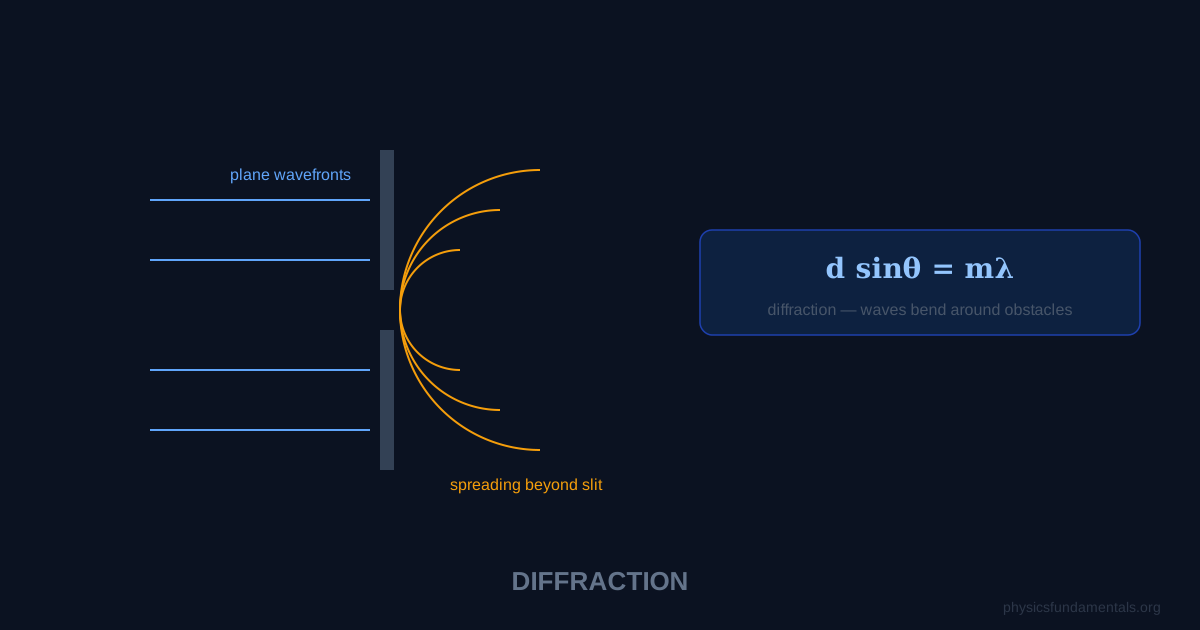
Diffraction is the spreading of waves when they pass through a gap or around an obstacle. The effect is most pronounced when the wavelength is comparable to the size of the gap: λ ≈ gap width. A diffraction grating — a surface with thousands of parallel slits — produces sharp intensity maxima at angles given by dsinθ = nλ, where d is the slit spacing, θ is the angle, and n is the order number.
Diffraction is why you can hear around corners (sound wavelengths ~ 1 cm to 10 m, comparable to everyday gap sizes) but can't see around corners (light wavelengths ~ 400–700 nm, far smaller than everyday gaps). Radio waves diffract around buildings and hills; X-rays diffract from crystal lattices to reveal atomic structure. Diffraction is ubiquitous wherever waves meet boundaries.
- What diffraction is and when it occurs (condition: λ ≈ gap width)
- Diffraction grating equation: dsinθ = nλ
- Single slit diffraction — central maximum width and secondary maxima
- 4 worked examples including grating calculations and X-ray diffraction
- Applications: spectroscopy, CD/DVD players, X-ray crystallography
When Does Diffraction Occur?
All waves diffract, but the effect is significant only when the wavelength is comparable to the obstacle or gap size:
- λ ≪ gap: very little diffraction — wave passes through almost straight (geometric shadow)
- λ ≈ gap: strong diffraction — wave spreads significantly into the shadow region
- λ ≫ gap: wave wraps completely around the gap — almost no transmission
Diffraction Grating: dsinθ = nλ
Where:
- d = grating spacing (distance between adjacent slits), in metres
- θ = angle of the nth order maximum from the straight-through direction
- n = order number (n = 0, ±1, ±2...) — n = 0 is straight through
- λ = wavelength of light, in metres
Grating lines per mm: if a grating has N lines per mm, d = 1/N mm = 10⁻³/N m.
Maximum order: sinθ ≤ 1, so n ≤ d/λ. Orders beyond this are not physically possible.
Single Slit Diffraction
A single slit of width a produces a central bright maximum flanked by progressively fainter secondary maxima. Minima occur at:
The central maximum has width 2λ/a (angular half-width = λ/a). A narrower slit produces a wider central maximum — a counter-intuitive result. A wider slit produces a narrower maximum, approaching geometric projection.
4 Worked Examples
Example 1 — Diffraction grating: angle of first order
Problem: Light of wavelength 589 nm hits a grating with 600 lines per mm. Find the angle of the first-order maximum.
Solution:
d = 1/600 mm = 1.667 × 10⁻⁶ m
sinθ = nλ/d = 1 × 589 × 10⁻⁹ / 1.667 × 10⁻⁶ = 0.3534
θ = arcsin(0.3534) = 20.7°
Example 2 — Maximum orders possible
Problem: For the grating above (d = 1.667 × 10⁻⁶ m) with 589 nm light, what is the maximum order visible?
Solution:
n_max = d/λ = 1.667 × 10⁻⁶ / 589 × 10⁻⁹ = 2.83 → maximum order = 2 (since n must be integer ≤ 2.83)
Example 3 — Finding wavelength from grating
Problem: A diffraction grating with 500 lines/mm produces a second-order maximum at 35°. Find the wavelength.
Solution:
d = 1/500 mm = 2.0 × 10⁻⁶ m
λ = dsinθ/n = 2.0 × 10⁻⁶ × sin35° / 2 = 2.0 × 10⁻⁶ × 0.5736 / 2 = 5.74 × 10⁻⁷ m = 574 nm
Example 4 — Single slit minimum
Problem: A single slit of width 0.1 mm is illuminated by 500 nm light. Find the angle of the first dark fringe.
Solution:
sinθ = λ/a = 500 × 10⁻⁹ / 0.1 × 10⁻³ = 0.005
θ = arcsin(0.005) = 0.29°
Applications
Spectroscopy: Diffraction gratings disperse light into its component wavelengths more precisely than prisms, enabling accurate measurement of atomic emission and absorption spectra.
CD and DVD players: The track spacing (~1.6 μm) acts as a reflection diffraction grating, producing the characteristic rainbow colours when white light reflects from a disc.
X-ray crystallography: Crystal lattice spacings (~0.1 nm) act as a 3D diffraction grating for X-rays (λ ~ 0.01–10 nm). The diffraction pattern reveals the atomic structure — used to determine the structure of DNA, proteins, and thousands of other molecules.
Why the Slit Width Matters
The central maximum of a single-slit diffraction pattern has angular half-width θ = λ/a. This means a narrower slit (smaller a) produces a wider central maximum — the light spreads more, not less. This inverse relationship is counter-intuitive but fundamental: confinement in space produces spreading in angle, an idea that connects directly to the Heisenberg uncertainty principle at the quantum level (confining a photon's position increases uncertainty in its transverse momentum).
A useful rule of thumb: significant diffraction requires λ and a to be within about one order of magnitude of each other. Visible light (λ ~ 500 nm) diffracts noticeably through gaps of 0.1 μm to 10 mm; for a 1 cm gap, the diffraction angle is only 0.003° — negligible. For a 1 μm gap, it's 30° — strongly diffracting.
Resolution and the Rayleigh Criterion
Diffraction limits the resolution of optical instruments. A circular aperture of diameter D produces a central diffraction maximum of angular radius 1.22λ/D (the factor 1.22 comes from the geometry of circular vs rectangular apertures). Two point sources can just be resolved when the central maximum of one falls on the first minimum of the other — the Rayleigh criterion:
This is why larger telescope mirrors resolve finer detail: bigger D → smaller θ_min → finer resolution. The Hubble Space Telescope (D = 2.4 m) achieves angular resolution of about 0.05 arcseconds at visible wavelengths — ten times better than is possible from Earth's surface through atmospheric turbulence.
Resolving Power of Optical Instruments
Diffraction fundamentally limits the resolution of every optical instrument — telescope, microscope, camera, or eye. The Rayleigh criterion gives the minimum angular separation that can be resolved by a circular aperture of diameter D:
The factor 1.22 arises from the first zero of the Airy function for a circular aperture (vs π for a slit). Two point sources just resolved when the central maximum of one coincides with the first minimum of the other.
Human eye: pupil diameter D ≈ 5 mm in daylight, λ ≈ 550 nm: θ_min = 1.22 × 550 × 10⁻⁹/5 × 10⁻³ = 1.34 × 10⁻⁴ rad ≈ 0.47 arcminutes. At 250 mm (normal reading distance), this gives minimum resolvable detail of 1.34 × 10⁻⁴ × 250 = 0.033 mm — consistent with the fact that print below about 0.3 mm is difficult to read.
Hubble Space Telescope: D = 2.4 m, λ = 500 nm: θ_min = 1.22 × 500 × 10⁻⁹/2.4 = 2.54 × 10⁻⁷ rad = 0.052 arcseconds. Ground-based telescopes are limited by atmospheric turbulence to about 1 arcsecond — 20 times worse. This is why the Hubble was launched into space.
Diffraction Gratings in Spectroscopy
Diffraction gratings are the workhorse instrument of spectroscopy. Their key advantage over prisms is that the dispersion (angular separation between wavelengths) is much larger and more uniform. The resolving power of a diffraction grating is:
Where n is the diffraction order and N is the total number of lines illuminated. A grating with 500 lines/mm and 20 mm beam width has N = 10,000 lines, so in first order R = 10,000 — it can resolve two wavelengths that differ by as little as λ/R = 500 nm/10,000 = 0.05 nm. This resolving power is easily sufficient to separate the sodium D-lines at 589.0 and 589.6 nm (Δλ = 0.6 nm).
Worked Example 5 — CD track spacing from diffraction
Problem: A laser of wavelength 650 nm is shone perpendicularly onto a CD surface. The first-order diffracted beam appears at 25°. Find the track spacing on the CD.
Solution:
A CD acts as a reflection diffraction grating. For first-order (n=1) maximum:
dsinθ = nλ → d = λ/sinθ = 650 × 10⁻⁹/sin25° = 650 × 10⁻⁹/0.4226 = 1.538 × 10⁻⁶ m ≈ 1.6 μm
This matches the actual CD track spacing of 1.6 μm — confirming that CDs act as diffraction gratings for visible light.
X-Ray Diffraction and Crystal Structure
Bragg's law describes diffraction from crystal planes:
Where d is the spacing between crystal planes, θ is the glancing angle, and n is the order. X-rays with λ ≈ 0.1 nm diffract from crystal planes spaced 0.1–0.5 nm apart, producing patterns of spots whose positions and intensities reveal the three-dimensional atomic arrangement.
The structure of DNA — the double helix — was deduced largely from X-ray diffraction data produced by Rosalind Franklin in 1952. The characteristic X-shaped diffraction pattern of the B-form of DNA revealed the helical structure with a pitch of 3.4 nm and diameter of 2 nm. Watson and Crick built a structural model consistent with this pattern in 1953 — one of the most important scientific discoveries of the 20th century, enabled by Bragg diffraction.
Electron and Neutron Diffraction
Any particle with a de Broglie wavelength comparable to lattice spacings can produce diffraction patterns. Electrons diffract from surface crystal structures (used in LEED — low-energy electron diffraction — to map surface atom positions). Neutrons diffract from crystal planes and, crucially, interact with nuclei rather than electrons, making them sensitive to light elements like hydrogen and to magnetic ordering in materials. Neutron diffraction is essential for studying water structures, protein hydrogen bonds, and magnetic phase transitions in superconductors and magnetic materials.
Exam Approach to Diffraction Problems
The diffraction grating equation dsinθ = nλ is the key formula. Be clear about what d represents: it's the distance between adjacent slits (or lines), not the width of each slit. If a grating has 500 lines per mm, d = 1/500 mm = 2.0 × 10⁻⁶ m. Common exam tasks: finding θ for a given order, finding λ from measured θ, finding the maximum possible order (n_max = d/λ, rounded down to integer). Always state which order you're calculating and check that sinθ ≤ 1 for every order claimed to exist. Orders beyond n = d/λ are physically impossible — they would require sinθ > 1.
For single-slit questions: dark fringes (minima) at asinθ = nλ (n = ±1, ±2...). The central bright maximum has width 2λ/a (angular width). A wider slit gives a narrower central maximum (inverse relationship). This contrasts with the double-slit: more slits/grating lines give sharper, brighter maxima but at the same positions (since the grating spacing d, not individual slit width a, determines the peak positions). Both slit width and grating spacing matter in a real diffraction grating — the envelope of intensity is the single-slit pattern, while the sharp peaks occur at positions given by the grating equation.
Diffraction and Everyday Life
Diffraction explains several everyday optical phenomena. The coloured rings around a distant streetlight seen through a thin fabric or net curtain arise from diffraction through the regular mesh. The iridescent colours of butterfly wings, peacock feathers, and some beetles don't come from pigments but from structural colouration — nanostructures (scales, thin films, arrays of rods) that produce constructive diffraction and interference at specific wavelengths. Holograms record the full diffraction pattern of light scattered by an object; reconstructing the hologram with a laser recreates the full three-dimensional wavefront. Each of these phenomena is a direct consequence of waves bending and interfering as they pass through or around structures comparable in size to their wavelength.
When light passes through a narrow slit, part of it spreads sideways into geometrical shadow regions — a clear violation of rectilinear propagation expected from ray optics. The narrower the slit relative to the wavelength, the more pronounced the spreading. This is why we can hear around corners (sound, λ ~ metres, easily diffracts around buildings) but cannot see around corners (light, λ ~ 500 nm, requires nanoscale gaps for significant diffraction). The wavelength of any wave determines the scale at which diffraction becomes important — the central design principle behind all diffraction-limited instruments from radio antennas to X-ray telescopes.
Every optical instrument is ultimately diffraction-limited — there is a minimum angle below which two point sources cannot be resolved, set by the wavelength of light and the aperture diameter. No amount of magnification overcomes this limit; magnifying beyond the diffraction limit just produces a larger blur. The only way to improve resolution is to use a shorter wavelength (UV microscopy, X-ray crystallography, electron microscopy) or a larger aperture (radio telescope arrays spanning thousands of kilometres, using interferometry to simulate an effectively enormous aperture). The Event Horizon Telescope, which produced the first image of a black hole in 2019, used radio telescopes on multiple continents to achieve an effective aperture equal to Earth's diameter — reaching a resolution of about 20 microarcseconds, sufficient to image a structure 55 million light-years away.
The resolving power of a diffraction grating R = nN is an intrinsic property of the number of illuminated lines and the diffraction order — not the grating line spacing. A grating with 600 lines/mm over a 10 mm beam (N = 6000) in second order resolves R = 12,000 — it can separate wavelengths as close as λ/12,000 ≈ 0.04 nm. Increasing the number of illuminated lines by widening the beam or using a larger grating improves resolving power linearly. This is why large diffraction gratings are preferred in high-resolution spectrographs used in astronomy to measure stellar velocities with precision of metres per second.
Frequently Asked Questions
What is diffraction?
What is the diffraction grating equation?
Why does diffraction require λ ≈ gap size?
What is the difference between diffraction and refraction?
Why does a narrower slit produce wider diffraction?
Share this article
Written by
Physics Fundamentals Editorial Team
Written and reviewed by our team of physics educators. Content is aligned with A-Level, GCSE, AP Physics, and undergraduate curricula.
About Physics Fundamentals →