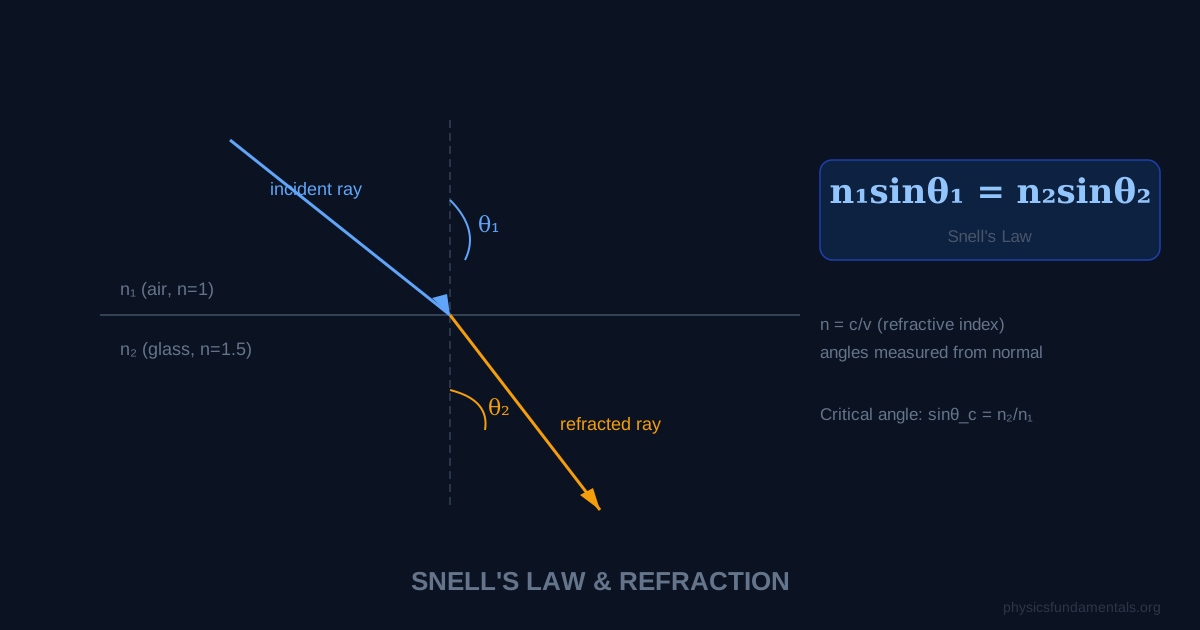
Snell's law describes how light bends when it crosses the boundary between two media: n₁sinθ₁ = n₂sinθ₂. Here n₁ and n₂ are the refractive indices of the two media, and θ₁ and θ₂ are the angles the light ray makes with the normal to the boundary. When light travels from a less dense medium into a denser one (larger n), it bends toward the normal. When it travels from denser to less dense, it bends away.
Snell's law is the foundation of optics. It explains why a straw looks bent in a glass of water, how lenses focus light, how the eye works, why the sky can sometimes hide the horizon over water, and how optical fibres transmit data across continents. Named after Dutch mathematician Willebrord Snellius (1580–1626), the law was independently discovered by Descartes and has been the cornerstone of geometric optics ever since.
- Snell's law n₁sinθ₁ = n₂sinθ₂ — every variable defined
- The refractive index n — what it means and values for common materials
- 4 worked examples including angle of refraction and critical angle
- Total internal reflection — the critical angle formula and fibre optics
- Derivation of Snell's law from Fermat's principle and Huygens' wavelets
What Is Refraction?
Refraction is the change in direction of a wave as it crosses the boundary between two media in which it travels at different speeds. For light, it's caused by the change in speed — light travels at c = 3 × 10⁸ m/s in a vacuum but slower in any material. In glass it travels at about 2 × 10⁸ m/s; in water at about 2.26 × 10⁸ m/s.
The direction change follows directly from the wave nature of light: different parts of a wavefront cross the boundary at different times, causing the wavefront to tilt. This tilt is what we observe as bending of the ray.
Snell's Law: n₁sinθ₁ = n₂sinθ₂
Where:
- n₁ = refractive index of the first medium (the one the ray is coming from)
- θ₁ = angle of incidence — measured from the normal to the boundary surface (not the surface itself)
- n₂ = refractive index of the second medium (the one the ray is entering)
- θ₂ = angle of refraction — angle of the transmitted ray, measured from the normal
Both θ₁ and θ₂ are measured from the normal (a line perpendicular to the interface), not from the surface itself. This is the most common source of error in Snell's law problems. Draw the normal first, then measure angles from it.
Use our Snell's Law Calculator to find any of the four variables instantly.
The Refractive Index n
The refractive index of a medium is defined as the ratio of the speed of light in a vacuum to the speed of light in that medium:
Since light always travels slower in a material than in vacuum, n ≥ 1 always. The vacuum has n = 1 (exactly); air has n ≈ 1.0003 (so close to 1 that we usually treat air as n = 1).
| Medium | Refractive index n | Speed of light (m/s) |
|---|---|---|
| Vacuum | 1.000 | 3.00 × 10⁸ |
| Air | 1.0003 | ≈ 3.00 × 10⁸ |
| Water | 1.333 | 2.26 × 10⁸ |
| Crown glass | 1.52 | 1.97 × 10⁸ |
| Dense glass | 1.70 | 1.76 × 10⁸ |
| Diamond | 2.42 | 1.24 × 10⁸ |
Higher n means light slows down more in that medium. Diamond's high refractive index (2.42) is why it sparkles so brilliantly — light bends sharply at its surfaces and undergoes total internal reflection multiple times before escaping, creating the characteristic brilliance.
4 Worked Examples
Example 1 — Light entering glass
Problem: A ray of light hits a glass surface (n = 1.52) at an angle of incidence of 30° from the normal. Find the angle of refraction inside the glass.
Solution:
n₁sinθ₁ = n₂sinθ₂
1.0 × sin(30°) = 1.52 × sinθ₂
sinθ₂ = sin(30°) / 1.52 = 0.5 / 1.52 = 0.3289
θ₂ = arcsin(0.3289) = 19.2°
Light bends toward the normal when entering a denser medium — 30° becomes 19.2°.
Example 2 — Light leaving water
Problem: A ray travels through water (n = 1.333) and hits the water-air boundary at 25° from the normal. Find the angle in air.
Solution:
1.333 × sin(25°) = 1.0 × sinθ₂
sinθ₂ = 1.333 × 0.4226 = 0.5633
θ₂ = arcsin(0.5633) = 34.3°
Light bends away from the normal when moving to a less dense medium.
Example 3 — Finding refractive index
Problem: Light in air hits an unknown liquid at 40°. The refracted angle inside the liquid is 28°. Find the refractive index of the liquid.
Solution:
n₁sinθ₁ = n₂sinθ₂
1.0 × sin(40°) = n₂ × sin(28°)
n₂ = sin(40°) / sin(28°) = 0.6428 / 0.4695 = 1.37
This is close to the refractive index of glycerol (n ≈ 1.47) or a dense sugar solution.
Example 4 — Critical angle
Problem: Find the critical angle for glass (n = 1.52) in air.
Solution: At the critical angle, θ₂ = 90°, so sinθ₂ = 1:
n_glass × sin(θ_c) = n_air × sin(90°) = 1.0 × 1
sin(θ_c) = 1/1.52 = 0.6579
θ_c = arcsin(0.6579) = 41.1°
Any ray inside the glass hitting the surface at more than 41.1° from the normal undergoes total internal reflection.
Total Internal Reflection and the Critical Angle
Total internal reflection (TIR) occurs when light travelling in a denser medium hits the boundary with a less dense medium at an angle greater than the critical angle. Instead of passing through, all the light is reflected back into the denser medium — no refracted ray exists.
The critical angle formula (when the second medium is air, n₂ = 1):
Two conditions must both be met for TIR:
- Light must be travelling from a denser medium to a less dense medium (n₁ > n₂)
- The angle of incidence must exceed the critical angle (θ₁ > θ_c)
Optical fibres — TIR in action
Optical fibres use total internal reflection to transmit light (and data) over vast distances with minimal loss. A glass core (n ≈ 1.50) is surrounded by a glass cladding of lower refractive index (n ≈ 1.46). The critical angle at this interface is arcsin(1.46/1.50) ≈ 76.7°. Any light entering the fibre at less than 13.3° from the fibre axis hits the core-cladding interface at more than 76.7° and undergoes TIR — bouncing along the fibre until it reaches the other end.
A single optical fibre the width of a human hair can carry terabits of data per second across thousands of kilometres. The internet backbone runs on total internal reflection.
Derivation of Snell's Law
Snell's law follows from Fermat's principle: light takes the path of least time between two points. Consider light going from point A in medium 1 to point B in medium 2, crossing a flat boundary. The time taken is:
Where x and y are the path lengths in each medium. Minimising t with respect to the crossing point (using calculus) gives:
Since n = c/v, and multiplying both sides by c:
This is exactly Snell's law — it emerges directly from the least-time principle that governs wave propagation.
Derivation of Snell's Law from Huygens' Principle
Snell's law can be derived from Huygens' principle — every point on a wavefront is the source of secondary spherical wavelets, and the new wavefront is the envelope of these wavelets. When a plane wave strikes a boundary between two media at angle θ₁, different parts of the wavefront enter the new medium at different times. In time t, the wavefront crosses a distance (v₁t) in medium 1 while the earlier part travels (v₂t) in medium 2:
Since v = c/n: sinθ₁/(c/n₁) = sinθ₂/(c/n₂) → n₁sinθ₁ = n₂sinθ₂. Snell's law emerges naturally from the wave nature of light without any reference to particles or force.
Total Internal Reflection Applications
Total internal reflection (TIR) occurs when light travels from a dense medium to a less dense medium (n₁ > n₂) at an angle exceeding the critical angle θ_c = arcsin(n₂/n₁). All the light reflects internally — no transmission occurs. This 100% reflectivity with zero absorption makes TIR far more efficient than metallic mirrors (which absorb 2–5% at each reflection).
- Optical fibres: light travels down a glass core (n ≈ 1.48) surrounded by lower-index cladding (n ≈ 1.46). TIR keeps light confined in the core regardless of bends, allowing information to travel thousands of kilometres with minimal loss. Modern single-mode fibres lose less than 0.2 dB/km — a signal can travel 100 km before losing half its power. The global internet backbone runs on optical fibre.
- Diamonds: cut to maximise TIR — the high refractive index (n ≈ 2.42, θ_c ≈ 24.4°) means most light entering the diamond exceeds the critical angle at internal surfaces and bounces around before exiting through the top. The facet angles are calculated to direct the maximum amount of light back out through the table and crown, producing the characteristic sparkle.
- Medical endoscopes: bundles of flexible optical fibres (coherent bundles where fibre positions are preserved) transmit images from inside the body to a camera outside. The image-carrying fibre bundle is surrounded by separate fibres delivering illumination light. TIR maintains light in each fibre even as the endoscope bends around organs.
- Right-angle prisms: a glass prism (n = 1.5, θ_c = 41.8°) used to deflect light through 90° or reverse it. A beam entering perpendicular to one face hits the hypotenuse at 45° — exceeding the critical angle — and reflects by TIR without absorption losses. Used in periscopes, binoculars, and laser systems.
Worked Example 5 — Optical fibre design
Problem: An optical fibre has core refractive index n_core = 1.52 and cladding index n_clad = 1.48. Find: (a) the critical angle, (b) the maximum angle to the fibre axis at which light can enter the fibre and still undergo TIR.
Solution:
(a) sinθ_c = n_clad/n_core = 1.48/1.52 = 0.9737 → θ_c = arcsin(0.9737) = 76.8°
(b) At the core-air end, light enters at angle α to the axis and refracts at angle β inside (from Snell's law: sinα = n_core × sinβ). For TIR inside, β must be > 90° − θ_c = 13.2° from the interface, i.e. ≤ 90° − 13.2° = 76.8° from the axis. The acceptance half-angle α_max:
sinα_max = n_core × sin(90° − θ_c) = 1.52 × cos76.8° = 1.52 × 0.2286 = 0.3474
α_max = arcsin(0.3474) = 20.3°
This is the numerical aperture NA = sinα_max = 0.347, a standard specification for optical fibres.
Refraction and the Speed of Light in Materials
The refractive index n = c/v tells us how much slower light travels in a medium. In glass (n ≈ 1.5): v = c/1.5 = 2 × 10⁸ m/s. In diamond (n ≈ 2.42): v = c/2.42 = 1.24 × 10⁸ m/s. In water (n ≈ 1.33): v = c/1.33 = 2.26 × 10⁸ m/s.
When light slows down entering a denser medium, its frequency remains the same (set by the source), so the wavelength decreases: λ_medium = λ_vacuum/n. A red photon (λ = 700 nm in vacuum) has λ = 700/1.5 = 467 nm in glass — nearly the wavelength of blue light in vacuum. The colour we perceive depends on frequency, not wavelength, so the red photon is still perceived as red despite its compressed wavelength in the glass.
Dispersion — Different Wavelengths Refract Differently
The refractive index of glass varies slightly with wavelength — a phenomenon called dispersion. Typically, n is larger for shorter wavelengths (blue light) than for longer wavelengths (red light). In a prism, this means blue light bends more than red, separating white light into a spectrum. The dispersion of glass:
- Red (700 nm): n ≈ 1.512
- Yellow (580 nm): n ≈ 1.517
- Blue (450 nm): n ≈ 1.526
- Violet (400 nm): n ≈ 1.532
This small spread (~2%) produces visible colour separation in a prism or diffraction grating. Rainbows arise from dispersion within spherical water droplets: light refracts entering the drop, reflects at the back surface, and refracts again on exit — with different colours emerging at slightly different angles (42° for red, 40° for violet). The rainbow's apparent width of ~2° is entirely due to this dispersion.
Worked Example 6 — Apparent depth
Problem: A fish is 1.2 m below the surface of a lake (n = 1.33). How deep does it appear to an observer directly above?
Solution:
For nearly vertical rays (paraxial approximation): apparent depth = real depth/n
Apparent depth = 1.2/1.33 = 0.902 m ≈ 90 cm
The fish appears about 25% closer to the surface than it actually is — which is why spear fishermen must aim below where they see a fish, accounting for the apparent depth illusion caused by refraction.
Exam Summary for Snell's Law
Snell's law: n₁sinθ₁ = n₂sinθ₂. Refractive index n = c/v = λ_vacuum/λ_medium. Total internal reflection requires: n₁ > n₂ and θ₁ > θ_c where sinθ_c = n₂/n₁. Light bends toward the normal when entering a denser medium (angle decreases); away from the normal when entering a less dense medium (angle increases). Critical angle exists only for light going from dense to less dense (n₁ > n₂). At exactly the critical angle, the refracted ray runs along the boundary (θ₂ = 90°). For apparent depth problems: apparent depth = real depth/n (for normal viewing). Key applications: optical fibres (TIR confinement), diamonds (TIR sparkle), prism spectrometers (dispersion), and camera lenses (multi-element designs correcting dispersion between wavelengths).
Try it yourself: check your own numbers with the Refractive Index & Critical Angle Calculator, which shows the formula, the worked substitution and the answer step by step.
Frequently Asked Questions
What is Snell's law?
What is the refractive index?
What is total internal reflection?
Why does light bend when entering water?
Does Snell's law apply to sound?
Share this article
Written by
Physics Fundamentals Editorial Team
Written and reviewed by our team of physics educators. Content is aligned with A-Level, GCSE, AP Physics, and undergraduate curricula.
About Physics Fundamentals →