Every camera lens, telescope, microscope, and pair of glasses works on the same single equation. Whether light bends through a curved piece of glass or bounces off a curved mirror, the relationship between where the object sits, where the image forms, and how strongly the surface bends light is governed by one formula: 1/f = 1/u + 1/v. Learn this equation properly, including its sign convention, which is where almost everyone trips up, and lenses and mirrors stop being separate topics and become one topic wearing two different hats.
- The lens and mirror equation 1/f = 1/u + 1/v, and the sign convention that makes it work for both
- Magnification, and how to tell whether an image is upright or inverted, real or virtual
- The difference between converging and diverging lenses, concave and convex mirrors
- 4 fully worked examples: a camera lens, a concave mirror, a diverging lens, and lens power in dioptres
- Ray diagram rules and the real-world optics inside cameras, telescopes, and the human eye
The Lens and Mirror Equation
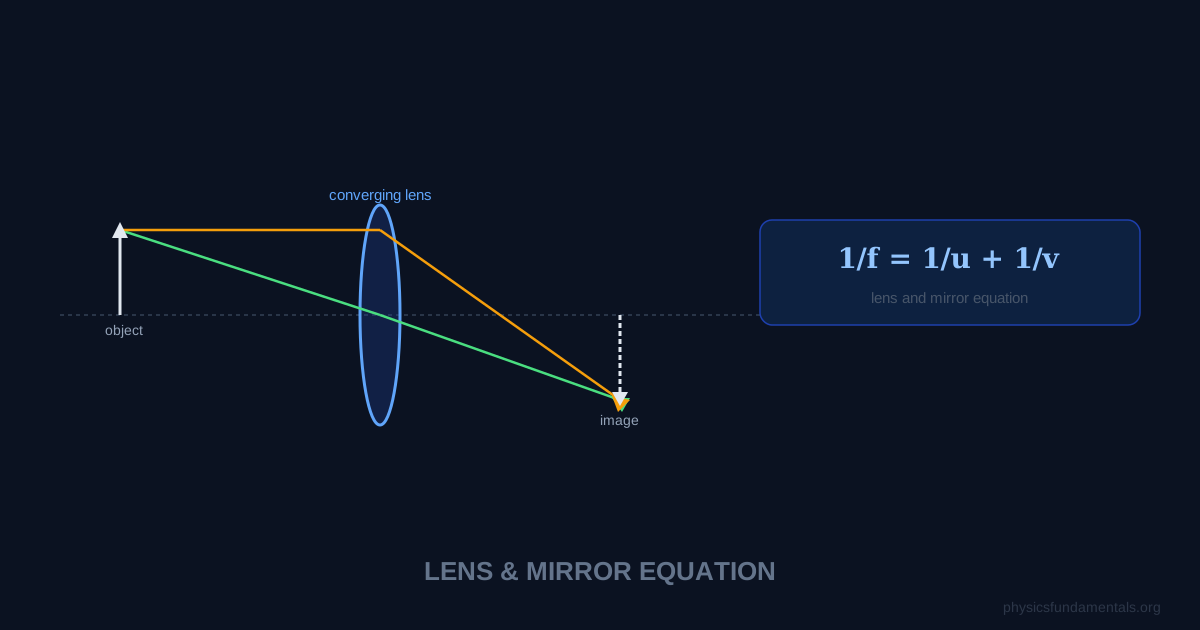
For a thin lens or a curved mirror, the object distance u, the image distance v, and the focal length f are related by:
This single equation describes converging lenses, diverging lenses, concave mirrors, and convex mirrors. The only thing that changes between them is the sign of f and the signs that come out of the calculation. Using the "real-is-positive" convention (the one most widely taught at GCSE and A-Level): distances to real objects and real images are positive; distances to virtual images are negative; a converging lens or concave mirror has positive f; a diverging lens or convex mirror has negative f. Get the sign convention right and the equation does all the physical reasoning for you: a negative v tells you the image is virtual before you've even drawn a diagram.
Magnification
Magnification tells you the size and orientation of the image relative to the object:
A positive m means the image is upright relative to the object; negative means inverted. The magnitude tells you the size ratio: |m| greater than 1 means the image is larger than the object, |m| less than 1 means smaller. A camera lens forming a small, inverted image of a large distant scene has |m| much less than 1 and m negative. A magnifying glass held close to a page has |m| greater than 1 and m positive.
Real vs Virtual Images
A real image forms where light rays actually converge. It can be projected onto a screen, and in the sign convention above, v comes out positive. A virtual image forms where light rays only appear to come from, when traced backward. It can't be projected onto a screen, and v comes out negative. A converging lens forms a real image when the object is further from the lens than the focal length, and a virtual, magnified image (like a magnifying glass) when the object is closer than the focal length. A single diverging lens, used alone, can only ever form a virtual image, regardless of where the object is placed. This is worth memorising, because it's a common exam trap.
Converging vs Diverging Lenses
A converging (convex) lens is thicker in the middle than at the edges and bends parallel rays inward to a real focal point, so f is positive. A diverging (concave) lens is thinner in the middle and spreads parallel rays outward, so they only appear to come from a virtual focal point on the same side as the incoming light, so f is negative. Short-sighted (myopic) eyes are corrected with diverging lenses, which spread the light out slightly before it enters the eye, moving the focal point back onto the retina. Long-sighted (hyperopic) eyes are corrected with converging lenses, which do the opposite.
The Mirror Equation: Same Formula, Curved Reflectors
Curved mirrors obey exactly the same 1/f = 1/u + 1/v relationship, because a mirror is optically equivalent to a lens that reflects rather than transmits light. The geometry of ray convergence is identical. A concave mirror (curving inward, like the inside of a spoon) converges light and has positive f, exactly like a converging lens. A convex mirror (curving outward, like a car's passenger-side mirror) diverges light and has negative f, exactly like a diverging lens. The focal length of a spherical mirror is half its radius of curvature: f = R/2.
Concave vs Convex Mirrors
A concave mirror can form either a real, inverted image (object beyond the focal point, used in reflecting telescopes and satellite dishes) or a virtual, magnified, upright image (object within the focal point, used in makeup and shaving mirrors). A convex mirror always forms a virtual, upright, diminished image regardless of object distance, which is exactly why they're used for car wing mirrors and shop security mirrors: the diminished image packs a wider field of view into the same mirror size, at the cost of objects appearing smaller and further away than they really are, hence the "objects in mirror are closer than they appear" warning.
Worked Example 1: A Camera Lens
A camera lens has a focal length of 50 mm. It photographs a subject 2 m away. Find the image distance and magnification.
m = -v/u = -0.0513/2 = -0.0256. The image forms 51.3 mm behind the lens (real, this is where the camera sensor sits), inverted (negative sign, corrected electronically or optically), and tiny compared to the subject, exactly as expected, since a camera compresses a large scene onto a small sensor.
Worked Example 2: A Concave Mirror
A concave makeup mirror has a focal length of 15 cm. A face is held 10 cm from the mirror, inside the focal length. Find the image position and magnification.
m = -v/u = -(-30)/10 = +3. The negative v confirms a virtual image, forming 30 cm behind the mirror. The magnification of +3 confirms it's upright and three times life-size, precisely the flattering, enlarged reflection a makeup mirror is designed to produce.
Worked Example 3: A Diverging Lens
A diverging lens has a focal length of -20 cm (negative, since it's diverging). An object is placed 25 cm in front of it. Find the image position and magnification.
m = -v/u = -(-11.1)/25 = +0.444. The image is virtual (negative v, forming 11.1 cm in front of the lens, on the same side as the object), upright (positive m), and diminished to 44% of the object's size. This is the signature behaviour of a diverging lens, which is why they only ever produce small, upright, virtual images no matter how far away the object is.
Lens Power and Dioptres
Opticians describe lens strength in dioptres (D) rather than focal length in metres, because dioptre values add directly when lenses are combined:
The 50 mm (0.05 m) camera lens above has a power of 1/0.05 = +20 D. A diverging lens with f = -50 cm (-0.5 m) has a power of 1/(-0.5) = -2 D, a fairly mild short-sightedness prescription. Stacking two thin lenses close together approximately adds their powers: a +3 D and a -1 D lens together behave like a single +2 D lens, which is why opticians can quote your prescription as a single dioptre number even though your glasses may combine multiple correcting effects.
Ray Diagram Rules
Three rays are enough to locate any image, and only two are needed in practice: a ray parallel to the principal axis refracts (or reflects) through the focal point; a ray through the centre of the lens (or the pole of the mirror) passes through undeviated; a ray through the near focal point emerges parallel to the axis. Where two of these rays actually cross, a real image forms. Where they only appear to cross when extended backward (shown as dashed lines), a virtual image forms. Drawing even a rough ray diagram before calculating is the single best habit for catching sign errors: if your diagram clearly shows a virtual, upright image but your calculation gives a positive v, something has gone wrong.
Real-World Applications
Cameras and the human eye: both form real, inverted images on a light-sensitive surface (sensor or retina) using a converging lens system, with the brain (or software) correcting for the inversion. Refracting telescopes: use a large-aperture converging objective lens to gather light and form a real image, magnified further by a smaller eyepiece lens. Reflecting telescopes: use a large concave mirror instead of a lens to gather light, avoiding the chromatic aberration that large lenses suffer from, which is why most major observatories use mirrors, not lenses. Microscopes: use two converging lenses in series, an objective and an eyepiece, each magnifying the image the other has already formed, multiplying their individual magnifications together.
Combining Multiple Lenses
Real optical instruments rarely use a single lens. When two thin lenses are placed close together, the image formed by the first lens becomes the object for the second — you simply apply the lens equation twice in sequence. A compound microscope's objective lens forms a small, real, magnified image of the specimen; that image then becomes the object for the eyepiece lens, which magnifies it further into a virtual image the eye can view comfortably. The overall magnification of the system is the product of each lens's individual magnification: m_total = m_objective × m_eyepiece. This is why microscope objectives are labelled ×10, ×40, ×100 and eyepieces ×10 — a ×40 objective with a ×10 eyepiece gives ×400 total magnification, and swapping either lens changes the total multiplicatively, not additively.
Aberrations: Why Real Lenses Aren't Perfect
The lens equation assumes an idealised "thin lens" with rays close to the principal axis, but real lenses depart from this ideal in two main ways. Chromatic aberration occurs because a lens's refractive index depends slightly on wavelength, so red and blue light focus at marginally different distances, producing coloured fringes around bright edges — this is corrected in quality camera and telescope lenses with achromatic doublets, pairs of lenses made from different glass types that cancel each other's chromatic spread. Spherical aberration occurs because a spherically curved lens doesn't bring rays far from the axis to exactly the same focus as rays near the axis, softening the image at wide apertures — this is why camera lenses are often sharper "stopped down" to a smaller aperture, and why high-end lenses use aspherical elements ground to a more complex, non-spherical shape specifically to correct it. Both aberrations are absent from first-pass calculations using 1/f = 1/u + 1/v, which is exact only for the idealised thin-lens, paraxial-ray case — real optical design adds correction terms and multiple lens elements to control these effects.
Common Mistakes
Mixing up sign conventions mid-problem. Pick one convention (real-is-positive is the most common in UK curricula) and stay consistent for the whole problem. Mixing conventions from different textbooks or exam boards is the single most common source of wrong answers. Forgetting that a diverging lens always has negative f. If a question describes a "diverging lens with focal length 20 cm," the focal length to substitute is -20 cm, not +20 cm. Assuming a negative magnification means a smaller image. The sign of m tells you orientation (upright vs inverted); the magnitude tells you size. A magnification of -3 means an inverted image three times the size of the object, not a small one.
Try it yourself: check your own numbers with the Lens & Mirror Equation Calculator, which shows the formula, the worked substitution and the answer step by step.
Frequently Asked Questions
What is the lens equation?
Is the mirror equation the same as the lens equation?
How do you know if an image is real or virtual?
What is magnification in optics?
Can a diverging lens ever form a real image?
What is lens power measured in?
Why do telescopes use mirrors instead of lenses for large apertures?
Share this article
Written by
Physics Fundamentals Editorial Team
Written and reviewed by our team of physics educators. Content is aligned with A-Level, GCSE, AP Physics, and undergraduate curricula.
About Physics Fundamentals →