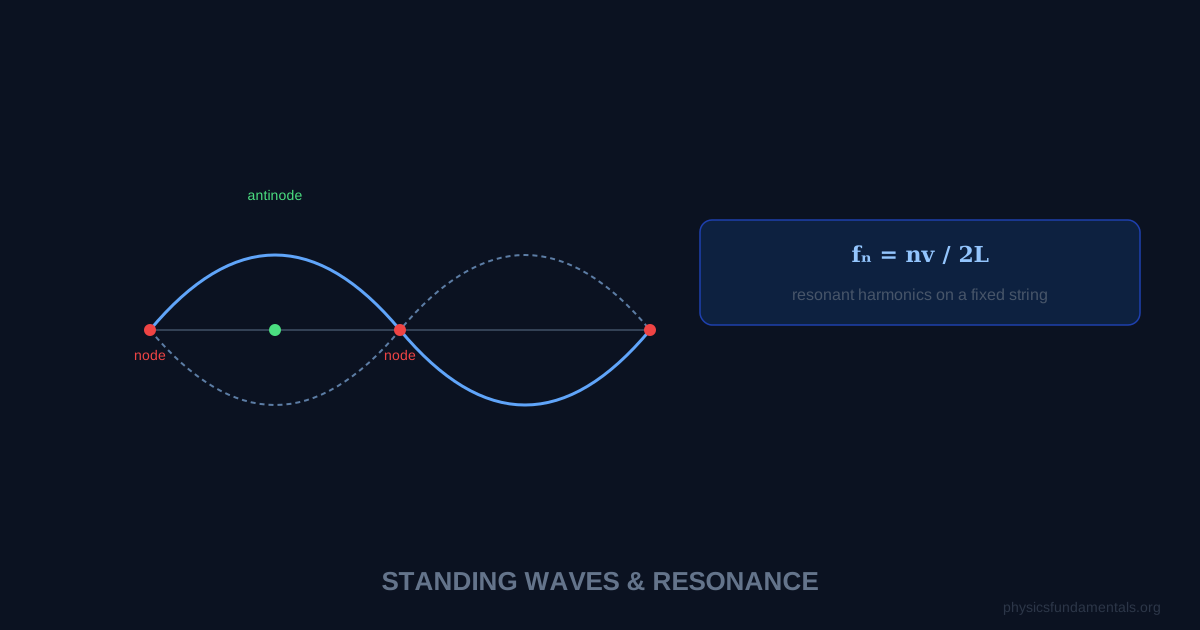
A standing wave forms when two identical waves travel in opposite directions and superpose. Unlike travelling waves, standing waves don't propagate — they oscillate in place, with fixed points of zero displacement (nodes) and maximum displacement (antinodes). On a string fixed at both ends, standing waves form only at specific frequencies — the resonant frequencies or harmonics: fₙ = nv/2L, where n = 1, 2, 3..., v is wave speed, and L is string length.
Standing waves are fundamental to musical instruments, microwave ovens, lasers, and quantum mechanics. The note you hear from a guitar string, a clarinet, or a pipe organ is determined by which standing wave modes the instrument can support. And at the quantum level, the allowed energy levels of electrons in atoms correspond to standing wave patterns — de Broglie waves that fit exactly around the orbit.
- How standing waves form from the superposition of two travelling waves
- Nodes and antinodes — positions and the relationship to wavelength
- Resonant frequencies for strings (fixed-fixed) and pipes (open/closed)
- 4 worked examples including string harmonics and pipe frequencies
- Why standing waves only form at specific frequencies
Formation of Standing Waves
When a wave reflects from a fixed boundary, the incident and reflected waves have the same frequency and amplitude but travel in opposite directions. Their superposition produces a standing wave. The mathematical result of adding y₁ = A sin(kx − ωt) and y₂ = A sin(kx + ωt) is:
The sin(kx) factor gives the spatial pattern (fixed in space); the cos(ωt) factor gives the time oscillation. The amplitude 2A cos(ωt) varies with time but the positions of zero and maximum amplitude are fixed — nodes and antinodes don't move.
Nodes and Antinodes
- Nodes: points of permanently zero displacement. Adjacent nodes are separated by λ/2.
- Antinodes: points of maximum displacement (amplitude = 2A). Located midway between nodes, also separated by λ/2.
- Node-to-antinode distance: λ/4.
Resonant Frequencies — Strings (Fixed at Both Ends)
A string of length L fixed at both ends must have nodes at both ends. This constrains the wavelengths to:
The resonant frequencies (harmonics):
Where v is the wave speed on the string. n = 1 is the fundamental (first harmonic); n = 2 is the second harmonic (first overtone), etc.
Resonant Frequencies — Pipes
Open pipe (open at both ends): antinodes at both ends. Same formula as strings: fₙ = nv/2L (n = 1, 2, 3... — all harmonics).
Closed pipe (closed at one end): node at closed end, antinode at open end. Only odd harmonics:
A closed pipe sounds one octave lower than an open pipe of the same length (fundamental is half the frequency).
4 Worked Examples
Example 1 — Guitar string harmonics
Problem: A guitar string is 0.65 m long. The wave speed is 400 m/s. Find the frequencies of the first three harmonics.
Solution:
f₁ = v/2L = 400/(2 × 0.65) = 307.7 Hz (fundamental)
f₂ = 2v/2L = 2 × 307.7 = 615.4 Hz (second harmonic)
f₃ = 3v/2L = 3 × 307.7 = 923.1 Hz (third harmonic)
Example 2 — Open pipe
Problem: An organ pipe open at both ends has length 0.85 m. Speed of sound = 340 m/s. Find the fundamental frequency and third harmonic.
Solution:
f₁ = v/2L = 340/(2 × 0.85) = 200 Hz
f₃ = 3 × 200 = 600 Hz
Example 3 — Closed pipe
Problem: A pipe closed at one end is 0.425 m long (speed of sound = 340 m/s). Find the fundamental and first two overtones.
Solution:
f₁ = v/4L = 340/(4 × 0.425) = 200 Hz (fundamental)
First overtone: f₃ = 3 × 200 = 600 Hz
Second overtone: f₅ = 5 × 200 = 1000 Hz
(Only odd harmonics — no even harmonics in closed pipe)
Example 4 — Finding string length
Problem: A string vibrates in its second harmonic at 480 Hz. Wave speed = 320 m/s. Find the string length.
Solution:
f₂ = 2v/2L → L = 2v/(2f₂) = v/f₂ = 320/480 = 0.667 m
Resonance
Resonance occurs when a system is driven at one of its natural frequencies — the standing wave amplitude grows rapidly. This is why bridges can be damaged by marching soldiers in step, why wine glasses shatter at the right note, and why microwave ovens excite water molecules at 2.45 GHz (the resonant frequency of water's rotational modes).
In musical instruments, resonance selects which harmonics are amplified by the body of the instrument, shaping the timbre of the sound.
Deriving the Standing Wave Equation
A standing wave is the superposition of two identical travelling waves moving in opposite directions. Taking:
Adding using sum-to-product identity: sin P + sin Q = 2 sin((P+Q)/2) cos((P−Q)/2):
This is the standing wave equation. sin(kx) is the spatial pattern — fixed in space, creating nodes at kx = nπ (x = nλ/2) and antinodes at kx = (n+½)π. cos(ωt) is the temporal oscillation — the entire pattern pulses in time but doesn't travel. Energy oscillates between KE (maximum at antinodes when they move through equilibrium) and PE (elastic — maximum at antinodes when they reach maximum displacement).
Harmonics in Strings and Closed Pipes
String fixed at both ends (and closed pipes — pressure antinodes at closed ends, nodes at open ends — wait, actually open pipes below):
Boundary condition: nodes at both ends. Allowed wavelengths: L = nλ_n/2 → λ_n = 2L/n. Frequencies:
Where f₁ = v/(2L) is the fundamental (n=1). All harmonics (n = 1, 2, 3...) are present. v = √(T/μ) for a string with tension T and linear mass density μ.
Open pipe (open at both ends): antinodes at both ends. Same formula: f_n = nv/(2L) for n = 1, 2, 3.... All harmonics present. This is why open flutes produce a richer tone than closed-ended instruments — more harmonics are present.
Closed pipe (closed at one end, open at other): node at closed end, antinode at open end. Only odd quarter-wavelengths fit: L = nλ/4 for n = 1, 3, 5.... Frequencies:
Only odd harmonics — the characteristic sound of a clarinet, which has an effectively closed cylindrical bore.
Worked Example 5 — Guitar string
Problem: A guitar string has length 0.65 m, tension 78 N, and linear density 4.5 × 10⁻³ kg/m. Find: (a) the wave speed in the string, (b) the fundamental frequency, (c) the frequencies of the 2nd and 3rd harmonics.
Solution:
(a) v = √(T/μ) = √(78/4.5 × 10⁻³) = √17,333 = 131.7 m/s
(b) f₁ = v/(2L) = 131.7/(2 × 0.65) = 131.7/1.3 = 101.3 Hz
(c) f₂ = 2f₁ = 202.6 Hz; f₃ = 3f₁ = 303.9 Hz
Resonance — When Standing Waves Are Forced
Resonance occurs when a system is driven at one of its natural frequencies. The system absorbs energy maximally at these frequencies, producing large-amplitude oscillations. In a driven string or pipe:
- At resonant frequency: energy is continuously absorbed; amplitude grows (limited only by damping) — large oscillation.
- Off resonant frequency: the driving force is sometimes in phase, sometimes out of phase with the wave — energy averages near zero — small oscillation.
Resonance bandwidth (how sharply tuned the resonance is) depends on damping. High damping → broad resonance (easy to excite but maximum amplitude is lower). Low damping → sharp resonance (hard to hit but amplitude can be enormous). Quality factor Q = f_resonant/Δf measures sharpness.
The Tacoma Narrows Bridge Collapse
The Tacoma Narrows Bridge (Washington State, USA) collapsed in 1940 just four months after opening. Wind didn't simply push the bridge — it created periodic vortices on alternating sides (Kármán vortex street) that drove the bridge at one of its natural torsional frequencies. The resonant torsional oscillation built up until the bridge twisted itself apart. Footage shows the bridge oscillating with amplitude of several metres at its resonant frequency before the deck collapsed. Modern bridge design uses aerodynamic cross-sections (like aircraft wings) to suppress vortex shedding, and deliberate damping to reduce Q — preventing resonance buildup.
Worked Example 6 — Resonance in an air column
Problem: A closed-ended pipe resonates at its first (fundamental) frequency with a tuning fork of 440 Hz. Find the pipe length. (Speed of sound = 343 m/s)
Solution:
For a closed pipe, fundamental: f₁ = v/(4L)
L = v/(4f₁) = 343/(4 × 440) = 343/1760 = 0.195 m = 19.5 cm
Check: second resonance (third harmonic, n=3): f₃ = 3v/(4L) = 3 × 440 = 1320 Hz
Standing Waves in 2D and 3D
Standing waves exist in two and three dimensions too. A vibrating drumhead (circular 2D membrane) has complex nodal patterns — lines and circles rather than just points. Chladni figures make these visible: sand sprinkled on a vibrating metal plate migrates to nodal lines, revealing the 2D standing wave pattern. Different resonant frequencies produce different, intricate nodal patterns — demonstrating the richness of 2D standing waves.
In 3D, standing electromagnetic waves in a microwave oven cavity create a pattern of hot spots and cool spots — which is why turntables are used in domestic microwaves (to move food through the hot spots) and why microwave ovens have stirrers (rotating reflectors) to distribute the standing wave pattern more evenly. The hot spots in a microwave oven are separated by half a wavelength: λ/2 = c/(2f) = 3 × 10⁸/(2 × 2.45 × 10⁹) ≈ 6.1 cm — which can be confirmed by melting chocolate and measuring the distance between the melted spots.
Exam Summary for Standing Waves
Key formula: f_n = nv/(2L) for strings and open pipes (all harmonics); f_n = nv/(4L) for n = 1, 3, 5... for closed pipes (odd harmonics only). Node spacing = λ/2; the distance between adjacent nodes or between adjacent antinodes. For strings: v = √(T/μ). For sound in pipes: v = speed of sound ≈ 343 m/s at 20°C. A resonant frequency is any frequency for which a standing wave can form in the system — i.e. the wavelength fits an integer (or half-integer) number of times in the length, satisfying the boundary conditions. Resonance is the dramatic amplitude increase when driving at a natural frequency — limited by damping in real systems.
Musical Instruments and Harmonics
The timbre (tone quality) of a musical instrument is determined by which harmonics are present and their relative amplitudes. A pure sine wave (fundamental only) sounds clinical and electronic. A violin produces a rich sound because bowing excites many harmonics simultaneously — typically up to the 10th harmonic or higher. The specific harmonic content is shaped by the instrument's body, which resonates more strongly at certain frequencies, selectively amplifying harmonics that match its resonant frequencies. This is why a Stradivarius violin sounds different from a student instrument — subtle differences in wood, varnish, and geometry produce different harmonic envelopes.
Brass instruments (trumpets, trombones) use the player's lips as the driving oscillator. By varying lip tension and air pressure, the player selects different harmonics of the instrument tube — each is a natural resonant frequency. The bugle (no valves) can only play the natural harmonic series; the trumpet (three valves, each lengthening the tube) has seven tube lengths, giving seven complete harmonic series, covering all semitones in the playable range. The physics is standing waves selecting which harmonic series is amplified.
Standing waves are the bridge between the physics of waves and the physics of musical sound, structural vibration, and quantum mechanics. The discrete allowed frequencies of a standing wave in a string (f_n = nv/2L) directly parallel the discrete allowed energies of a quantum particle in a box (En ∝ n²/L²) — both arise from the same mathematics of imposing boundary conditions on wave equations. Bohr's model of the atom was inspired by the idea of standing electron waves around the nucleus (de Broglie, 1924) — the allowed orbits are those where an integer number of electron wavelengths fit around the circumference. Standing waves in a string are thus not merely a topic in A-Level physics — they are the conceptual precursor to quantum mechanics itself.
In practical engineering, resonance must either be exploited (musical instruments, radio tuners, MRI scanners, laser cavities — all use resonance to select specific frequencies) or avoided (bridges, aircraft, buildings — resonance can cause catastrophic failure). The key design principle for avoiding resonance: ensure the natural frequencies of the structure are well separated from any driving frequencies in the environment. Bridges are designed with natural frequencies above the typical wind vortex shedding frequencies for their expected wind speeds. Aircraft engines are balanced so their vibration frequencies don't coincide with the natural frequencies of the wing or fuselage. Tall buildings use tuned mass dampers — large pendulums near the top — to absorb resonant wind-induced oscillations.
The physics of standing waves on a string predicts that the fundamental frequency depends on tension, length, and mass density: f₁ = (1/2L)√(T/μ). A guitar player uses all three to tune and play: tightening a tuning peg increases T → raises pitch; pressing a fret shortens L → raises pitch; heavier strings have higher μ → lower pitch for the same tension. The six strings of a guitar span a pitch range of about 2.5 octaves by combining all three effects — the thinnest string (e, lightest μ, highest tension) has a fundamental 16× the frequency of the thickest string (E, heaviest μ, lower tension). All six strings are the same length, so length is used only dynamically (by fretting) to change pitch during playing.
Frequently Asked Questions
What is a standing wave?
What is the difference between a node and an antinode?
What are harmonics?
Why does a closed pipe only produce odd harmonics?
What is resonance?
Share this article
Written by
Physics Fundamentals Editorial Team
Written and reviewed by our team of physics educators. Content is aligned with A-Level, GCSE, AP Physics, and undergraduate curricula.
About Physics Fundamentals →