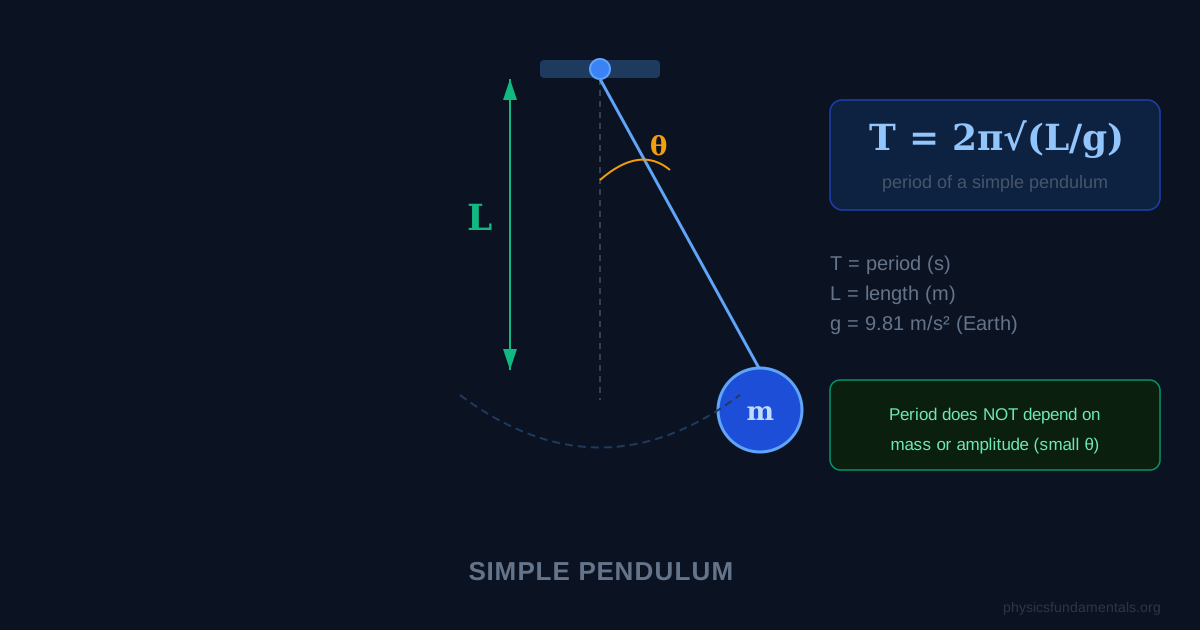
The period of a simple pendulum is T = 2π√(L/g), where T is the time for one complete swing in seconds, L is the length of the pendulum in metres, and g is gravitational field strength (9.81 m/s² on Earth). The period depends on length and gravity — not on the mass of the bob, and not on the amplitude of the swing for small angles. That surprising independence from mass is what makes pendulums useful as timekeepers.
Galileo noticed this around 1602 while watching a chandelier swing in the cathedral at Pisa. He timed the swings against his own pulse and found the period stayed constant regardless of how far the chandelier swung. That observation launched the era of the pendulum clock — for nearly three centuries, the most accurate timekeeping devices in the world all used the pendulum's regularity.
- The period formula T = 2π√(L/g) — derived, not just given
- Why period is independent of mass and amplitude (for small angles)
- 3 worked examples including finding g from a pendulum experiment
- How pendulums relate to simple harmonic motion
- The small-angle approximation and when it breaks down
What Is a Simple Pendulum?
A simple pendulum consists of a point mass (the bob) suspended by a massless, inextensible string of length L from a fixed pivot. When displaced from equilibrium and released, it oscillates back and forth under gravity. Real pendulums approximate this model when the string mass is negligible and the bob is small compared to the string length.
The "simple" in simple pendulum refers to the idealised model — massless string, point mass, no air resistance, no friction at the pivot. Real pendulums deviate from this, but for most school-level calculations and many practical applications, the simple pendulum model is accurate enough.
The equilibrium position is the lowest point of the swing, directly below the pivot. When the bob is displaced to an angle θ and released, gravity provides a restoring force pulling it back toward equilibrium. For small angles (below about 15°), this restoring force is approximately proportional to displacement — the defining feature of simple harmonic motion.
The Period Formula T = 2π√(L/g)
Where:
- T = period of oscillation — time for one complete swing (there and back), in seconds (s)
- L = length of the pendulum from pivot to centre of mass of the bob, in metres (m)
- g = gravitational field strength, in m/s² (9.81 m/s² on Earth's surface)
- π = 3.14159...
Rearranging for each variable:
The second rearrangement is particularly useful in experiments: measure the period T and length L, and you can calculate g at your location. This is how students in school labs determine g without a free-fall timer.
Use our Pendulum Period Calculator to find T, L, or g for any values.
What the formula tells you
Four important observations from T = 2π√(L/g):
- Longer pendulums have longer periods. T ∝ √L. Double the length and the period increases by √2 ≈ 1.41. Quadruple the length to double the period.
- Stronger gravity gives shorter periods. T ∝ 1/√g. A pendulum on the Moon (g = 1.62 m/s²) swings much more slowly than the same pendulum on Earth.
- Mass does not appear in the formula. Period is completely independent of the bob's mass — a 1 kg bob and a 10 kg bob on the same string have identical periods.
- Amplitude does not appear in the formula (for small angles). Swing wide or swing narrow — the period is the same, within the small-angle approximation.
Derivation of T = 2π√(L/g)
The derivation uses the small-angle approximation: for θ ≪ 1 radian (roughly below 15°), sin θ ≈ θ.
Consider a pendulum bob of mass m at angle θ. The component of gravity acting along the arc (restoring force) is:
The arc length displacement from equilibrium is s = Lθ, so θ = s/L:
This is the form F = −kx with k = mg/L — simple harmonic motion. For SHM, the period is:
The mass cancels, leaving T = 2π√(L/g). The independence from mass isn't a coincidence — it's because the restoring force (gravity) is proportional to mass, so the mass divides out of the equation of motion entirely.
The Small-Angle Approximation
The formula T = 2π√(L/g) is exact only for infinitely small oscillations. In practice, it holds well for angles below about 15° (0.26 rad) — the error is less than 0.5%. Beyond that, the true period is longer than the formula predicts:
- At 15°: error ≈ 0.5%
- At 30°: error ≈ 1.7%
- At 45°: error ≈ 4.0%
- At 90°: error ≈ 18%
For exam purposes, always use T = 2π√(L/g) unless specifically told the amplitude is large. The small-angle approximation is valid in all standard school and university problems.
3 Worked Examples
Example 1 — Finding the period
Problem: A simple pendulum has a length of 0.64 m. Calculate its period on Earth. (g = 9.81 m/s²)
Solution:
T = 2π√(L/g)
T = 2π√(0.64/9.81)
T = 2π√(0.0652)
T = 2π × 0.2554
T = 1.60 s
This pendulum completes one full swing (out and back) in 1.60 seconds.
Example 2 — Finding the length for a given period
Problem: A grandfather clock uses a pendulum with a period of exactly 2.00 s. What length of pendulum is required? (g = 9.81 m/s²)
Solution:
Rearranging: L = g(T/2π)²
L = 9.81 × (2.00/(2π))²
L = 9.81 × (0.3183)²
L = 9.81 × 0.1013
L = 0.994 m ≈ 1.00 m
A 1-metre pendulum has a period of almost exactly 2 seconds — this is where the "seconds pendulum" gets its name, and why grandfather clocks are about a metre tall.
Example 3 — Measuring g with a pendulum
Problem: A student measures a pendulum of length 0.500 m and times 20 complete oscillations as 28.4 s. Calculate g from this data.
Solution:
Period: T = 28.4 / 20 = 1.42 s
Rearranging T = 2π√(L/g): g = 4π²L/T²
g = 4π² × 0.500 / (1.42)²
g = 19.739 × 0.500 / 2.016
g = 9.870 / 2.016
g = 4.90 m/s²
Wait — that's wrong. Let's check: g = 4 × 9.870 × 0.500 / 2.016 = 9.74 m/s². The student's measurement gives g ≈ 9.74 m/s², close to the standard 9.81 m/s². Small timing errors of a fraction of a second over 20 swings account for the discrepancy — which is why timing at least 20 oscillations and repeating the measurement is standard experimental practice.
Pendulums on Other Planets
Since T = 2π√(L/g), a pendulum clock calibrated on Earth runs slow on any planet with weaker gravity and fast on any planet with stronger gravity.
- Moon (g = 1.62 m/s²): A 1 m pendulum has T = 2π√(1/1.62) = 4.94 s — nearly 2.5× slower than on Earth
- Mars (g = 3.72 m/s²): Same pendulum gives T = 2π√(1/3.72) = 3.26 s
- Jupiter (g = 24.8 m/s²): T = 2π√(1/24.8) = 1.26 s — 1.27× faster than Earth
This is why pendulum clocks can't be used on the Moon — they'd lose about 60% of their ticking speed without any adjustment. Modern atomic clocks don't have this problem.
Pendulum and Simple Harmonic Motion
The simple pendulum is a classic example of simple harmonic motion (SHM) — but only for small angles. The key SHM quantities for a pendulum are:
- Angular frequency: ω = 2π/T = √(g/L)
- Frequency: f = 1/T = (1/2π)√(g/L)
- Maximum velocity: v_max = Aω, where A is the amplitude (arc length at maximum displacement)
- Maximum acceleration: a_max = Aω² = A(g/L)
The energy of the pendulum alternates between gravitational potential energy (maximum at the endpoints) and kinetic energy (maximum at the lowest point), with total mechanical energy conserved throughout the swing in the absence of friction.
Derivation of T = 2π√(L/g) from Newton's Laws
Consider a pendulum bob of mass m on a string of length L, displaced by angle θ from vertical. The restoring force along the arc is the tangential component of gravity: F = −mg sinθ. For small angles (θ < ~15°), sinθ ≈ θ (in radians), so:
Where s = Lθ is the arc displacement. This is Hooke's law F = −ks with effective spring constant k = mg/L. For SHM, T = 2π√(m/k) = 2π√(m/(mg/L)) = 2π√(L/g):
The mass m cancels — period is independent of mass. A 100 g and a 1 kg bob on identical strings swing in perfect synchrony. This mass independence was Galileo's famous observation (reportedly from watching a cathedral lamp swing) and was the key property that made pendulums useful as timekeepers.
Energy Analysis of the Pendulum
Taking the lowest point as the reference (GPE = 0), the pendulum bob at angle θ is at height h = L(1 − cosθ):
At the lowest point: all KE, v_max = √(2gL(1−cosθ_max)). For small angles, 1−cosθ ≈ θ²/2, so v_max ≈ θ_max√(gL) = Aω where A = Lθ_max is the arc amplitude and ω = √(g/L) is the angular frequency. The energy continuously converts between GPE (maximum at the extremes) and KE (maximum at the bottom), with total mechanical energy constant (no air resistance).
Worked Example 5 — Pendulum as a clock
Problem: A grandfather clock uses a seconds pendulum — it ticks once per second (half-period = 1 s, so T = 2 s). Find the required pendulum length.
Solution:
T = 2π√(L/g) → L = g(T/2π)² = 9.81 × (2/2π)² = 9.81 × (1/π)² = 9.81/9.870 = 0.9937 m ≈ 99.4 cm
The "metre" was originally defined as 1/10 of the length of a seconds pendulum — a natural unit based on the physics of gravity at Earth's surface. The metre was later redefined in terms of the Earth's circumference (1/10,000,000 of the distance from pole to equator), which coincidentally gives nearly the same result.
Measuring g with a Pendulum
The pendulum provides a simple and accurate method for measuring local gravitational acceleration. From T = 2π√(L/g): g = 4π²L/T². To minimise percentage errors: (1) use a long string (L > 1 m — reduces the percentage error in measuring L); (2) time many oscillations (e.g. 50 complete swings — time error in one period is (total timing error)/50); (3) use small amplitudes (θ < 5°) so the small angle approximation holds to better than 0.2%; (4) measure L from the pivot to the centre of the bob, not the top.
A typical school experiment: L = 1.0 m, T measured over 20 oscillations. If total time = 40.2 s: T = 2.01 s; g = 4π² × 1.0/2.01² = 39.478/4.040 = 9.77 m/s². Real g at sea level ≈ 9.81 m/s² — the 0.4% discrepancy arises from measurement uncertainties and any deviation from the small-angle approximation.
The Conical Pendulum
In a conical pendulum, the bob moves in a horizontal circle while the string traces a cone. If the string makes angle θ with the vertical:
- Vertical equilibrium: T cosθ = mg
- Horizontal (centripetal): T sinθ = mω²r = mω²L sinθ
- Dividing: cosθ = g/(ω²L) → ω = √(g/L cosθ)
- Period: T_conical = 2π√(L cosθ/g)
As θ → 0 (nearly vertical): T_conical → 2π√(L/g) — the simple pendulum result. As θ increases, the period decreases. A conical pendulum rotating at 60 rpm with L = 0.5 m: ω = 2π rad/s; cosθ = g/(ω²L) = 9.81/(4π² × 0.5) = 9.81/19.74 = 0.497 → θ = 60.2°.
The Physical (Compound) Pendulum
A simple pendulum is an idealisation: a point mass on a massless string. Real pendulums are usually rigid bodies swinging about a fixed horizontal axis: a metre rule pivoted at one end, a swinging door, a leg swinging as you walk. This is called a physical pendulum or compound pendulum. Because its mass is spread out, its period depends on the body's moment of inertia, not just on a length.
Deriving the period of a physical pendulum
Let m be the mass, d the distance from the pivot to the centre of mass, and I the moment of inertia about the pivot. Gravity acts at the centre of mass and produces a restoring torque τ = −mgd sin θ. For small angles sin θ ≈ θ, and Newton's second law for rotation (Iα = τ) gives:
This is the standard simple harmonic motion equation with ω² = mgd/I, so:
Check: a point mass on a string of length L has I = mL² and d = L, so T = 2π√(mL²/(mgL)) = 2π√(L/g), the simple pendulum formula. The physical pendulum formula contains it as a special case.
Equivalent simple pendulum length
Any physical pendulum swings with the same period as a simple pendulum of length Leq = I/(md). If you know the moment of inertia about the centre of mass, Icm, the parallel-axis theorem gives I = Icm + md², so:
| Simple pendulum | Physical (compound) pendulum | |
|---|---|---|
| Model | Point mass on a massless string | Rigid body of any shape, pivoted about a horizontal axis |
| Period | T = 2π√(L/g) | T = 2π√(I/(mgd)) |
| Depends on | Length L and g only | Shape, mass distribution and pivot position, through I and d |
| Equivalent simple length | L | Leq = I/(md) |
Example 1 — Uniform rod pivoted at one end
Problem: A uniform rod of length L = 1.00 m is pivoted at one end and swings in a vertical plane. Find its period. (g = 9.81 m/s²)
Solution: For a uniform rod about its end, I = mL²/3, and the centre of mass is at d = L/2.
T = 2π√(I/(mgd)) = 2π√((mL²/3)/(mgL/2)) = 2π√(2L/(3g))
T = 2π√(2 × 1.00/(3 × 9.81)) = 1.64 s
The equivalent simple pendulum length is 2L/3 ≈ 0.67 m. A 1.00 m simple pendulum has T = 2.01 s, so the rod swings noticeably faster than a point mass at the same distance.
Example 2 — Uniform disc pivoted at its rim
Problem: A uniform disc of radius R = 0.20 m hangs from a pivot on its rim and swings about an axis perpendicular to the disc. Find its period.
Solution: By the parallel-axis theorem, I = ½mR² + mR² = 3mR²/2, and d = R.
T = 2π√((3mR²/2)/(mgR)) = 2π√(3R/(2g))
T = 2π√(3 × 0.20/(2 × 9.81)) = 1.10 s
Example 3 — Disc rolling inside a circular track
A related small-oscillation problem: a solid disc of radius r rolls without slipping back and forth inside a fixed circular track of radius R. Let θ be the angle between the vertical and the line from the track's centre to the disc's centre. Write Ω = dθ/dt. That centre moves at speed (R − r)Ω, and rolling without slipping means the disc spins at (R − r)Ω/r. The kinetic energy is therefore:
The potential energy is −mg(R − r)cos θ ≈ ½mg(R − r)θ² plus a constant. Differentiating the total energy gives d²θ/dt² = −(2g/(3(R − r)))θ, so the angular frequency and period are:
For R = 0.50 m and r = 0.10 m: T = 2π√(3 × 0.40/(2 × 9.81)) = 1.55 s. A point mass sliding without friction along the same path (radius 0.40 m) would take 2π√(0.40/9.81) = 1.27 s. The extra factor of 3/2 comes from rolling: part of the energy goes into spin, so the disc swings more slowly.
All the results in this section assume small amplitudes (sin θ ≈ θ), so the accuracy limits in the small-angle section above apply here too.
Damped Oscillations and Energy Loss
A real pendulum loses energy to air resistance and pivot friction, so its amplitude decays over time. For light damping, the period is approximately unchanged but the amplitude decreases exponentially:
Where γ is the damping constant. A clock pendulum uses an escapement mechanism to deliver small periodic impulses that replenish the energy lost to damping, maintaining constant amplitude. Without this energy input, a pendulum in air loses roughly 0.1–1% of its energy per swing, depending on construction quality — a well-made grandfather clock pendulum would stop within hours without the escapement's energy input.
Pendulum Applications Beyond Timekeeping
Foucault pendulum: a long pendulum (typically 20–70 m) swinging freely demonstrates Earth's rotation. The plane of oscillation appears to rotate over 24 hours (or less at non-polar latitudes — the rotation rate is proportional to sinφ where φ is latitude). The original Foucault pendulum in the Panthéon, Paris (1851) was the first direct mechanical demonstration of Earth's rotation.
Seismometers use pendulum-like masses that remain stationary while the Earth moves around them during earthquakes — the relative motion is detected and recorded. Accelerometers in smartphones use tiny MEMS (microelectromechanical systems) oscillators — microscopic pendulums on silicon chips — to detect device orientation and motion. Ballistic pendulum (mentioned in collision articles) uses momentum and energy conservation to measure bullet speed.
The simple pendulum is the prototype for all oscillatory systems. Its behaviour — period independent of amplitude for small angles, proportional to √(L/g), independent of mass — exemplifies the power of the SHM model. The derivation from F = −kx (with k = mg/L) shows how any system with a linear restoring force oscillates at ω = √(k/m), regardless of the physical nature of k. Springs (k = spring constant), LC circuits (k = 1/C), molecular vibrations (k = bond stiffness), and acoustically resonant cavities all follow the same mathematical framework. The pendulum, being the simplest and most accessible example, provides the intuition that carries through all of these more complex applications.
Frequently Asked Questions
What is the formula for the period of a simple pendulum?
What is the period of a physical (compound) pendulum?
Does the period of a pendulum depend on mass?
Does the period of a pendulum depend on amplitude?
How do you find g using a pendulum?
What is the period of a 1-metre pendulum?
Share this article
Written by
Physics Fundamentals Editorial Team
Written and reviewed by our team of physics educators. Content is aligned with A-Level, GCSE, AP Physics, and undergraduate curricula.
About Physics Fundamentals →