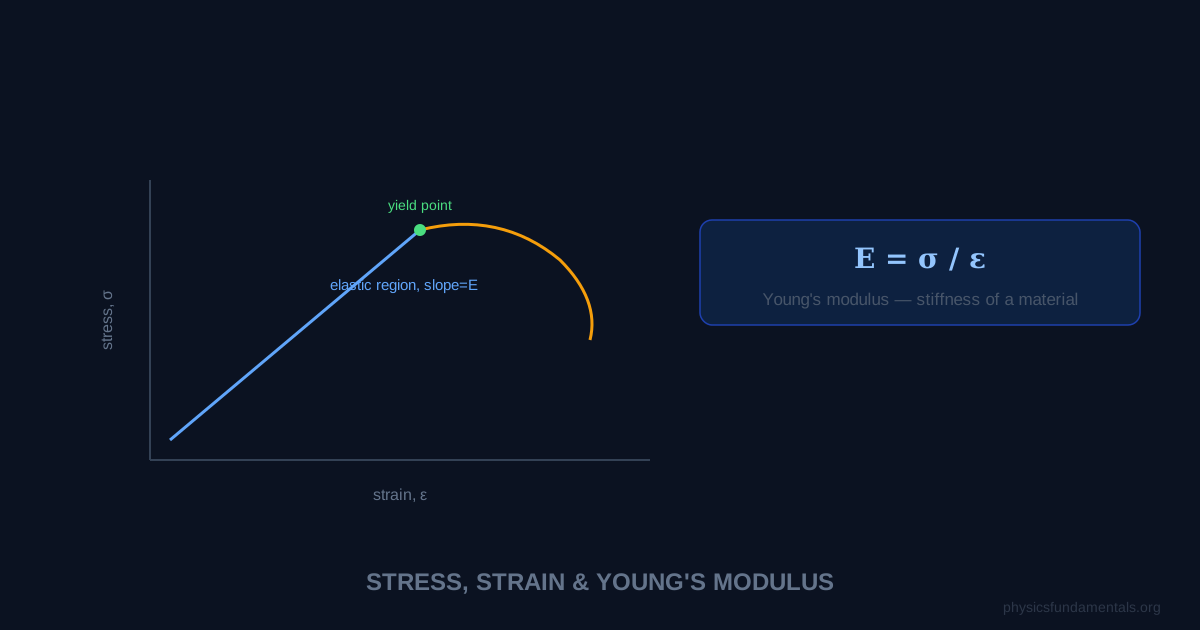
When a force stretches or compresses a material, stress is the force per unit area (σ = F/A) and strain is the fractional change in length (ε = ΔL/L₀). In the elastic region, stress is proportional to strain, and the ratio is Young's modulus: E = σ/ε. Young's modulus is a material constant — steel always has E ≈ 200 GPa, rubber ≈ 0.01–0.1 GPa, regardless of the sample's dimensions. It tells you how stiff a material is: how much force per unit area is needed to produce a given fractional extension.
This is the foundation of materials science and structural engineering. Every bridge, building, aircraft component, and medical implant is designed using these principles — the engineer must ensure that stresses remain below the material's elastic limit, or the structure will permanently deform.
- Stress: σ = F/A — force per unit cross-sectional area (Pa or N/m²)
- Strain: ε = ΔL/L₀ — fractional extension (dimensionless)
- Young's modulus: E = σ/ε — the stiffness of a material
- The stress-strain graph: elastic region, yield point, plastic deformation
- 4 worked examples including finding extension and modulus from data
Stress: σ = F/A
Where σ (sigma) is tensile stress in pascals (Pa = N/m²), F is the applied force (N), and A is the cross-sectional area perpendicular to the force (m²).
Stress is independent of the material's length — a short rod and a long rod with the same cross-section experience the same stress under the same force. It's the force intensity that the material must resist. Higher stress means more internal force per unit area trying to pull the atoms apart.
Strain: ε = ΔL/L₀
Where ε (epsilon) is tensile strain (dimensionless — no units), ΔL is the extension (m), and L₀ is the original length (m). Strain is often expressed as a percentage: 0.001 = 0.1%.
Strain measures how much the material has deformed relative to its original size. A 1 m rod extending by 1 mm has strain ε = 0.001. A 2 m rod extending by 2 mm under the same force has the same strain — strain is a relative measure, independent of original length.
Young's Modulus: E = σ/ε
Young's modulus is measured in pascals (Pa) — the same unit as stress, since strain is dimensionless. In practice, values are in GPa (10⁹ Pa) for most engineering materials.
| Material | Young's Modulus E | Character |
|---|---|---|
| Diamond | ~1000 GPa | Extremely stiff |
| Steel | ~200 GPa | Very stiff |
| Aluminium | ~70 GPa | Moderately stiff |
| Bone | ~20 GPa | Fairly stiff |
| Wood | ~10 GPa | Moderately stiff |
| Rubber | ~0.01–0.1 GPa | Very flexible |
The Stress-Strain Graph
A stress-strain graph shows the relationship between stress and strain as a material is stretched to breaking point:
- Elastic region (linear): Stress is proportional to strain (Hooke's law for the material). The gradient = Young's modulus. The material returns to its original shape when force is removed.
- Limit of proportionality: The point where the graph first deviates from linear. Above this, stress is no longer proportional to strain but the material may still be elastic.
- Elastic limit: Maximum stress where the material still returns to its original shape. Beyond this, permanent (plastic) deformation occurs.
- Yield point: The material begins to deform plastically — large strains occur with little increase in stress. Metals often show a pronounced yield point.
- Ultimate tensile strength (UTS): Maximum stress the material can withstand. Beyond this, necking occurs and the material weakens.
- Breaking point (fracture): The material breaks.
4 Worked Examples
Example 1 — Extension of a steel wire
Problem: A steel wire (E = 200 GPa) has length 2.0 m and cross-sectional area 1.5 × 10⁻⁶ m². A 600 N load is applied. Find the extension.
Solution:
σ = F/A = 600 / 1.5 × 10⁻⁶ = 4.0 × 10⁸ Pa
ε = σ/E = 4.0 × 10⁸ / 200 × 10⁹ = 2.0 × 10⁻³
ΔL = ε × L₀ = 2.0 × 10⁻³ × 2.0 = 4.0 × 10⁻³ m = 4.0 mm
Example 2 — Finding Young's modulus from experiment
Problem: A wire of diameter 0.8 mm and length 1.5 m extends by 2.1 mm under a 180 N load. Find Young's modulus.
Solution:
A = π(d/2)² = π × (0.4 × 10⁻³)² = 5.027 × 10⁻⁷ m²
σ = 180 / 5.027 × 10⁻⁷ = 3.581 × 10⁸ Pa
ε = 2.1 × 10⁻³ / 1.5 = 1.4 × 10⁻³
E = σ/ε = 3.581 × 10⁸ / 1.4 × 10⁻³ = 2.56 × 10¹¹ Pa ≈ 256 GPa
Example 3 — Stress in a bone
Problem: A femur (thigh bone) has cross-sectional area 6 cm² = 6 × 10⁻⁴ m². During a jump landing, the compressive force is 4500 N. Find the compressive stress.
Solution:
σ = F/A = 4500 / 6 × 10⁻⁴ = 7.5 × 10⁶ Pa = 7.5 MPa
Bone's compressive strength is ~170 MPa, so this is well within safe limits.
Example 4 — Strain and percentage extension
Problem: A rubber band of original length 8 cm stretches to 14 cm. Find the strain and express it as a percentage.
Solution:
ΔL = 14 − 8 = 6 cm = 0.06 m; L₀ = 0.08 m
ε = ΔL/L₀ = 0.06/0.08 = 0.75 = 75%
This large strain is possible for rubber because it's highly elastic — metals typically fail at strains below 0.5%.
The Stress-Strain Graph in Detail
A careful stress-strain graph for a ductile metal (like mild steel) shows several distinct regions:
- Linear elastic region (O to P): stress proportional to strain (Hooke's law for the material). Gradient = Young's modulus E. The material fully recovers on unloading — no permanent deformation. P is the limit of proportionality.
- Non-linear elastic region (P to E): stress no longer proportional to strain, but the material still returns to its original shape on unloading. E is the elastic limit — the maximum stress for fully reversible deformation.
- Yield point (Y): the material suddenly begins to flow plastically at approximately constant stress (the upper and lower yield points for mild steel). Large strains occur with little stress increase.
- Plastic region / strain hardening: stress increases again as the material work-hardens (dislocations pile up and obstruct each other). The material is permanently deformed — it won't return to original length on unloading.
- Ultimate tensile strength (UTS, U): maximum stress the material can withstand. Above this, "necking" begins — the sample thins locally.
- Fracture point (F): the material breaks.
Elastic vs Plastic Materials
Materials vary widely in their stress-strain behaviour:
- Ductile metals (mild steel, copper, aluminium): large plastic region before fracture — can be drawn into wire, stamped into shapes. High toughness (area under stress-strain curve = energy per unit volume absorbed before fracture).
- Brittle materials (glass, cast iron, ceramics): virtually no plastic region — fracture at the elastic limit with no warning. High strength but low toughness.
- Rubber: large reversible strains (up to 600%), non-linear stress-strain curve (not Hookean), very low Young's modulus (~0.01 GPa). The stress-strain curve for rubber is hysteretic — the loading and unloading curves differ, with energy dissipated as heat. This hysteresis in car tyres contributes to rolling resistance.
- Bone: composite material (hydroxyapatite mineral in collagen matrix). Elastic up to ~1% strain; stiffer in compression than tension; anisotropic (different E in different directions). Optimised by evolution for the loading patterns of normal activity.
Worked Example 5 — Bone loading during exercise
Problem: A runner's tibia (shinbone) has cross-sectional area 4.5 cm² and length 36 cm. The compressive force during a footstrike is 2,700 N. Given E_bone = 20 GPa in compression, find: (a) compressive stress, (b) strain, (c) compression of the bone.
Solution:
(a) σ = F/A = 2700/(4.5 × 10⁻⁴) = 6.0 × 10⁶ Pa = 6.0 MPa
Bone's compressive strength is ~170 MPa — this is well within safe limits (factor of ~28 safety margin).
(b) ε = σ/E = 6.0 × 10⁶/20 × 10⁹ = 3.0 × 10⁻⁴ = 0.03%
(c) ΔL = εL₀ = 3.0 × 10⁻⁴ × 0.36 = 1.08 × 10⁻⁴ m = 0.108 mm
The bone compresses by about 0.1 mm per footstrike — imperceptible, but the cyclic loading is critical for bone remodelling and maintaining density.
Hardness, Toughness, and Stiffness — Distinguishing Material Properties
These three properties are frequently confused:
- Stiffness (Young's modulus E): resistance to elastic deformation. High E = material deforms little under stress. Stiffness is the slope of the elastic region on the stress-strain curve.
- Strength (yield strength or UTS): the stress at which the material permanently deforms (yield) or breaks (UTS). High strength = withstands large stress before yielding.
- Hardness: resistance to indentation/scratching. Related to yield strength but measured differently (Vickers, Brinell, Rockwell scales). Diamond is the hardest material (hardness 10 on Mohs scale) but brittle.
- Toughness: energy absorbed before fracture = area under the full stress-strain curve (J/m³). A tough material can be strong and ductile. Glass is strong but not tough (brittle fracture). Rubber is neither strong nor stiff but very tough (enormous strain before fracture).
Worked Example 6 — Composite cable design
Problem: A suspension bridge cable is made of 200 parallel steel wires, each 5 mm diameter. E_steel = 200 GPa, yield strength = 1500 MPa. Find: (a) total cross-sectional area, (b) maximum safe load (using 50% of yield strength as safety factor), (c) extension under half the safe load for a 500 m cable.
Solution:
(a) A_wire = π(0.0025)² = 1.963 × 10⁻⁵ m²; A_total = 200 × 1.963 × 10⁻⁵ = 3.927 × 10⁻³ m² ≈ 39.3 cm²
(b) Safe stress = 1500/2 = 750 MPa; F_safe = σ × A = 750 × 10⁶ × 3.927 × 10⁻³ = 2.945 × 10⁶ N ≈ 2.95 MN
(c) Load = F_safe/2 = 1.473 MN; σ = 1.473 × 10⁶/3.927 × 10⁻³ = 375 MPa
ε = σ/E = 375 × 10⁶/200 × 10⁹ = 1.875 × 10⁻³
ΔL = ε × L = 1.875 × 10⁻³ × 500 = 0.9375 m ≈ 94 cm
A 500 m cable under moderate load extends by nearly a metre — elastic deformation at the scale of large structures is non-trivial and must be accounted for in engineering design.
Exam Summary for Stress, Strain and Young's Modulus
Three key formulas: σ = F/A (stress, Pa); ε = ΔL/L₀ (strain, dimensionless); E = σ/ε = FL₀/(AΔL) (Young's modulus, Pa). Typical Young's moduli: steel 200 GPa, aluminium 70 GPa, bone 20 GPa, rubber 0.01–0.1 GPa. From the stress-strain graph: gradient of linear region = E; limit of proportionality = end of linear region; elastic limit = where permanent deformation begins; yield point = where large plastic deformation starts at approximately constant stress; UTS = highest point; fracture = end of curve. Ductile materials have a long plastic region (steel, copper); brittle materials fracture near the elastic limit (glass, ceramics).
Poisson's Ratio and Lateral Strain
When a material is stretched longitudinally, it contracts laterally. The ratio of lateral strain to longitudinal strain is the Poisson's ratio ν:
Most materials have ν ≈ 0.2–0.5. For an incompressible material (rubber, soft tissues): ν = 0.5 — the volume is preserved as the material stretches (what it gains in length it loses in cross-section). Cork has ν ≈ 0 — it doesn't expand laterally when compressed, which is why corks are pushed into bottles without making them wider. Some exotic metamaterials have negative ν (auxetic materials) — they expand laterally when stretched, used in medical stents that expand when deployed.
Poisson's ratio matters in 3D stress analysis. A block under uniaxial compression (like a pillar) also experiences lateral tension — which can cause splitting failure perpendicular to the load direction. This is why concrete columns sometimes fail by vertical cracking: the lateral Poisson expansion is resisted by the surrounding material, creating tensile hoop stresses.
Young's modulus is measured experimentally by the wire extension method: hang known masses from a long thin wire, measure extension with a travelling microscope or micrometer, plot stress vs strain, and take the gradient. The main sources of uncertainty are: measuring the wire diameter accurately (enters as d² in the area calculation, so a 1% error in d gives 2% error in E); measuring a small extension with a large systematic zero error; and not checking whether the wire is in the elastic region (yield point exceeded by too heavy a load). A well-executed school experiment can achieve ±5–10% accuracy in E for a metal wire — sufficient to identify the material from a table of Young's moduli values.
Materials science is fundamentally the study of the stress-strain curves of different materials and the microscopic mechanisms that produce them. The stiffness (E) is set by the atomic bond spring constant at the atomic level — stronger, shorter bonds give higher E. The yield strength is determined by how easily dislocations (line defects in the crystal) can move — more dislocations and obstacles mean higher yield strength (work hardening, precipitation hardening in alloys). The fracture mode depends on whether cracks can propagate or blunt before reaching critical length (Griffith crack theory). Modern materials science manipulates all these properties through alloying, heat treatment, cold working, and microstructure control — producing materials with specific combinations of stiffness, strength, and toughness tailored to particular engineering applications.
Try it yourself: check your own numbers with the Stress, Strain & Young's Modulus Calculator, which shows the formula, the worked substitution and the answer step by step.
Frequently Asked Questions
What is Young's modulus?
What is the difference between stress and pressure?
What is the difference between elastic and plastic deformation?
How do you measure Young's modulus experimentally?
Why does a thicker wire of the same material extend less under the same force?
Share this article
Written by
Physics Fundamentals Editorial Team
Written and reviewed by our team of physics educators. Content is aligned with A-Level, GCSE, AP Physics, and undergraduate curricula.
About Physics Fundamentals →