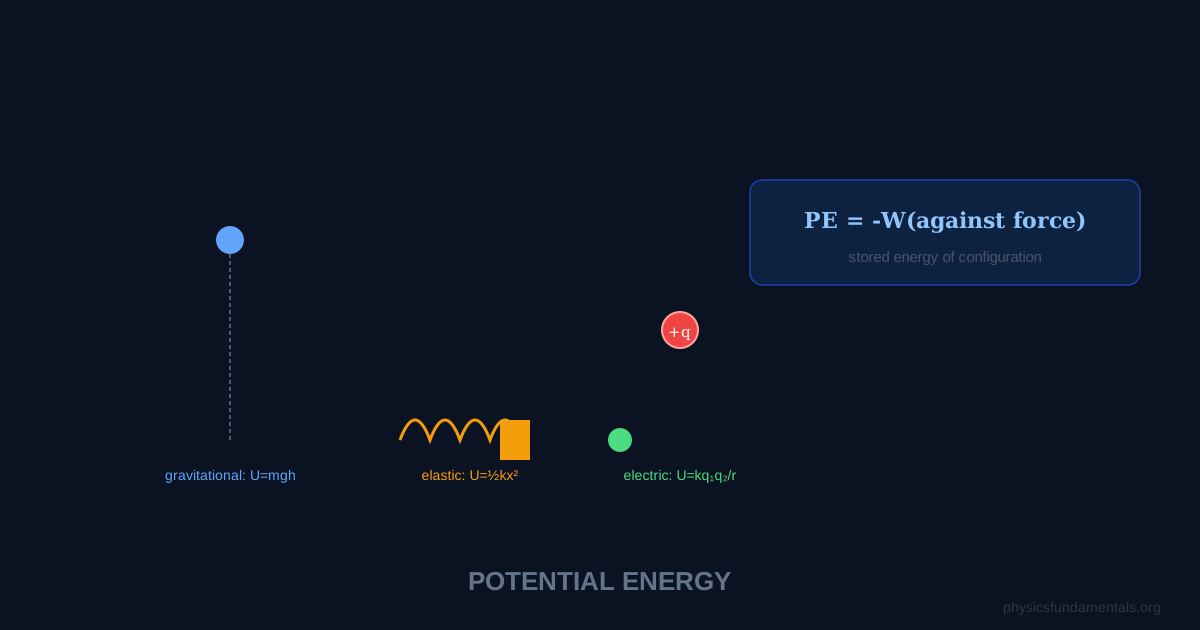
Potential energy is stored energy that an object has due to its position or configuration, which can be released and converted to kinetic energy. There are three main types in A-Level physics: gravitational PE = mgh (energy due to height in a gravitational field), elastic PE = ½kx² (energy stored in a stretched or compressed spring), and electric PE = kQq/r (energy due to the positions of charged particles). All three follow the same fundamental principle — conservative forces store energy in a field, and that energy is fully recovered when the object returns to its original configuration.
The common thread is the concept of a conservative force: one where the work done is independent of the path taken and equals the change in potential energy. Gravity, spring forces, and electrostatic forces are all conservative. Friction is not — work done against friction is lost as heat and cannot be recovered as kinetic energy.
- Gravitational PE: E_g = mgh near Earth's surface; E_g = −GMm/r at large distances
- Elastic PE: E_e = ½kx² — energy stored in a spring
- Electric PE: E_E = kQq/r — energy between point charges
- The common thread: all are stored by conservative forces
- 4 worked examples using all three forms
What Is Potential Energy?
Potential energy is stored energy associated with the position or configuration of an object within a force field. It is the negative of the work done by the conservative force as the object moves from a reference position to its current position.
The key insight: every conservative force has an associated potential energy. Gravitational force → gravitational PE. Spring force (Hooke's law) → elastic PE. Coulomb force → electric PE. Chemical energy, nuclear energy, and magnetic energy are also forms of potential energy stored in fields or bonds.
When a conservative force does positive work on an object, the PE decreases and KE increases by the same amount — energy is conserved:
Gravitational Potential Energy
Near Earth's surface (uniform field):
m = mass (kg), g = 9.81 m/s², h = height above reference level (m). Reference is arbitrary — only changes in GPE matter physically.
At large distances from Earth (radial field):
Defined as zero at infinite distance. Always negative for a bound mass (energy must be supplied to escape). See our full article on gravitational potential energy.
Elastic Potential Energy
A spring stretched or compressed by extension x from its natural length stores elastic PE:
k = spring constant (N/m), x = extension or compression from natural length (m). This follows from Hooke's law: F = kx. Since the force varies linearly with x, the work done (area under F-x graph) is ½kx² — hence the ½ factor.
Elastic PE converts entirely to kinetic energy when the spring is released (no friction): ½kx² = ½mv², giving v = x√(k/m) — the launch speed from a spring-gun, for instance.
Electric Potential Energy
The potential energy of two point charges Q₁ and Q₂ separated by distance r:
k = 8.99 × 10⁹ N·m²/C². Positive for like charges (energy needed to bring them together — repulsion), negative for opposite charges (energy released — bound state). See our full article on electric potential energy.
Comparison of Potential Energy Forms
| Type | Formula | Key feature |
|---|---|---|
| Gravitational (uniform) | mgh | Linear in h; ref. is arbitrary |
| Gravitational (radial) | −GMm/r | Always negative; zero at ∞ |
| Elastic | ½kx² | Always positive; proportional to x² |
| Electric | kQ₁Q₂/r | Sign depends on charge signs |
4 Worked Examples
Example 1 — Gravitational PE and speed
Problem: A 0.5 kg ball is released from rest at 10 m above the ground. Find its speed when it is 3 m above the ground.
Solution:
Change in GPE = mg(h₁ − h₂) = 0.5 × 9.81 × (10 − 3) = 34.335 J
This equals KE gained: ½mv² = 34.335
v = √(2 × 34.335/0.5) = √137.34 = 11.7 m/s
Example 2 — Elastic PE launch
Problem: A spring (k = 200 N/m) is compressed by 0.12 m and launches a 0.08 kg ball horizontally. Find the ball's launch speed.
Solution:
E_e = ½kx² = ½ × 200 × 0.12² = ½ × 200 × 0.0144 = 1.44 J
½mv² = 1.44 → v² = 2 × 1.44/0.08 = 36
v = 6.0 m/s
Example 3 — Electric PE and work done
Problem: Two protons are brought from infinite separation to 1.0 × 10⁻¹⁵ m apart (nuclear scale). How much work must be done against the electrostatic repulsion? (q = 1.6 × 10⁻¹⁹ C)
Solution:
E_E = kq²/r = 8.99 × 10⁹ × (1.6 × 10⁻¹⁹)² / (1.0 × 10⁻¹⁵)
= 8.99 × 10⁹ × 2.56 × 10⁻³⁸ / 10⁻¹⁵ = 2.30 × 10⁻¹³ J = 1.44 MeV
This is the energy scale of nuclear physics — MeV rather than eV as in atomic physics.
Example 4 — Mixed energy problem
Problem: A spring (k = 600 N/m) is compressed 0.10 m on a ramp 2 m long inclined at 20°. A 0.3 kg ball sits on the compressed spring. It is released and slides up the frictionless ramp. Find its speed at the top of the ramp.
Solution:
Elastic PE stored = ½ × 600 × 0.01 = 3.0 J
Height gained = 2 × sin20° = 0.684 m
GPE gained = mgh = 0.3 × 9.81 × 0.684 = 2.012 J
KE at top = 3.0 − 2.012 = 0.988 J
v = √(2 × 0.988/0.3) = √6.587 = 2.57 m/s
Potential Energy Curves and Equilibrium
Plotting potential energy vs position gives a potential energy curve — one of the most powerful tools in physics. The force at any point equals the negative gradient:
So wherever the curve has a minimum (dU/dx = 0), there is a force-free equilibrium. The shape of the minimum tells you about stability:
- Potential energy minimum: stable equilibrium. Any displacement increases U → restoring force → object returns. This is exactly the condition for simple harmonic motion for small displacements about the minimum.
- Potential energy maximum: unstable equilibrium. Any displacement decreases U → force pushes further away → object does not return.
- Potential energy flat region: neutral equilibrium. No restoring or destabilising force — object stays wherever displaced.
Interatomic Potential Energy — The Lennard-Jones Curve
The potential energy between two atoms has a characteristic shape: steeply repulsive at short distances (electron-electron repulsion) and weakly attractive at longer distances (van der Waals or chemical bonding). The Lennard-Jones potential:
has a minimum at r = 2^(1/6)σ — the equilibrium bond length. This minimum is the equilibrium separation of two atoms in a molecule or crystal. The depth of the minimum ε is the dissociation energy. The force F = −dU/dr is zero at the minimum (equilibrium), repulsive (positive) at shorter distances, and attractive (negative) at longer distances — exactly the behaviour of a real atomic bond. For small displacements about the minimum, the curve is approximately parabolic: U ≈ ½k(r−r₀)², leading directly to Hooke's law behaviour (F = −k(r−r₀)) and SHM vibrations of molecules.
Gravitational Potential Energy on a Cosmic Scale
On the scale of stars and galaxies, gravitational potential energy dominates all other forms. The gravitational potential energy of a gas cloud of mass M and radius R:
As a protostar collapses (R decreasing), U_grav becomes more negative — energy is released. Half goes to kinetic energy of the gas (virial theorem); half radiates away as the star heats up. A solar-mass protostar collapsing from a light-year radius to solar radius releases ~3 × 10³⁸ J — more than the Sun will radiate in its entire 10-billion year main sequence lifetime. This gravitational PE release is what heats the core to ignite hydrogen fusion and forms the star.
Worked Example 5 — Comparing gravitational and elastic PE
Problem: A 5 kg mass sits at rest on a vertical spring (k = 500 N/m) that compresses it by x = mg/k. (a) Find the compression x. (b) Find the elastic PE stored. (c) Find the gravitational PE lost if we take the original (uncompressed) spring length top as the reference. (d) Where does the remaining energy go?
Solution:
(a) x = mg/k = 5 × 9.81/500 = 0.0981 m = 9.81 cm
(b) E_elastic = ½kx² = ½ × 500 × 0.0981² = ½ × 500 × 0.00962 = 2.406 J
(c) E_grav lost = mgh = 5 × 9.81 × 0.0981 = 4.810 J
(d) Difference = 4.810 − 2.406 = 2.404 J was dissipated as heat in the damping that brought the system to rest. (If released from the uncompressed position, the mass would oscillate; internal friction eventually brings it to the equilibrium position, dissipating 50% of the initial GPE loss as heat.)
Electric Potential Energy in Chemical Bonding
All chemical bonds are ultimately electrostatic potential energy — the negative potential energy between electrons and positive nuclei that holds atoms together. A covalent bond forms when sharing electrons between two nuclei creates a lower total electrostatic PE than the two separate atoms have. Bond dissociation energy (the energy needed to break a bond) is the depth of the PE minimum — typically 1–10 eV per bond. Ionic bonds (NaCl: ~7.9 eV) are stronger than hydrogen bonds (~0.1–0.5 eV) because Coulomb attraction F = kQ₁Q₂/r is stronger for full-charge ions than for partial-charge hydrogen bond partners.
The reason exothermic reactions (combustion, neutralisation) release heat: the products have lower total potential energy than the reactants. The "released" energy is the difference in potential energy — it appears as kinetic energy of the product molecules (heat), radiated light, or useful work. Conservation of energy always holds: the decrease in chemical PE equals exactly the heat released plus any work done.
Nuclear Potential Energy Well
The nuclear strong force creates a deep attractive PE well for protons and neutrons at distances below ~10⁻¹⁵ m (1 fm). The depth of this well (the nuclear binding energy) is ~8 MeV per nucleon — about 10⁶ times deeper than atomic/chemical binding energies. Outside ~1 fm, the strong force drops to zero and Coulomb repulsion dominates between protons. This creates a Coulomb barrier that protons must overcome (or quantum-mechanically tunnel through) to enter the nucleus and undergo fusion — which is why nuclear fusion requires either enormous temperatures (~10⁸ K for thermonuclear fusion) or extreme pressures.
Exam Summary for Potential Energy
Three forms to know: gravitational PE = mgh (near surface) or −GMm/r (large distances, always negative, zero at infinity); elastic PE = ½kx² (always positive, energy stored in stretched or compressed spring); electric PE = kQq/r (positive for like charges, negative for opposite charges). All three are conservative — the force equals −dU/dx; energy stored is fully recoverable. For exam problems: identify which PE forms are present, set up E_initial = E_final (if no friction) or E_final = E_initial − W_friction. Mixed problems (spring + gravity + electric) are handled by including all PE terms: E = ½mv² + mgh + ½kx² + kQq/r. Choose the reference position for each PE type consistently and never mix reference levels between initial and final states.
Negative PE values indicate a bound state — energy must be supplied to reach zero PE (escape to infinity). A particle in a potential energy minimum oscillates back and forth (if E_total > U_min) or is trapped in the well. The deeper the minimum and the larger the curvature (d²U/dx²), the stronger the restoring force and the higher the oscillation frequency: ω = √(d²U/dx²/m). This connection between potential energy curvature and oscillation frequency unifies springs (U = ½kx², frequency √(k/m)), atoms in crystals (Lennard-Jones minimum, frequency √(k_eff/m)), and molecular vibrations (measured by infrared spectroscopy).
The unifying concept across all forms of potential energy is the conservative force: a force for which the work done depends only on start and end position, not the path taken, and which can be derived from a potential energy function as F = −dU/dx. Gravity, springs, and Coulomb forces are all conservative. This means any energy stored as these forms of PE is always fully recoverable as kinetic energy — nothing is lost. The contrast with non-conservative forces (friction, air resistance) is fundamental: friction irreversibly converts mechanical energy to heat, while conservative PE stores are perfect energy reservoirs. Understanding which forces are conservative in any given problem tells you immediately whether mechanical energy is conserved, and therefore which analytical tool to use: energy conservation (conservative forces only) or the work-energy theorem (any forces).
The three most important worked example types for potential energy at A-Level: (1) a falling mass converting GPE to KE — use mgh = ½mv², mass cancels, v = √(2gh); (2) a spring launching a mass — ½kx² = ½mv², giving v = x√(k/m); (3) a charge accelerated through a potential difference — qV = ½mv², giving v = √(2qV/m). In each case, the relevant potential energy form is zero at the end state, so the entire PE converts to KE. For mixed problems where PE doesn't fully convert (e.g., spring launches mass uphill), write the full energy equation including all PE terms and KE at both initial and final positions, then solve for the unknown.
Frequently Asked Questions
What is potential energy?
Why is gravitational PE near Earth's surface positive but the radial formula gives negative values?
Why is the elastic PE formula ½kx² and not kx²?
What makes a force conservative?
Can potential energy be negative?
Share this article
Written by
Physics Fundamentals Editorial Team
Written and reviewed by our team of physics educators. Content is aligned with A-Level, GCSE, AP Physics, and undergraduate curricula.
About Physics Fundamentals →