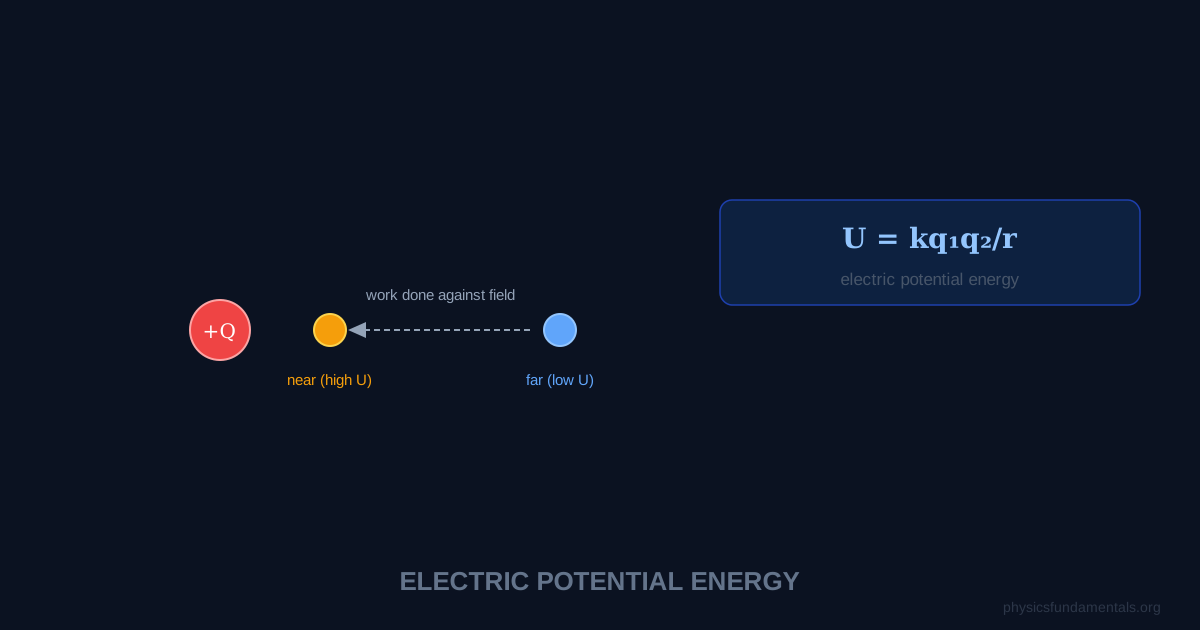
The electric potential energy between two point charges is E = kQq/r, where k = 8.99 × 10⁹ N·m²/C² (Coulomb's constant), Q and q are the charges (coulombs), and r is the separation (metres). This energy is positive for like charges (repulsion — energy stored) and negative for opposite charges (attraction — bound state). It's the electrical analogue of gravitational potential energy.
Electric potential energy is what drives current in circuits, accelerates particles in accelerators, and holds atoms together. The work done moving a charge q through a potential difference ΔV is W = qΔV — a relation that connects the abstract potential to practical energy calculations in circuits and fields.
- Electric potential energy E = kQq/r — formula, sign, and what it means
- Electric potential V = kQ/r — the energy per unit charge
- Work done: W = qΔV — moving charges through a potential difference
- 4 worked examples including electron-volt calculations
- Potential energy in uniform fields: E = qEd
Electric Potential Energy: E = kQq/r
Where: k = 8.99 × 10⁹ N·m²/C², Q = source charge (C), q = test charge (C), r = separation (m).
- Like charges (QQ positive): E_p positive → energy must be supplied to bring them together → repulsion
- Opposite charges (Qq negative): E_p negative → energy released when they come together → attraction, bound state
- E_p = 0 at r = ∞: zero reference point is infinite separation
Electric Potential: V = kQ/r
Electric potential is electric potential energy per unit charge: V = E_p/q. It's a scalar field — a number at every point in space giving the energy per coulomb a positive test charge would have there. Units: volts (V) = J/C.
The potential energy of a charge q at potential V is simply: E_p = qV.
Work Done Moving a Charge
Moving a positive charge from low to high potential requires work (like lifting a mass). Moving it from high to low potential releases energy. This is exactly what batteries do — they maintain a potential difference (voltage) that drives positive charges from low to high potential inside the battery, then the charges release that energy as they flow through the external circuit.
The Electron-Volt
The electron-volt (eV) is a convenient energy unit for atomic-scale calculations: 1 eV is the kinetic energy gained by an electron accelerated through 1 volt.
4 Worked Examples
Example 1 — PE of two protons
Problem: Two protons (q = 1.6 × 10⁻¹⁹ C each) are 1.0 × 10⁻¹⁵ m apart (nuclear scale). Find the electric PE.
Solution:
E_p = kQq/r = 8.99 × 10⁹ × (1.6 × 10⁻¹⁹)² / (1.0 × 10⁻¹⁵)
= 8.99 × 10⁹ × 2.56 × 10⁻³⁸ / 10⁻¹⁵ = 2.30 × 10⁻¹³ J = 1.44 MeV
Example 2 — Work done in a field
Problem: An electron moves from a point at +500 V to a point at +200 V. Find the work done by the electric field. (e = 1.6 × 10⁻¹⁹ C)
Solution:
W = qΔV = (−1.6 × 10⁻¹⁹) × (200 − 500) = (−1.6 × 10⁻¹⁹) × (−300)
W = 4.8 × 10⁻¹⁷ J (positive — field does positive work on the electron moving to lower potential)
Example 3 — Electron-volt conversion
Problem: A proton is accelerated through 20,000 V. Find its kinetic energy in joules and eV.
Solution:
KE = qV = 1.6 × 10⁻¹⁹ × 20,000 = 3.2 × 10⁻¹⁵ J = 20,000 eV = 20 keV
Example 4 — Electric potential from two charges
Problem: Charge Q₁ = +3 μC is at origin. Q₂ = −2 μC is 0.3 m away. Find the electric potential at the midpoint (0.15 m from each).
Solution:
V₁ = kQ₁/r₁ = 8.99 × 10⁹ × 3 × 10⁻⁶ / 0.15 = 179,800 V
V₂ = kQ₂/r₂ = 8.99 × 10⁹ × (−2 × 10⁻⁶) / 0.15 = −119,867 V
V_total = 179,800 − 119,867 = 59,933 V ≈ 60 kV
Work Done by the Electric Field
The work done by the electric field when a charge q moves from point A to point B is:
This is the decrease in electric potential energy: W_field = −ΔE_PE. If positive charge moves from high potential to low potential (the natural direction), the field does positive work and the charge gains kinetic energy — the potential energy decreases. If you push positive charge from low to high potential (against the field), you do positive work and the charge's potential energy increases — like lifting a mass against gravity.
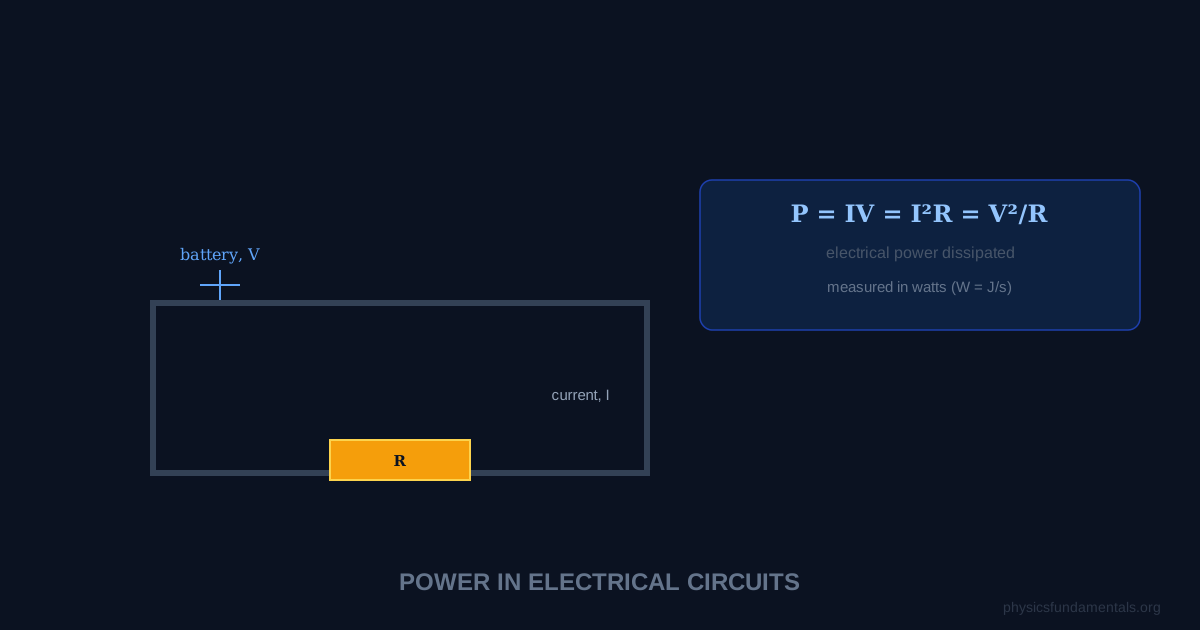
This is exactly how a battery works: it does work on positive charge, moving it from the negative terminal (low potential) to the positive terminal (high potential) through an internal chemical process. The work done per unit charge is the EMF: ε = W/q. For every coulomb of charge moved through a 9 V battery, the battery does 9 J of work on the charge.
Electric Field Lines and Equipotentials
The electric field is the negative gradient of potential:
Field lines always point in the direction of decreasing potential — from high V to low V. Equipotential surfaces (surfaces of constant V) are always perpendicular to field lines. Moving along an equipotential requires no work (since ΔV = 0 → W = qΔV = 0). This is why no work is done moving a charge tangentially along a conductor surface — it's an equipotential surface.
Potential Due to Multiple Charges — Superposition
Electric potential is a scalar quantity, so the potential from multiple charges adds algebraically (no vector addition needed):
This is much simpler than the vector addition needed for electric fields or forces. The total electric potential energy of a system of charges is the sum of the potential energies of all pairs:
For three charges Q₁, Q₂, Q₃: E_PE = k(Q₁Q₂/r₁₂ + Q₁Q₃/r₁₃ + Q₂Q₃/r₂₃)
Capacitors and Electric Potential Energy
The energy stored in a capacitor is electric potential energy stored in the electric field between the plates. In terms of field quantities:
For a parallel plate capacitor with uniform field E = V/d and volume Ad: total energy = ½ε₀(V/d)² × Ad = ½ε₀V²A/d = ½(ε₀A/d)V² = ½CV² — consistent with our earlier formula. This shows that the energy is stored in the electric field itself, not in the charges. The concept of energy stored in fields is fundamental in electromagnetism — electromagnetic waves carry energy entirely in their oscillating E and B fields.
Worked Example 5 — Energy of a charge configuration
Problem: Three charges are arranged at the corners of a right triangle: Q₁ = +4 μC at the origin, Q₂ = +3 μC at (0.3, 0) m, Q₃ = −2 μC at (0, 0.4) m. Find the total electric potential energy of the configuration.
Solution:
r₁₂ = 0.3 m; r₁₃ = 0.4 m; r₂₃ = √(0.3² + 0.4²) = √(0.09 + 0.16) = √0.25 = 0.5 m
E_PE = k(Q₁Q₂/r₁₂ + Q₁Q₃/r₁₃ + Q₂Q₃/r₂₃)
= 8.99 × 10⁹ × (4 × 3 × 10⁻¹²/0.3 + 4 × (−2) × 10⁻¹²/0.4 + 3 × (−2) × 10⁻¹²/0.5)
= 8.99 × 10⁹ × (40 × 10⁻¹² − 20 × 10⁻¹² − 12 × 10⁻¹²)
= 8.99 × 10⁹ × 8 × 10⁻¹² = 0.0719 J = 71.9 mJ
Van de Graaff Generators and High Voltage
A Van de Graaff generator builds up high electric potential by mechanically transporting charge on a moving belt to a metal sphere. The potential at the sphere surface: V = kQ/R. A sphere of radius 0.3 m charged to 1 μC reaches V = 8.99 × 10⁹ × 10⁻⁶/0.3 = 30,000 V = 30 kV. The electric potential energy stored is E = ½QV = ½ × 10⁻⁶ × 30,000 = 0.015 J — enough to produce a visible spark (and give you a small electric shock). Laboratory Van de Graaff generators reach 300 kV–1 MV, used in electrostatic precipitation, particle accelerators (Cockroft-Walton, Pelletron), and physics demonstrations.
Connection Between Potential Energy and Atomic Structure
Electric potential energy holds atoms and molecules together. The hydrogen atom's ground state energy of −13.6 eV is entirely electric potential energy (at atomic scale, the kinetic energy of the electron partially offsets the negative potential energy). Chemical bond energies (1–5 eV per bond) are the potential energies associated with electrons being shared between atoms at equilibrium separations. The entire structure of chemistry — reactivity, bond strength, molecular geometry — is determined by the Coulomb potential energy between electrons and nuclei, calculated using Schrödinger's equation for the wave function. In this deep sense, chemistry is applied electrostatics.
Exam Tips for Electric Potential Energy
The most important distinction: electric potential V = kQ/r (property of the field, in V = J/C) vs electric potential energy E_PE = qV = kQq/r (energy of a specific charge q in the field, in J). Potential exists independently of any test charge; potential energy requires both the source charge Q and the test charge q. When a charge q moves through a potential difference ΔV: ΔE_PE = qΔV. If q is positive and moves to higher V: potential energy increases. If q moves to lower V: potential energy decreases and kinetic energy increases. For negative charges, reverse: moving to higher V decreases potential energy (because q is negative, qΔV is negative for positive ΔV).
Lightning and Atmospheric Electricity
The atmosphere acts as a leaky capacitor between the ionosphere (~50 km altitude, near-perfect conductor) and Earth's surface. The potential difference maintained by thunderstorms worldwide is approximately 300,000 V, with the ionosphere positive and Earth negative. This global electric circuit carries a fair-weather downward current of about 2 kA (1000 A/km²) globally. During a thunderstorm, charge separation in the cloud (ice crystals carry positive charge upward, graupel carries negative charge downward) builds a potential of up to 100 million volts between cloud and ground — far exceeding air's breakdown potential. The resulting lightning bolt carries 5 C of charge in about 30 ms, releasing electrical potential energy of Q × ΔV = 5 × 10⁸ J per kilometre of channel (most dissipated as heat, thunder, and light).
Worked Example 6 — Charge accelerated through two stages
Problem: An alpha particle (charge +2e = 3.2 × 10⁻¹⁹ C, mass 6.64 × 10⁻²⁷ kg) is accelerated from rest through 50 kV, then through a further 30 kV. Find its final speed.
Solution:
Total potential difference = 50 + 30 = 80 kV = 80,000 V
KE gained = qΔV = 3.2 × 10⁻¹⁹ × 80,000 = 2.56 × 10⁻¹⁴ J
½mv² = 2.56 × 10⁻¹⁴ J
v = √(2 × 2.56 × 10⁻¹⁴/6.64 × 10⁻²⁷) = √(7.711 × 10¹²) = 2.78 × 10⁶ m/s
This is about 0.93% of the speed of light — non-relativistic, so our formula is valid. Note: the final speed depends only on total potential difference, not on the order of the two stages.
The electric potential energy framework is essential for particle physics and nuclear energy. In a nuclear reactor, uranium nuclei fission when a slow neutron is captured, releasing binding energy (ultimately from the strong nuclear force overcoming electrostatic PE between protons). In a particle accelerator, charged particles gain kinetic energy by being accelerated through potential differences — the Large Hadron Collider accelerates protons through roughly 450 billion volts (spread over many accelerating cavities) to give each proton 6.5 × 10¹² eV of kinetic energy. The energy stored in electric potential — from the simple eV scale of atomic physics to the TV of particle physics — is one of the most useful concepts in all of physics.
The sign convention for electric potential energy is: positive for repulsive pairs (like charges), negative for attractive pairs (opposite charges). The reference (zero) is at infinite separation. Moving like charges from infinity to a finite separation r requires doing positive work (against repulsion), storing positive potential energy kQq/r > 0. Moving opposite charges from infinity toward each other releases energy (they attract), so the stored PE is kQq/r < 0 — the system has less energy when the charges are close. Ionisation requires supplying energy to separate opposite charges to infinity — overcoming the negative potential energy well. This is why ionisation energies are positive even though bound state energies are negative.
Two common applications of electric PE on exam papers: (1) a charged particle accelerated through a potential difference gains KE = qV; use ½mv² = qV to find speed. (2) The escape condition: for a charge q at distance r from Q, escape requires total energy ≥ 0, so ½mv² ≥ kQq/r for attractive potentials. The electric analogue of escape velocity gives the minimum speed for a positive charge to escape from a negative charge well. Both applications reduce to straightforward algebra once you identify the initial and final potential energies correctly.
Electric potential energy is one of the most unified concepts in physics — the same formula kQq/r describes the binding energy of hydrogen (−13.6 eV), the energy stored in a capacitor, the energy needed to overcome electrostatic repulsion in nuclear fusion, and the forces driving chemical reactions. From the scale of quarks (where it's overwhelmed by the strong force) through atoms, molecules, macroscopic circuits, and up to the global electric circuit in Earth's atmosphere, Coulomb potential energy governs an enormous range of phenomena. Mastering the sign convention and the relationship between potential V and potential energy E_PE = qV is the key to applying it correctly across all these scales.
Frequently Asked Questions
What is electric potential energy?
What is the difference between electric potential and electric potential energy?
What is an electron-volt?
Why is electric potential energy negative for opposite charges?
How does electric PE relate to voltage in a circuit?
Share this article
Written by
Physics Fundamentals Editorial Team
Written and reviewed by our team of physics educators. Content is aligned with A-Level, GCSE, AP Physics, and undergraduate curricula.
About Physics Fundamentals →