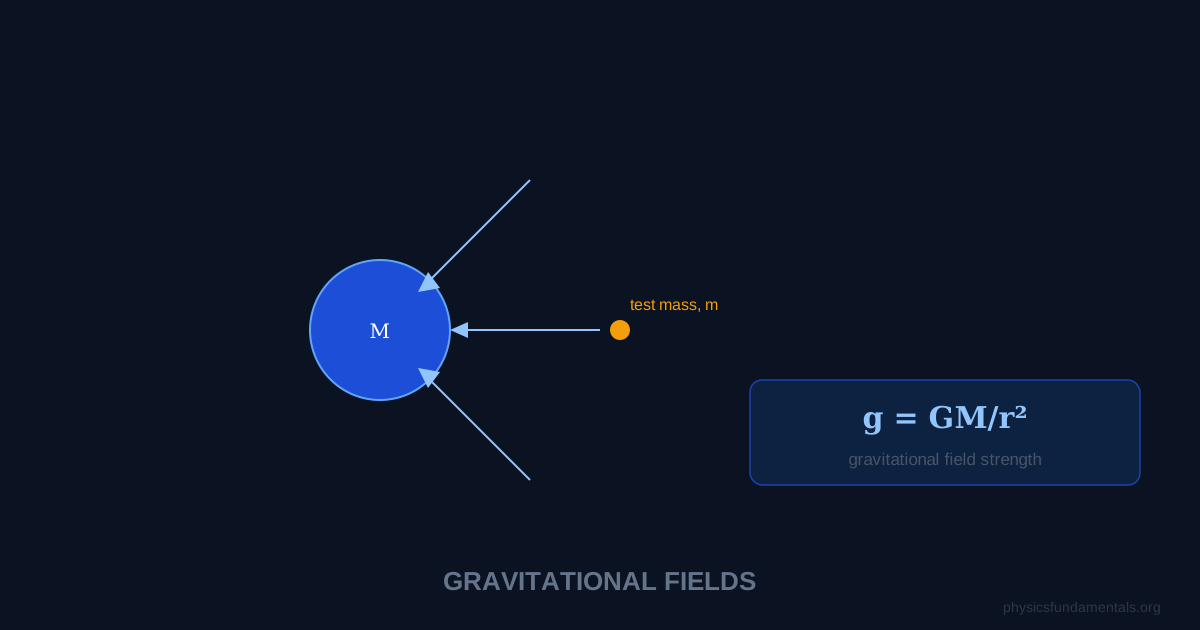
The gravitational field strength at distance r from a mass M is g = GM/r², where G = 6.674 × 10⁻¹¹ N·m²/kg². At Earth's surface (r = R_E), this gives g ≈ 9.81 N/kg — the familiar gravitational field strength. Further from Earth, g decreases with the inverse square of distance, following Newton's law of gravitation.
The gravitational field is a vector field — at every point in space, it has a magnitude and a direction (always pointing toward the mass causing the field). Field lines visualise it: they point inward toward the mass, becoming more closely spaced where the field is stronger (closer to the mass), and spreading out where it weakens.
- Gravitational field strength g = GM/r² — what it means and how it varies
- Field lines and equipotential surfaces — what they show
- Orbital speed v = √(GM/r) and orbital period T = 2πr/v
- 4 worked examples including satellite orbits and field strength at altitude
- Uniform vs radial fields — near Earth's surface vs far away
Gravitational Field Strength: g = GM/r²
Where: G = 6.674 × 10⁻¹¹ N·m²/kg², M = mass of the body creating the field (kg), r = distance from its centre (m). Units: N/kg (equivalent to m/s²).
This is also the acceleration due to gravity experienced by any mass at distance r, regardless of its own mass. At Earth's surface (M_E = 5.97 × 10²⁴ kg, R_E = 6.37 × 10⁶ m): g = 6.674 × 10⁻¹¹ × 5.97 × 10²⁴ / (6.37 × 10⁶)² = 9.81 N/kg ✓
Field Lines and Equipotentials
Field lines show the direction of the gravitational field (always radially inward toward the mass) and relative strength (closer spacing = stronger field). For a uniform sphere, the field outside is identical to that of a point mass at the centre.
Equipotential surfaces are surfaces of constant gravitational potential. For a spherical mass, they're concentric spheres. No work is done moving along an equipotential. Field lines always cross equipotentials at right angles.
Near Earth's surface, where g is approximately constant, the field lines are parallel and equally spaced (uniform field), and equipotentials are horizontal planes.
Orbital Speed and Period
For a circular orbit at radius r, gravitational force provides centripetal force:
Solving for orbital speed (mass cancels):
Orbital period:
This is Kepler's third law: T² ∝ r³.
4 Worked Examples
Example 1 — Field strength at altitude
Problem: Find g at 400 km above Earth's surface. (M_E = 5.97 × 10²⁴ kg, R_E = 6.37 × 10⁶ m)
Solution:
r = 6.37 × 10⁶ + 4.0 × 10⁵ = 6.77 × 10⁶ m
g = GM/r² = 6.674 × 10⁻¹¹ × 5.97 × 10²⁴ / (6.77 × 10⁶)²
= 3.982 × 10¹⁴ / 4.583 × 10¹³ = 8.69 N/kg
g at the ISS altitude is only about 11% less than at sea level — astronauts are not in zero gravity, they're in free fall.
Example 2 — ISS orbital speed
Problem: Find the orbital speed of the ISS at 400 km altitude.
Solution:
v = √(GM/r) = √(6.674 × 10⁻¹¹ × 5.97 × 10²⁴ / 6.77 × 10⁶)
= √(3.982 × 10¹⁴ / 6.77 × 10⁶) = √(5.882 × 10⁷) = 7,669 m/s ≈ 7.7 km/s
Example 3 — Orbital period
Problem: Find the orbital period of the ISS at r = 6.77 × 10⁶ m.
Solution:
T = 2πr/v = 2π × 6.77 × 10⁶ / 7669 = 4.254 × 10⁷ / 7669 = 5,547 s ≈ 92.5 minutes
Example 4 — Geostationary orbit radius
Problem: Find the orbital radius for a geostationary satellite (T = 24 hours = 86,400 s).
Solution:
T² = 4π²r³/GM → r³ = GMT²/4π²
r³ = 6.674 × 10⁻¹¹ × 5.97 × 10²⁴ × 86,400² / (4π²)
= 3.982 × 10¹⁴ × 7.465 × 10⁹ / 39.48 = 7.53 × 10²²
r = (7.53 × 10²²)^(1/3) = 4.22 × 10⁷ m = 42,200 km
Gravitational Potential
Gravitational potential V_g is the gravitational potential energy per unit mass at a point in the field:
Always negative — the reference is zero at infinity, and any bound object is at negative potential. The gravitational field strength is the negative gradient of potential: g = −dV_g/dr = GM/r². This relationship — field is the negative gradient of potential — is the fundamental connection between field and potential, applicable to both gravitational and electric fields.
Equipotential surfaces are spheres around the mass (for a point mass or uniform sphere). Moving along an equipotential requires no work — the gravitational force is perpendicular to the motion. Moving to a higher potential (further from Earth) requires positive work; moving to lower potential (falling) releases energy. The potential difference between two points equals the work done per unit mass moving between them.
Escape Velocity from Gravitational Potential
The escape velocity can be elegantly derived from gravitational potential. An object at Earth's surface has potential V_g = −GM/R_E. To escape, it needs to reach V_g = 0 (at infinity). The kinetic energy per unit mass needed:
This matches the escape velocity derivation from energy conservation — confirming the consistency of the field/potential framework. See our full article on escape velocity for worked examples.
Gravitational Potential Energy at Large Distances
Near Earth's surface, GPE = mgh (where h is measured from an arbitrary reference). For large distances, the precise formula using gravitational potential is:
Where r is the distance from Earth's centre. The negative sign means a bound object (r finite) has less energy than a free object at infinity (r = ∞, GPE = 0). The total mechanical energy of a satellite in a circular orbit:
Total energy is negative (bound orbit) and equals half the gravitational PE. This negative total energy is why satellites don't fly away — they're in a gravitational potential well.
Gravitational Potential V_g
Gravitational potential at distance r from mass M:
It's always negative (reference at infinity) and the field strength is its negative gradient: g = −dV_g/dr = GM/r². Equipotential surfaces are concentric spheres. The work done per unit mass moving between potentials V₁ and V₂:
Moving a mass from Earth's surface (V_g = −GM/R) to infinity (V_g = 0) requires work per unit mass = GM/R — this equals v_e²/2, consistent with escape velocity.
Kepler's Laws from Newton
Newton's law of gravitation explains all three of Kepler's empirical laws:
- Kepler's 1st Law (elliptical orbits): The inverse-square force law leads to conic section orbits — ellipses for bound orbits, parabolas and hyperbolas for unbound trajectories. This follows from solving Newton's equations for two gravitating bodies.
- Kepler's 2nd Law (equal areas in equal times): Conservation of angular momentum (L = mvr for circular, generalised for ellipses) means a planet sweeps out equal areas in equal times. Closer to the Sun → faster speed; further away → slower speed.
- Kepler's 3rd Law (T² ∝ r³): From GMm/r² = mv²/r and T = 2πr/v: T² = 4π²r³/(GM). The ratio T²/r³ = 4π²/(GM) is constant for all bodies orbiting the same central mass M.
Worked Example 5 — Geostationary orbit
Problem: A geostationary satellite must orbit with the same period as Earth's rotation (T = 24 h = 86,400 s). Find its orbital radius and height above the surface. (M_E = 5.97 × 10²⁴ kg)
Solution:
From T² = 4π²r³/GM: r³ = GMT²/(4π²)
r³ = 6.674 × 10⁻¹¹ × 5.97 × 10²⁴ × 86400²/(4π²)
= 3.983 × 10¹⁴ × 7.465 × 10⁹/39.48 = 7.533 × 10²²
r = (7.533 × 10²²)^(1/3) = 4.22 × 10⁷ m = 42,200 km
Height above surface = 42,200 − 6,371 = 35,829 km ≈ 35,800 km
All geostationary satellites — communications, weather — orbit at this precise altitude directly above the equator.
Field Strength Inside a Hollow Sphere
A remarkable result from Newton's shell theorem: the gravitational field inside a uniform hollow spherical shell is exactly zero. The contributions from all parts of the shell cancel perfectly at every interior point. This means: inside the Earth (treating it as composed of nested shells), only the mass below your current depth contributes to g. At radius r inside Earth (r < R_E): g = GM(r)/r² where M(r) = M_E(r/R_E)³ (uniform density approximation) → g = (GM_E/R_E³)r. Field strength increases linearly from zero at the centre to 9.81 m/s² at the surface. This result (that field inside a shell is zero) also applies to electric fields inside conductors — the free electrons redistribute to cancel the internal field exactly.
Tidal Forces
Tidal forces arise from the variation of gravitational field across a finite-sized object. The Moon exerts a stronger gravitational pull on the near side of Earth than the far side. This differential pull stretches Earth slightly along the Earth-Moon axis, creating tidal bulges. Water, being fluid, responds more strongly than rock — explaining ocean tides. The same tidal forces from Earth keep the Moon tidally locked (always showing the same face), and tidal forces from Jupiter on its moon Io are so intense they power active volcanoes.
Gravitational Field Mapping
The gravitational field around a spherical mass is radial — field lines point toward the centre, spacing increasing with distance (field weakening as 1/r²). Equipotential surfaces are concentric spheres. The work done moving a mass m between two equipotentials is W = mΔV_g — independent of path, confirming gravity is a conservative force.
For a uniform field (near Earth's surface): field lines are parallel and evenly spaced (g = 9.81 N/kg everywhere), equipotentials are horizontal planes (constant height). This uniform approximation is accurate within about 0.3% over 10 km vertical range — perfectly adequate for most terrestrial physics.
Orbital Mechanics — Changing Orbits
To move a satellite from a lower to a higher circular orbit (Hohmann transfer): (1) fire engines to increase speed at the lower orbit → enter an elliptical transfer orbit; (2) at the highest point of the ellipse (apoapsis), fire engines again to circularise into the higher orbit. Both burns increase speed, yet the satellite ends up moving slower in the higher orbit (v_orb = √(GM/r) decreases with r). The apparent contradiction resolves: the first burn converts KE into both KE and PE; the satellite climbs while slowing; the second burn adds enough energy to circularise at the new speed.
Worked Example 6 — Two-body gravitational problem
Problem: A binary star system has two stars of equal mass M = 2 × 10³⁰ kg orbiting their common centre of mass, separated by 4 × 10¹¹ m. Find their orbital speed and period.
Solution:
Each star orbits at r = 2 × 10¹¹ m from the centre. The gravitational force between them provides centripetal force for each:
GM²/(2r)² = Mv²/r → v² = GM/(4r) = 6.674 × 10⁻¹¹ × 2 × 10³⁰/(4 × 2 × 10¹¹)
v² = 1.335 × 10²⁰/8 × 10¹¹ = 1.668 × 10⁸
v = 1.29 × 10⁴ m/s = 12.9 km/s
T = 2πr/v = 2π × 2 × 10¹¹/12,900 = 9.73 × 10⁷ s ≈ 3.1 years
Gravitational Waves
Einstein's general relativity predicts that accelerating masses radiate gravitational waves — ripples in spacetime propagating at c. The first direct detection came in September 2015 when LIGO observed the merger of two black holes 1.3 billion light-years away. The gravitational wave caused a strain of 10⁻²¹ — a fractional length change of one part in 10²¹, equivalent to measuring a change in the Earth-Sun distance of less than the diameter of a proton. Gravitational waves carry energy and angular momentum away from binary systems, causing orbits to spiral inward — exactly as observed in the Hulse-Taylor binary pulsar (a Nobel Prize–winning indirect confirmation in 1974). The LIGO/Virgo/KAGRA detectors now regularly observe binary mergers, opening a new window on the universe that complements electromagnetic astronomy.
Exam Summary for Gravitational Fields
Key formulas: g = GM/r² (field strength); V_g = −GM/r (gravitational potential); GPE = mV_g = −GMm/r; v_orb = √(GM/r); T² = 4π²r³/(GM) (Kepler's third law); v_e = √(2GM/r). The field strength g and potential V_g both decrease with distance but follow different laws: g ∝ 1/r², V_g ∝ 1/r. They are related by g = −dV_g/dr. Always use SI units (r in metres, M in kg, G = 6.674 × 10⁻¹¹ N m² kg⁻²) before substituting numbers.
Escape from the Solar System
The escape velocity from the Sun at Earth's orbital radius (1 AU = 1.496 × 10¹¹ m) is v_e = √(2GM_sun/r) = √(2 × 6.674 × 10⁻¹¹ × 1.989 × 10³⁰/1.496 × 10¹¹) = √(1.776 × 10⁹) = 42.1 km/s. Earth's orbital speed is ~29.8 km/s. The Voyager probes needed a net heliocentric speed exceeding 42.1 km/s to escape the solar system — achieved using gravity assists from Jupiter and Saturn that boosted their heliocentric speeds to over 50 km/s. Voyager 1 crossed the heliopause (boundary of the Sun's influence) in 2012, becoming the first human-made object in interstellar space. Its gravitational field calculation from 1977 remains one of the most elegant applications of Newtonian gravity ever performed.
The gravitational field concept — assigning a vector value g at every point in space, representing the force per unit mass that any object placed there would experience — is the prototype for all field theories in physics. The electric field, magnetic field, and quantum fields of particle physics all follow the same pattern: a source creates a field permeating space, and other objects respond to the local field value at their position. Newton's gravitational field was the first physical field in history, predating Maxwell's electromagnetic field by 150 years, and establishing the conceptual framework that Einstein later revolutionised with the idea that gravity is not a field at all but a curvature of spacetime.
Try it yourself: check your own numbers with the Gravitational Field Strength Calculator or the Escape Velocity Calculator, which show the formula, the worked substitution and the answer step by step.
Frequently Asked Questions
What is gravitational field strength?
Why are astronauts weightless in the ISS if g is still 8.69 N/kg there?
What is the difference between a radial and uniform gravitational field?
What is Kepler's third law and how does it follow from g = GM/r²?
What is a geostationary orbit?
Share this article
Written by
Physics Fundamentals Editorial Team
Written and reviewed by our team of physics educators. Content is aligned with A-Level, GCSE, AP Physics, and undergraduate curricula.
About Physics Fundamentals →