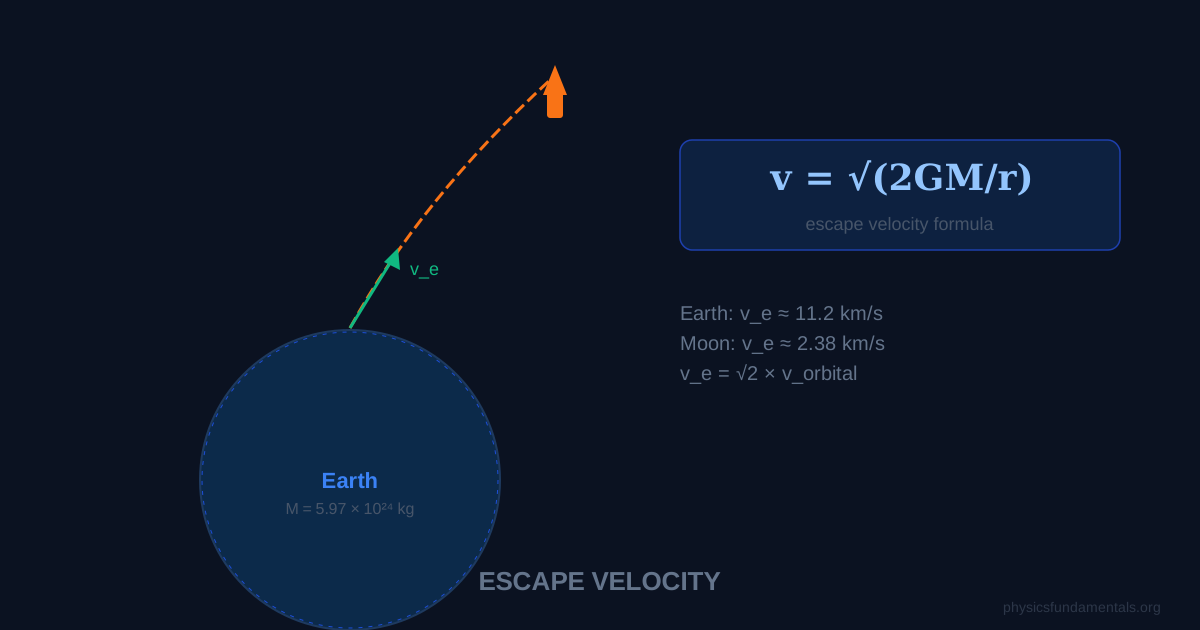
Escape velocity is the minimum speed an object needs to escape a planet's gravitational field without further propulsion. The formula is v_e = √(2GM/r), where G is the gravitational constant (6.674 × 10⁻¹¹ N·m²/kg²), M is the mass of the planet, and r is the distance from the planet's centre to the object. For Earth, the escape velocity from the surface is approximately 11.2 km/s — about 33 times the speed of sound.
The key word is "minimum" — and it comes with an important assumption. Escape velocity assumes the object is given one initial burst of speed and then travels under gravity alone with no further thrust. A rocket with continuous thrust can escape at any speed, given enough fuel. Escape velocity is the threshold for a projectile, not a powered vehicle.
- The escape velocity formula v = √(2GM/r) — derived from energy conservation
- Earth's escape velocity (11.2 km/s) and values for other planets
- 3 worked examples including calculating escape velocity and orbital speed
- The relationship between escape velocity and orbital velocity
- Black holes — what happens when escape velocity exceeds c
What Is Escape Velocity?
Escape velocity is the minimum initial speed required for an object to escape a gravitational field completely, starting from a given distance r from the centre of the mass M, without any further propulsion. At exactly escape velocity, the object's kinetic energy equals the magnitude of its gravitational potential energy — it has just enough energy to reach infinity with zero speed remaining.
Escape velocity is independent of the mass of the escaping object — a pebble and a spacecraft have the same escape velocity from the same location. This is the same mass-cancellation we see in free fall: gravitational force is proportional to mass, but so is inertia, so mass always cancels out of the equations of motion.
The Escape Velocity Formula
Where:
- v_e = escape velocity (m/s)
- G = universal gravitational constant = 6.674 × 10⁻¹¹ N·m²/kg²
- M = mass of the planet or body being escaped from (kg)
- r = distance from the centre of the body to the launch point (m)
For escape from Earth's surface: M = 5.972 × 10²⁴ kg, r = 6.371 × 10⁶ m.
You'll sometimes see this written as v_e = √(2μ/r), using the standard gravitational parameter μ = GM (Greek letter mu). Combining G and M into a single constant μ is common in orbital mechanics and aerospace engineering because μ can be measured very precisely for a given body even when G and M individually carry more uncertainty. For Earth, μ = GM ≈ 3.986 × 10¹⁴ m³/s² — plugging this into v_e = √(2μ/r) with r = 6.371 × 10⁶ m gives the same v_e ≈ 11.19 km/s as the G, M form above.
Use our Escape Velocity Calculator to find v_e for any planet or body.
Derivation from Energy Conservation
The escape velocity derivation uses conservation of energy. An object of mass m at distance r from planet mass M has:
- Kinetic energy: KE = ½mv²
- Gravitational potential energy: GPE = −GMm/r (negative because it's a bound state)
For the object to just escape (reach infinity with zero velocity), its total mechanical energy must be zero or positive:
The mass m cancels:
This derivation is elegant — escape velocity is simply the speed at which kinetic energy exactly cancels the (negative) gravitational potential energy. An object with exactly v_e has total energy = 0 and will reach infinity with zero speed left over. Anything faster has positive total energy and will reach infinity with some speed remaining.
Escape Velocities for Planets and Bodies
| Body | Mass (kg) | Radius (km) | Escape velocity |
|---|---|---|---|
| Moon | 7.34 × 10²² | 1,737 | 2.38 km/s |
| Mars | 6.39 × 10²³ | 3,390 | 5.03 km/s |
| Earth | 5.97 × 10²⁴ | 6,371 | 11.2 km/s |
| Saturn | 5.68 × 10²⁶ | 58,232 | 35.5 km/s |
| Jupiter | 1.90 × 10²⁷ | 69,911 | 59.5 km/s |
| Sun | 1.99 × 10³⁰ | 695,700 | 617.5 km/s |
3 Worked Examples
Example 1 — Earth's escape velocity
Problem: Calculate the escape velocity from Earth's surface. (G = 6.674 × 10⁻¹¹ N·m²/kg², M_E = 5.972 × 10²⁴ kg, R_E = 6.371 × 10⁶ m)
Solution:
v_e = √(2GM/r)
v_e = √(2 × 6.674 × 10⁻¹¹ × 5.972 × 10²⁴ / 6.371 × 10⁶)
v_e = √(7.972 × 10¹⁴ / 6.371 × 10⁶)
v_e = √(1.251 × 10⁸)
v_e = 11,186 m/s ≈ 11.2 km/s
Example 2 — Escape velocity from the Moon
Problem: Find the escape velocity from the Moon's surface. (M_Moon = 7.342 × 10²² kg, R_Moon = 1.737 × 10⁶ m)
Solution:
v_e = √(2 × 6.674 × 10⁻¹¹ × 7.342 × 10²² / 1.737 × 10⁶)
v_e = √(9.796 × 10¹² / 1.737 × 10⁶)
v_e = √(5.639 × 10⁶)
v_e = 2375 m/s ≈ 2.38 km/s
The Moon's lower escape velocity is why the Apollo missions could use a small lunar module ascent engine rather than a full rocket to leave the Moon.
Example 3 — Escape velocity at altitude
Problem: What is the escape velocity from 400 km above Earth's surface (approximate height of the ISS)?
Solution:
r = R_E + 400 km = 6.371 × 10⁶ + 4.0 × 10⁵ = 6.771 × 10⁶ m
v_e = √(2 × 6.674 × 10⁻¹¹ × 5.972 × 10²⁴ / 6.771 × 10⁶)
v_e = √(7.972 × 10¹⁴ / 6.771 × 10⁶)
v_e = √(1.177 × 10⁸)
v_e = 10,853 m/s ≈ 10.9 km/s
Escape velocity decreases with altitude — the further you are from a planet's centre, the less speed you need to escape it.
Escape Velocity vs Orbital Velocity
The orbital velocity at radius r (the speed required to maintain a circular orbit) is:
Comparing with v_e = √(2GM/r), we see:
Escape velocity is always exactly √2 times the circular orbital velocity at the same radius. At Earth's surface: orbital velocity ≈ 7.9 km/s, escape velocity ≈ 11.2 km/s. The ISS orbits at about 7.7 km/s — to escape from that orbit, it would need to accelerate to about 10.9 km/s.
Black Holes — When Escape Velocity Exceeds c
A black hole forms when a massive body is compressed to a radius (the Schwarzschild radius) at which the escape velocity equals the speed of light:
Below this radius, not even light has enough speed to escape — hence "black hole." For Earth's mass, the Schwarzschild radius is about 8.9 mm — if all of Earth's mass were compressed into a sphere smaller than a marble, it would become a black hole.
For the Sun: r_s ≈ 3 km. For a 10-solar-mass stellar black hole: r_s ≈ 30 km. For the supermassive black hole at the centre of our galaxy (4 million solar masses): r_s ≈ 12 million km — about 17 times the Sun's radius.
Escape Velocity and Gravitational Potential
Escape velocity can be elegantly derived from gravitational potential. At radius r from a mass M, the gravitational potential is V_g = −GM/r (energy per unit mass). The total specific energy (energy per unit mass) of a projectile is:
For the projectile to escape, this specific energy must be ≥ 0 (reaching infinity with v ≥ 0). At the minimum (e = 0): ½v_e² = GM/r → v_e = √(2GM/r). The escape velocity is precisely the speed at which kinetic energy per unit mass equals the magnitude of gravitational potential energy per unit mass.
Orbital Velocity and its Relationship to Escape Velocity
At radius r, the circular orbital velocity is found by equating gravitational force to centripetal force:
Comparing: v_e = √(2) × v_orb. To escape from a circular orbit, you need to increase speed by a factor of √2 ≈ 1.414. For an astronaut in the ISS orbiting at 7.7 km/s, the escape velocity from that orbit is 7.7 × 1.414 = 10.9 km/s — requiring a significant boost (called Trans-Earth Injection or, for deeper space, Trans-Lunar Injection) from rocket engines.
Multi-Stage Rockets and the Rocket Equation
Rockets must carry propellant that is itself heavy, making reaching escape velocity extremely demanding. The Tsiolkovsky rocket equation gives the achievable Δv (change in velocity):
Where v_e here is the exhaust velocity (not escape velocity — same symbol, different meaning), m_initial is fully fuelled mass, and m_final is the dry mass after burnout. To reach 11.2 km/s with exhaust velocity 3000 m/s: m_initial/m_final = e^(11200/3000) = e^3.73 = 41.7. You need 40.7 kg of propellant for every 1 kg of payload plus structure. This is why rockets are mostly fuel and why multi-stage designs are used — each stage discards empty tanks and engines, dramatically improving the mass ratio for the remaining stages.
Escape Velocity in Astrophysics
Escape velocity from the surface of different bodies determines what atmospheres they can retain. Atmospheric gases escape when their thermal velocities are a significant fraction of escape velocity. Since thermal speed v_thermal = √(3kT/m_molecule), lighter molecules (hydrogen, helium) escape more readily.
- Moon (v_e = 2.38 km/s): virtually no atmosphere. Even heavy CO₂ molecules escape at lunar temperatures. The Moon's escape velocity is too low to retain any gas.
- Mars (v_e = 5.0 km/s): thin CO₂ atmosphere. Hydrogen and water vapour escape, but heavy CO₂ is mostly retained — though Mars has lost most of its original atmosphere over billions of years to solar wind stripping (its weak magnetic field provides no protection).
- Earth (v_e = 11.2 km/s): retains N₂ and O₂ but loses hydrogen (H₂ thermal speed ~1.9 km/s at 300 K can reach escape velocity in the upper atmosphere).
- Jupiter (v_e = 59.5 km/s): retains all gases including hydrogen and helium — a gas giant.
Worked Example 4 — Speed needed for interplanetary transfer
Problem: A spacecraft orbiting Earth at 400 km altitude needs to reach a parabolic escape trajectory (to leave Earth's gravity). It's currently at orbital speed 7.67 km/s. What Δv must the engine provide?
Solution:
Escape velocity at r = 6.77 × 10⁶ m:
v_e = √(2GM/r) = √(2 × 6.674 × 10⁻¹¹ × 5.97 × 10²⁴/6.77 × 10⁶)
= √(1.176 × 10⁸) = 10,847 m/s ≈ 10.85 km/s
Δv = v_escape − v_orbital = 10.85 − 7.67 = 3.18 km/s
This is the minimum Δv (called trans-Earth injection or Earth escape burn) needed to leave Earth's sphere of influence. Real missions add margin for trajectory corrections and gravitational losses.
Worked Example 5 — Schwarzschild radius from escape velocity
Problem: Use the escape velocity formula to find the Schwarzschild radius of a 10 solar-mass black hole. (M_sun = 1.99 × 10³⁰ kg)
Solution:
Set v_e = c: c² = 2GM/r_s → r_s = 2GM/c²
M = 10 × 1.99 × 10³⁰ = 1.99 × 10³¹ kg
r_s = 2 × 6.674 × 10⁻¹¹ × 1.99 × 10³¹/(3 × 10⁸)²
= 2.657 × 10²¹/9 × 10¹⁶ = 2.95 × 10⁴ m ≈ 29.5 km
A 10-solar-mass stellar black hole has an event horizon radius of about 30 km — smaller than a city. Note: this is a Newtonian derivation of the Schwarzschild radius; the correct derivation uses general relativity but gives the same formula r_s = 2GM/c².
Historical and Cultural Significance
The concept of escape velocity dates to John Michell in 1783, who asked whether gravity could be so strong that even light couldn't escape — predicting what we now call black holes, 150 years before general relativity. Michell used Newton's corpuscular theory of light and Newton's law of gravity in exactly the escape velocity formula: setting v_e = c gives r = 2GM/c², the correct Schwarzschild radius despite using entirely classical physics. The concept became central to 20th-century astronomy and is now fundamental to understanding neutron stars, black holes, gravitational waves, and the large-scale structure of the universe.
Practically, escape velocity is why interplanetary and interstellar travel requires such enormous energy. The voyager probes achieved Earth escape velocity in 1977 using gravity assists from Jupiter and Saturn — the planets' gravitational fields acted as slingshots, transferring orbital energy from the planets to the spacecraft. This gravity assist technique, exploiting the conservation of energy and momentum in multi-body gravitational encounters, is the standard tool for reaching the outer solar system without impractically large rocket engines.
Exam Tips for Escape Velocity
The formula v_e = √(2GM/r) must be derived or stated precisely. Two common mistakes: (1) using the wrong r — escape velocity is measured from the centre of the mass, so from Earth's surface use R_Earth = 6.37 × 10⁶ m, not the distance to the surface. From an orbit at altitude h, use r = R_Earth + h. (2) Confusing escape velocity (minimum speed for an unpowered object to escape) with orbital velocity (speed for a circular orbit). Escape velocity = √2 × orbital velocity — always greater. To escape from an orbit, you need to increase speed by a factor of √2 from the orbital speed, not from zero.
The standard method: set total energy = 0 at escape. KE + GPE = 0: ½mv_e² − GMm/r = 0 → v_e = √(2GM/r). The mass of the escaping object cancels — escape velocity is independent of the object's mass. This is the same mass independence as free fall: gravitational force is proportional to mass, so the resulting acceleration g = GM/r² is the same for all masses, and the escape velocity (derived from this acceleration) is similarly mass-independent.
In summary: escape velocity v_e = √(2GM/r) is the minimum launch speed for a projectile to escape gravity without further propulsion. From Earth's surface v_e = 11.2 km/s ≈ √2 × 7.9 km/s (orbital speed). From higher altitudes, v_e decreases as 1/√r — the further you already are, the less additional speed you need. Escape velocity determines which gases a planet can retain in its atmosphere (light molecules escape more easily), and setting v_e = c gives the Schwarzschild radius of a black hole r_s = 2GM/c² — the event horizon from which not even light escapes.
Frequently Asked Questions
What is the escape velocity formula sqrt(2 mu / r)?
What is escape velocity?
Does escape velocity depend on the mass of the object?
Why is Earth's escape velocity 11.2 km/s?
What is the relationship between escape velocity and orbital velocity?
Can rockets exceed escape velocity?
Share this article
Written by
Physics Fundamentals Editorial Team
Written and reviewed by our team of physics educators. Content is aligned with A-Level, GCSE, AP Physics, and undergraduate curricula.
About Physics Fundamentals →