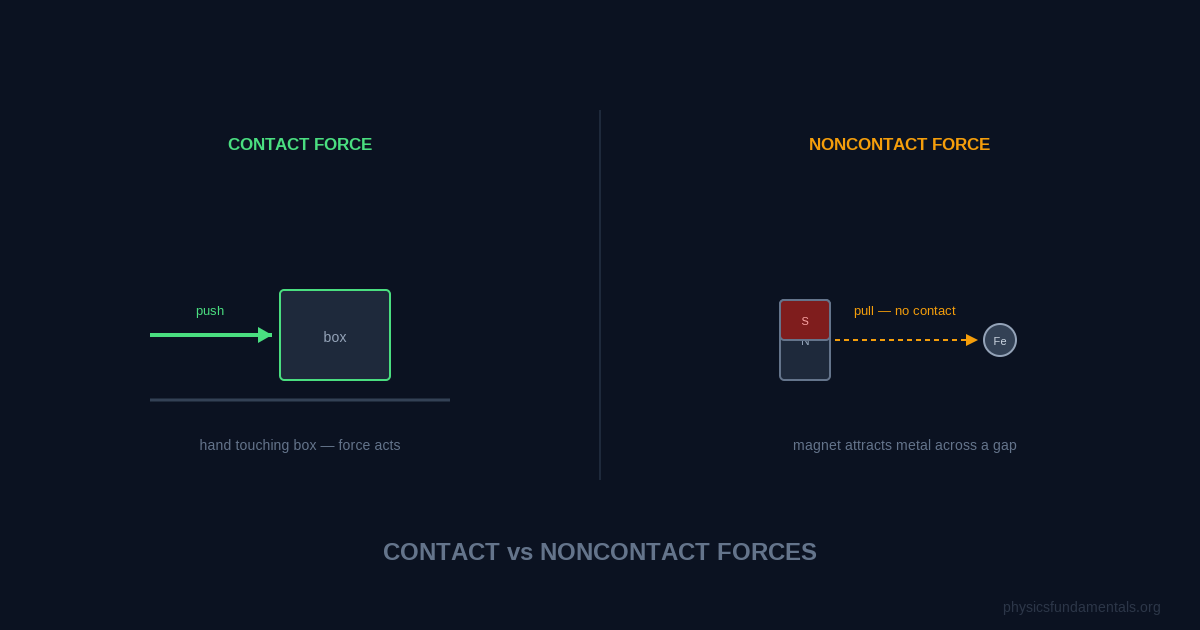
A contact force only acts when two objects are physically touching; a noncontact force acts even when the objects are separated by empty space. Push a box, stretch a spring, or feel the floor push back on your feet — all contact. Drop a ball and gravity pulls it down before it touches anything, or bring two magnets close and they tug on each other through the air between them — both noncontact. This single question — "are the two objects touching?" — is the entire test; nothing else about how strong, how common, or how obvious a force is matters for the classification.
Every force you meet in introductory physics falls into exactly one of these two categories, and a handful of specific cases — is air resistance a contact force, is friction ever noncontact, does a magnet have to touch something to push it — come up constantly on homework and exams because they're slightly less obvious than "push" and "gravity." This guide gives the complete list for both categories, works through the specific cases people get wrong, and ends with a worked classification example.
Contact Forces vs Noncontact Forces — Side by Side
| Property | Contact Force | Noncontact Force |
|---|---|---|
| Requires touching? | Yes — the objects must be in physical contact | No — acts across empty space, with a gap between the objects |
| How it acts | Direct mechanical interaction at the surfaces in contact | Through a field (gravitational, electric, or magnetic) that fills the space around the object |
| Range | Zero — stops the instant contact is broken | Extends outward indefinitely, weakening with distance but never reaching exactly zero |
| Examples | Friction, normal force, tension, applied (push/pull) force, spring force, air resistance | Gravity, electric (electrostatic) force, magnetic force |
| Common mix-up | Air resistance looks like "nothing touching" but it's countless air molecules physically colliding with the object | Weight (gravity) is often confused with the normal force that balances it, even though one is noncontact and the other is contact |
- The six contact forces you'll meet in intro physics, with a one-line description of each
- The three noncontact forces, and why they're able to act without touching (fields)
- Direct answers to the specific cases people get wrong: is air resistance contact? Is friction ever noncontact? Is a magnet's pull contact or noncontact?
- A worked example classifying every force on a single object
The Contact Forces
These six show up in almost every mechanics problem. All of them require two surfaces (or a surface and a medium, for air resistance) to actually be touching.
- Friction — opposes relative sliding (or the tendency to slide) between two surfaces in contact. See the full friction force guide for static vs kinetic friction and the f = μN formula.
- Normal force — the push a surface exerts perpendicular to itself on anything resting against it, preventing objects from passing through each other. Full details in the normal force guide.
- Tension — the pulling force transmitted along a string, rope, cable, or rod that's taut. See the tension force guide.
- Applied force — any direct push or pull from a person or object (pushing a box, pulling a sled). This is the most intuitive contact force — it's literally what "contact force" means in everyday language.
- Spring (elastic) force — the push or pull a stretched or compressed spring exerts, proportional to how far it's deformed. See Hooke's law and springs for F = −kx.
- Air resistance (drag) — the backward force a fluid (usually air) exerts on an object moving through it. See the full breakdown in free fall and terminal velocity.
The Noncontact Forces
Only three noncontact forces appear in introductory and most intermediate physics. All three act through a field — a region of space where the force exists at every point, not just at the exact location of contact.
- Gravitational force — every object with mass attracts every other object with mass, with no contact needed; it's why a dropped object starts accelerating downward before it ever touches anything. See gravitational force and Newton's law of gravitation.
- Electric (electrostatic) force — the attraction or repulsion between electric charges, acting across the gap between them. See electric charge and Coulomb's law.
- Magnetic force — the attraction or repulsion between magnets, or between a magnet and a magnetic material, acting without the two ever needing to touch. See magnetic fields and forces.
The reason these three can act "at a distance" is the same in every case: the source object (a mass, a charge, a magnet) creates a field that fills the surrounding space, and any other mass/charge/magnetic material placed anywhere in that field feels a force from it — no physical link between the two objects is needed.
Specific Cases People Get Wrong
Is air resistance a contact force? Yes. It can feel like "nothing is touching" the object, but air resistance is the combined effect of countless individual air molecules physically colliding with the object's surface as it moves — that's direct contact at the molecular level, just distributed across billions of tiny impacts instead of one solid surface.
Is the normal force contact or noncontact? Contact. It only exists between two surfaces that are actually pressed against each other; the instant they separate, the normal force drops to zero.
Is tension a contact force? Contact. Tension is transmitted through a physical string, rope, or cable — the string has to actually be attached to and touching both objects it connects.
Is friction a contact or noncontact force? Contact. By definition, friction only acts between two surfaces that are touching and sliding (or trying to slide) against each other; it's zero the moment the surfaces separate.
Is an applied (push or pull) force contact or noncontact? Contact. "Applied force" specifically means a direct push or pull exerted by one object touching another.
Worked Example — Classifying Every Force on an Object
A book rests on a table. A string tied to the book runs up and over a pulley to a hanging weight, pulling the book sideways. Identify every force acting on the book and classify each as contact or noncontact.
Weight (gravity on the book): noncontact — Earth pulls the book downward without touching it.
Normal force (table on book): contact — the table surface pushes up on the book only because it's resting on it.
Tension (string on book): contact — the string is physically tied to the book.
Friction (table on book, opposing the sideways pull): contact — it only exists because the book's underside is touching the table.
Four forces, and the pattern holds exactly as expected: the one force with nothing physically touching the book (gravity) is the only noncontact force in the whole problem — every other force involves something in direct physical contact with the book.
Common Mistakes
Confusing weight with the normal force. In a simple "book on a table" scenario, weight (down, noncontact) and normal force (up, contact) are often equal in magnitude — but they're still two completely different forces from two different causes, one of which needs contact and one of which doesn't.
Assuming magnetism needs contact because magnets "stick together." Two magnets snapping together is the result of a noncontact force pulling them toward each other — the force exists and acts on both magnets before they touch; contact is just where it ends up, not a requirement for the force to exist.
Treating air resistance as an exception. It's tempting to call air resistance noncontact since there's no single solid surface involved, but molecular-level collision is still physical contact — it's just contact with a fluid (billions of individual air molecules) instead of a solid.
Frequently Asked Questions
What are contact and noncontact forces?
What are examples of contact and noncontact forces?
Is air resistance a contact or noncontact force?
Is the normal force a contact or noncontact force?
Is tension a contact or noncontact force?
Share this article
Written by
Physics Fundamentals Editorial Team
Written and reviewed by our team of physics educators. Content is aligned with A-Level, GCSE, AP Physics, and undergraduate curricula.
About Physics Fundamentals →