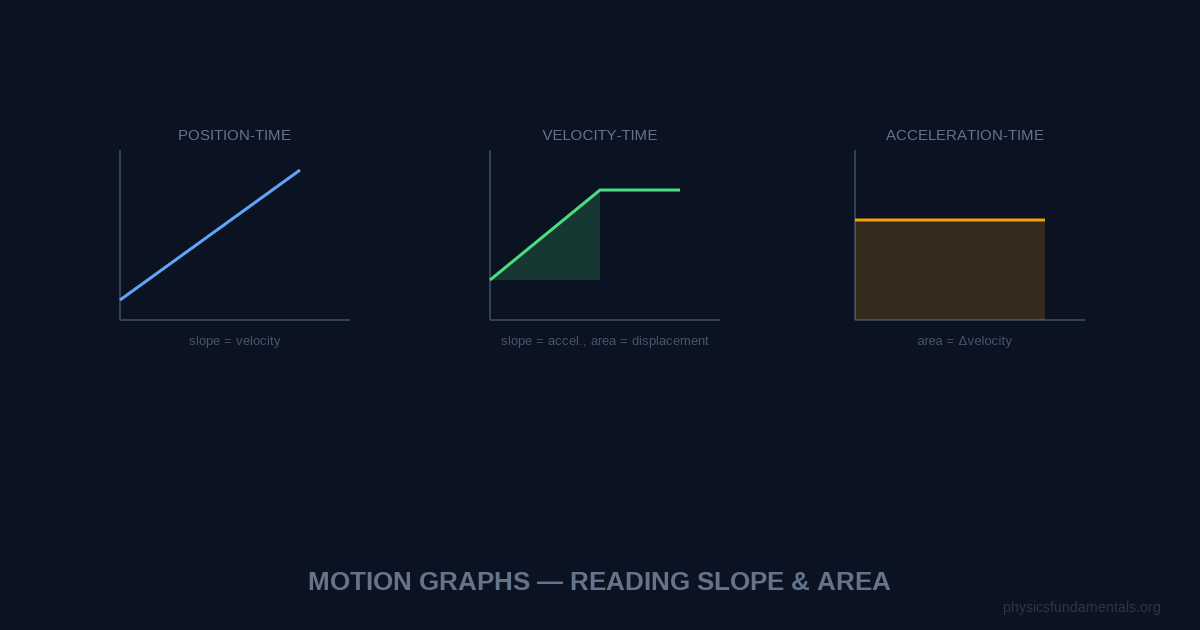
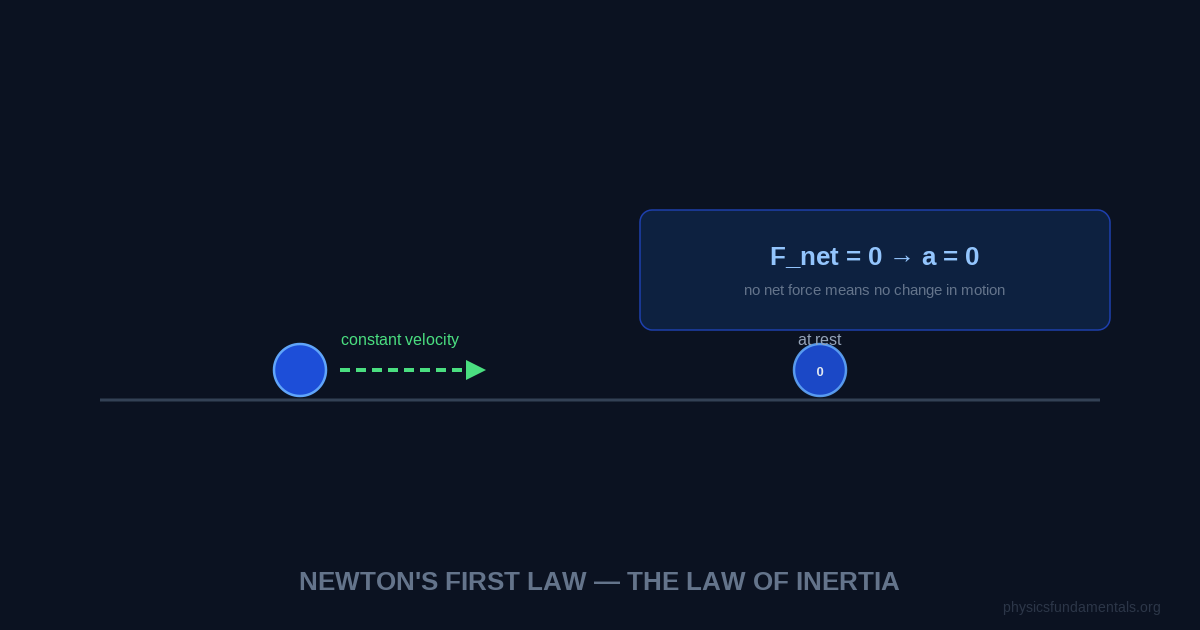
Newton's first law states that an object at rest stays at rest, and an object in motion stays in motion at constant velocity, unless acted on by a net external force. This is also called the law of inertia — inertia being an object's built-in resistance to any change in its motion. Written as an equation, it's the special case Fnet = 0, which gives a = 0: zero net force means zero acceleration, which means the object's velocity never changes.
This is the first of Newton's three laws of motion, published in 1687. It sounds almost too obvious to be a law — but it directly contradicts a deep, intuitive (and wrong) belief most people carry: that moving objects naturally slow down and stop on their own. They don't. They slow down because something — usually friction or air resistance — is pushing back on them. Remove every force, and motion continues forever, unchanged.
- The precise definition — and why "an object in motion stays in motion" is so often misunderstood
- The #1 misconception: Aristotelian thinking, and why moving objects don't need a constant force
- Worked examples: frictionless sliding, seatbelts, the tablecloth trick, and a simple quantitative case
- How the first law is really just a special case of the second law
What Is Newton's First Law?
An object at rest stays at rest, and an object in motion stays in motion with the same speed and in the same direction, unless acted upon by a net external force. This is also known as the law of inertia. Inertia is not a force — it's a property every object has, a built-in resistance to having its velocity changed. Mass is the quantitative measure of inertia: a bowling ball has more inertia than a tennis ball, which is why it's harder to start moving and harder to stop.
As an equation:
If the net force on an object is exactly zero, its acceleration is exactly zero — meaning its velocity (both speed and direction) never changes. An object that's stationary stays stationary; an object moving at 10 m/s east keeps moving at exactly 10 m/s east, forever, until some force intervenes.
Newton's First Law vs the Other Two Laws
| Law | Statement | Equation |
|---|---|---|
| First Law (Inertia) | An object remains at rest or in uniform motion unless acted on by a net force | F_net = 0 → a = 0 |
| Second Law (F = ma) | Net force equals mass times acceleration | F = ma |
| Third Law (Action-Reaction) | Every force has an equal, opposite reaction force on the other object | F₁₂ = −F₂₁ |
Note that the first law isn't really separate physics from the second law — it's the special case of F = ma when the net force is exactly zero. Newton stated it separately because it establishes something conceptually essential before the second law can even make sense: that the "natural" state of an object is constant velocity (including zero), not rest, and that a force is only needed to change motion, never to sustain it.
Who Discovered Newton's First Law?
Sir Isaac Newton published this law in his 1687 work Philosophiæ Naturalis Principia Mathematica, but the core idea didn't start with him. Galileo Galilei had already argued, decades earlier, that a ball rolling on a perfectly smooth, level surface would roll forever if nothing slowed it down — his thought experiments on inclined planes were the first real challenge to the ancient Aristotelian view that objects need a continuous push to keep moving. Newton formalized and generalized Galileo's insight into the first of his three laws, framing it in terms of force and inertia precisely enough to build the rest of classical mechanics on top of it.
The #1 Misconception — Aristotelian Thinking
Moving objects do not need a continuous force to keep moving. They only need a force to change their motion (speed up, slow down, or change direction). An object slows down only because something — usually friction or air resistance — is actively pushing back on it, not because motion itself "runs out."
Many students believe that a moving object must have a force acting on it in the direction of travel just to keep going — that's Aristotelian thinking, and it's wrong. It feels intuitively true only because, in daily life, friction and air resistance are always present and always slowing things down, so we never actually see unopposed motion. A hockey puck sliding across frictionless ice needs no forward force to maintain its velocity — it glides at constant speed forever, in a straight line, unless something pushes or pulls it. The puck eventually stopping on real ice is entirely explained by friction (a real, external force), not by the puck "running out" of motion.
Worked Example 1: Frictionless Sliding
A hockey puck slides across a perfectly frictionless patch of ice at 5 m/s. No friction, no air resistance, no other horizontal force acts on it. What happens to its velocity?
Since F_net = 0, the first law says a = 0 — the puck's velocity never changes. It continues gliding at exactly 5 m/s in a straight line indefinitely, for as long as the frictionless condition holds. This is the cleanest possible illustration of the law precisely because removing friction removes the one force everyday intuition is used to seeing.
Worked Example 2: A Simple Quantitative Case
Problem: A 1,000 kg car coasts on a perfectly level, frictionless test track at a constant 20 m/s, with its engine off and no air resistance. How far does it travel in 10 seconds?
With F_net = 0, acceleration is zero, so velocity stays constant at 20 m/s throughout. Distance is simply speed × time:
No force, no mass, and no complicated kinematics are needed here — that's the point of the first law. Constant velocity motion is the simplest case in all of mechanics, which is exactly why it's the baseline every other case is measured against.
Worked Example 3: Seatbelts and Inertia
A car traveling at 15 m/s suddenly brakes hard and stops. Why does a passenger without a seatbelt keep moving forward?
The passenger's body has inertia — by the first law, it continues moving at 15 m/s forward unless a force acts on it to change that. The car's seat and brakes act on the car, not directly on an unrestrained passenger's body. Without a seatbelt, the only thing that eventually stops the passenger's forward motion is a collision with the dashboard, windshield, or airbag. A seatbelt supplies the backward force needed to decelerate the passenger along with the car, safely and over a longer distance, instead of their inertia carrying them into something hard and unyielding.
Worked Example 4: The Tablecloth Trick
A classic demonstration: a tablecloth is yanked horizontally, very quickly, out from under a table setting of plates and glasses — and the dishes barely move. Why?
The dishes have inertia. The yank is fast enough that the frictional force between the tablecloth and the dishes only acts for a very brief time — too brief to impart much velocity change to the dishes (by the second law, a given force over a very short time produces only a small change in momentum). Once the tablecloth is gone, there's no longer a horizontal force pulling the dishes along, so by the first law they simply stay where they were, settling straight down under gravity rather than following the cloth.
Worked Example 5: A Book at Rest on a Table
A book sits motionless on a table. Is this an example of the first law? What forces act on it?
Yes — the book is at rest, and by the first law it stays at rest as long as the net force on it is zero. Two forces act on the book: gravity pulling down, and the table's normal force pushing up, with equal magnitude. These are not a Newton's third-law pair (both act on the same object, the book) — they're simply two separate forces that happen to balance exactly, which is precisely why the book obeys the first law and remains at rest instead of accelerating.
Inertial Reference Frames
Newton's first law only holds true in what's called an inertial reference frame — a frame of reference that is itself not accelerating. Inside a car accelerating forward, a loose object on the dashboard appears to slide backward with no obvious force causing it — that's because the car itself is an accelerating (non-inertial) frame, and the first law doesn't directly apply there without introducing a fictitious "pseudo-force" to account for the frame's own acceleration. Any reference frame moving at constant velocity relative to the stars — including one at rest — is inertial, and the first law holds exactly within it.
Common Mistakes
Thinking motion itself requires a sustaining force. The single most common error (see the misconception section above). A force is needed to start, stop, or change motion — never to simply continue it.
Confusing "no net force" with "no forces at all." The first law requires zero net force, not the complete absence of forces. The book on the table has two real forces acting on it (gravity and the normal force) — they just cancel exactly.
Forgetting that "at rest" is just a special case of "constant velocity." Being stationary is constant velocity with the value zero. The first law treats "staying still" and "moving in a straight line at constant speed" as the exact same phenomenon — both are what happens by default, with no net force required to maintain either one.
Applying the law inside a non-inertial frame without adjustment. Inside an accelerating car, plane, or rotating system, objects can appear to accelerate with no visible force causing it — that's a sign the frame itself is non-inertial, not a violation of the first law.
Frequently Asked Questions
What is Newton's first law of motion?
What is the law of inertia?
Newton's first law is also known as the law of what?
What does Newton's first law of motion state?
Is Newton's first law just a special case of the second law?
Why don't moving objects keep moving forever in everyday life?
Does Newton's first law apply inside an accelerating car or plane?
Share this article
Written by
Physics Fundamentals Editorial Team
Written and reviewed by our team of physics educators. Content is aligned with A-Level, GCSE, AP Physics, and undergraduate curricula.
About Physics Fundamentals →