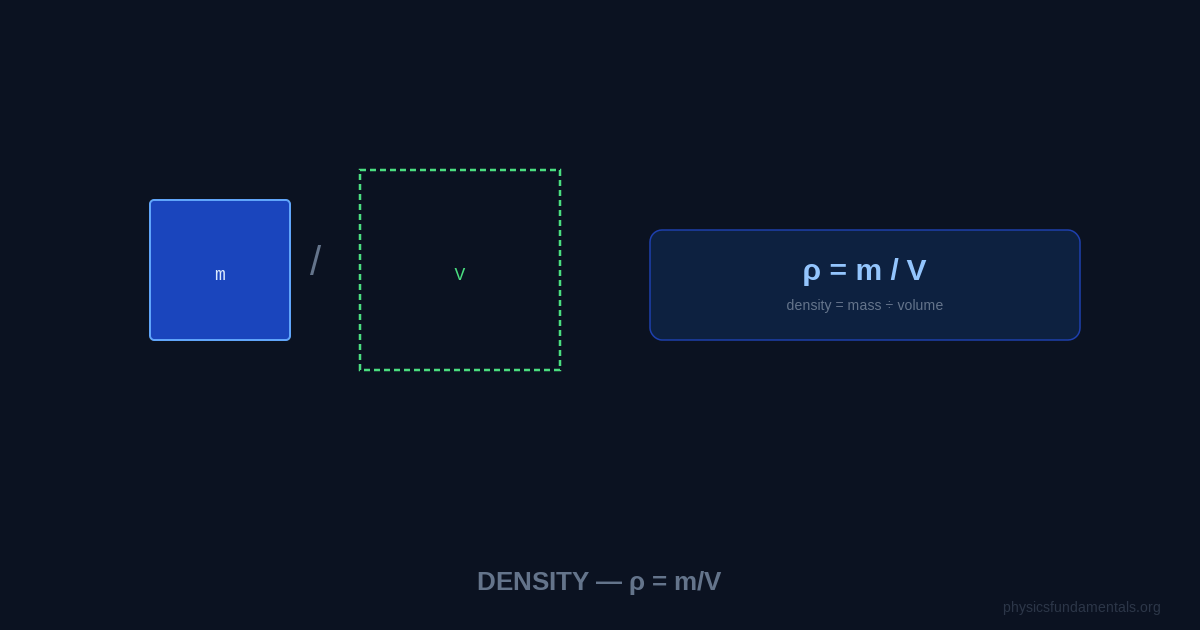
Density is the amount of mass packed into a given volume. The formula is ρ = m/V — density (ρ, the Greek letter "rho") equals mass divided by volume. Its SI unit is kilograms per cubic metre (kg/m³), though grams per cubic centimetre (g/cm³) is common for everyday objects and grams per millilitre (g/mL) for liquids. Density is why a brick sinks and a similarly-sized piece of foam floats, even though both have a size, a weight, and are made of "stuff" — what matters is how tightly that mass is packed into the space it occupies.
- The density formula, symbol, and SI units — with conversions between common unit systems
- A reference table of common substance densities
- How density determines whether something floats or sinks
- 5 worked examples: finding density, mass, volume, and predicting flotation
Want to plug in your own numbers? Try the density calculator for instant results in kg/m³, g/cm³, or g/mL.
What Is Density?
Density (ρ) is mass per unit volume: ρ = m/V. It measures how tightly matter is packed into a given space. Two objects can have exactly the same mass but very different densities if their volumes differ — a kilogram of feathers takes up far more space than a kilogram of lead, so lead has a much higher density.
Rearranged, this gives two equally useful forms: m = ρV (find mass from density and volume) and V = m/ρ (find volume from mass and density). Density is an intensive property — unlike mass or volume, it doesn't depend on how much of a substance you have. A teaspoon of water and a swimming pool of water have wildly different masses and volumes, but identical density.
Units of Density
The SI unit of density is kilograms per cubic metre (kg/m³). In practice, smaller, more convenient units are often used for everyday objects and liquids:
| Unit | Typically used for | Conversion |
|---|---|---|
| kg/m³ | SI unit, large-scale and gases | base unit |
| g/cm³ | solids and everyday objects | 1 g/cm³ = 1,000 kg/m³ |
| g/mL | liquids | 1 g/mL = 1 g/cm³ = 1,000 kg/m³ |
Common Substance Densities
| Substance | Density (kg/m³) | Density (g/cm³) |
|---|---|---|
| Air (at sea level) | 1.2 | 0.0012 |
| Ice | 920 | 0.92 |
| Water (fresh, 4°C) | 1,000 | 1.00 |
| Seawater | 1,025 | 1.025 |
| Aluminium | 2,700 | 2.70 |
| Iron / Steel | 7,870 | 7.87 |
| Gold | 19,300 | 19.30 |
Notice ice is less dense than liquid water (920 vs 1,000 kg/m³) — this is why ice floats, an unusual property most other substances don't share (most solids are denser than their own liquid form).
Density and Floating: Archimedes' Principle
An object floats in a fluid if its average density is less than the fluid's density, and sinks if its density is greater. An object with exactly equal density to the fluid will hover, neutrally buoyant, neither rising nor sinking. This is why a solid steel block sinks in water (steel: 7,870 kg/m³ ≫ water: 1,000 kg/m³) while a steel ship floats — the ship's hollow shape spreads its mass over a much larger volume, dramatically lowering its average density below water's. For the full buoyancy force calculation behind this, see Buoyancy and Archimedes' Principle.
Worked Example 1: Finding Density
A rock has a mass of 150 g and a volume of 60 cm³. Find its density.
ρ = m/V = 150/60 = 2.5 g/cm³ (= 2,500 kg/m³)
Worked Example 2: Finding Mass
A block has a density of 800 kg/m³ and a volume of 0.5 m³. Find its mass.
m = ρV = 800 × 0.5 = 400 kg
Worked Example 3: Finding Volume
A piece of aluminium has a mass of 270 g and a density of 2.7 g/cm³. Find its volume.
V = m/ρ = 270/2.7 = 100 cm³
Worked Example 4: Will It Float?
An object has a density of 850 kg/m³. Will it float in fresh water (1,000 kg/m³)?
Since 850 kg/m³ < 1,000 kg/m³, the object's density is less than water's — it will float, with part of its volume above the waterline (the fraction submerged equals the ratio of the two densities, 850/1000 = 85% submerged).
Worked Example 5: Unit Conversion
A liquid has a density of 0.8 g/mL. Express this in kg/m³.
0.8 g/mL = 0.8 g/cm³ = 0.8 × 1,000 kg/m³ = 800 kg/m³
Common Mistakes
Confusing density with mass or weight. A large object can have a small mass if it's not very dense (like a balloon), and a small object can have a large mass if it's very dense (like a lead weight). Density is about how tightly packed matter is, not how much of it there is.
Mixing up units without converting. g/cm³ and kg/m³ differ by a factor of 1,000 — always check which unit a density value is given in before comparing or calculating with it.
Assuming bigger objects are automatically denser. Size (volume) and density are independent — a huge block of foam is far less dense than a small pebble, despite being much bigger.
Frequently Asked Questions
What is the formula for density?
What is the symbol for density?
What are the units of density?
How do you find the density of a liquid?
Why does ice float on water?
Share this article
Written by
Physics Fundamentals Editorial Team
Written and reviewed by our team of physics educators. Content is aligned with A-Level, GCSE, AP Physics, and undergraduate curricula.
About Physics Fundamentals →