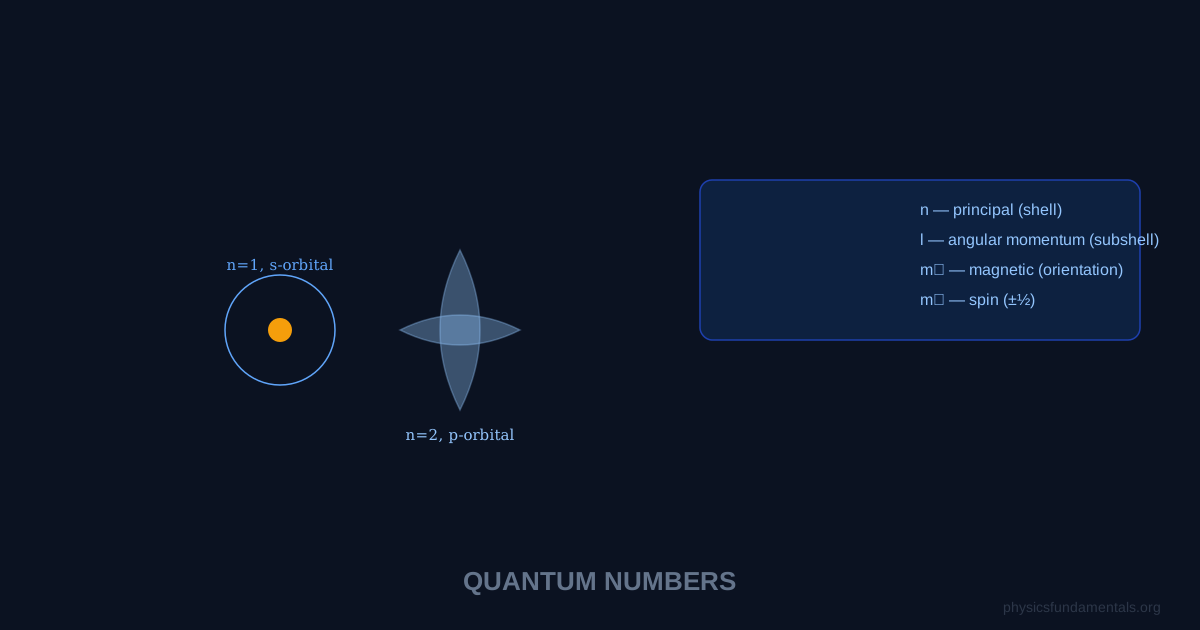
Each electron in an atom is described by four quantum numbers that together specify its state completely: the principal quantum number n, the angular momentum quantum number l, the magnetic quantum number m_l, and the spin quantum number m_s. By the Pauli exclusion principle, no two electrons in the same atom can have the same set of four quantum numbers. This principle, together with the allowed values of each quantum number, determines the entire structure of the periodic table — how electrons fill shells and subshells and why elements have the chemical properties they do.
Quantum numbers emerge from solving the Schrödinger equation for an electron in a Coulomb potential. They are not arbitrary labels — each arises from a symmetry of the system and corresponds to a conserved physical quantity: n to energy, l to angular momentum magnitude, m_l to the z-component of angular momentum, and m_s to spin angular momentum.
- Principal quantum number n: energy level and shell size
- Angular momentum quantum number l: subshell shape (s, p, d, f)
- Magnetic quantum number m_l: orbital orientation
- Spin quantum number m_s: electron spin (up or down)
- Pauli exclusion principle and electron configuration
- Worked examples: writing electron configurations and counting states
The Four Quantum Numbers
1. Principal Quantum Number: n
n = 1, 2, 3, 4, ... (positive integers only)
- Physical meaning: determines the electron's energy level and average distance from the nucleus. Higher n = higher energy, greater average distance.
- For hydrogen: En = −13.6/n² eV (the Bohr model result)
- Shell label: n = 1 (K shell), n = 2 (L shell), n = 3 (M shell), n = 4 (N shell)
- Maximum electrons in shell n: 2n²
2. Angular Momentum Quantum Number: l
l = 0, 1, 2, ..., (n−1) — integers from 0 to n−1
- Physical meaning: magnitude of the electron's orbital angular momentum L = ħ√(l(l+1))
- Subshell labels: l = 0 (s), l = 1 (p), l = 2 (d), l = 3 (f)
- Orbital shapes: s = spherical, p = dumbbell (3 orientations), d = cloverleaf (5 orientations)
- For n = 3: l can be 0, 1, or 2 → subshells 3s, 3p, 3d
3. Magnetic Quantum Number: m_l
m_l = −l, −l+1, ..., 0, ..., l−1, l — integers from −l to +l (2l+1 values)
- Physical meaning: z-component of orbital angular momentum: L_z = m_l × ħ
- Describes orientation of the orbital in space (relevant in a magnetic field)
- For l = 1 (p subshell): m_l = −1, 0, +1 → three p orbitals (px, py, pz)
- For l = 2 (d subshell): m_l = −2, −1, 0, +1, +2 → five d orbitals
4. Spin Quantum Number: m_s
m_s = +½ or −½ only (two values)
- Physical meaning: intrinsic spin angular momentum of the electron: S_z = m_s × ħ
- m_s = +½: "spin up" (↑); m_s = −½: "spin down" (↓)
- Electron spin has no classical analogue — it's an intrinsic quantum property
- Each orbital holds exactly 2 electrons: one spin up, one spin down
Pauli Exclusion Principle
No two electrons in the same atom can have the same set of four quantum numbers (n, l, m_l, m_s). Each electron state is unique.
This principle — proposed by Wolfgang Pauli in 1925 — explains why electrons fill different orbitals rather than all collapsing into the lowest energy state. It's the foundation of the electronic structure of all atoms and molecules, and ultimately the diversity of chemical elements.
Counting States in Each Shell and Subshell
| n | l values | Subshells | Orbitals (2l+1) | Electrons (2n²) |
|---|---|---|---|---|
| 1 | 0 | 1s | 1 | 2 |
| 2 | 0, 1 | 2s, 2p | 1 + 3 = 4 | 8 |
| 3 | 0, 1, 2 | 3s, 3p, 3d | 1+3+5 = 9 | 18 |
| 4 | 0, 1, 2, 3 | 4s, 4p, 4d, 4f | 1+3+5+7 = 16 | 32 |
Electron Configuration
Electrons fill orbitals in order of increasing energy, following the Aufbau principle. The order (with some exceptions for d and f electrons due to subshell interactions):
1s → 2s → 2p → 3s → 3p → 4s → 3d → 4p → 5s → 4d → 5p → 6s → 4f → 5d → 6p...
Hund's rule: within a subshell, electrons fill each orbital singly before pairing (to minimise electron-electron repulsion).
4 Worked Examples
Example 1 — Valid quantum number sets
Problem: Which of these sets (n, l, m_l, m_s) are valid?
(a) (2, 1, 0, +½) (b) (3, 3, 0, +½) (c) (2, 1, 2, −½) (d) (4, 2, −1, −½)
Solution:
(a) n=2, l=1 (valid: l must be 0 to n−1 = 0 or 1), m_l=0 (valid: −1 to +1), m_s=+½ ✓ Valid
(b) n=3, l=3 — invalid: l must be 0 to 2 for n=3. Invalid
(c) n=2, l=1, m_l=2 — invalid: m_l must be −1, 0, or +1 for l=1. Invalid
(d) n=4, l=2, m_l=−1 (valid: −2 to +2), m_s=−½ ✓ Valid
Example 2 — Number of electrons in a subshell
Problem: How many electrons can the 3d subshell hold?
Solution:
l = 2 for d subshell → m_l values: −2, −1, 0, +1, +2 → 5 orbitals
Each orbital holds 2 electrons (m_s = +½ and −½)
Total = 5 × 2 = 10 electrons
Example 3 — Electron configuration of chlorine
Problem: Write the electron configuration of chlorine (Z = 17).
Solution:
Fill in order: 1s² 2s² 2p⁶ 3s² 3p⁵
Check: 2 + 2 + 6 + 2 + 5 = 17 ✓
Configuration: 1s² 2s² 2p⁶ 3s² 3p⁵
The 3p subshell is one electron short of a full octet — this makes Cl highly reactive, wanting to gain one electron.
Example 4 — Quantum numbers for the 15th electron
Problem: Write the quantum numbers for the last electron added in phosphorus (Z = 15).
Solution:
Configuration: 1s² 2s² 2p⁶ 3s² 3p³
The 15th electron is the 3rd electron in 3p. Using Hund's rule, it occupies the 3rd empty 3p orbital with spin up:
n = 3, l = 1, m_l = +1 (third 3p orbital), m_s = +½
Quantum numbers: (3, 1, +1, +½)
Schrödinger's Equation and the Origin of Quantum Numbers
The four quantum numbers arise naturally from solving the Schrödinger equation for an electron in a Coulomb potential (the hydrogen atom). The equation is a partial differential equation in three spatial coordinates (r, θ, φ in spherical coordinates). When solved by separation of variables:
- The radial equation yields the principal quantum number n = 1, 2, 3... and determines the allowed energies En = −13.6/n² eV and the radial shape of the wave function.
- The polar angular equation yields the angular momentum quantum number l = 0, 1, ..., n−1 and the shape of the orbital.
- The azimuthal equation yields the magnetic quantum number m_l = −l, ..., +l and the orientation of the orbital.
- Electron spin (m_s = ±½) does not come from Schrödinger's equation — it requires the Dirac equation (1928), the relativistic quantum mechanical treatment. Dirac found that spin emerges automatically from combining special relativity with quantum mechanics.
Orbital Shapes and Chemistry
Each set of quantum numbers (n, l, m_l) corresponds to an orbital — a 3D probability distribution for the electron. The shape depends on l:
- s orbitals (l=0): spherically symmetric. One orientation (m_l = 0). Smallest and most penetrating — s electrons spend more time near the nucleus. Electrons in s orbitals are more tightly bound and screen nuclear charge most effectively.
- p orbitals (l=1): dumbbell-shaped, three orientations (m_l = −1, 0, +1) along x, y, z axes. Carbon's four bonds arise from sp³ hybridisation (mixing one s and three p orbitals to form four equivalent tetrahedral bonding orbitals).
- d orbitals (l=2): complex four-lobed shapes, five orientations. Transition metals (Fe, Cu, Ni) have partially filled d shells, responsible for their magnetic properties and catalytic activity.
- f orbitals (l=3): very complex, seven orientations. The lanthanide and actinide series result from filling f subshells.
The Periodic Table from Quantum Numbers
The structure of the periodic table follows directly from the Pauli exclusion principle and the aufbau ordering of energy levels:
- Period 1 (H, He): fills 1s (2 electrons, n=1)
- Period 2 (Li to Ne): fills 2s and 2p (8 electrons, n=2)
- Period 3 (Na to Ar): fills 3s and 3p (8 electrons, n=3)
- Period 4 (K to Kr): fills 4s, 3d, 4p (18 electrons — 3d comes before 4p in energy)
- Lanthanides: fills 4f (14 electrons, explaining the 14-element-wide insert)
The periodic table is literally a map of electron configuration — similar chemical properties arise from similar outermost electron configurations (same number of valence electrons). Quantum numbers don't just describe individual atoms; they predict chemical behaviour across the entire periodic table.
Worked Example 5 — Full quantum number set for iron
Problem: Write the electron configuration of iron (Z = 26) and give the quantum numbers for its outermost electron.
Solution:
Filling in order (1s 2s 2p 3s 3p 4s 3d 4p...):
Fe: 1s² 2s² 2p⁶ 3s² 3p⁶ 4s² 3d⁶
Check: 2+2+6+2+6+2+6 = 26 ✓
The outermost subshell is 3d⁶. By Hund's rule: 3d fills as: ↑ ↑ ↑ ↑ ↑↓ (4 up-spin, 1 pair)
The last electron fills the 5th 3d orbital (m_l = +2, completing the first pair): n=3, l=2, m_l=+2 (or m_l=−2), m_s=−½
Quantum numbers: (3, 2, +2, −½) [or (3, 2, −2, −½) — both are equivalent choices for "last filled"]
Iron's 4 unpaired 3d electrons make it strongly ferromagnetic — the largest number of unpaired electrons among the common transition metals.
Selection Rules and Spectral Lines
Not all transitions between energy levels are equally probable. Quantum mechanical selection rules govern which transitions are "allowed" (high probability) and which are "forbidden" (very low probability):
- Δn: any integer change (no restriction from n)
- Δl = ±1: angular momentum must change by exactly 1 (the photon carries angular momentum ħ)
- Δm_l = 0, ±1: magnetic quantum number can change by 0 or ±1
Transitions that violate these rules (e.g. s → s, Δl = 0) are "forbidden" — they can still occur but with much lower probability (typically 10⁶ times less likely). The selection rules explain why atomic spectra show specific lines at certain wavelengths: only transitions satisfying Δl = ±1 produce the intense lines we observe. The hydrogen Balmer series involves transitions to n=2, and all allowed transitions to 2p from higher levels: 3p→2s is forbidden (Δl = 0); 3s→2p is allowed (Δl = +1).
Worked Example 6 — Spectroscopic notation and electron count
Problem: (a) How many electrons can be in the 4f subshell? (b) Write all possible quantum number combinations for a 2p electron. (c) Which element has the configuration [Ar] 3d¹⁰ 4s²?
Solution:
(a) 4f: n=4, l=3. m_l values: −3, −2, −1, 0, +1, +2, +3 → 7 orbitals × 2 electrons = 14 electrons
(b) 2p: n=2, l=1. m_l = −1, 0, or +1; m_s = +½ or −½. Six combinations:
(2,1,−1,+½), (2,1,−1,−½), (2,1,0,+½), (2,1,0,−½), (2,1,+1,+½), (2,1,+1,−½)
(c) [Ar] = 1s²2s²2p⁶3s²3p⁶ (18 electrons). Adding 3d¹⁰ + 4s² = 18+10+2 = 30 electrons. Z=30 = Zinc (Zn). The filled 3d¹⁰ shell makes zinc non-transition-metal-like in many respects despite being in period 4.
Exam Summary for Quantum Numbers
Four quantum numbers, four rules: n = 1,2,3... (principal, energy); l = 0 to n−1 (orbital shape); m_l = −l to +l (orientation); m_s = +½ or −½ (spin). Pauli exclusion: no two electrons share all four. Aufbau: fill in order of increasing energy (1s, 2s, 2p, 3s, 3p, 4s, 3d, 4p...). Hund's rule: within a subshell, fill each orbital singly before pairing. Maximum electrons in shell n = 2n²; in subshell l = 2(2l+1). For valid quantum number sets: check l < n (l must be smaller than n), |m_l| ≤ l, m_s = ±½ only. The most common exam error: choosing l = n (e.g. l = 2 for n = 2 is invalid; l can only be 0 or 1 when n = 2).
Quantum numbers are not merely abstract labels — they have direct physical meaning in terms of measurable quantities. Measure the energy of an atomic electron: you get En ∝ 1/n². Measure the magnitude of orbital angular momentum: you get L = ħ√(l(l+1)). Measure the z-component of orbital angular momentum: you get Lz = m_l × ħ. Measure the z-component of spin angular momentum: you get Sz = ms × ħ = ±ħ/2. These quantised values have been confirmed to extraordinary precision — the electron's magnetic moment (related to spin) is known to 12 significant figures, matching quantum electrodynamics predictions. The quantum numbers are the most precisely verified predictions in all of science.
The four quantum numbers and the Pauli exclusion principle explain not just atomic spectra but the entire framework of chemistry. The periodic repetition of properties (the periodic law) arises from the periodic repetition of outermost electron configurations as shells fill. The reactivity of alkali metals (one valence s electron, easily lost) vs noble gases (complete shells, unreactive) vs halogens (one electron short of complete p subshell, highly reactive) all flow from the same quantum mechanical rules. Understanding quantum numbers deeply means understanding why the universe has the chemical elements it does, in the proportions it does, with the properties they have — a remarkable explanatory achievement from four integers and a principle discovered in 1925.
Summary: the four quantum numbers emerge from the quantum mechanical treatment of the hydrogen atom and generalise to all atoms via the Pauli exclusion principle and Hund's rules. They are: n (energy and shell size), l (orbital shape), m_l (orbital orientation), m_s (spin). Together they uniquely specify every electron state; no two electrons in the same atom can share all four. The structure of the periodic table — its periods of length 2, 8, 8, 18, 18, 32 — is a direct consequence of these rules filling subshells in order of increasing energy. Quantum numbers are the bridge between quantum mechanics and chemistry, making the structure of matter comprehensible from first principles.
Frequently Asked Questions
What are the four quantum numbers?
What is the Pauli exclusion principle?
How many electrons can each shell hold?
What does the principal quantum number n represent physically?
Why does electron spin have only two values?
Share this article
Written by
Physics Fundamentals Editorial Team
Written and reviewed by our team of physics educators. Content is aligned with A-Level, GCSE, AP Physics, and undergraduate curricula.
About Physics Fundamentals →