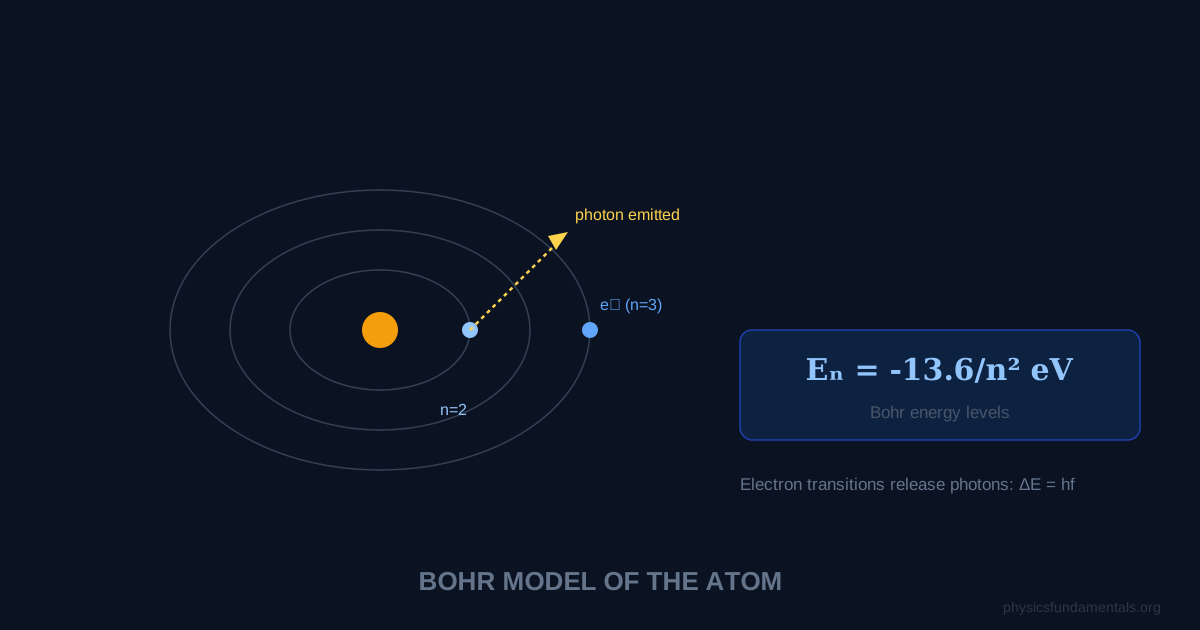
The Bohr model of the atom predicts that electrons occupy fixed energy levels, each described by a principal quantum number n = 1, 2, 3... For hydrogen, the energy of each level is En = −13.6/n² eV. When an electron drops from a higher level (n₂) to a lower level (n₁), it emits a photon of energy ΔE = hf = En₂ − En₁. This model, proposed by Niels Bohr in 1913, was the first to successfully explain the hydrogen emission spectrum — specific lines of light at precise wavelengths that classical physics had failed to account for.
The Bohr model is now superseded by quantum mechanics, but it remains a crucial stepping stone and is still the framework taught at A-Level and AP Physics for understanding atomic spectra. It gets the energy levels of hydrogen exactly right — for a single-electron atom, the predictions are still used today.
- Bohr's postulates — quantised orbits and what makes them stable
- Energy levels: En = −13.6/n² eV for hydrogen
- Photon emission and absorption: ΔE = hf
- Emission vs absorption spectra — how each forms
- 4 worked examples: photon energy, wavelength, ionisation, series limits
Bohr's Postulates
Bohr made three key assumptions that classical physics couldn't justify but experiment confirmed:
- Electrons orbit the nucleus in specific allowed circular orbits without radiating energy. (Classical electromagnetism says accelerating charges radiate — this was the first contradiction with classical theory.)
- Only orbits where the angular momentum is an integer multiple of ħ are allowed: mvr = nħ, where n = 1, 2, 3... This is the quantisation condition, which de Broglie later explained as standing wave orbits.
- Energy is emitted or absorbed only when an electron transitions between levels. The photon energy equals the energy difference: E_photon = hf = |E_upper − E_lower|.
Energy Levels: En = −13.6/n² eV
Where n = 1, 2, 3, ... is the principal quantum number. Key values:
- n = 1 (ground state): E₁ = −13.6 eV — the lowest, most stable state
- n = 2 (first excited state): E₂ = −13.6/4 = −3.40 eV
- n = 3: E₃ = −13.6/9 = −1.51 eV
- n = 4: E₄ = −13.6/16 = −0.85 eV
- n → ∞ (ionisation): E = 0 eV
The negative values reflect that the electron is bound — energy must be supplied to remove it. The ionisation energy of hydrogen (energy to remove the electron from ground state) is 13.6 eV.
Photon Emission and Absorption
When an electron transitions from level n₂ to level n₁ (n₂ > n₁), it emits a photon:
The wavelength of the photon: λ = hc/E_photon.
Absorption: an electron in level n₁ absorbs a photon of exactly the right energy to jump to n₂. If the photon energy doesn't match a transition, it passes straight through — which is why each element absorbs specific wavelengths and has a unique absorption spectrum.
Hydrogen Spectral Series
| Series | Final level (n₁) | Region | First line (n₂=n₁+1) |
|---|---|---|---|
| Lyman | n₁ = 1 | Ultraviolet | 121.6 nm |
| Balmer | n₁ = 2 | Visible | 656.3 nm (red) |
| Paschen | n₁ = 3 | Infrared | 1875 nm |
| Brackett | n₁ = 4 | Infrared | 4051 nm |
4 Worked Examples
Example 1 — Energy of an emitted photon
Problem: A hydrogen electron drops from n = 4 to n = 2. Find the energy and frequency of the emitted photon. (h = 6.626 × 10⁻³⁴ J·s)
Solution:
E₄ = −13.6/16 = −0.85 eV; E₂ = −13.6/4 = −3.40 eV
E_photon = E₄ − E₂ = −0.85 − (−3.40) = 2.55 eV
In joules: 2.55 × 1.6 × 10⁻¹⁹ = 4.08 × 10⁻¹⁹ J
f = E/h = 4.08 × 10⁻¹⁹ / 6.626 × 10⁻³⁴ = 6.16 × 10¹⁴ Hz (visible, orange-red)
Example 2 — Wavelength of emitted photon
Problem: Find the wavelength of the photon emitted in Example 1.
Solution:
λ = c/f = 3 × 10⁸ / 6.16 × 10¹⁴ = 4.87 × 10⁻⁷ m = 487 nm (blue-green, Balmer series)
Example 3 — Minimum photon energy for ionisation
Problem: What is the minimum energy of a photon that can ionise a hydrogen atom in the n = 2 state?
Solution:
Ionisation means exciting from n = 2 to n = ∞ (E = 0)
E_min = 0 − E₂ = 0 − (−3.40) = 3.40 eV
Example 4 — Identifying a transition
Problem: A photon of energy 1.89 eV is absorbed by hydrogen. Which transition does this correspond to?
Solution:
Check E₃ − E₂ = −1.51 − (−3.40) = 1.89 eV ✓
This is absorption from n = 2 to n = 3 (Balmer series absorption)
Emission vs Absorption Spectra
Emission spectrum: A hot gas emits light at specific wavelengths — bright lines on a dark background. Each line corresponds to an electron dropping to a lower energy level and emitting a photon. The pattern of lines is unique to each element — a spectral fingerprint.
Absorption spectrum: White light passed through a cool gas produces a continuous spectrum with dark lines at exactly the same wavelengths as the emission lines. The cool gas absorbs photons that match its transitions, removing those wavelengths from the continuous spectrum.
The two spectra are complementary — the dark lines in absorption are at the same positions as the bright lines in emission. This is how astronomers identify elements in distant stars: the star's light passes through its outer atmosphere and produces an absorption spectrum.
Deriving the Bohr Radius
Bohr's second postulate — mvr = nħ — combined with the requirement that the Coulomb force provides centripetal acceleration gives the allowed orbital radii. For a hydrogen electron (charge −e) orbiting a proton (charge +e):
From the quantisation condition: v = nħ/(mr). Substituting:
Where a₀ = ħ²/(mke²) = 5.29 × 10⁻¹¹ m is the Bohr radius — the radius of the ground state orbit (n = 1). For n = 2: r₂ = 4a₀ = 2.12 × 10⁻¹⁰ m. The orbit radius scales as n², so higher energy states are much larger.
Limitations of the Bohr Model
Despite its success with hydrogen, the Bohr model has serious failures that quantum mechanics later resolved:
- Multi-electron atoms: it fails completely. Electron-electron repulsion destroys the simple energy formula. Even helium (two electrons) cannot be solved accurately with Bohr's approach.
- Fine structure: spectral lines are actually split into multiplets (due to spin-orbit coupling and relativistic effects) that the Bohr model doesn't predict.
- No wave nature of electrons: the model treats electrons as classical particles in orbits. Quantum mechanics shows electrons have no definite orbits — they exist as probability distributions (orbitals).
- Relative intensities of spectral lines: the Bohr model predicts which wavelengths appear but not how bright each line is — that requires quantum mechanical transition probabilities.
- The Zeeman effect: splitting of spectral lines in a magnetic field requires quantum numbers beyond n (specifically the magnetic quantum number m_l).
Excitation Methods
Electrons move to higher energy levels (excited states) through several mechanisms:
- Photon absorption: a photon of exactly the right energy (hf = ΔE) is absorbed and the electron jumps up. This produces the absorption spectrum — specific dark lines at exactly the wavelengths of the emission lines.
- Electron collision: a free electron collides with the atom and transfers energy. If the transferred energy matches a transition energy, excitation occurs. If it exceeds the ionisation energy, the atom is ionised. This is how discharge tubes (neon lights, mercury vapour lamps) produce light — electrons accelerated by a voltage collide with gas atoms.
- Thermal excitation: at very high temperatures (stars, plasmas), thermal kinetic energy is sufficient to excite or ionise atoms through collisions. The Sun's photosphere at ~5,800 K produces a continuous blackbody spectrum, while the corona at millions of K produces a very different spectrum from highly ionised atoms.
Calculating Photon Wavelengths — The Rydberg Formula
The Bohr model predicts spectral wavelengths through the Rydberg formula:
Where R_H = 1.097 × 10⁷ m⁻¹ is the Rydberg constant (for hydrogen). This formula was known experimentally before Bohr — he derived it from first principles, which was the model's greatest triumph. For the Balmer series (n₁ = 2, n₂ = 3, 4, 5...):
n₂ = 3: 1/λ = 1.097 × 10⁷ × (1/4 − 1/9) = 1.097 × 10⁷ × 5/36 = 1.524 × 10⁶ m⁻¹ → λ = 656.3 nm (red H-alpha line)
n₂ = 4: λ = 486.1 nm (blue-green)
n₂ = 5: λ = 434.0 nm (violet)
These four visible hydrogen lines (the Balmer series) were precisely measured by Balmer in 1885 using a diffraction grating — 28 years before Bohr explained them.
Hydrogen Spectrum in Astrophysics
The hydrogen emission and absorption spectrum is the most important diagnostic tool in astronomy. Since the universe is roughly 75% hydrogen by mass, nearly every astronomical spectrum shows hydrogen lines. The redshift of these lines (shift toward longer wavelengths) due to the Doppler effect reveals how fast distant galaxies are moving away — the primary evidence for the expansion of the universe. Edwin Hubble used hydrogen spectral line shifts in 1929 to establish what is now Hubble's Law: recession speed is proportional to distance.
Ionisation and the Continuous Spectrum
Above n = ∞ (E = 0), the electron is free — it has been ionised. Any photon with energy greater than the ionisation energy from a given level will ionise the atom, and the excess energy becomes the kinetic energy of the freed electron:
This process produces a continuous spectrum above the series limit wavelength. In the Lyman series (n₁ = 1), the series limit is at λ = 91.2 nm — any UV photon shorter than this ionises hydrogen from the ground state. The continuous absorption and emission above this limit is why the interstellar medium (mostly hydrogen) is largely opaque to UV radiation shorter than 91.2 nm.
Extension: Bohr Model for Hydrogen-Like Ions
The Bohr model works exactly for any single-electron ion — ions with all electrons removed except one. For a nucleus with atomic number Z:
Examples:
- He⁺ (Z=2): E₁ = −13.6 × 4 = −54.4 eV. Ionisation energy 54.4 eV — four times hydrogen's.
- Li²⁺ (Z=3): E₁ = −13.6 × 9 = −122.4 eV.
- C⁵⁺ (Z=6): E₁ = −13.6 × 36 = −489.6 eV. X-rays are needed to ionise this from the ground state.
The Z² scaling means the Bohr model predicts successively stronger binding for heavier hydrogen-like ions — exactly what experiment confirms. This is one of the rare cases where the Bohr model gives exactly the right answer even in the full quantum mechanical treatment.
Worked Example 5 — Full spectrum calculation
Problem: A hydrogen atom is in the n = 5 state. (a) How many different photon wavelengths can it emit as it returns to the ground state through all possible paths? (b) Find the highest and lowest energy photons it can emit in a single transition.
Solution:
(a) From n = 5, possible transitions: 5→1, 5→2, 5→3, 5→4, then from n=4: 4→1, 4→2, 4→3, from n=3: 3→1, 3→2, from n=2: 2→1. Total unique transitions = 4+3+2+1 = 10 different wavelengths.
(b) Highest energy single transition: 5→1 (Lyman series)
ΔE = E₅ − E₁ = −13.6/25 − (−13.6) = −0.544 + 13.6 = 13.056 eV → λ = hc/E = 1240/13.056 = 95.0 nm
Lowest energy single transition: 5→4
ΔE = E₄ − E₅ = (−13.6/16) − (−13.6/25) = −0.85 + 0.544 = 0.306 eV → λ = 1240/0.306 = 4052 nm (infrared, Brackett series)
The Correspondence Principle
Bohr himself noted that for very large quantum numbers n, the quantum predictions must match classical predictions — this is the correspondence principle. At high n, adjacent energy levels are very close together (ΔE = 13.6 × 2/n³ eV, which → 0 as n → ∞), and the emitted photon frequency matches the classical orbital frequency. The correspondence principle was a key guide in the development of quantum mechanics: any new theory must reproduce classical results in the limit of large quantum numbers, where classical physics is known to work.
Laser Operation and Population Inversion
Lasers exploit atomic energy levels — and the Bohr model provides the conceptual framework. A laser requires population inversion: more atoms in an excited state than in the ground state (the reverse of thermal equilibrium). When a photon of the right energy passes an excited atom, it triggers stimulated emission — the atom drops to the lower level and emits a second photon identical in phase, frequency, and direction to the triggering photon. This process cascades through the laser medium, amplifying light. The specific frequencies at which lasers operate correspond directly to energy level differences in the lasing medium — helium-neon lasers emit at 632.8 nm (the n=5 to n=3 transition in neon, in the Paschen series), chosen by engineering the gas mixture to achieve population inversion at that transition.
Summary of Key Relationships
The Bohr model gives three interconnected results for hydrogen: the allowed orbital radii r_n = n²a₀ (where a₀ = 0.529 Å), the energy levels E_n = −13.6/n² eV, and the photon wavelengths 1/λ = R_H(1/n₁² − 1/n₂²). Each spectral series — Lyman (UV, ends at n=1), Balmer (visible, ends at n=2), Paschen (infrared, ends at n=3) — corresponds to transitions ending at a fixed lower level. The series limit (shortest wavelength, highest energy) for each series corresponds to the transition from n = ∞ to the series' lower level, giving the ionisation energy from that state.
Try it yourself: check your own numbers with the Bohr Model Energy Levels Calculator, which shows the formula, the worked substitution and the answer step by step.
Frequently Asked Questions
What is the Bohr model?
Why are energy levels negative in the Bohr model?
What is the ionisation energy of hydrogen?
What is the difference between emission and absorption spectra?
Why does the Bohr model fail for multi-electron atoms?
Share this article
Written by
Physics Fundamentals Editorial Team
Written and reviewed by our team of physics educators. Content is aligned with A-Level, GCSE, AP Physics, and undergraduate curricula.
About Physics Fundamentals →