Nuclear decay equations show how an unstable nucleus transforms by emitting radiation. In alpha decay, the nucleus emits a helium-4 nucleus (⁴₂He), reducing mass number A by 4 and atomic number Z by 2. In beta-minus decay, a neutron converts to a proton, emitting an electron (⁰₋₁e) and increasing Z by 1. Gamma decay emits a high-energy photon with no change to A or Z. All decay equations must conserve both mass number (A) and atomic number (Z).
Nuclear decay is covered in all A-Level and AP Physics courses as the practical application of radioactive decay. Writing and balancing these equations requires careful bookkeeping of A and Z — the conservation laws are the entire method.
- Nuclear notation: ᴬ_Z X — mass number A and atomic number Z
- Alpha decay: A decreases by 4, Z decreases by 2
- Beta-minus decay: A unchanged, Z increases by 1
- Beta-plus decay: A unchanged, Z decreases by 1
- Gamma decay: A and Z unchanged — just energy released
- 4 worked examples with full equation balancing
Nuclear Notation
Every nucleus is written as ᴬ_Z X, where X is the element symbol, A is the mass number (protons + neutrons), and Z is the atomic number (number of protons). For example: ²³⁸_₉₂U is uranium-238 with 92 protons and 146 neutrons.
Conservation laws: In every nuclear decay equation, the sum of A on both sides must be equal, and the sum of Z on both sides must be equal.
Alpha Decay (α)
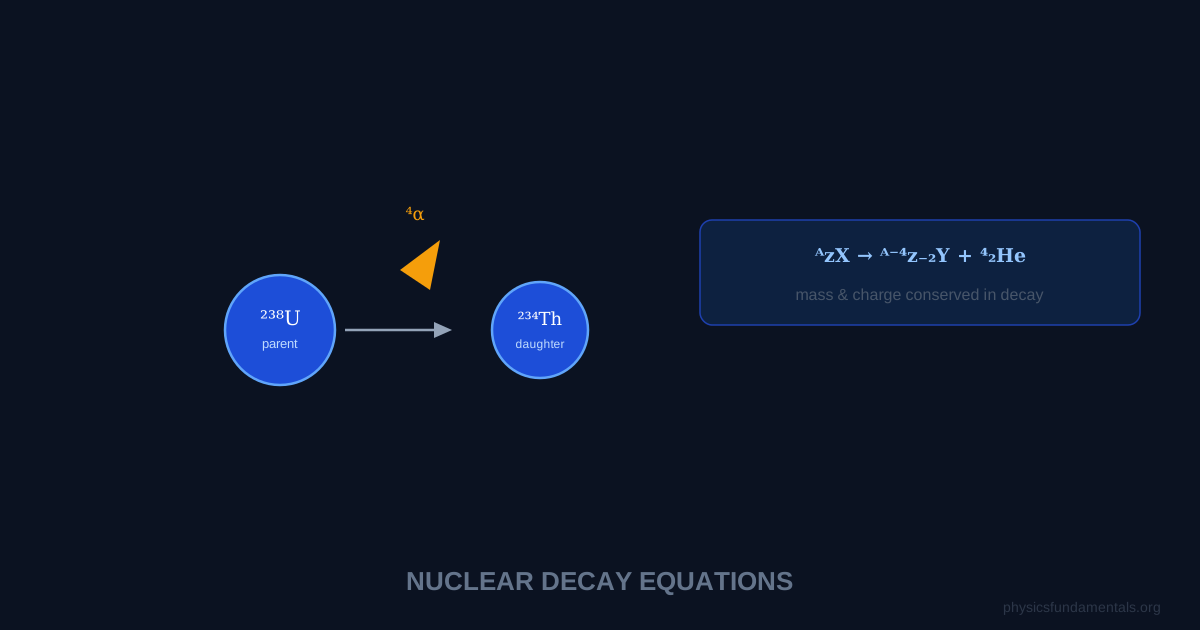
An alpha particle is a helium-4 nucleus: ⁴₂He. It has 2 protons and 2 neutrons.
In alpha decay: A decreases by 4, Z decreases by 2.
Example: Uranium-238 → Thorium-234 + alpha:
²³⁸_₉₂U → ²³⁴_₉₀Th + ⁴₂He
Check: A: 238 = 234 + 4 ✓; Z: 92 = 90 + 2 ✓
Beta-Minus Decay (β⁻)
A beta-minus particle is an electron: ⁰₋₁e. It's emitted when a neutron converts to a proton. An antineutrino (ν̄) is also emitted but often omitted in equations.
A is unchanged; Z increases by 1. Example: Carbon-14:
¹⁴_₆C → ¹⁴_₇N + ⁰₋₁e
Check: A: 14 = 14 + 0 ✓; Z: 6 = 7 + (−1) ✓
Beta-Plus Decay (β⁺)
A proton converts to a neutron, emitting a positron (⁰₊₁e) and a neutrino:
A unchanged; Z decreases by 1. Used in PET scanners: fluorine-18 → oxygen-18 + positron.
Gamma Decay (γ)
Gamma emission doesn't change A or Z — it releases energy from an excited nucleus:
Gamma rays often accompany alpha or beta decay, as the daughter nucleus is left in an excited state and then emits a gamma photon to reach ground state.
4 Worked Examples
Example 1 — Alpha decay of radium
Problem: Radium-226 undergoes alpha decay. Write the equation.
Solution:
²²⁶_₈₈Ra → ᴬ_(Z) Y + ⁴₂He
A: 226 = A + 4 → A = 222
Z: 88 = Z + 2 → Z = 86 (Radon)
²²⁶_₈₈Ra → ²²²_₈₆Rn + ⁴₂He
Example 2 — Beta-minus decay of strontium
Problem: Strontium-90 (A=90, Z=38) undergoes beta-minus decay. Identify the daughter nucleus.
Solution:
A unchanged: A_daughter = 90
Z increases by 1: Z_daughter = 39 (Yttrium)
⁹⁰_₃₈Sr → ⁹⁰_₃₉Y + ⁰₋₁e
Example 3 — Decay chain
Problem: Thorium-234 undergoes beta-minus decay to form element X, which then undergoes beta-minus decay. Identify both products.
Solution:
Step 1: ²³⁴_₉₀Th → ²³⁴_₉₁Pa + ⁰₋₁e (Protactinium-234)
Step 2: ²³⁴_₉₁Pa → ²³⁴_₉₂U + ⁰₋₁e (Uranium-234)
This is part of the uranium-238 decay series.
Example 4 — Unknown decay type
Problem: ²¹⁰_₈₄Po → ²⁰⁶_₈₂Pb + X. Identify X and the decay type.
Solution:
A of X: 210 − 206 = 4
Z of X: 84 − 82 = 2
X = ⁴₂He = alpha particle → alpha decay
Conservation Laws in Nuclear Decay
Every nuclear decay equation must satisfy two conservation laws simultaneously:
- Conservation of mass number (A): the total number of nucleons (protons + neutrons) is the same on both sides of the equation. Alpha decay reduces A by 4; beta decay leaves A unchanged; gamma decay leaves A unchanged.
- Conservation of atomic number (Z): the total number of protons (charge) is the same on both sides. Alpha: Z decreases by 2. Beta-minus: Z increases by 1. Beta-plus: Z decreases by 1. Gamma: Z unchanged.
These aren't just book-keeping rules — they reflect conservation of charge and conservation of baryon number, which are fundamental laws of particle physics. Charge is conserved in every known physical process. Baryon number (roughly, total nucleon count) is conserved in all low-energy processes including nuclear decay.
Energy Released in Decay
Every nuclear decay releases energy — this is what drives the decay. The energy comes from the mass difference between parent and products (E = Δmc²). For alpha decay of uranium-238:
The Q value (energy released) = (m_U − m_Th − m_He) × c² = 4.27 MeV. This energy appears as kinetic energy of the alpha particle (most of it) and the recoiling thorium nucleus (a small fraction, by conservation of momentum). The alpha particle from U-238 decay has kinetic energy of approximately 4.2 MeV.
Nuclear Notation and Conservation Rules
Every nuclear decay equation is written as: ᴬ_Z X → ᴬ'_Z' Y + particle. Two conservation laws always hold simultaneously:
- Conservation of mass number A: total nucleons (protons + neutrons) is the same on both sides. This follows from conservation of baryon number — a fundamental law of particle physics.
- Conservation of atomic number Z: total charge is the same on both sides. This follows from conservation of electric charge — another fundamental law.
These two constraints mean that given the parent nucleus and the type of decay, the daughter nucleus is uniquely determined. You cannot choose it — it is fixed by arithmetic.
Types of Decay — Summary Table
| Decay type | Particle emitted | Change in Z | Change in A | Penetration |
|---|---|---|---|---|
| Alpha (α) | ⁴₂He | −2 | −4 | Few cm in air |
| Beta-minus (β⁻) | e⁻ + ν̄_e | +1 | 0 | Few mm aluminium |
| Beta-plus (β⁺) | e⁺ + ν_e | −1 | 0 | Few mm aluminium |
| Gamma (γ) | photon | 0 | 0 | Many cm lead |
| Electron capture | ν_e emitted | −1 | 0 | No external radiation |
Beta Decay in Detail — The Weak Force
Beta-minus decay: n → p + e⁻ + ν̄_e (antineutrino). A neutron inside the nucleus converts to a proton, emitting an electron and an electron antineutrino. The electron is detected as the beta particle; the antineutrino is essentially undetectable (no charge, near-zero mass, barely interacts with matter). This process is mediated by the weak nuclear force — one of the four fundamental forces.
Beta-plus decay: p → n + e⁺ + ν_e (neutrino). A proton converts to a neutron, emitting a positron and an electron neutrino. This requires the proton to be inside a nucleus (free protons don't beta-plus decay — it would violate energy conservation). The positron quickly annihilates with a nearby electron, producing two 0.511 MeV gamma rays — the signal detected in PET scanning.
Beta particle energies form a continuous spectrum (unlike the discrete lines of alpha and gamma decay), because the available energy is shared between the beta particle and the (nearly undetectable) neutrino. This continuous spectrum was the first clue that a third particle (the neutrino) was involved — Pauli proposed it in 1930 to explain the missing energy; Fermi named it and developed the theory of beta decay.
Decay Series — Reaching Stability
Heavy radioactive nuclei often undergo a series of decays (a decay chain) before reaching a stable nucleus. Uranium-238 undergoes 8 alpha decays and 6 beta decays to eventually reach lead-206 — stable, non-radioactive. The full chain has a half-life of 4.47 billion years (for the first step) down to microseconds for intermediate isotopes. The intermediate products — including radium, radon, and polonium — are themselves radioactive and accumulate in uranium-containing rocks. Radon-222 (t½ = 3.8 days), a noble gas, can seep out of granite and accumulate in buildings — it is the second leading cause of lung cancer in the UK, after smoking.
Worked Example 5 — Complete decay chain step
Problem: Thorium-228 undergoes alpha decay to radium, then the radium undergoes beta-minus decay. Write both equations and identify all products.
Solution:
Alpha decay: ²²⁸₉₀Th → ²²⁴₈₈Ra + ⁴₂He
Check: A: 228 = 224 + 4 ✓; Z: 90 = 88 + 2 ✓
Beta-minus decay: ²²⁴₈₈Ra → ²²⁴₈₉Ac + ⁰₋₁e + ν̄_e
Check: A: 224 = 224 + 0 ✓; Z: 88 = 89 + (−1) ✓
Products: radium-224 from the alpha decay, then actinium-224 from the beta decay.
Gamma Decay and Nuclear Excited States
After alpha or beta decay, the daughter nucleus often exists in an excited energy state (analogous to an excited electron in an atom). It drops to the ground state by emitting a gamma ray photon — a very high energy photon, typically in the MeV range. Gamma emission changes neither A nor Z — it is a pure energy readjustment, not a transmutation. Technetium-99m is the most medically important gamma emitter: the "m" stands for metastable (an excited state with a relatively long half-life of 6 hours, rather than nanoseconds). It decays to ground-state Tc-99 by emitting a 140 keV gamma ray — ideal for medical imaging (high enough to penetrate tissue, low enough to be detected efficiently, and the 6-hour half-life keeps patient dose low).
Worked Example 6 — Identifying unknown products
Problem: Complete these decay equations and identify the unknown product X: (a) ²¹⁰₈₄Po → X + ⁴₂He (b) ¹⁴₆C → ¹⁴₇N + X + ν̄_e (c) ²³⁸₉₂U → ²³⁴₉₀Th + X
Solution:
(a) A: 210 = A_X + 4 → A_X = 206; Z: 84 = Z_X + 2 → Z_X = 82. Element 82 = lead. X = ²⁰⁶₈₂Pb
(b) A: 14 = 14 + A_X → A_X = 0; Z: 6 = 7 + Z_X → Z_X = −1. X = ⁰₋₁e (beta-minus particle / electron)
(c) A: 238 = 234 + A_X → A_X = 4; Z: 92 = 90 + Z_X → Z_X = 2. X = ⁴₂He (alpha particle)
Radiation Protection and Biological Effects
The three types of radiation differ enormously in penetrating power and therefore in radiation protection requirements. Alpha particles (stopped by a sheet of paper or a few cm of air) are only dangerous when inhaled or ingested — they deposit all their energy in a tiny volume of tissue. Beta particles (stopped by a few mm of aluminium or plastic) can penetrate skin and cause burns. Gamma rays (attenuated, not stopped, by lead and concrete) require substantial shielding — intensity halves every few cm of lead.
The absorbed dose (gray, Gy = J/kg) measures energy deposited; the equivalent dose (sievert, Sv = Gy × quality factor) accounts for biological effectiveness. Alpha radiation has quality factor 20; beta and gamma have quality factor 1. So 1 Gy of alpha deposits the same energy as 1 Gy of gamma, but causes 20 Sv of biological damage — 20 times more harmful per joule because alpha tracks are densely ionising. Annual background radiation dose in the UK is about 2.7 mSv; the dose limit for radiation workers is 20 mSv/year.
Exam Summary for Nuclear Decay Equations
Master two rules: A (mass number) is conserved; Z (atomic number) is conserved. Alpha: A decreases by 4, Z decreases by 2. Beta-minus: A unchanged, Z increases by 1. Beta-plus: A unchanged, Z decreases by 1. Gamma: A and Z both unchanged. To find an unknown product: apply both conservation laws algebraically. The element is identified from Z using the periodic table. Always write the full nuclear symbol with both A (superscript) and Z (subscript) for every particle in the equation, including beta particles (⁰₋₁e) and alpha particles (⁴₂He). Neutrinos and antineutrinos are often omitted in A-Level equations unless specifically asked for.
Nuclear transmutation — the conversion of one element to another through radioactive decay — was the medieval alchemists' dream, but nature does it constantly and spontaneously through these three decay modes. Every atom of lead-206 in a uranium-bearing rock was once uranium-238, transformed over billions of years through 14 intermediate decays. Every atom of helium in a natural gas well was produced by alpha decay underground — the helium has accumulated there over geological time. Nuclear decay equations are the accounting tool that tracks these transmutations, and their conservation laws are the fundamental constraint that makes the accounting exact.
Two key skills for nuclear decay equation questions: (1) identify the type of decay from the changes in A and Z (if A decreases by 4 and Z by 2, it's alpha; if A unchanged and Z increases by 1, it's beta-minus); (2) complete unknown product symbols by applying both conservation laws simultaneously. The most common exam error is getting the Z for beta decay wrong — remember that Z increases by 1 in beta-minus (a neutron becomes a proton, adding a proton to the nucleus) and decreases by 1 in beta-plus (a proton becomes a neutron, removing a proton). Drawing a quick table of A and Z before and after always catches arithmetic errors.
Frequently Asked Questions
What are the three types of nuclear decay?
How do you balance a nuclear decay equation?
What is the difference between alpha and beta decay?
Why doesn't gamma decay change A or Z?
What is a decay chain?
Share this article
Written by
Physics Fundamentals Editorial Team
Written and reviewed by our team of physics educators. Content is aligned with A-Level, GCSE, AP Physics, and undergraduate curricula.
About Physics Fundamentals →