In 1900, a formula that classical physics confidently predicted turned out to be catastrophically wrong. Classical wave theory said a hot object should radiate infinite energy at ultraviolet wavelengths — a prediction so absurd it became known as the "ultraviolet catastrophe." Real objects obviously don't do this: a red-hot poker glows red, not with an infinite blast of UV. Max Planck's fix for this one broken formula, published almost as a mathematical trick to make the numbers work, turned out to be the opening move of quantum mechanics. Black-body radiation isn't just a thermodynamics topic — it's the specific place where classical physics broke and a new physics had to be invented to replace it.
- What a black body is, and why it's the cleanest possible object to apply thermal radiation physics to
- The ultraviolet catastrophe, and how Planck's quantisation hypothesis resolved it
- Wien's displacement law and the Stefan-Boltzmann law, with worked examples
- 3 fully worked examples: human body radiation, the cosmic microwave background, and classifying a star by colour
- How black-body radiation connects directly to the photoelectric effect and the birth of quantum theory
What Is a Black Body?
A black body is an idealised object that absorbs all electromagnetic radiation falling on it — no reflection, no transmission — and, because it's in thermal equilibrium, also emits radiation as efficiently as physically possible at every wavelength. "Black" refers to this perfect absorption, not necessarily to how the object looks: a black body at high temperature glows brightly, because emission and absorption efficiency are two sides of the same property (a good absorber is, by the same physics, a good emitter). No real object is a perfect black body, but stars, the filament in an incandescent bulb, and a cavity with a small hole drilled into it (the classic laboratory approximation) all come close enough that black-body physics predicts their radiation with excellent accuracy.
The Ultraviolet Catastrophe
By the late 1800s, physicists had a classical formula — the Rayleigh-Jeans law — for how much energy a black body should radiate at each wavelength, derived from treating radiation as continuous electromagnetic waves with energy that could take any value. The formula worked well at long wavelengths but predicted that radiated energy should increase without limit as wavelength got shorter, diverging to infinity in the ultraviolet and beyond. A perfectly ordinary object at room temperature would, according to this formula, be blasting out infinite power in X-rays and gamma rays. This obviously doesn't happen — the "ultraviolet catastrophe" was not a subtle discrepancy but a complete failure of classical theory, and by 1900 it was clear that something fundamental was missing from the physics of radiation, not just an error needing a correction factor.
Planck's Solution: Quantised Energy
Max Planck resolved the catastrophe with a proposal that, at the time, he treated as a mathematical convenience rather than a statement about physical reality: energy is not radiated continuously, but in discrete packets, or quanta, with energy E = hf, where h is Planck's constant (6.626 × 10⁻³⁴ J·s) and f is frequency. At high frequencies (short wavelengths), each quantum requires so much energy that the available thermal energy simply can't produce many of them — this suppresses high-frequency emission and eliminates the ultraviolet divergence entirely, matching the observed spectrum with remarkable precision. Planck's full radiation law, from which both Wien's law and the Stefan-Boltzmann law can be derived, correctly predicts the entire black-body spectrum at any temperature. Einstein took Planck's mathematical device and argued in 1905 that light quanta were physically real — the same argument that explains the photoelectric effect. Between them, these two results mark the birth of quantum theory.
The Stefan-Boltzmann Law: Total Power Radiated
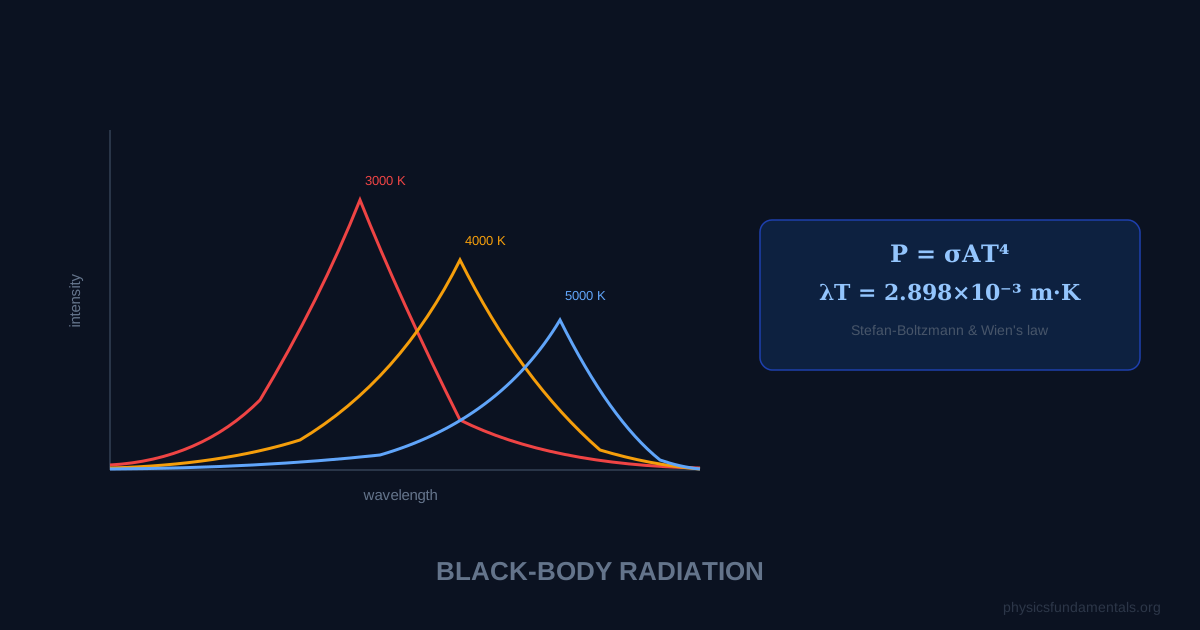
The total power radiated by a black body, summed across all wavelengths, follows the Stefan-Boltzmann law:
where σ = 5.67 × 10⁻⁸ W·m⁻²·K⁻⁴ is the Stefan-Boltzmann constant, A is surface area, and T is absolute temperature in kelvin. For a real (non-ideal) object, this becomes P = εσAT⁴, where emissivity ε (between 0 and 1) accounts for how closely the surface approximates a true black body. The T⁴ dependence is severe: doubling absolute temperature increases radiated power sixteenfold. This is why temperature differences matter so much more than they first appear in thermal radiation — a star's surface temperature being 20% hotter than another's means it radiates roughly twice the power per unit area, not 20% more.
Wien's Displacement Law: Peak Wavelength
The wavelength at which a black body radiates most intensely shifts predictably with temperature, following Wien's displacement law:
Hotter objects peak at shorter wavelengths. At room temperature (roughly 293 K), the peak falls at about 9.9 μm — deep infrared, invisible to human eyes, which is exactly why you can't see people glowing in a dark room but a thermal camera can. At the Sun's surface temperature (5,778 K), the peak falls at about 502 nm — right in the middle of the visible spectrum, which is not a coincidence: human vision evolved under sunlight and is most sensitive close to the wavelength the Sun radiates most strongly.
Worked Example 1: Human Body Radiation
Estimate the peak wavelength and net radiated power of a person with skin temperature 305 K (32°C), surface area 1.8 m², emissivity 0.98, in a room at 293 K (20°C).
This falls deep in the infrared — exactly the range thermal imaging cameras are built to detect. For net power, subtract what the body absorbs from the room at 293 K from what it emits at 305 K:
128 W of net heat loss by radiation alone is close to typical resting metabolic heat production — a useful sanity check that the physics matches everyday experience: at rest, in a normal room, radiation alone accounts for roughly the whole of a person's basal heat loss, with convection and evaporation making up the rest in warmer conditions.
Worked Example 2: The Cosmic Microwave Background
The universe is filled with leftover radiation from roughly 380,000 years after the Big Bang, now cooled by cosmic expansion to a near-perfect black-body spectrum at 2.725 K. Find its peak wavelength.
A peak wavelength of about 1 mm falls in the microwave region of the spectrum — which is exactly why it's called the cosmic microwave background. Its near-perfect agreement with the black-body spectrum, first measured precisely by the COBE satellite in the early 1990s, is one of the strongest pieces of evidence for the Big Bang model: an almost perfectly thermalised early universe cools, as it expands, into an almost perfectly thermal spectrum today.
Worked Example 3: Classifying a Star by Colour
A star's spectrum peaks at 450 nm (blue-white). Find its surface temperature and identify roughly what type of star it is.
At roughly 6,400 K, this star is somewhat hotter than the Sun (5,778 K) and would be classified as a late F-type or early G-type star — white to yellow-white in colour. Astronomers use exactly this method, applying Wien's law to a star's measured spectrum, to determine surface temperatures across the entire stellar classification system, from cool red M-type stars (under 3,700 K) to blazing blue O-type stars (over 30,000 K), without ever needing to send a probe anywhere near them.
Real Objects vs Ideal Black Bodies
No physical object is a perfect black body, but many are close enough that the ideal formulas remain highly accurate. Stars are excellent black-body approximations because their outer layers are thick enough to absorb and re-emit radiation many times before it escapes, thermalising the spectrum. A cavity with a small hole (any radiation entering has almost no chance of escaping before being absorbed) is the standard laboratory realisation of a perfect black body. Human skin, despite its visible colour, has emissivity around 0.98 in the infrared regardless of race or pigmentation — visible-light colour and infrared emissivity are almost entirely unrelated properties, which is why thermal cameras work equally well on everyone. Shiny metal surfaces, by contrast, have low emissivity (polished aluminium can be as low as 0.05) — they're poor black-body approximations, which is exactly why emergency blankets and vacuum flask linings are silvered: low emissivity means low radiative heat loss.
From Black-Body Radiation to the Photoelectric Effect
Black-body radiation and the photoelectric effect are the two experimental results that broke classical physics within five years of each other, and both were resolved by the same idea: light exists in discrete energy quanta E = hf. Planck's 1900 black-body work introduced quantisation as a property of how radiation is emitted and absorbed; Einstein's 1905 photoelectric paper argued that light itself is quantised, whether or not it's interacting with matter at all. Bohr then used exactly this quantisation idea to explain atomic spectra in 1913, and by the mid-1920s the full mathematical machinery of quantum mechanics had been built on this same foundation. Understanding black-body radiation properly is understanding the specific historical crack in classical physics that the entire quantum revolution grew out of.
Colour Temperature in Everyday Lighting
Light bulb packaging quotes a "colour temperature" in kelvin, and it's a direct application of black-body physics even for sources that aren't literally black bodies. An incandescent filament genuinely is close to a black body — heated tungsten at around 2,700 K radiates a warm, yellowish-white spectrum, matching Wien's law for that temperature. LED and fluorescent bulbs don't work by heating a filament, but manufacturers still rate them by the colour temperature of the black body that would produce a visually similar spectrum: a "2,700 K warm white" LED is engineered to look like a 2,700 K incandescent bulb, a "6,500 K daylight" LED is engineered to look like an overcast sky (whose colour is itself set by the Sun's roughly 5,800 K black-body spectrum, scattered and mixed by the atmosphere). Photographers and cinematographers rely on this scale constantly: shifting a scene's colour temperature lower makes it look warmer and more intimate, shifting it higher makes it look colder and more clinical, and white-balancing a camera is nothing more than telling it what colour temperature to treat as neutral white.
Common Mistakes
Confusing peak wavelength with the only wavelength radiated. A black body radiates across a continuous spectrum of all wavelengths — Wien's law gives the peak of that spectrum, not the sole wavelength emitted. A star radiates plenty of light on either side of its peak wavelength too. Forgetting the fourth-power dependence in Stefan-Boltzmann calculations. A common error is treating power as proportional to T rather than T⁴ — always raise temperature to the fourth power, and always use absolute temperature in kelvin, never Celsius. Assuming visible colour tells you emissivity. A black-painted radiator and a white-painted radiator of the same material radiate heat almost identically in the infrared, because visible-light colour and infrared emissivity are largely independent properties — this trips up many students who assume "black objects radiate more heat" applies straightforwardly to every situation.
Try it yourself: check your own numbers with the Black-Body Radiation Calculator, which shows the formula, the worked substitution and the answer step by step.
Frequently Asked Questions
What is black-body radiation?
What was the ultraviolet catastrophe?
What is Wien's displacement law?
What is the Stefan-Boltzmann law?
How did black-body radiation lead to quantum theory?
Why is the cosmic microwave background considered black-body radiation?
Does emissivity depend on visible colour?
Share this article
Written by
Physics Fundamentals Editorial Team
Written and reviewed by our team of physics educators. Content is aligned with A-Level, GCSE, AP Physics, and undergraduate curricula.
About Physics Fundamentals →