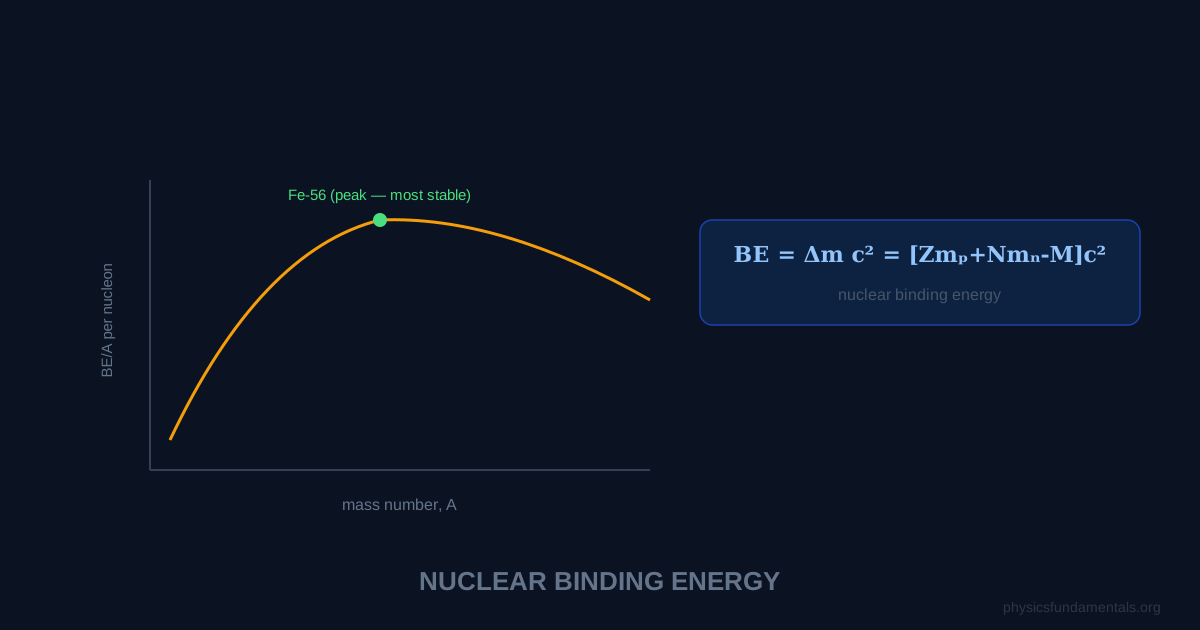
Nuclear binding energy is the energy required to completely separate a nucleus into its individual protons and neutrons. It arises because a bound nucleus is lighter than the sum of its free nucleons — the missing mass (mass defect Δm) was converted to binding energy when the nucleus formed: E_B = Δmc². The binding energy per nucleon (E_B/A) is the key quantity for nuclear stability: it peaks at iron-56 (≈ 8.8 MeV/nucleon). Nuclei on either side of this peak release energy when they move toward it — heavy nuclei via fission, light nuclei via fusion.
This is the physics behind both nuclear power and nuclear weapons, as well as the energy source of stars. Understanding the binding energy curve is understanding why the universe has the elements it does and why certain reactions release energy while others require it.
- Mass defect: why nuclei are lighter than their separated constituents
- Binding energy: E_B = Δmc² — how to calculate it
- Binding energy per nucleon curve — reading and interpreting it
- Why fission (heavy nuclei) and fusion (light nuclei) both release energy
- 4 worked examples with mass defect and energy calculations
Mass Defect
When protons and neutrons bind together in a nucleus, the nucleus has less mass than the sum of its separated nucleons. This mass difference is the mass defect Δm:
Where Z = number of protons, N = number of neutrons, m_p = 1.007276 u (proton mass), m_n = 1.008665 u (neutron mass), and m_nucleus is the actual nuclear mass in atomic mass units (u).
In practice, nuclear masses are given as atomic masses (including electron masses). For most A-level calculations, use:
Where m_H = 1.007825 u (hydrogen atom mass, which accounts for the Z electrons). The electron masses cancel on both sides for neutral atoms.
1 atomic mass unit: 1 u = 1.6605 × 10⁻²⁷ kg = 931.5 MeV/c²
Binding Energy: E_B = Δmc²
In convenient units: E_B (MeV) = Δm (u) × 931.5 MeV/u
The binding energy is the energy released when the nucleus forms from free nucleons — or equivalently, the energy that must be supplied to break the nucleus apart completely. Higher binding energy = more stable nucleus = harder to break apart.
Binding Energy Per Nucleon
Dividing by the mass number A gives a measure of how tightly each nucleon is bound on average. This is the quantity plotted on the famous binding energy per nucleon curve:
- Light nuclei (A < 56): E_B/A increases with A — nucleons become more tightly bound as the nucleus grows (more nuclear force neighbours)
- Peak at iron-56 (A = 56): E_B/A ≈ 8.8 MeV/nucleon — the most stable nucleus. Iron is the end product of stellar nucleosynthesis in massive stars
- Heavy nuclei (A > 56): E_B/A decreases — repulsive electrostatic forces between the many protons increasingly overcome the attractive nuclear force
Why Fission and Fusion Release Energy
Fusion (light nuclei combining): moves left-side nuclei (low E_B/A) up the curve toward the peak. Products have more E_B/A — more tightly bound. Energy released = difference in total binding energy.
Fission (heavy nuclei splitting): moves right-side nuclei (slightly below peak) up the curve. Products (medium-mass nuclei) have higher E_B/A. Energy released ≈ 200 MeV per U-235 fission event.
Iron-56 is the endpoint — you cannot release energy by fissioning or fusing iron. Stars that have burned to iron cores can no longer generate energy and collapse in a supernova.
4 Worked Examples
Example 1 — Mass defect of helium-4
Problem: Helium-4 has atomic mass 4.002602 u. Find its mass defect. (m_H = 1.007825 u, m_n = 1.008665 u)
Solution:
Z = 2, N = 2
Sum of constituents = 2 × 1.007825 + 2 × 1.008665 = 2.01565 + 2.01733 = 4.03298 u
Δm = 4.03298 − 4.002602 = 0.030378 u
Example 2 — Binding energy of helium-4
Problem: Find the total binding energy and binding energy per nucleon for helium-4.
Solution:
E_B = Δm × 931.5 MeV/u = 0.030378 × 931.5 = 28.30 MeV
E_B/A = 28.30/4 = 7.07 MeV/nucleon
Example 3 — Energy from uranium fission
Problem: Uranium-235 fissions into barium-141 and krypton-92, releasing 3 neutrons. Binding energies: U-235 = 1784 MeV, Ba-141 = 1173 MeV, Kr-92 = 783 MeV. Find the energy released.
Solution:
Total binding energy of products = 1173 + 783 = 1956 MeV
Binding energy of reactant = 1784 MeV
Energy released = 1956 − 1784 = 172 MeV
(The 3 neutrons have zero binding energy since they're free.)
Example 4 — Fusion energy
Problem: Deuterium (²₁H, binding energy 2.22 MeV) and tritium (³₁H, binding energy 8.48 MeV) fuse to produce helium-4 (binding energy 28.30 MeV) and a neutron. Find the energy released.
Solution:
Products: He-4 (28.30 MeV) + neutron (0 MeV) = 28.30 MeV
Reactants: D (2.22 MeV) + T (8.48 MeV) = 10.70 MeV
Energy released = 28.30 − 10.70 = 17.60 MeV per reaction
This is the DT fusion reaction targeted by ITER and all major fusion programmes.
The Semi-Empirical Mass Formula
The binding energy per nucleon curve can be reproduced quantitatively by the semi-empirical mass formula (Bethe-Weizsäcker formula), which models the nucleus as a liquid drop:
Where: a_V A is the volume term (bulk nuclear binding, proportional to number of nucleons); −a_S A^{2/3} is the surface term (surface nucleons have fewer neighbours, less binding); −a_C Z(Z−1)/A^{1/3} is the Coulomb term (proton-proton electrostatic repulsion reduces binding); −a_A(A−2Z)²/A is the asymmetry term (stability favours N ≈ Z); δ is the pairing term (even-even nuclei are most stable). This formula, with fitted constants, predicts binding energies to within ~1% across most of the periodic table — remarkable for such a simple model.
Worked Example 5 — Energy from D-T fusion
Problem: Deuterium-Tritium fusion: ²H + ³H → ⁴He + n. Atomic masses: D = 2.01410 u, T = 3.01605 u, He-4 = 4.00260 u, n = 1.00866 u. Find the energy released per reaction in MeV.
Solution:
Δm = (m_D + m_T) − (m_He + m_n)
= (2.01410 + 3.01605) − (4.00260 + 1.00866)
= 5.03015 − 5.01126 = 0.01889 u
Q = 0.01889 × 931.5 = 17.59 MeV
This 17.6 MeV is shared: 14.1 MeV to the neutron, 3.5 MeV to the alpha particle (He-4), in the inverse ratio of their masses by momentum conservation.
Nuclear Shell Model
Just as electrons occupy atomic shells with extra stability at filled shells (noble gases), protons and neutrons occupy nuclear shells with extra stability at "magic numbers": 2, 8, 20, 28, 50, 82, 126. Nuclei with magic numbers of both protons and neutrons (doubly magic) are exceptionally stable: helium-4 (Z=2, N=2), oxygen-16 (Z=8, N=8), calcium-40 (Z=20, N=20), lead-208 (Z=82, N=126). Lead-208 is the heaviest stable doubly-magic nucleus and the heaviest completely stable nucleus — beyond it, all elements are radioactive. This shell structure explains why the binding energy per nucleon curve has small peaks at helium-4, oxygen-16, and calcium-40 even though the overall trend is smooth.
Mass-Energy Accounting in Practice
Every nuclear engineering calculation uses the Q-value formula: Q = Δm × c² = Δm (in u) × 931.5 MeV. For reactor physics: fission of one U-235 nucleus releases ~200 MeV, of which ~168 MeV appears as kinetic energy of fragments (becoming heat), ~5 MeV goes to prompt gamma rays, ~12 MeV goes to beta decay products of fission fragments (becoming heat over time), and ~12 MeV goes to neutrinos (which escape — wasted). The heat from fission fragments is captured in the reactor coolant; the delayed heat from beta decay continues for days after shutdown — which is why reactor cooling cannot be simply switched off when the reactor shuts down, and why the Fukushima accident (loss of cooling power three days after shutdown) still caused fuel melting despite the chain reaction having stopped.
Worked Example 6 — Alpha particle binding energy
Problem: Calculate the binding energy per nucleon for helium-4, given: m(²H) = 2.01410 u, m(¹H) = 1.00783 u, m(n) = 1.00866 u, m(⁴He atom) = 4.00260 u.
Solution:
Using atomic masses (electrons cancel in neutral atom calculation):
Mass of 2 protons + 2 neutrons = 2 × 1.00783 + 2 × 1.00866 = 2.01566 + 2.01732 = 4.03298 u
Mass defect = 4.03298 − 4.00260 = 0.03038 u
E_B = 0.03038 × 931.5 = 28.30 MeV
E_B per nucleon = 28.30/4 = 7.07 MeV/nucleon
This is the well-known value for helium-4, which sits significantly below the iron peak (~8.8 MeV/nucleon), explaining why fusing light hydrogen isotopes to make helium releases energy.
Energy Scales: Comparing Chemical and Nuclear
The energy released per reaction in nuclear physics (MeV range) dwarfs chemical reactions (eV range) by a factor of roughly one million. One kilogram of TNT releases about 4.2 MJ; one kilogram of uranium-235 fissioning completely releases about 82 TJ — 20 million times more. This factor arises because chemical reactions involve rearrangement of electrons in atomic bonds (forces of ~10⁻⁸ N acting over ~10⁻¹⁰ m distances → energy ~eV), while nuclear reactions involve rearrangement of nucleons held by the strong nuclear force (forces of ~10⁴ N acting over ~10⁻¹⁵ m distances → energy ~MeV). The strong force is roughly 10⁶ times stronger per unit energy than electrostatic bonding, and the nuclear scale of 10⁻¹⁵ m is 10⁵ times smaller than atomic scale 10⁻¹⁰ m, giving the total energy difference of ~10⁶. This is why nuclear power stations use such small amounts of fuel and why nuclear weapons are so destructive.
Exam Summary for Binding Energy
Three formulas: Δm = Σ(constituent masses) − m_nucleus; E_B = Δm × c² = Δm(u) × 931.5 MeV; Q = (m_reactants − m_products) × 931.5 MeV. The binding energy curve peaks at Fe-56 (8.8 MeV/nucleon). Both fission (heavy nuclei splitting toward the peak) and fusion (light nuclei combining toward the peak) release energy — energy released = increase in total binding energy of products. Mass defect is always positive for stable nuclei (products are lighter than separated constituents). Use atomic masses in u for calculations — the electron masses cancel for neutral atoms, avoiding the need to separately add and subtract electron rest masses.
Worked Example 7 — Fission Q-value from binding energies
Problem: Uranium-235 (E_B = 7.59 MeV/nucleon, A=235) undergoes fission to produce barium-141 (E_B = 8.26 MeV/nucleon, A=141) and krypton-92 (E_B = 8.52 MeV/nucleon, A=92) with 2 neutrons. Find the energy released.
Solution:
Total binding energy of reactants: 235 × 7.59 = 1783.7 MeV (neutrons have zero binding energy)
Total binding energy of products: 141 × 8.26 + 92 × 8.52 = 1164.7 + 783.8 = 1948.5 MeV
Energy released = 1948.5 − 1783.7 = 164.8 MeV ≈ 165 MeV
This matches the typical quoted value of ~170–200 MeV per fission event (the range reflects different fission product pairs and prompt vs delayed energy accounting).
Radioactive Decay as a Binding Energy Effect
Alpha decay occurs because the daughter nucleus plus the alpha particle have more total binding energy than the parent — i.e. the products are more stable. The energy released (Q-value) is exactly the difference in binding energies. For a nucleus to be alpha-unstable, it must be energetically favourable: E_B(daughter) + E_B(alpha) > E_B(parent). Since the binding energy per nucleon curve decreases for very heavy nuclei (A > 150 or so), heavy nuclei can increase their total binding energy by emitting an alpha particle — the strongly bound helium-4 nucleus (7.07 MeV/nucleon) "bites off" a chunk from the weakly-bound tail of the curve. This is why alpha emitters are exclusively found among heavy elements (A > 140 in practice), and why alpha emission is such a common mode of decay for actinides.
Beta decay occurs when the neutron-to-proton ratio is wrong for maximum stability. The stable N/Z ratio drifts from 1:1 for light nuclei to ~1.5:1 for heavy nuclei (due to increasing Coulomb repulsion requiring more neutrons to dilute the proton-proton repulsion). Nuclei with too many neutrons undergo beta-minus decay (n → p + e⁻ + anti-neutrino); too few undergo beta-plus decay or electron capture (p → n + e⁺ + neutrino). Both processes adjust the N/Z ratio toward the stability valley, releasing binding energy in the process.
Nuclear binding energy is ultimately what powers the universe. Stars shine because hydrogen fusion converts mass to energy; supernovae synthesise all elements heavier than iron by endothermic nuclear processes driven by the gravitational collapse energy; the Earth's internal heat (which drives plate tectonics, volcanoes, and the magnetic field) comes largely from radioactive decay of uranium, thorium, and potassium in the mantle. On Earth, nuclear power stations generate ~10% of global electricity from fission binding energy. The binding energy curve — one of the most important graphs in physics — predicts and explains all of these phenomena through the single principle that nuclei prefer to have higher binding energy per nucleon, and will release energy to get there.
Try it yourself: check your own numbers with the Nuclear Binding Energy Calculator, which shows the formula, the worked substitution and the answer step by step.
Frequently Asked Questions
What is nuclear binding energy?
What is mass defect?
Why is iron-56 the most stable nucleus?
Why do both fission and fusion release energy?
How much energy does one fission event release?
Share this article
Written by
Physics Fundamentals Editorial Team
Written and reviewed by our team of physics educators. Content is aligned with A-Level, GCSE, AP Physics, and undergraduate curricula.
About Physics Fundamentals →