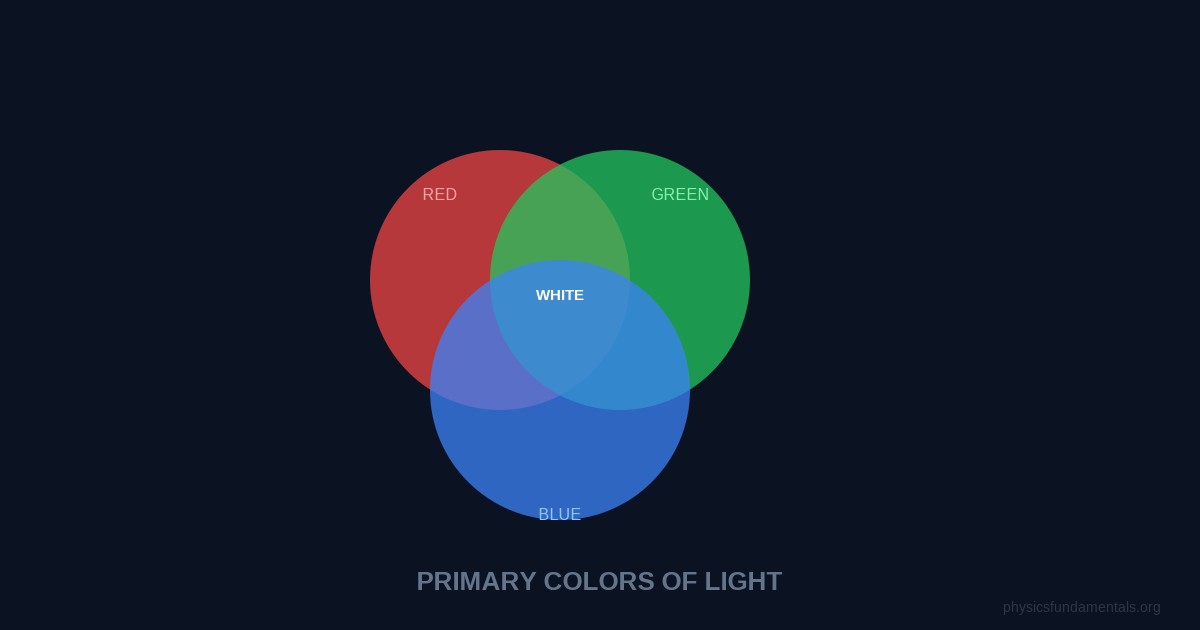
The primary colors of light are red, green, and blue (RGB). Combining them in different proportions is how screens, stage lighting, and human color vision itself produce every color we see. Unlike mixing paint, mixing colored light is additive: starting from darkness, adding more wavelengths of light makes the result brighter, and combining all three primaries at full intensity produces white light.
This directly contradicts what most people learn in art class — that the primary colors are red, yellow, and blue. Both are correct, but they're answering different questions: RGB are the primaries for light (additive mixing), while red-yellow-blue (or more precisely, cyan-magenta-yellow in print) are the primaries for pigments (subtractive mixing). They're genuinely different physical processes. For how wavelength relates to color in the first place, see our guide to electromagnetic waves.
- Why red, green, and blue — and not red, yellow, and blue — are light's primary colors
- The difference between additive mixing (light) and subtractive mixing (pigment)
- How RGB combinations produce the secondary colors cyan, magenta, and yellow
- Why human trichromatic vision is the reason RGB works at all
Additive Color Mixing
Mixing colored light is additive: you start with darkness (no light = black), and each color of light you add contributes its own wavelengths, making the combined result brighter. Red + Green + Blue light, all at full intensity, add up to white light.
| Combination | Result |
|---|---|
| Red + Green | Yellow |
| Green + Blue | Cyan |
| Blue + Red | Magenta |
| Red + Green + Blue | White |
Yellow, cyan, and magenta — each made from two of the three primaries — are called the secondary colors of light. This is the exact system behind every screen you look at: a pixel on a phone, TV, or monitor is actually three tiny sub-pixels — one red, one green, one blue — and every color you perceive is created by varying the brightness of those three sub-pixels and letting your eye blend them additively.
Why Not Red, Yellow, and Blue?
Red-yellow-blue is the traditional set of primary pigments taught for paint and art — but pigments work by subtractive mixing: a pigment absorbs (subtracts) certain wavelengths from white light and reflects the rest, which is what you perceive as its color. Mixing pigments together means each one subtracts its own wavelengths, so the result gets darker, not brighter — the opposite of what happens with light. (Modern printing actually uses cyan, magenta, and yellow as the subtractive primaries, not red-yellow-blue, because they more accurately reproduce the full range of colors — but the underlying subtractive principle is the same one taught with red-yellow-blue in early art classes.)
Because pigment mixing and light mixing are genuinely different physical processes — one subtracts wavelengths from reflected white light, the other adds wavelengths of emitted light directly — they don't share the same primary colors, and trying to apply paint-mixing intuition to screens (or vice versa) leads to confusion rather than insight.
Why RGB Specifically? Human Color Vision
The human eye has three types of cone cells, each most sensitive to a different range of wavelengths — roughly corresponding to red, green, and blue light. This is called trichromatic vision. Because the brain interprets color based on the relative signal strength from these three cone types, any color we can perceive can be reproduced by mixing just three suitably chosen wavelengths of light in the right proportions — which is exactly why RGB displays work at all. A screen doesn't need to emit the actual wavelength of, say, orange light; it just needs to stimulate your red and green cones in the same proportion that real orange light would, and your brain perceives orange either way.
Real-World Applications
Screens and displays: every LCD, LED, and OLED screen uses red, green, and blue sub-pixels, with no other colors physically present — every color on your screen right now is an RGB blend.
Stage and theatrical lighting: colored stage lights are mixed additively to create specific moods and effects, using the same red-green-blue principle.
Digital photography and color sensors: camera sensors use a grid of red, green, and blue filtered photosites (often a Bayer filter pattern) to capture color images, mirroring the eye's own trichromatic system.
Common Mistakes
Assuming the primary colors are universal across all contexts. "Primary colors" depends entirely on whether you're mixing light (additive, RGB) or pigment (subtractive, traditionally red-yellow-blue, more precisely cyan-magenta-yellow). Neither is more "correct" than the other — they're answers to different physical questions.
Thinking mixing all primary lights gives black. That's true for pigments (subtractive mixing darkens toward black), but the opposite is true for light — mixing all three primary light colors gives white, since you're adding wavelengths, not removing them.
Frequently Asked Questions
What are the primary colors of light?
Why are the primary colors of light different from paint primary colors?
What color do you get from mixing all three primary colors of light?
Why is RGB used for screens and displays?
Share this article
Written by
Physics Fundamentals Editorial Team
Written and reviewed by our team of physics educators. Content is aligned with A-Level, GCSE, AP Physics, and undergraduate curricula.
About Physics Fundamentals →