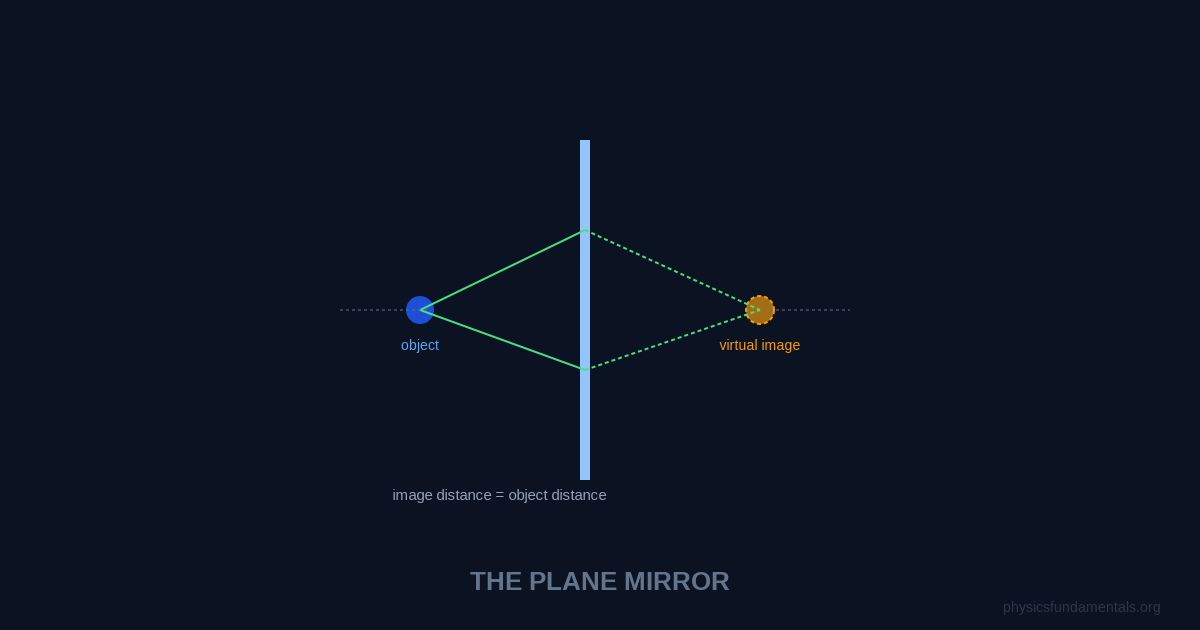
A plane mirror is a flat, reflective surface that forms a virtual image of any object placed in front of it. The image sits exactly as far behind the mirror as the object is in front, is the same size as the object (magnification = 1), appears upright, and is laterally inverted — left and right appear swapped, though up and down do not.
Every one of these properties follows directly from the law of reflection (angle of incidence equals angle of reflection) applied to a perfectly flat surface — nothing about a plane mirror needs separate rules from any other reflection problem.
- Why a plane mirror's image is virtual, upright, and the same size as the object
- How to construct a ray diagram for a plane mirror image
- Why mirrors appear to flip left-right but not up-down
- 3 worked examples, including the classic "minimum mirror size" problem
Properties of a Plane Mirror Image
- Virtual: the reflected rays only appear to come from behind the mirror; they never actually converge there, so the image can't be projected onto a screen.
- Same distance behind the mirror as the object is in front: image distance = object distance.
- Same size as the object: magnification = 1.
- Upright: not flipped top-to-bottom.
- Laterally inverted: left and right are swapped (see below for why).
Constructing a Ray Diagram
To find a plane mirror's image geometrically: pick two rays leaving a point on the object. For each ray, apply the law of reflection at the mirror surface (angle of incidence = angle of reflection, both measured from the normal — the line perpendicular to the mirror). The reflected rays diverge as they leave the mirror; trace them backward (as dashed lines, behind the mirror) until they meet. That meeting point is the image of that point on the object. Repeat for enough points to build up the full image.
Because the geometry is symmetric — the mirror is flat, and the law of reflection is simple — this construction always places the image exactly as far behind the mirror as the object is in front, with no magnification and no inversion top-to-bottom.
Why Mirrors Flip Left-Right but Not Up-Down
A mirror doesn't actually swap left and right — it reverses front and back (the direction perpendicular to the mirror surface). What looks like a left-right flip is really you mentally rotating the image to face you, which swaps left and right as a side effect of that rotation. Up and down are untouched because that rotation happens around a vertical axis.
This is one of the most persistent misconceptions in optics. A mirror image reverses depth — whatever was closest to the mirror (say, your nose) stays closest to the mirror in the image too, but "closest to the mirror" has flipped from being in front of you to being in front of your mirror-self facing back at you. When you compare your real self to the image by imagining turning around to face yourself, that mental rotation is what introduces the apparent left-right swap — the mirror itself never rotated anything.
Worked Example 1: Locating the Image
A person stands 1.2 m in front of a plane mirror. How far is their image from the mirror, and how far is the image from the person?
Image distance behind the mirror = object distance in front = 1.2 m.
Distance from the person to their image = 1.2 + 1.2 = 2.4 m.
Worked Example 2: Minimum Mirror Size to See Your Full Reflection
A person is 1.8 m tall, with their eyes 1.7 m above the floor. What is the minimum height of a vertical plane mirror that lets them see their entire body, from feet to the top of their head — and does the answer depend on how far they stand from the mirror?
Using the law of reflection and similar triangles, the minimum mirror height needed is always exactly half the person's height, regardless of viewing distance:
The mirror must be positioned with its bottom edge at the midpoint between the eyes and the feet (1.7 / 2 = 0.85 m above the floor) and its top edge at the midpoint between the eyes and the top of the head ((1.8 + 1.7) / 2 = 1.75 m above the floor) — a span of 1.75 − 0.85 = 0.9 m, confirming the result. Moving closer to or farther from the mirror changes nothing: both the object and image distances scale together, so the required mirror height stays exactly half the person's height.
Worked Example 3: Multiple Reflections Between Two Mirrors
Two plane mirrors are placed facing each other, parallel, 2 m apart. An object sits exactly in the middle. Describe the images formed.
Each mirror forms an image of the object 1 m behind itself (equal to the 1 m object distance to that mirror). But each mirror also reflects the image formed by the other mirror, creating an image of an image — and this repeats indefinitely, producing, in principle, an infinite series of images receding into the distance in both directions. This is exactly the effect seen when standing between two parallel bathroom mirrors.
Real-World Applications
Periscopes: use two plane mirrors (or prisms acting as mirrors) at 45° to let an observer see over an obstacle — classic use in submarines and trench warfare.
Car side mirrors (flat sections): the flat portion gives an undistorted, true-to-size (magnification 1) view, unlike the curved convex sections used for a wider field of view with a smaller image.
Kaleidoscopes: use two or three plane mirrors at an angle to each other, producing repeated, symmetric reflections of colored objects through multiple reflections, similar in principle to Worked Example 3.
Common Mistakes
Thinking the image can be projected onto a screen. A plane mirror's image is virtual — the light rays only appear to diverge from behind the mirror; they never actually meet there. Placing a screen at the image location captures nothing.
Saying mirrors flip up and down. They don't — see the dedicated section above. The apparent left-right swap is a result of mentally rotating to compare yourself with your reflection, not something the mirror itself does.
Forgetting the image size equals the object size. Unlike curved mirrors or lenses, a plane mirror never magnifies or shrinks the image — magnification is always exactly 1.
Frequently Asked Questions
What is a plane mirror?
How do you draw a ray diagram for a plane mirror?
Why does a mirror flip left and right but not up and down?
What is the minimum size of a mirror needed to see your whole body?
Is the image in a plane mirror real or virtual?
Share this article
Written by
Physics Fundamentals Editorial Team
Written and reviewed by our team of physics educators. Content is aligned with A-Level, GCSE, AP Physics, and undergraduate curricula.
About Physics Fundamentals →