Electromagnetic waves are transverse waves consisting of oscillating electric and magnetic fields, perpendicular to each other and to the direction of propagation, travelling at c = 3 × 10⁸ m/s in a vacuum. Unlike mechanical waves (sound, water waves), electromagnetic waves need no medium — they travel through empty space. They carry energy E = hf per photon, where h = 6.626 × 10⁻³⁴ J·s is Planck's constant and f is frequency. The entire electromagnetic spectrum, from radio waves to gamma rays, consists of the same type of wave — differing only in frequency and wavelength.
Maxwell predicted the existence of electromagnetic waves in 1865 by showing that changing electric fields produce magnetic fields and vice versa — a self-sustaining oscillation that propagates through space. Hertz confirmed the prediction experimentally in 1887. Today, electromagnetic waves underpin essentially all of modern technology: communication, medicine, cooking, astronomy, and computing all exploit different parts of the spectrum.
- What electromagnetic waves are — E and B fields oscillating in phase
- Key properties: speed c, transverse nature, travel in vacuum
- The EM spectrum: radio to gamma — frequencies, wavelengths, sources
- Photon energy: E = hf and E = hc/λ
- 4 worked examples: frequency, wavelength, photon energy calculations
What Is an Electromagnetic Wave?
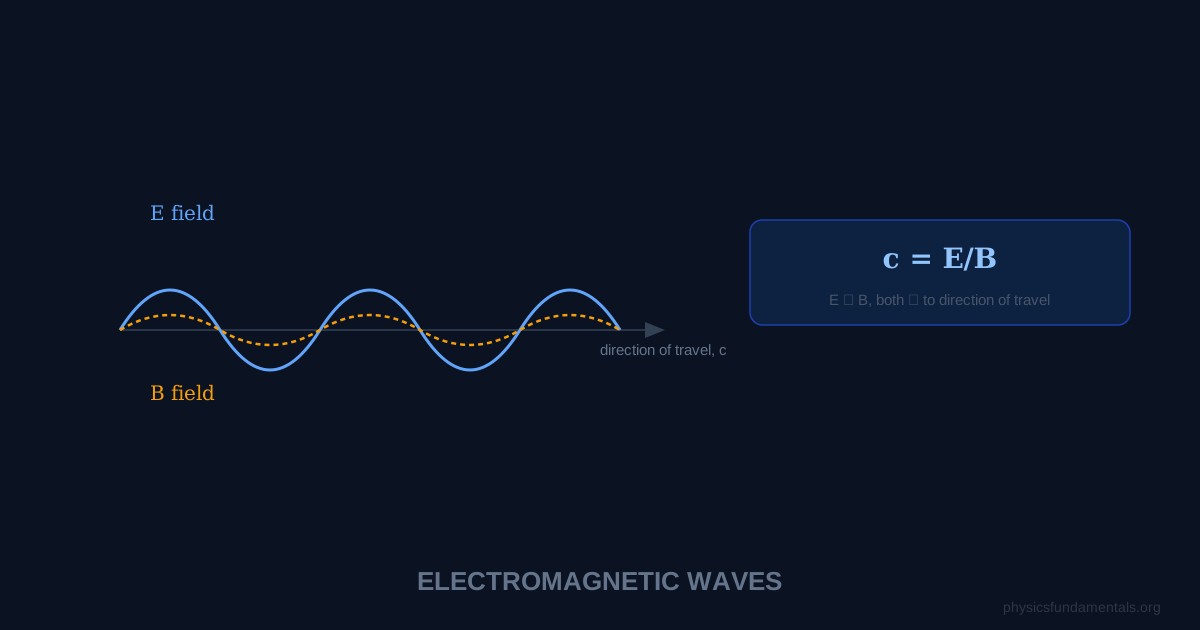
An electromagnetic wave is a transverse wave in which oscillating electric and magnetic fields are mutually perpendicular and both perpendicular to the direction of wave propagation. It requires no medium and travels at c = 2.998 × 10⁸ m/s in a vacuum.
The electric field (E) and magnetic field (B) oscillate in phase — they reach their maximum and zero values simultaneously. E and B are always perpendicular to each other and to the direction of travel. This is called a TEM wave (Transverse Electric and Magnetic).
Maxwell showed that the speed of these waves in a vacuum is:
Where ε₀ = 8.854 × 10⁻¹² F/m (permittivity of free space) and μ₀ = 4π × 10⁻⁷ H/m (permeability of free space). When he calculated this and found it matched the known speed of light, he immediately recognised that light itself is an electromagnetic wave.
Key Properties of EM Waves
- Travel at c in a vacuum: c = 2.998 × 10⁸ m/s ≈ 3 × 10⁸ m/s. In a medium, speed is reduced: v = c/n, where n is the refractive index.
- Transverse waves: E and B fields oscillate perpendicular to the direction of travel — they can be polarised.
- Travel through vacuum: no medium required — unlike sound, which cannot travel through empty space.
- Obey wave equation: c = fλ, where f is frequency (Hz) and λ is wavelength (m).
- Carry energy: energy per photon E = hf. Intensity falls as 1/r² from a point source (inverse square law).
- Show wave behaviours: reflection, refraction, diffraction, interference, polarisation.
The Electromagnetic Spectrum
| Type | Frequency (Hz) | Wavelength | Source / Use |
|---|---|---|---|
| Radio | < 3 × 10⁹ | > 0.1 m | Broadcasting, communication, radar |
| Microwave | 3 × 10⁹ – 3 × 10¹¹ | 1 mm – 0.1 m | Wi-Fi, mobile phones, cooking, radar |
| Infrared | 3 × 10¹¹ – 4 × 10¹⁴ | 700 nm – 1 mm | Thermal imaging, remote controls, heating |
| Visible | 4–7.5 × 10¹⁴ | 400–700 nm | Human vision, optical instruments |
| Ultraviolet | 7.5 × 10¹⁴ – 3 × 10¹⁶ | 10–400 nm | Sterilisation, tanning, fluorescence |
| X-ray | 3 × 10¹⁶ – 3 × 10¹⁹ | 0.01–10 nm | Medical imaging, crystallography |
| Gamma | > 3 × 10¹⁹ | < 0.01 nm | Nuclear decay, cancer treatment, sterilisation |
Note: the boundaries between regions are not sharply defined — they overlap and the labels are conventions. All types are the same phenomenon; only frequency and wavelength differ. Higher frequency = shorter wavelength = more energy per photon.
Photon Energy: E = hf
Electromagnetic radiation is quantised — it comes in discrete packets called photons. The energy of each photon:
Where h = 6.626 × 10⁻³⁴ J·s (Planck's constant), f is frequency (Hz), c = 3 × 10⁸ m/s, λ is wavelength (m). Energy is often expressed in electron-volts: 1 eV = 1.6 × 10⁻¹⁹ J.
Visible light photons carry energies of 1.8–3.1 eV. X-ray photons carry keV of energy. Gamma ray photons carry MeV — which is why they are so ionising and dangerous to biological tissue.
4 Worked Examples
Example 1 — Frequency of green light
Problem: Green light has wavelength 550 nm. Find its frequency and the energy of one photon.
Solution:
f = c/λ = 3 × 10⁸ / (550 × 10⁻⁹) = 5.45 × 10¹⁴ Hz
E = hf = 6.626 × 10⁻³⁴ × 5.45 × 10¹⁴ = 3.61 × 10⁻¹⁹ J = 2.26 eV
Example 2 — Wavelength of a radio wave
Problem: BBC Radio 4 broadcasts at 198 kHz. Find the wavelength.
Solution:
λ = c/f = 3 × 10⁸ / 198 × 10³ = 1515 m ≈ 1.5 km
This is why radio antennas need to be large — the wavelength is enormous compared to visible light.
Example 3 — Comparing photon energies
Problem: Compare the energy of an X-ray photon (λ = 0.1 nm) with a microwave photon (f = 2.45 GHz, used in microwave ovens).
Solution:
X-ray: E = hc/λ = 6.626 × 10⁻³⁴ × 3 × 10⁸ / (0.1 × 10⁻⁹) = 1.99 × 10⁻¹⁵ J = 12.4 keV
Microwave: E = hf = 6.626 × 10⁻³⁴ × 2.45 × 10⁹ = 1.62 × 10⁻²⁴ J = 1.01 × 10⁻⁵ eV
X-ray photon has ~10⁹ times more energy per photon than a microwave photon — which is why X-rays ionise and microwaves merely rotate water molecules.
Example 4 — Speed of light in glass
Problem: Light travels through glass of refractive index n = 1.5. Find its speed and the wavelength of 600 nm (vacuum) light inside the glass.
Solution:
v = c/n = 3 × 10⁸ / 1.5 = 2 × 10⁸ m/s
λ_glass = λ_vacuum / n = 600/1.5 = 400 nm
Frequency is unchanged (it's fixed by the source); wavelength and speed both reduce by factor n.
Why EM Waves Don't Need a Medium
A changing electric field produces a magnetic field (Ampere-Maxwell law). A changing magnetic field produces an electric field (Faraday's law). Once started, each field regenerates the other — the wave is self-sustaining. No material is needed to support the oscillation, unlike mechanical waves where a medium provides the restoring force.
This is why radio signals from Mars (light-minutes away) reach Earth across perfect vacuum, while sound from an explosion on the Moon would be completely inaudible here despite the enormous energy released.
Maxwell's Equations and the Wave
Maxwell synthesised all of electricity and magnetism into four equations (1865). Two of them directly predict electromagnetic waves:
- Faraday's law: a changing magnetic field creates an electric field (curl E = −∂B/∂t)
- Ampere-Maxwell law: a changing electric field creates a magnetic field (curl B = μ₀ε₀ ∂E/∂t)
These two laws form a self-sustaining cycle: a changing E creates a changing B, which creates a changing E, which creates a changing B — propagating through space at speed c = 1/√(μ₀ε₀). When Maxwell calculated this speed and found it matched the known speed of light (approximately 3 × 10⁸ m/s, measured by Fizeau in 1849), he immediately recognised that "light itself is an electromagnetic disturbance" — one of the greatest unifications in physics history.
Intensity and the Inverse Square Law
The intensity of electromagnetic radiation from a point source decreases with the square of distance:
Where P is the total power radiated and r is the distance from the source. This inverse square law arises purely from geometry: the same total power is spread over the surface area of a sphere of radius r, which is 4πr² — a larger sphere has more surface, so the power per unit area (intensity) decreases as 1/r².
The Sun's total power output is P = 3.85 × 10²⁶ W (the solar luminosity). At Earth's distance r = 1.5 × 10¹¹ m: I = 3.85 × 10²⁶/(4π × (1.5 × 10¹¹)²) = 3.85 × 10²⁶/2.827 × 10²³ = 1,361 W/m² — the solar constant. At Mars (r = 2.28 × 10¹¹ m): I = 590 W/m² — less than half. This is why Mars is much colder than Earth and why solar panels in the outer solar system need very large areas.
Polarisation of Electromagnetic Waves
EM waves are transverse — the E and B fields oscillate perpendicular to propagation. This means they can be polarised: the E-field direction can be restricted to a single plane. Unpolarised EM waves (sunlight, lamp light) have E-fields oscillating in all directions perpendicular to propagation. A polariser transmits only the component parallel to its transmission axis.
After a polariser, intensity is halved: I₁ = I₀/2. A second polariser at angle θ to the first transmits: I₂ = I₁cos²θ (Malus's law). At θ = 90° (crossed polarisers): I₂ = 0 — no light gets through. This is the basis of LCD screens: liquid crystals between crossed polarisers rotate the polarisation direction by 90° when no voltage is applied (light passes through), and align parallel to one polariser when voltage is applied (blocking light). Each pixel switches between these states under computer control.
Worked Example 5 — Solar panel power
Problem: A satellite solar panel has area 8 m² and efficiency 28%. At the Earth-Sun distance (I = 1361 W/m²), find the electrical power output. If the satellite moves to the orbit of Jupiter (average distance 5.2 AU), find the new power output.
Solution:
At Earth: P = I × A × η = 1361 × 8 × 0.28 = 3048 W ≈ 3.05 kW
At Jupiter: distance = 5.2 AU → I_Jupiter = I_Earth/(5.2)² = 1361/27.04 = 50.3 W/m²
P_Jupiter = 50.3 × 8 × 0.28 = 113 W
The power drops to 3.7% of the Earth-orbit value. This is why the Juno spacecraft at Jupiter uses solar panels 9 m long on each wing, yet still only generates ~500 W — less than a household kettle.
Radio Propagation
Different frequencies of radio waves propagate differently through the atmosphere. Long-wave radio (wavelengths 1–10 km) diffracts over the horizon and follows Earth's curvature, enabling ground-wave propagation over thousands of kilometres. Short-wave radio (wavelengths 10–100 m) reflects off the ionosphere, enabling sky-wave propagation that bounces between ionosphere and ground multiple times, reaching global distances. Microwaves and UHF (wavelengths 1 mm–1 m) are line-of-sight, requiring clear paths between transmitter and receiver — which is why mobile phone masts are placed on high ground and why satellite TV dishes point at a specific angle in the sky.
Exam Summary for Electromagnetic Waves
All electromagnetic waves: travel at c = 3 × 10⁸ m/s in vacuum; are transverse (can be polarised); obey v = fλ (with v = c in vacuum, c/n in material); carry energy in photons of energy E = hf = hc/λ. The spectrum from lowest to highest frequency: radio → microwave → infrared → visible (ROYGBIV) → ultraviolet → X-ray → gamma. Higher frequency = shorter wavelength = more energy per photon = more penetrating and ionising. Intensity of a point source: I = P/4πr² (inverse square law). Key applications: radio (broadcasting), microwave (communication, heating), IR (thermal imaging, remote controls), UV (sterilisation, fluorescence), X-ray (medical imaging, crystallography), gamma (cancer treatment, nuclear medicine). For Malus's law: I = I₀cos²θ where θ is between polarisation directions.
A common exam question: "explain why electromagnetic waves can travel through a vacuum." The answer references Maxwell's equations — a changing electric field generates a magnetic field (Ampere-Maxwell), and a changing magnetic field generates an electric field (Faraday). The two fields sustain each other without requiring a material medium. This self-sustaining oscillation propagates at c = 1/√(ε₀μ₀) = 3 × 10⁸ m/s. No medium is needed because the fields themselves carry energy and can propagate through empty space — in contrast to mechanical waves, which require a medium to provide the restoring force.
The electromagnetic spectrum is not divided into neat boxes — the boundaries between radio, microwave, infrared, visible, UV, X-ray, and gamma are conventional and approximate. Radio waves merge into microwaves around millimetre wavelengths. X-rays and gamma rays overlap entirely — a 100 keV photon from an X-ray tube and a 100 keV photon from a nuclear decay are physically identical; the names just reflect their origins. The important physical distinctions are energy per photon (which determines ionising ability) and wavelength (which determines diffraction and interference properties). Knowing that E = hf = hc/λ lets you convert between any of these descriptions.
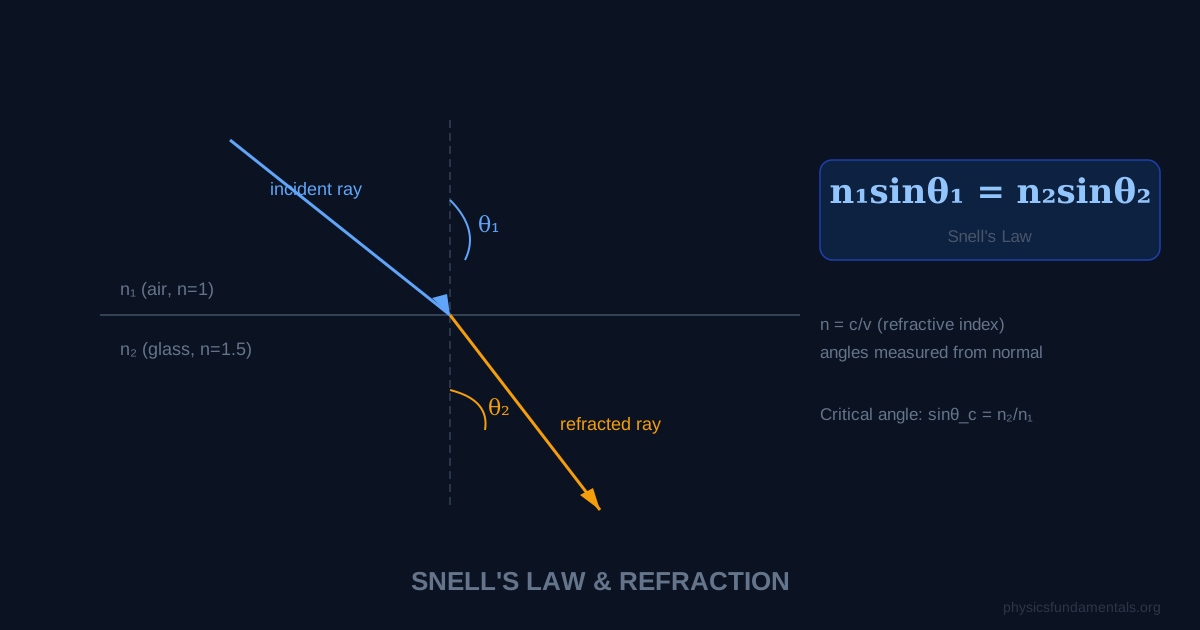
One more key topic for exam purposes: the speed of light in a medium is v = c/n where n is the refractive index. Since c = fλ and frequency doesn't change at a boundary, the wavelength changes: λ_medium = λ_vacuum/n. The frequency is fixed by the source. So when light enters glass (n = 1.5), it slows from 3 × 10⁸ to 2 × 10⁸ m/s, and its wavelength shrinks from say 600 nm to 400 nm, but it still oscillates at the same 5 × 10¹⁴ Hz. This is why refraction occurs — different parts of a wavefront enter the medium at different times and slow down, tilting the wavefront and bending the ray direction (Snell's law). The photon energy hf is also unchanged — energy and frequency are tied together invariantly.
Frequently Asked Questions
What is an electromagnetic wave?
Why do all EM waves travel at the same speed in a vacuum?
What is the difference between X-rays and gamma rays?
How does a microwave oven work?
Can electromagnetic waves be polarised?
Share this article
Written by
Physics Fundamentals Editorial Team
Written and reviewed by our team of physics educators. Content is aligned with A-Level, GCSE, AP Physics, and undergraduate curricula.
About Physics Fundamentals →