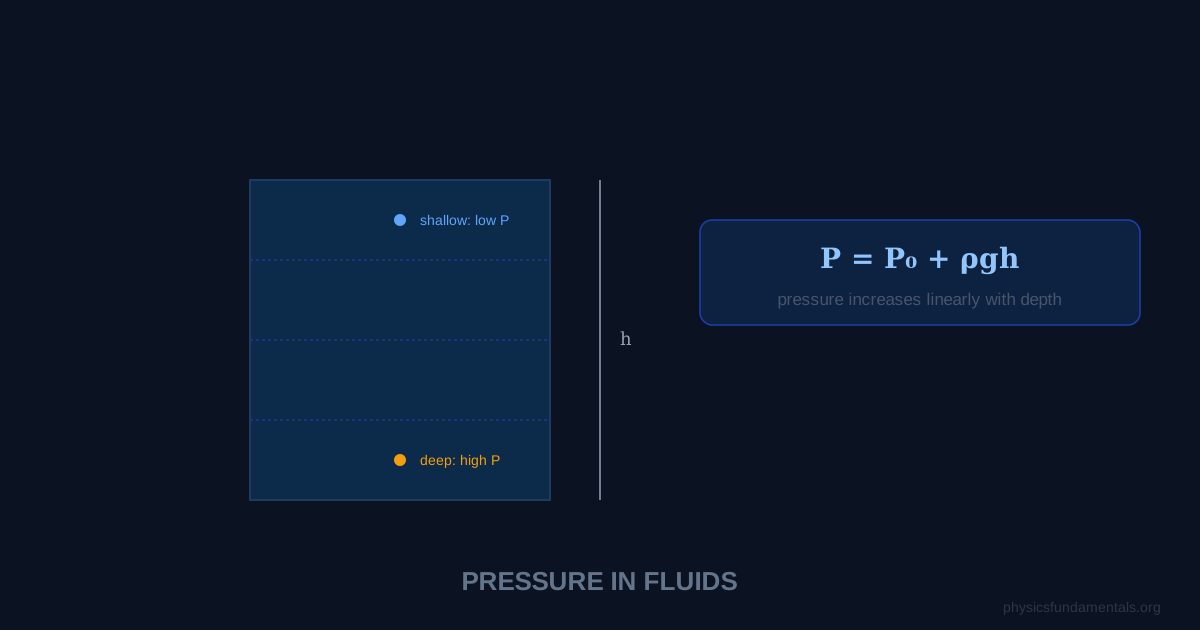
Pressure in a fluid at depth h is P = ρgh, where ρ is the fluid density (kg/m³), g is gravitational field strength (9.81 m/s²), and h is the depth below the surface (m). Pressure increases linearly with depth, which is why deep-sea submarines need thick hulls and why your ears hurt when you dive deep. Total pressure at depth h: P_total = P_atm + ρgh.
Pascal's law states that any pressure applied to an enclosed fluid is transmitted equally in all directions throughout the fluid. This is the foundation of hydraulic systems: a small force applied over a small area creates pressure that can exert a large force over a large area — multiplying force as levers do, but using fluid instead of rigid rods.
- Fluid pressure formula P = ρgh — derivation and variables
- Pascal's law and the hydraulic multiplier F₂/F₁ = A₂/A₁
- Atmospheric pressure: 101,325 Pa = 1 atm
- 4 worked examples including hydraulic presses and depth calculations
- Connection to Archimedes' principle via pressure difference
Pressure in a Fluid: P = ρgh
Derivation: consider a column of fluid of height h, cross-sectional area A, and density ρ. Its weight is W = ρAhg. Pressure = force/area = ρAhg/A = ρgh. The area cancels — pressure at depth h depends only on ρ, g, and h, not the shape of the container or the total amount of fluid.
Total pressure at depth h below the surface:
Where P_atm = 101,325 Pa (1 atmosphere). At depth 10 m in water: P = 101,325 + 1000 × 9.81 × 10 = 199,425 Pa ≈ 2 atm — pressure doubles every ~10 m in water.
Pascal's Law
A change in pressure applied to an enclosed fluid at rest is transmitted undiminished and equally in all directions throughout the fluid.
For a hydraulic system with two pistons of areas A₁ and A₂:
Force is multiplied by the ratio of areas. A hydraulic car lift with A₂/A₁ = 100 multiplies input force by 100. Energy is conserved: the small piston moves further than the large one, so work done (F × d) is the same on both sides.
Atmospheric Pressure
Standard atmospheric pressure: P_atm = 101,325 Pa = 1.013 × 10⁵ Pa = 1 atm = 760 mmHg = 1013 mbar.
This is the pressure exerted by the column of air above every point on Earth's surface. It decreases with altitude (less air above) — at 5,500 m, pressure is roughly half sea-level pressure.
4 Worked Examples
Example 1 — Pressure at depth
Problem: Find the total pressure at 30 m depth in seawater (ρ = 1025 kg/m³, P_atm = 101,325 Pa).
Solution:
P = P_atm + ρgh = 101,325 + 1025 × 9.81 × 30
= 101,325 + 301,657 = 402,982 Pa ≈ 4 atm
Example 2 — Hydraulic press
Problem: A hydraulic press has a small piston of area 0.002 m² and a large piston of area 0.1 m². A force of 500 N is applied to the small piston. Find the force on the large piston.
Solution:
F₂ = F₁ × A₂/A₁ = 500 × 0.1/0.002 = 25,000 N = 25 kN
Example 3 — Finding depth from pressure
Problem: A diver's pressure gauge reads 250,000 Pa gauge pressure (above atmospheric). How deep is the diver in fresh water (ρ = 1000 kg/m³)?
Solution:
P_gauge = ρgh → h = P_gauge/(ρg) = 250,000/(1000 × 9.81) = 25.5 m
Example 4 — Force on a dam wall
Problem: A rectangular dam is 20 m wide and holds water to depth 15 m. Find the average pressure on the dam face and the total force. (ρ = 1000 kg/m³)
Solution:
Average depth = 15/2 = 7.5 m (pressure varies linearly from 0 at top to ρg×15 at bottom)
Average pressure = ρg × h_avg = 1000 × 9.81 × 7.5 = 73,575 Pa
Total force = P_avg × A = 73,575 × (20 × 15) = 22,072,500 N ≈ 22 MN
Pressure Transmission and the Hydraulic Multiplier
Pascal's law enables force multiplication in hydraulic systems. The pressure applied at the small piston transmits unchanged throughout the fluid to the large piston:
Energy is conserved: the work done by both pistons must be equal (in the ideal case). If the large piston produces 100× more force, it moves 100× less distance: W = F₁d₁ = F₂d₂ → d₂ = d₁(A₁/A₂). A hydraulic jack with A₂/A₁ = 50 amplifies force 50-fold, but the small piston must move 50 times further than the large one rises.
Real hydraulic systems lose efficiency through fluid viscosity, seal friction, and compressibility. Professional hydraulic lifts achieve efficiencies of 85–95%. The hydraulic principle is used in: car braking systems (brake fluid transmits foot pedal force to all four brakes simultaneously), aircraft control surfaces, industrial presses, and heavy construction equipment.
Pressure Gauges and Manometers
A U-tube manometer measures gauge pressure directly from the height difference h of a liquid column: P_gauge = ρgh. If one side of the U-tube is open to atmosphere and the other connects to the gas being measured, the liquid level difference gives: P_gas = P_atm + ρgh (if gas pressure is higher) or P_gas = P_atm − ρgh (if lower).
Mercury manometers use mercury (ρ = 13,600 kg/m³) because its high density gives compact instruments — atmospheric pressure (101,325 Pa) corresponds to only 760 mm of mercury rather than 10.3 m of water. Blood pressure is still measured in mmHg for historical reasons: a systolic pressure of "120" means 120 mmHg above atmospheric ≈ 16 kPa gauge pressure.
Absolute vs Gauge Pressure
Two pressure scales are commonly used:
- Absolute pressure: pressure measured from perfect vacuum (0 Pa). Atmospheric pressure at sea level ≈ 101,325 Pa = 1 atm. Always positive.
- Gauge pressure: pressure relative to atmospheric pressure. P_gauge = P_absolute − P_atm. Can be negative (below atmospheric — partial vacuum). A car tyre inflated to "32 psi" means 32 psi gauge pressure; absolute pressure = 32 + 14.7 = 46.7 psi.
In fluid calculations: P = ρgh gives gauge pressure (pressure above atmospheric at depth h). The absolute pressure at depth h is P_abs = P_atm + ρgh. In sealed systems (hydraulics), gauge pressure is used because both sides are above atmospheric by the same amount — the atmospheric term cancels in force calculations.
Pressure in Blood Circulation
Blood pressure is the fluid pressure in the circulatory system. Systolic pressure (during heart contraction) is typically 120 mmHg = 16 kPa gauge. Diastolic pressure (between beats) is typically 80 mmHg = 10.7 kPa. These are measured at heart level; the pressure distribution through the body follows P = ρgh from the heart. Standing upright, blood pressure at the feet is approximately P_heart + ρgh = 16,000 + 1060 × 9.81 × 1.4 ≈ 30,600 Pa ≈ 230 mmHg absolute — blood must flow uphill from feet to heart against the hydrostatic head. This is why leg muscles pumping blood upward (the "muscle pump") and one-way venous valves are essential for the return circulation, and why varicose veins develop when these valves fail.
Worked Example 5 — Hydraulic car lift
Problem: A hydraulic car lift has a small piston of diameter 3 cm and a large piston of diameter 30 cm. (a) What force on the small piston is needed to lift a 1500 kg car? (b) If the small piston moves 0.4 m, how far does the large piston rise?
Solution:
Area of small piston: A₁ = π(0.015)² = 7.069 × 10⁻⁴ m²
Area of large piston: A₂ = π(0.15)² = 7.069 × 10⁻² m²
(a) F₁/A₁ = F₂/A₂ → F₁ = F₂ × A₁/A₂ = (1500 × 9.81) × (7.069 × 10⁻⁴/7.069 × 10⁻²)
F₁ = 14,715 × 0.01 = 147.15 N ≈ 147 N
(b) Work conservation: F₁d₁ = F₂d₂ → d₂ = d₁ × F₁/F₂ = 0.4 × (A₁/A₂) = 0.4 × 0.01 = 0.004 m = 4 mm
The car rises only 4 mm when the hand pump is pushed 40 cm — force is amplified 100× but displacement is reduced 100×.
Atmospheric Pressure and Altitude
Atmospheric pressure decreases with altitude because the weight of air above decreases. For an isothermal atmosphere: P = P₀e^{−h/H}, where H ≈ 8.5 km is the scale height. At 5.5 km altitude, P ≈ P₀/2 ≈ 50 kPa. At 10 km (cruising altitude), P ≈ 26 kPa — about 26% of sea-level pressure. Commercial aircraft pressurize cabins to the equivalent of ~2,400 m altitude (~75 kPa) to avoid hypoxia. The lower pressure also means water boils at ~92°C at 2,400 m equivalent — food takes longer to cook in a pressurised aircraft kitchen.
Boyle's law governs pressure-altitude relationships for enclosed gas volumes. A sealed gas cylinder at sea level contains gas at P_atm + P_gauge. Taken to altitude where external pressure is lower, the gauge reading rises (the absolute pressure inside hasn't changed; atmospheric pressure has decreased). This is why car tyres should be checked at similar temperatures and altitudes to their normal operating conditions.
Viscosity and Real Fluid Flow
Real fluids resist flow due to viscosity — the internal friction between fluid layers moving at different speeds. For viscous flow through a cylindrical pipe (Poiseuille flow), the volume flow rate:
Where r is pipe radius, ΔP is pressure difference, η is dynamic viscosity, L is pipe length. The r⁴ dependence is dramatic: halving the radius reduces flow rate by 16× for the same pressure. This is why arterial blockages reduce blood flow so severely and why blood pressure must rise when vessels narrow.
Turbulent flow (at high Reynolds number Re = ρvr/η > ~2000) replaces Poiseuille's orderly laminar flow. Turbulent flow dissipates much more energy — the pressure drop for turbulent flow scales as v² rather than v (laminar). Designing pipe systems to remain laminar (low Re) dramatically reduces pumping power. Dolphins' skin is thought to suppress turbulence in the boundary layer, reducing drag and explaining their efficient high-speed swimming.
Worked Example 6 — Depth in different fluids
Problem: A deep-sea diver working at 150 m depth in seawater (ρ = 1025 kg/m³). Find: (a) gauge pressure at this depth, (b) absolute pressure, (c) force on a 1 cm² area of the diver's suit.
Solution:
(a) P_gauge = ρgh = 1025 × 9.81 × 150 = 1,509,187 Pa ≈ 1.51 MPa ≈ 15 atm
(b) P_abs = P_gauge + P_atm = 1,510,000 + 101,325 = 1,611,325 Pa ≈ 15.9 atm
(c) F = P_gauge × A = 1,509,187 × (1 × 10⁻⁴) = 150.9 N on every cm² of suit surface
The suit must withstand the equivalent of a 15.4 kg mass pressing on every square centimetre — why deep-sea diving suits are engineered to such precise specifications.
Exam Summary for Pressure in Fluids
Key formula: P = ρgh for gauge pressure at depth h in fluid of density ρ. Absolute pressure: P_abs = P_atm + ρgh. Pascal's law: pressure applied to an enclosed fluid transmits equally in all directions; hydraulic systems: F₁/A₁ = F₂/A₂ (force amplification) with d₁/d₂ = A₂/A₁ (displacement reduction). Archimedes: upthrust = weight of displaced fluid = ρ_fluid × V_submerged × g.
Common mistakes: (1) confusing gauge and absolute pressure — decide which you need before substituting; (2) using P = ρgh to find the force on a flat surface — multiply by area: F = P × A = ρgh × A; (3) applying Archimedes incorrectly — upthrust depends on the volume of fluid displaced and the fluid's density, not the object's density (which only matters for whether it floats). In atmospheric pressure problems, remember P_atm ≈ 101 kPa = 1.01 × 10⁵ Pa = 760 mmHg = 1 atm — know at least two of these equivalents.
Barometers and Atmospheric Pressure Measurement
A mercury barometer (invented by Torricelli in 1644) measures atmospheric pressure by balancing it against a column of mercury. A tube sealed at the top, filled with mercury, and inverted into a mercury trough: atmospheric pressure P_atm acting on the trough surface supports a mercury column of height h. P_atm = ρ_mercury × g × h. At sea level: h ≈ 760 mm Hg = 0.760 m. P_atm = 13,600 × 9.81 × 0.760 = 101,396 Pa ≈ 101 kPa ✓. The space above the mercury column is nearly a perfect vacuum (Torricelli vacuum) — the first artificial vacuum produced in history, disproving Aristotle's claim that "nature abhors a vacuum."
Aneroid barometers use a flexible evacuated metal capsule that expands or contracts with changing atmospheric pressure. As a storm approaches, pressure drops (typically by 5–10 hPa over several hours) — the capsule expands and a mechanical linkage moves a pointer on the dial. Combined with the trend of pressure change (rising or falling), barometric pressure is the oldest and still most reliable indicator of approaching weather.
Pressure in fluids is one of the most widely applied topics in physics and engineering. From the design of dams (where pressure increases linearly with depth, and total force on the face requires integration P × dA over the entire face) to submarine hull design (sustained external pressures of 6 MPa at 600 m depth), to the human cardiovascular system (blood pressure regulation) and to atmospheric science (weather prediction depends on pressure maps) — the fundamental formula P = ρgh and Pascal's transmission principle underlie all of it. The key insight is that pressure in a static fluid is a scalar: it acts equally in all directions at any point, which is why a dam experiences the same horizontal force from water as a vertical downward force — pressure is isotropic, not directional, unlike stress in solids.
Frequently Asked Questions
What is the formula for pressure in a fluid?
Why doesn't pressure depend on the shape of the container?
What is Pascal's law?
How is fluid pressure related to buoyancy?
What is gauge pressure vs absolute pressure?
Share this article
Written by
Physics Fundamentals Editorial Team
Written and reviewed by our team of physics educators. Content is aligned with A-Level, GCSE, AP Physics, and undergraduate curricula.
About Physics Fundamentals →